Since the Bitcoin halving in 2024, the operating environment of the Bitcoin mining industry has become more severe. The halving is a key mechanism in Bitcoin's monetary design, which cuts block rewards approximately every four years to ensure Bitcoin's long-term scarcity. Although the halving has enhanced Bitcoin's economic resilience, it has also instantly put miners under direct pressure of a sharp reduction in income.
According to TheMinerMag, by 2025, this had created the "most severe profit margin environment in Bitcoin mining history", with plummeting revenues and soaring debt being the main hindering factors.
Even publicly listed Bitcoin mining companies with large cash reserves and sufficient funds struggle to maintain profitability relying solely on mining. To sustain operations, many mining companies are accelerating their transformation into other data-intensive business areas to stabilize income and reduce over-reliance on the price of pure hash power.
Among them, the opportunities in the two fields of artificial intelligence (AI) and high-performance computing (HPC) are particularly important. Since the end of 2022, these two fields have developed rapidly with the sharp growth in demand for computing power. Bitcoin mining companies have unique advantages in exploring these markets because their mining facilities are already equipped with large-scale power access and cooling infrastructure, which can be used for purposes other than SHA - 256 hashing operations.
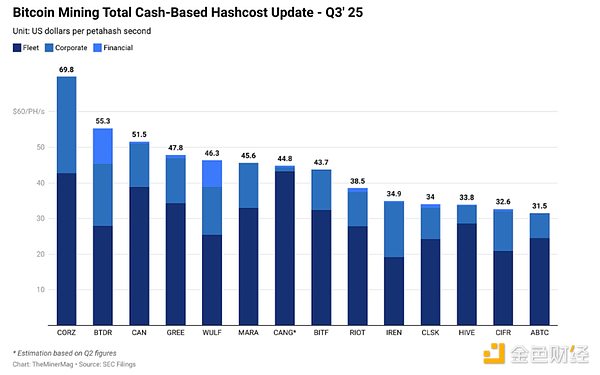
Average Bitcoin mining costs of 14 listed mining companies in Q3 2025. Source: TheMinerMag
By 2026, Bitcoin will still be in the fourth mining cycle following the halving in April 2024, which is expected to last until around 2028. With block rewards fixed at 3.125 BTC and competition becoming increasingly fierce, this further drives the entire industry towards efficiency and revenue diversification.
The following are the three key themes expected to drive the development of the Bitcoin mining industry in 2026.
Mining Profitability Depends on Energy Strategies and Fee Markets
Hash rate is used to measure the computing power that secures the Bitcoin network, while hash price reflects the revenue generated by this computing power. This distinction remains at the core of mining economics, but as block rewards continue to decrease, profitability is increasingly influenced by factors beyond scale.
Access to low-cost energy and entry into the Bitcoin transaction fee market have become key factors for miners to maintain profits during the cycle.
Bitcoin price still plays a crucial role. However, 2025 did not see the kind of surge many in the industry expected, nor the surge that usually occurs a year after the halving.
Instead, Bitcoin's trend was more stable, climbing in a stepped manner, and finally breaking through the peak of $126,000 in October. But whether this is the cyclical high of this round is still inconclusive.
However, price fluctuations have significantly affected miners' income. Data from TheMinerMag shows that the hash power price has fallen from an average of about $55 per PH/s in the third quarter to what the media calls a "structural low" — close to $35.
Worse still, the average cost of Bitcoin mining continued to rise throughout 2025, reaching about $70,000 in the second quarter, which further compressed the earnings of miners whose profit margins were already limited due to the decline in hash power prices.
The sharp correction in Bitcoin price, falling from its high to less than $80,000 in November, is closely related to the predicament of miners. If Bitcoin enters a broader downward cycle, the pressure on miners may continue into 2026, although similar situations have occurred in previous halving cycles, there is no guarantee that it will happen again.
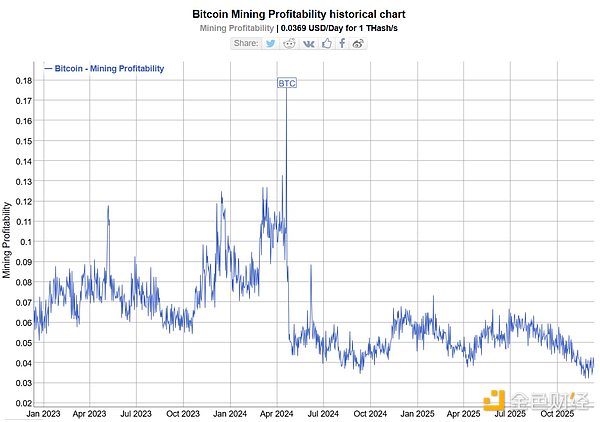
Over the past three years, Bitcoin mining profitability, measured by dollar earnings per unit of hash power, has shown a downward trend, reflecting compressed earnings after halving and increased mining difficulty. Source: BitInfoCharts
Artificial Intelligence, High-Performance Computing and Industry Consolidation Reshape the Mining Landscape
Publicly listed Bitcoin mining companies no longer position themselves merely as Bitcoin companies. They increasingly describe their businesses as digital infrastructure providers, which reflects their broader strategy of using power, real estate and data center capabilities to generate profits beyond block rewards.
HIVE Digital Technologies was one of the first companies to take action. It began shifting part of its business to high-performance computing in 2022 and reported HPC-related revenue the following year. At that time, this strategy was particularly notable as the industry was still mainly focused on increasing hash power.
Since then, more and more publicly listed mining companies have followed suit, retrofitting part of their infrastructure for GPU-based workloads related to artificial intelligence and high-performance computing, or have announced retrofitting plans. These companies include Core Scientific, MARA Holdings, Hut 8, Riot Platforms, TeraWulf and IREN.
The scale and execution of these initiatives vary greatly, but overall, they indicate a broader transformation taking place across the mining industry. As profit margins come under pressure and competition intensifies, many mining companies now see artificial intelligence and computing services as a means to stabilize cash flow, rather than relying solely on block rewards.
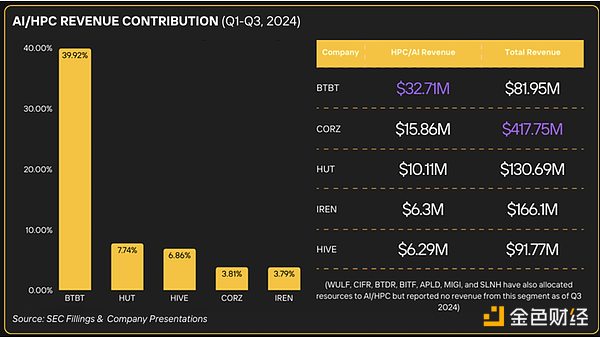
By 2024, artificial intelligence and high-performance computing had already brought considerable revenue to some mining companies. Source: Digital Mining Solutions
This transformation is expected to continue into 2026. This continues the consolidation trend pointed out by Galaxy, a digital asset investment and consulting firm, in 2024, when it noted that the wave of mergers and acquisitions among mining companies was expanding.
Bitcoin Mining Stocks: Volatility and Dilution Risks
Publicly listed Bitcoin mining companies play an important role in the market. They not only secure the network but also become one of the largest corporate holders of Bitcoin. In the past few years, many listed mining companies have moved beyond the pure operational model and begun to view Bitcoin as a strategic balance sheet asset.
More and more miners are following the example of Michael Saylor of Strategy, adopting a more cautious Bitcoin treasury reserve strategy and retaining a portion of the Bitcoin they mine. By the end of the year, mining companies had become among the largest public holders of Bitcoin, with companies such as MARA Holdings, Riot Platforms, Hut 8 and CleanSpark ranking among the top ten in total corporate Bitcoin holdings.
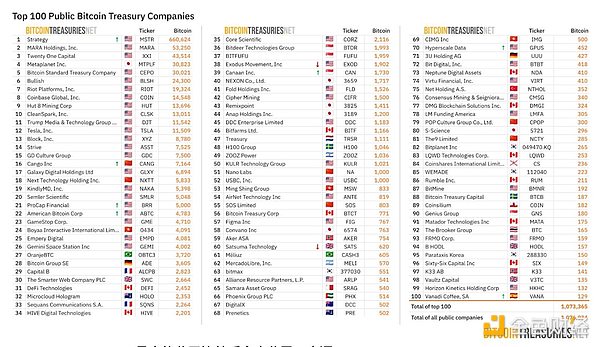
Largest Publicly Listed Bitcoin Treasury Companies. Source: BitcoinTreasuries.NET
However, this exposure also increases volatility risks. As Bitcoin prices fluctuate, mining companies holding large Bitcoin reserves experience greater balance sheet volatility, similar to other digital asset treasury companies that come under pressure during market downturns.
Mining stocks also face ongoing equity dilution risks. The industry remains capital-intensive, requiring continuous investment in ASIC hardware, data center expansion, and debt repayment during economic downturns.
When operating cash flow is tight, mining companies often turn to equity financing to maintain liquidity, including at-the-market (ATM) offerings and secondary stock issuances.
Recent financing activities highlight this trend. Several mining companies, including TeraWulf and IREN, have utilized the debt and convertible bond markets to improve their balance sheets and fund various growth plans.
Across the industry, Bitcoin mining companies raised billions of dollars through debt and convertible bond issuances in the third quarter alone, continuing the accelerating financing model since 2024.
Looking ahead to 2026, dilution risks are likely to remain a focus for investors, especially if mining profits remain under pressure and Bitcoin enters a bear market.
Mining operators with high break-even costs or aggressive expansion plans may continue to rely on equity capital, while those with lower break-even costs and stronger balance sheets are better positioned to limit shareholder dilution as the cycle matures.
