There is a type of company that actually benefits when the world situation worsens: defense contractors, oil unions, gold miners. These are common archetypes whose business models are inherently unstable, leveraging this risk into pricing.
Circle does not belong to this category. Its token was designed to always be pegged to 1 US dollar. Stability is the essence of its product.
However, Circle's stock price has skyrocketed from $49.90 on February 5th to around $123 today, more than doubling in just five weeks. Meanwhile, the broader cryptocurrency market is still down 44% from its peak last October.
A company whose product is meant to pursue price stability has become the hottest item in the market as the world becomes more turbulent.
This article will explain the reasons behind this phenomenon and the disparity between the true nature of Circle and its current market valuation.
What is Circle Really (Let's Get Back to Basics)
Strip away the brand packaging, payment narrative, and infrastructure references, and what you have left is: Circle holding US treasuries.
Every circulating USDC dollar is backed by one US dollar held in short-term government bonds. Circle earns the interest on these debts. This comprises around 90% of the company's revenue in any given quarter. Once you see this, its business model is not complex: Circle is a stablecoin issuance money market fund.
This means that a key indicator of Circle's revenue is the federal funds rate. When rates are high, so are the treasuries, and Circle earns more for each circulating USDC. When rates drop, the revenue contracts. Everything else is just noise.
Here are the chain reactions that led to a 150% rebound from the February low:
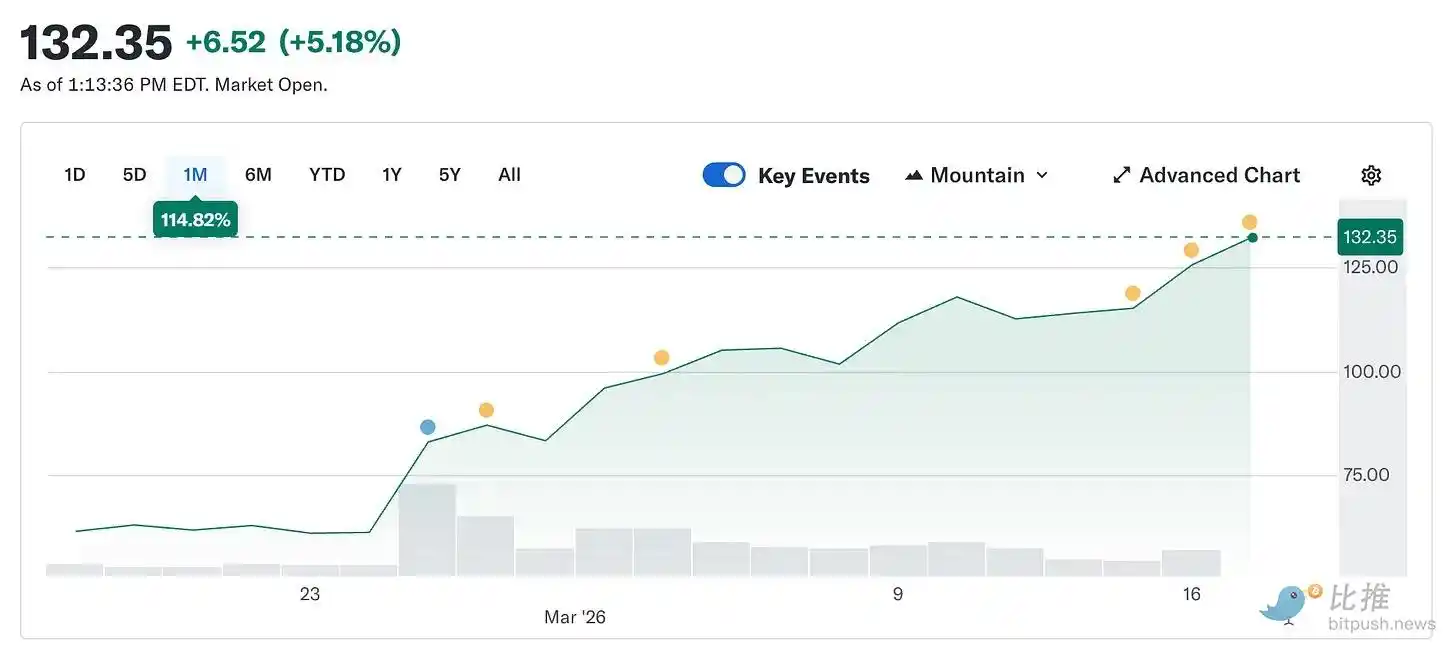
According to @finance.yahoo, the Iran conflict has driven the market up approximately 35% since February 28. Crossing over $100 signifies over-panic, and over-panic means a reckless Fed if it cuts. The decisiveness of the March 18 rate hold was never really in question. Even before the war, CME FedWatch showed over a 90% probability of rates staying put.
What has truly changed is this year's rate-cut expectation. Before the conflict, the market priced in two 25-basis-point cuts in 2026. Post-conflict, this expectation scaled down to one, prioritized to be pushed back after September. The probability of no cuts in 2026 nearly doubled. With rates staying elevated for a longer period, the cyclical bond reserves continue to yield return. More yield means more revenue, more revenue means higher stock prices. War broke out, and a stablecoin issuer emerged as a beneficiary. This was never in anyone's projection model.
Background: February pinned down Circle's stock price to $49 on a bearish thesis fundamentally a bet against a cut.
At that time, the market foresaw multiple rate cuts by the Fed in 2026, directly squeezing Circle's FX gold revenue. Rough math: at the current $79 billion USDC supply level, each 25-basis-point cut would result in a $40-60 million annual revenue loss for Circle. A double cut would wipe out nearly $100 million of top-line revenue by year-end. The war rendered this calculation moot overnight. Not because of Circle, but because the macro backdrop of what that whole argument was about couldn't be regurgitated anymore.
How the Short Squeeze Started
While the rate story supported the stock price, the initial surge came from position unwinding.
Prior to the February 25 release of the fourth-quarter earnings, about 17.8% of Circle's float was shorted. Hedge funds built sizable short recovery positions. Their argument was that rates would eventually fall, domestic revenue would compress, and this company's revenue didn't rely on a rate floor. Fundamentally, it was hard to argue against.
Additionally, Circ reported an EPS at the start of the year of $0.43, widely expected at $0.16. Revenue hit $7.7 billion, with expectations at $7.49 billion. On-chain USDC transaction volumes approached $12 trillion QoQ, growing 247% YoY. Shorts covered. The stock soared 35% in a single day of trading. According to 10X data research, hedge funds estimated losses of $500 million on their short positions that day. The war then took the baton from the earnings relay.
Coinbase Issue
Here is a section referenced in an update narrative.
Circle's 2025 Loss is a $70 Million Loss, Not a Profit. The fourth quarter was strong, but this year is not the same. To understand why, you need to understand its relationship with Coinbase, which is the most important and underestimated fact about Circle's business.
When USDC was first launched in 2018, Circle and Coinbase formed a joint consortium to manage it. The consortium dissolved in 2023, giving Circle full control over USDC issuance. However, Coinbase retained the revenue stream.
Coinbase took 100% of the interest on the USDC reserve held on its platform, with all other revenue split fifty-fifty with Circle. In 2024, this arrangement saw Circle donate $908 million of its $10.1 billion total distribution cost directly to Coinbase.
Roughly put, for every $1 of Circle's funds, 54 cents flowed east to a company that neither mints the token nor manages the reserve. In early 2025, Coinbase held 22% of the total supply of USDC, up from 5% in 2022. The more USDC grows on the Coinbase platform, the heavier the share of in-network payments.
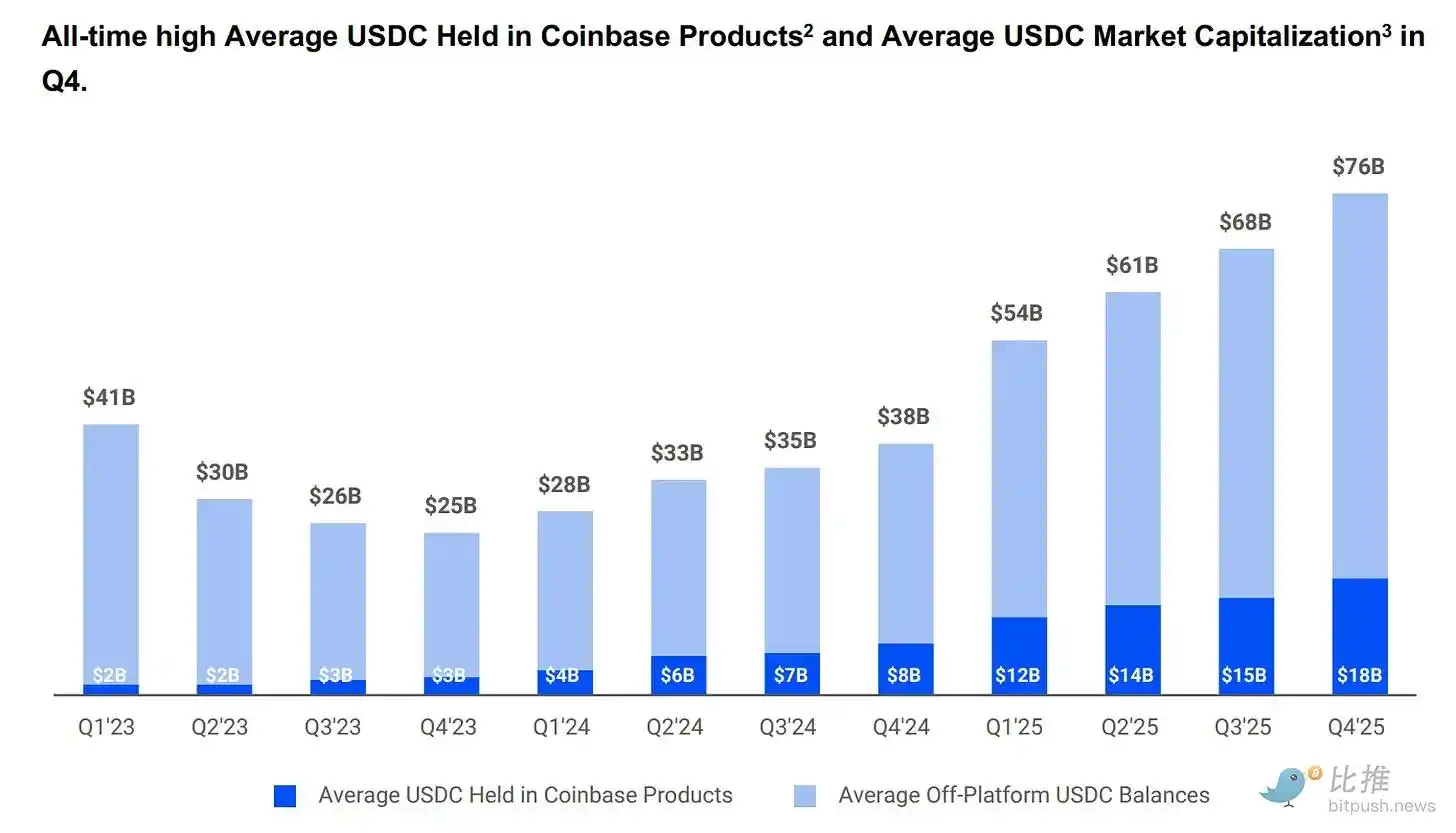
According to @q4cdn.com, the partnership automatically renews every three years, and Circle cannot unilaterally exit. Any outcome of the next renegotiation will directly impact Circle's profit margin. In Q4 2025, distribution costs alone amounted to $461 million, up 52% from the same period.
The current $70 million net loss partly stems from a $424 million IPO-attributable stock compensation, which makes the overall figure look worse than the actual business situation. However, the actual business still faces a structural cost issue that no interest rate environment can fully resolve.
The market prices Circle as infrastructure, but the income statement shows it as a rate trading tool bearing expensive distribution costs. Both views can coexist. They are just different pricing logics, and the market is now paying for the "best version" of both simultaneously.
Why This Is More Than Just a Macro Trade
The supply of USDC recently hit a record high of $79 billion, while the broader crypto market plummeted by 44% since October. This decoupling is worth pondering. When the market drops, speculative assets usually follow suit. The growth of USDC continues as people are using it to move funds rather than just as a speculative bet.
During the Iran conflict, there was a surge in demand for USDC in the Middle East precisely because traditional banking became unreliable. When normal channels were disrupted, people turned to it for cross-border and cross-border transfers. This is payment infrastructure under pressure: its usage frequency goes up, not down.
Transaction data confirms this. In February alone, USDC processed around $1.26 trillion in adjusted transaction volume, compared to $514 billion for USDT. Tether's (USDT) market cap still stands at $184 billion, while USDC is at $79 billion. By total supply, the two are not comparable. But the current amount of funds in USDC has already exceeded USDT.
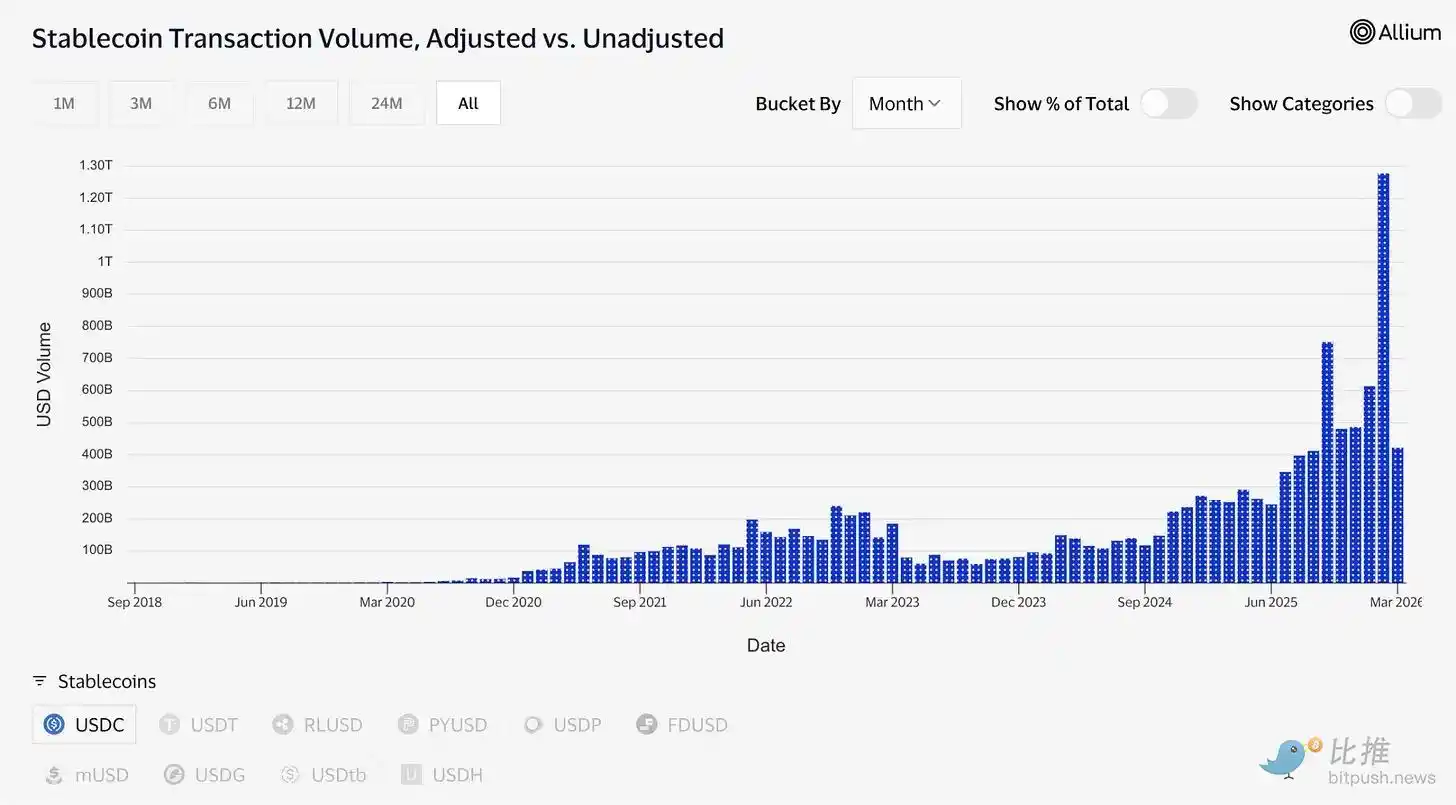
According to @visaonchainanalytics, 'Dormant Supply' and 'Active Settlement' are two different concepts. Previously indicating where people park dollars, it now shows which dollars get used when value needs to be moved.
Stan Druckenmiller made some related points this week. In a January 30th recorded and Thursday-released Morgan Stanley interview, he forecasted the global payment system running on stablecoins for 10 to 15 days annually and dubbed cryptocurrencies as 'a solution looking for a problem.'
The world's most trusted macro investor divides this space into two: stablecoins are the foundational bedrock, with everything else looking for a reason to exist. This framework lends credence to the bullish thesis.
Infrastructure Collateral
Tokenized assets have grown from around $1.5 billion in early 2023 to about $26.5 billion today. Many such products (including the BUIDL tokenized treasury bond fund held over $2 billion, part of BlackRock) rely on USDC for subscriptions, redemptions, and settlement processes.
The prediction market processed over $22 billion in transaction volume in 2025, mostly settled via USDC (solely on Polymarket). Visa currently supports 130+ different stablecoin-linked cards across 50+ countries globally, with an annual settlement volume of around $4.6 billion.
Circle is building the infrastructure underneath all of this. The Circle Payments Network connects 55 financial institutions with an annualized processing volume of $5.7 billion, enabling banks and payment providers to seamlessly convert USDC cross-border into local currencies.
Arc is Circle's proprietary Layer-1 blockchain designed to fully support institutional systems. This system is independent of Ethereum or Solana's settlement infrastructure. While Ethereum and Solana currently have a minimal impact on revenue, the two are strategic bets for the future if rates decline.
The AI system's dollar volume is modest but structurally interesting. Data released in March by Circle's global spending chief shows that in the past 9 months, the AI smart agents completed 140 million payments totaling $43 million. 98.6% of these were settled in USDC, with an average transaction size of $0.31. There are now over 400,000 AI smart agents with purchasing power. While the dollar amount is still small, the trend is undeniable.
If AI smart agents need computational power, data access, and API calls while paying each other high-frequency, sub-penny amounts, they need tools for instant settlement and near-zero-cost transfers. Circle has just launched Nano payments tailored specifically to this need: supporting sub-micro $0.000001 transactions in Gas-less USDC overnight, leveraging off-chain resources and batch settlement. The testnet already supports 12 chains, including Arbitrum, Base, and Ethereum's native chain.
This is the Circle that the market is willing to pay a $123 stock price for: a company at the intersection of tokenized finance, AI agent business, cross-border payments, and the prediction market center, with regulatory scrutiny under the GENIUS Act and a high likelihood of passing the CLARITY Act before summer. Bernstein has a target price of $190, Clear Street at $136, and Wall Street's most bullish Harbor Global with a target price as high as $280.
The Lingering Contradiction
Here, I want to talk openly about a point that bullish investors often overlook.
Circle's profits rely on maintaining high interest rates. This is not a permanent condition. The Fed will eventually cut rates at some point. When that happens, the Treasury bond reserve yield supporting USDC will shrink, and Circle's interest income will also dwindle.
Circle is aware of this. It has been expanding transaction fees, enterprise services, the payments network, and Arc—businesses that do not rely on an interest rate environment to operate. However, currently, the scale of these revenue streams is still small. Interest income extraction is still everything.
Therefore, you will find these two logics coexisting in the same stock price, but they are not the same bet.
The fundamental thesis argues that USDC is becoming a true payment rail. A pipeline that is regulated, transparent, and eager to embed itself deep in traditional finance, with or without interest rates, this embed has stickiness. The argument is supported by data: digitized transaction volume, integrations, Druck's framework, and Maguire calling stablecoins the foundational layer of global financial infrastructure.
If this thesis is correct, then Circle appears cheap in any interest rate environment because its potential market is the entire global payment system.
The interest rate trading thesis believes that Circle is a leveraged bet on "higher and longer rates," with the stock price already reflecting the expectation of no more Fed rate cuts. If this is the primary driver of the price, then every future Fed rate cut is a headwind, as the stock price has priced in the fundamentals under normalized rates.
Both viewpoints are priced in. The war makes it hard for people to figure out which narrative the market is buying into.
This may be the most crucial point to grasp about CRCL (Circle's stock symbol) right now. It's not so much about whether it will surge to $190, but whether you are buying into the "infrastructure," a "Treasury bill turned ticket taker with a good story." The former is a long position; the latter collapses in a moment of Powell's change of heart.
For now, the value is in keeping both sides alive. The dollar is fulfilling its most crucial must-do. And in the gap between the two scenarios lies the true enigma of this company—it figured out how to make a dollar-denominated internet currency but now figured out how to survive when the dollar no longer yields 5%.
