The two biggest competitors in the prediction market space have come together on one thing.
On March 23, according to Fortune magazine, Kalshi early employee Adhi Rajaprabhakaran and Noah Zingler-Sternig are co-founding a venture capital fund named 5c(c)Capital, aiming to raise up to $35 million, focusing on investing in prediction market startups, with the first round of fundraising expected to be completed next month.
This fund has received joint investments from Kalshi CEO Tarek Mansour and Polymarket CEO Shayne Coplan, a rare collaboration of the two top platform CEOs, making it a milestone event in the prediction market space.
In addition to the CEOs of Kalshi and Polymarket, early supporters of the fund also include venture capital giant Marc Andreessen (through the Moneta Luna fund), Ribbit Capital founder Micky Malka, and former co-founder of Multicoin Capital Kyle Samani.
Marc Andreessen is a co-founder of a16z, while Kyle Samani announced on February 5th this year that he was stepping down from his role at Multicoin Capital and parting ways with Multicoin Capital, showing the significance of their involvement. Moneta Luna founder and managing partner Elena Silenok expressed confidence in Adhi's investment capabilities. Kyle stated in his announcement that the next few years are a critical period for building infrastructure around prediction markets.
The competitive relationship between Kalshi and Polymarket is no secret. The former followed the compliance path regulated by the CFTC, while the latter entered with a crypto-native model. The two platforms have long been in opposition in terms of user acquisition, market share, and even regulatory gamesmanship. However, when Kalshi's early employees came out to fundraise, the two CEOs chose to appear together on the list of investors.
The logic behind this move is not complicated. The speed of the prediction market's growth has exceeded everyone's expectations: Kalshi's valuation has skyrocketed from $2 billion in June 2025 to $220 billion in March, while Polymarket also received a $20 billion strategic investment from an intercontinental trading platform in October 2025, now valued at $200 billion.
However, the industry's growth bottleneck is becoming increasingly apparent, with issues such as lack of liquidity providers, absence of index products, infrastructure fragmentation, which cannot be independently addressed by a single platform. Perhaps to the two CEOs, supporting a fund focused on ecosystem infrastructure would be more valuable than continuing to cannibalize each other on the current track. Rather than each fighting on their own, it's better to work together to grow the pie.
The name 5c(c) Capital is derived from Section 5c(c) of the Commodity Exchange Act, titled "New Contract, New Rule." The fund's website explains that this naming reflects its core idea: enduring innovation comes from a combination of new thinking and regulatory standards. Several media outlets have described this fund as the first specialized VC fund in the history of the prediction market field.
According to fundraising documents, the fund plans to invest in approximately 20 companies over the next two years, covering liquidity providers in the prediction market, index design tools, and other infrastructure projects surrounding event contract ecosystems.
Liquidity providers are the core of the prediction market's liquidity. The open interest in the current prediction market has reached $924 million, but most contracts still face issues such as large bid-ask spreads and lack of depth. Professional liquidity providers can offer continuous quotes for various event contracts, reducing user transaction costs and improving market efficiency.
Index design tools are key to upgrading the prediction market from "single-event betting" to composable financial products. Just as traditional financial markets have indices such as the S&P 500 and Nasdaq 100, the prediction market also needs standardized index products to help users track the overall performance of a class of event contracts. At the infrastructure level, this includes a range of support systems from order book design, clearing mechanisms to compliance frameworks.
These components together form the "upstream and downstream" of the prediction market, creating a comprehensive ecosystem rather than just a few trading platforms.
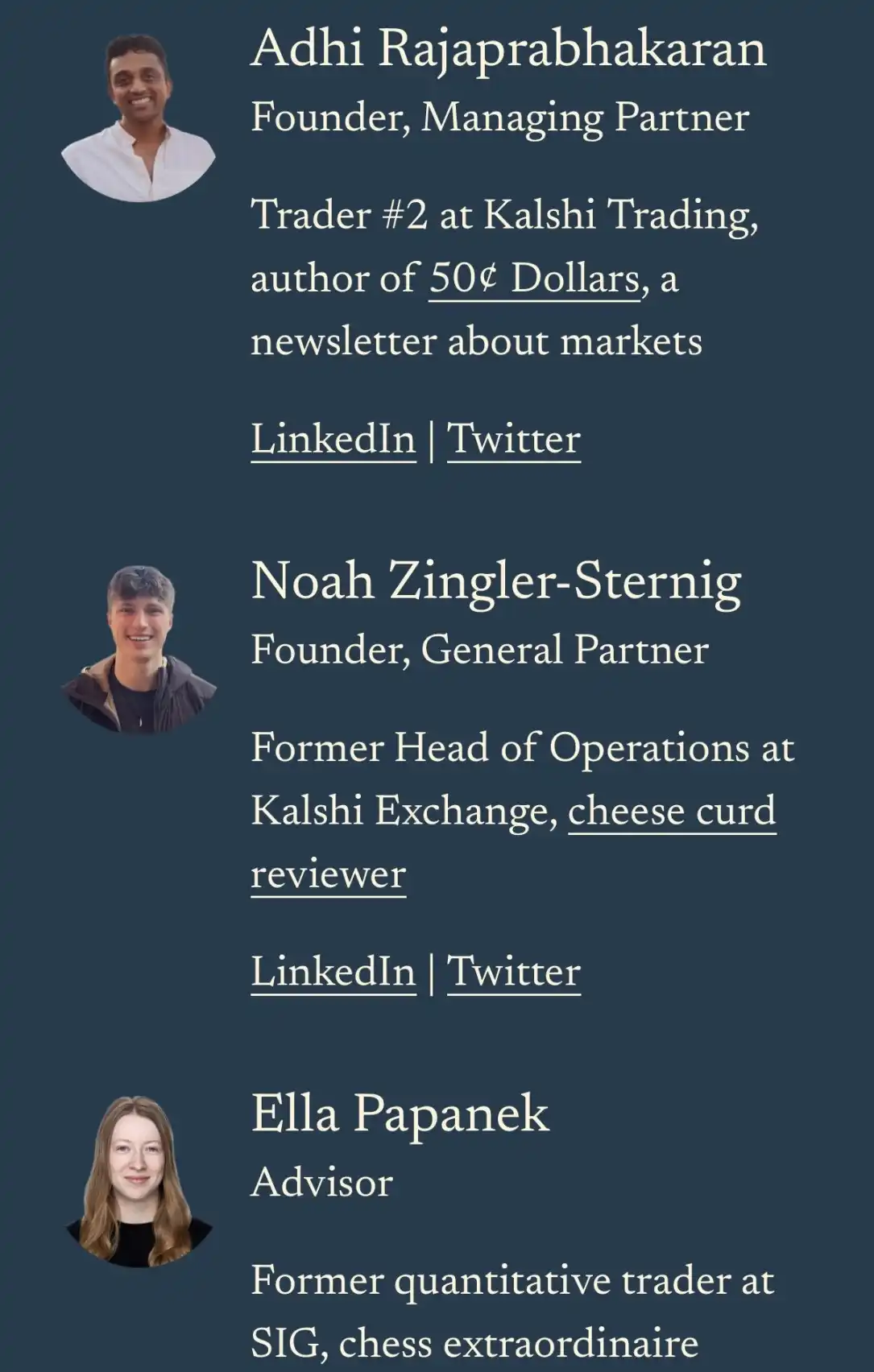
5c(c) Capital was co-founded by two early employees of Kalshi. Adhi Rajaprabhakaran serves as the Founding Managing Partner, having joined Kalshi in 2022 as an associated liquidity provider, becoming the team's second professional trader with over five years of prediction market trading experience. He also runs a Substack column called "50¢ Dollars," focusing on regulatory and business analysis of the prediction market, and hosts a related podcast. Adhi holds a Master's degree in Economics from The University of Texas at Austin and a Bachelor's degree in Economics and Data Science from Michigan State University.
Noah Zingler-Sternig serves as a Founding General Partner, previously operating at Kalshi as Head of Operations overseeing projects such as market support, trader services, and Robinhood integration. His prediction market experience dates back to high school (circa 2017) when he earned over $100,000 trading prediction markets to fund his college tuition. Noah graduated from the University of Wisconsin–Madison with a Bachelor's degree in Finance, Investment, and Banking and previously worked as an analyst in JPMorgan Chase's Commercial Banking division.
Fund Advisor Ella Papanek also brings a strong prediction market background. She is a graduate of Harvard University's Statistics Department and spent around three years as a quantitative sports trader at Susquehanna International Group (SIG). Additionally, she was an early tester and active participant in prediction markets like Augur, Kalshi, and Polymarket. She is also a competitive international chess player, ranking in the top 100 among U.S. women.
The rapid expansion of prediction markets has also drawn regulatory attention. As Kalshi and Polymarket expand their platforms to sports event markets, U.S. Senators Adam Schiff and John Curtis are set to introduce a bipartisan bill this week aimed at prohibiting entities under the oversight of the U.S. Commodity Futures Trading Commission (CFTC), including U.S.-based platforms of Kalshi and Polymarket, from offering contracts related to sports events.
In mid-March, Arizona Attorney General Kris Mayes filed a criminal lawsuit against Kalshi, alleging that while Kalshi may portray itself as a "prediction market," it is, in fact, engaged in illegal gambling activities, including taking bets on Arizona elections, both of which violate Arizona law.
Despite facing legal challenges, the fundraising documents of 5c(c) Capital still describe prediction markets as an "intergenerational investment opportunity." The two founders aim to leverage their industry experience and network to provide capital and operational support to this emerging ecosystem. The fund's website states: "We believe event contracts and prediction markets will fundamentally change the way we understand risk-taking." This viewpoint is also reflected in terms of data and capital.
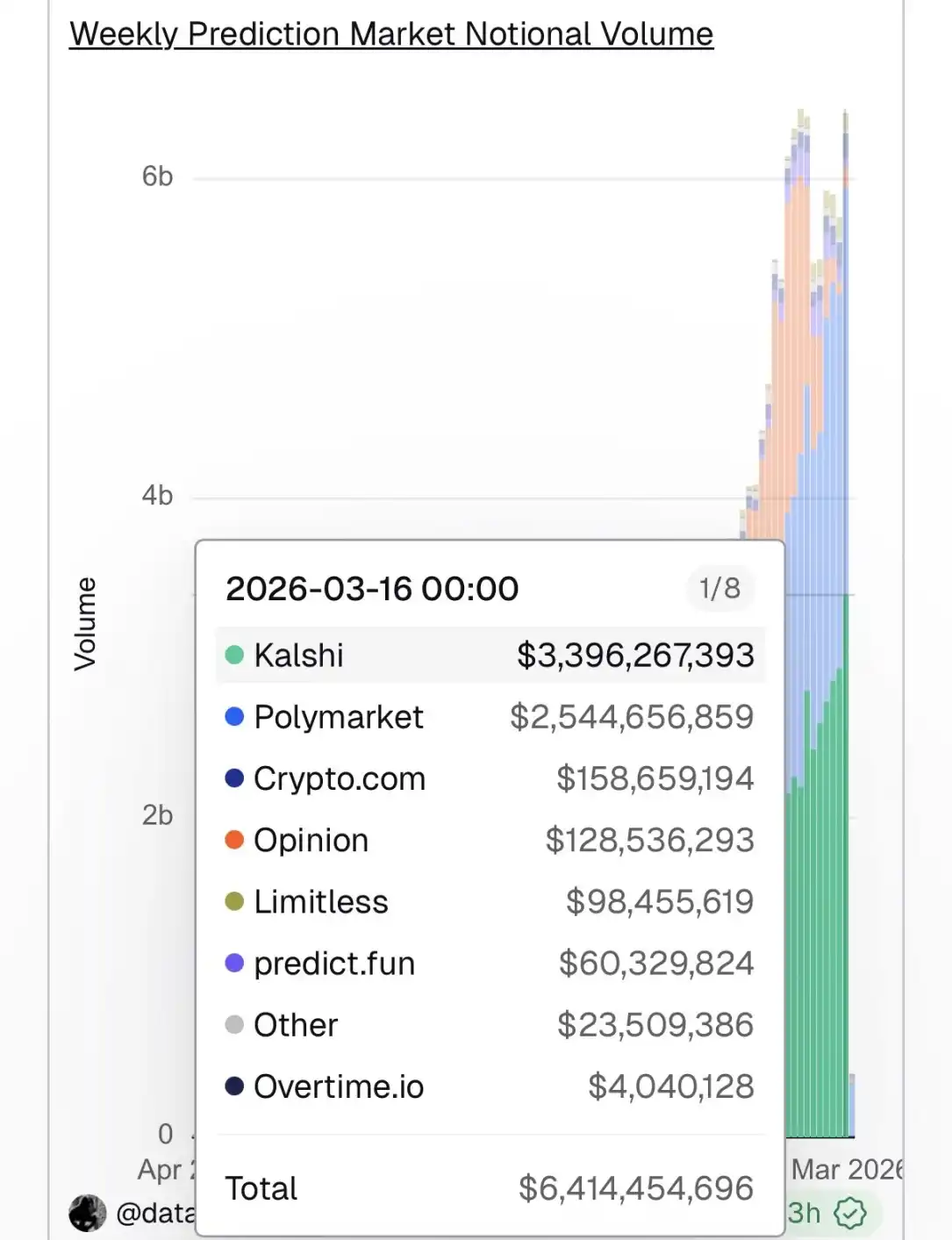
According to Dune Analytics data, as of writing on March 24th, the cumulative independent user count in prediction markets has exceeded 2.8 million, with an open interest of $924 million, a nominal trading volume of $152.4 billion, and a total transaction count of 672 million. In the past week, the nominal trading volume has surpassed $6.4 billion.
Kalshi is currently undergoing a new funding round with a valuation of $22 billion, led by Coatue Management with a funding amount of over $1 billion; its competitor, Polymarket, is in talks with potential investors for a funding round at a valuation of around $20 billion.
