By | Lin Wanwan
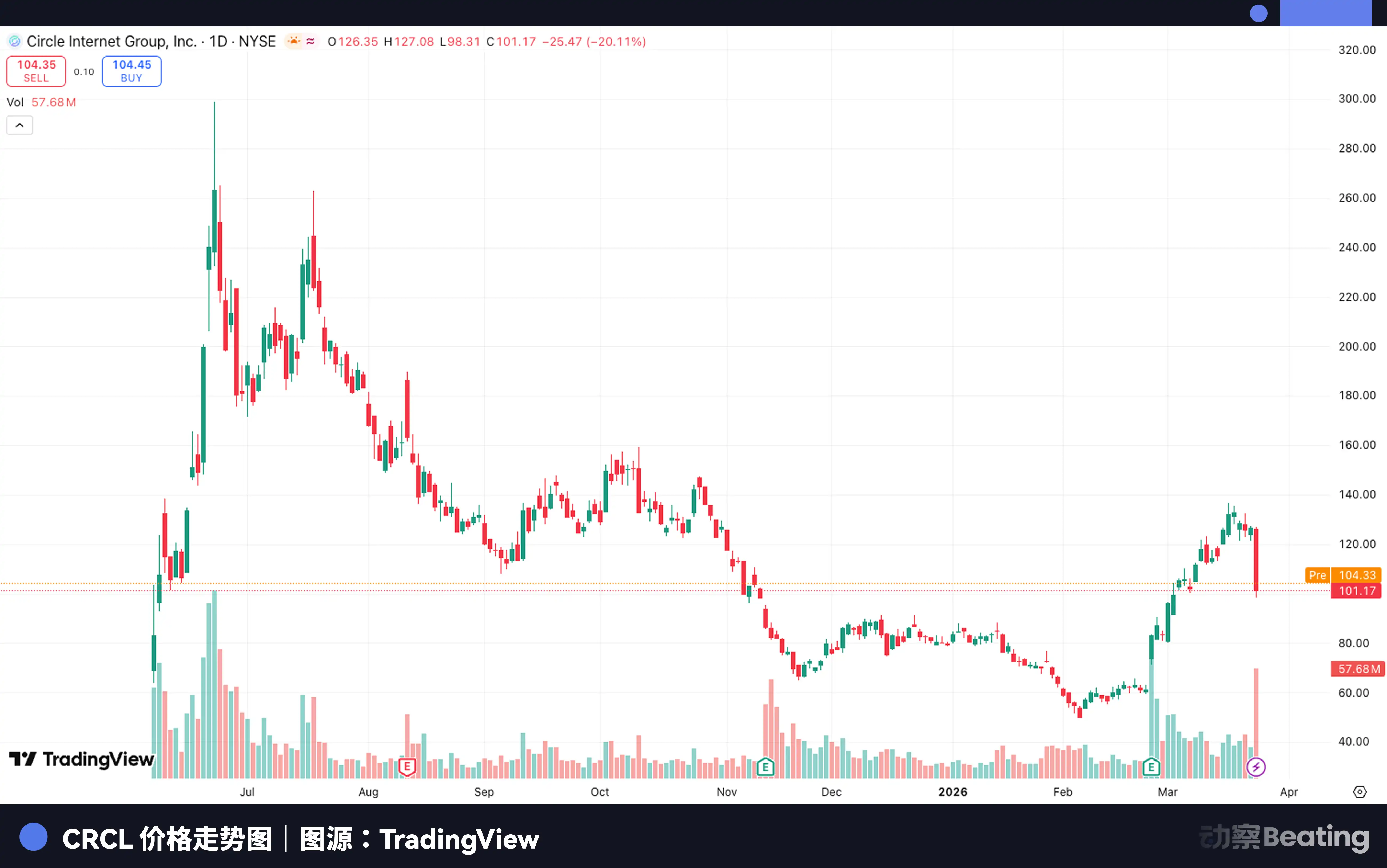
On March 24, 2026, Circle's CEO Jeremy Allaire probably experienced the toughest trading day since the company went public.
The stablecoin company he co-founded saw its stock price evaporate by one-fifth intraday. With over 30 million shares traded that day, panic was clearly visible on the trading floor.
And all of this was triggered by a few pages of paper flowing out of an office building in Washington.
A $780 Billion "Tap Water" Business
To understand this dramatic plunge, we first need to understand how Circle makes money.
Many people think of a stablecoin company as a tech company, but what Circle does is more akin to banking. You give it $1, and it gives you 1 USDC token. You can then freely transact and spend the token on the blockchain, while Circle takes your dollar to buy U.S. Treasury bonds.
The interest on the Treasury bonds is Circle's profit.
How lucrative is this business? In Q4 2025, interest income alone contributed $733 million.
The circulation of USDC surged by 72% within a year, reaching $780 billion. With a $780 billion fund pool in hand, Circle continuously receives interest like tap water, non-stop.
Just attracting deposits is not enough; more people need to be willing to exchange their money for USDC. So, Circle and Coinbase made a deal: Circle shares a portion of the interest income with Coinbase, and Coinbase, in turn, offers a 3.5% annualized reward to USDC holders. You put your money in, lie back, and earn interest. No need to understand blockchain, no need for any operations, the earnings are automatically credited.
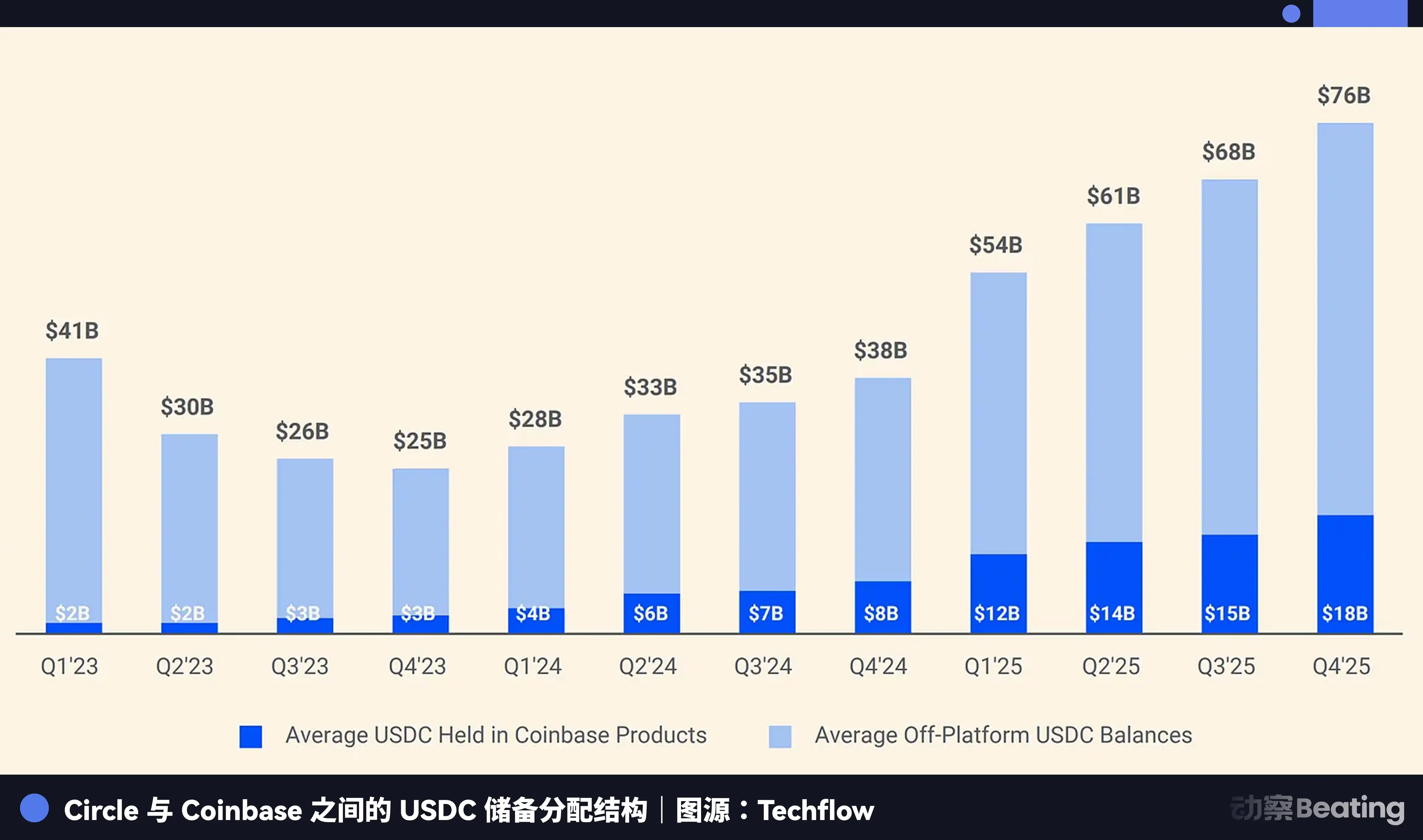
This model formed a beautiful flywheel: earnings attract users, users bring funds, funds generate interest, and interest feeds back into earnings. The faster the flywheel spins, the higher Circle's stock price soared from around $50 in early February to $135, a 170% increase in six weeks. The market expected the Fed to maintain high-interest rates, which also benefited Circle; the higher the interest rate, the more generous the interest income.
Then, someone set their sights on this machine.
The Banking Sector Fights Back
On March 24, the latest draft of the U.S. Senate's CLARITY Act was revealed.
This legislation, formally known as the "Digital Asset Market Clarity Act," was originally intended to regulate the crypto market and had previously passed in the House of Representatives. However, the Senate added an amendment in the latest version: prohibiting any platform from directly or indirectly providing yield for passive holding of stablecoins, including any arrangement that is economically or functionally equivalent to interest on bank deposits.
In simple terms, the "earnings on holdings" mechanism you guys have will no longer be allowed.
This prohibition strikes at the heart of Circle. If earnings cannot be provided, there will be no short-term incentive for holding USDC, and in the long term, the stablecoin business on Coinbase will also shrink. In the fourth quarter, Coinbase had $364 million in revenue from stablecoins, and this money is now hanging in the balance.
The power play behind the ban is more interesting than the ban itself.
This tug-of-war over stablecoin yields has actually been going on for almost a year.
The GENIUS Act, which took effect in July 2025, already prohibited issuers from directly paying interest to holders, but the law did not explicitly cover related parties and third-party platforms. Circle and Coinbase have been taking advantage of this gray area: Circle distributes reserve interest to Coinbase, which then distributes it to users under the guise of "rewards," completing the loop and ensuring the funds still arrive.
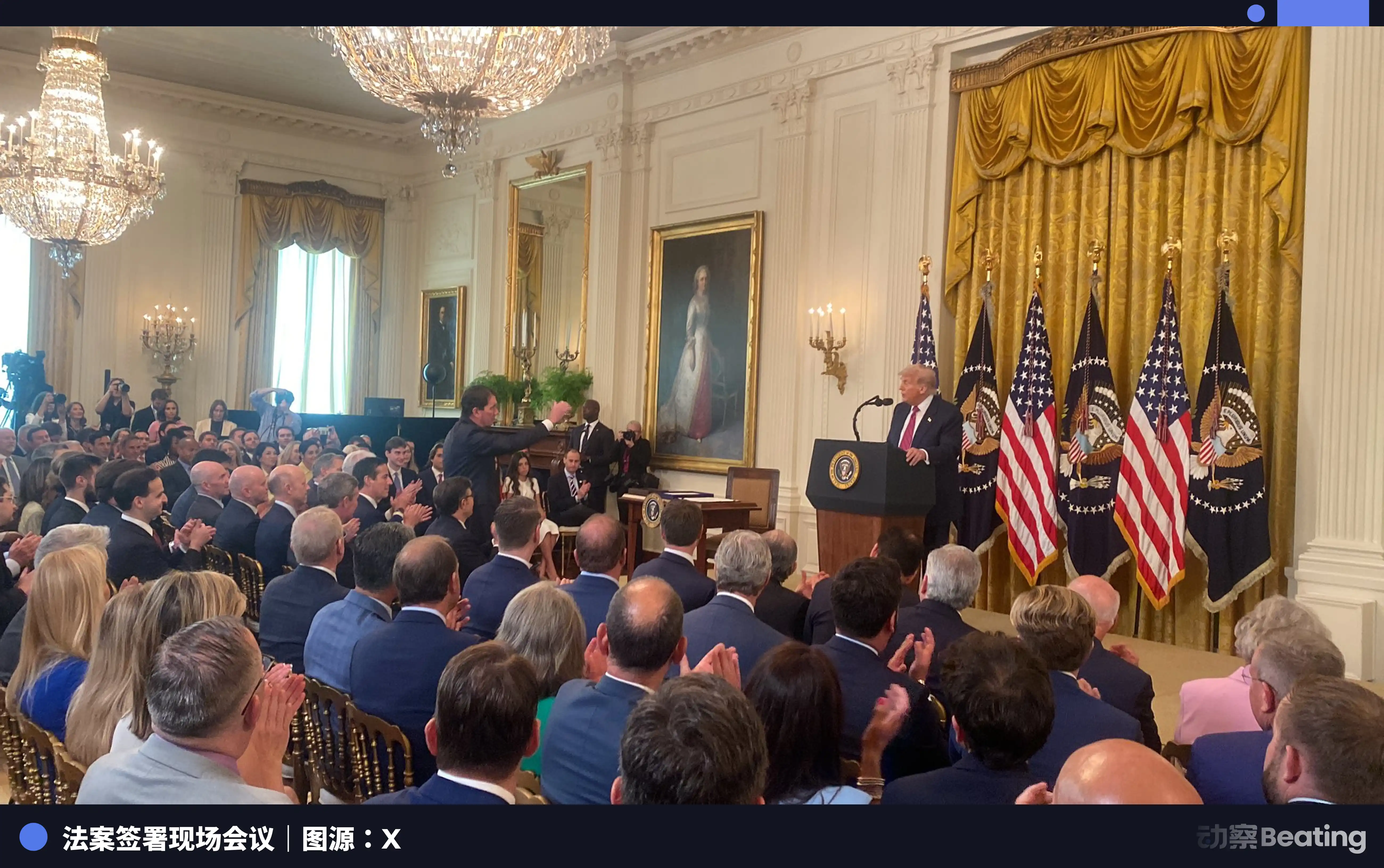
Following this, over 40 banking industry associations led by the American Bankers Association jointly wrote to Congress, urging them to close this loophole. The earnings ban in the latest version of the CLARITY Act is a direct result of this lobbying effort.
The traditional banking sector is driving this amendment.
The reasoning is simple: If Coinbase can offer a 3.5% yield, why would customers keep their money in a traditional bank's checking account? The yield mechanism of stablecoins directly undermines the foundation of bank deposits. It was reported that bank representatives were scheduled for a review on the same day the draft text was released. The crypto industry aims to take on banking activities, and banks will not stand idly by as their deposits are siphoned off by a group of code writers.
On Capitol Hill, lawmakers need to choose between these two forces, and at least from this draft, the traditional forces seem to have the upper hand for now.
Shay Boloor, Chief Market Strategist at Futurum Equities, highlighted a more critical issue: this ban blocks USDC from transitioning from a payment tool to a "value storage" product.
And that upgrade path is precisely the core logic behind Circle's stock price surge in recent weeks. The 170% price increase was driven by the market's pricing of USDC's future potential. Now, that potential has been dealt a blow by the legislative proposal, and the 170% surge has instead become the best short-selling reason.
The stock price plummeted from a high of $125 to around $101, marking the largest single-day drop since its listing in June 2025. Coinbase, dragged down alongside, fell by about 10%.
Tether's "Kick 'em While They're Down"
Unfortunately, troubles do not come alone.
On the same day, Circle's biggest competitor, Tether, announced that it has hired one of the Big Four accounting firms to conduct a full audit of its USDT reserves.
While this news might have been just a side story on a normal day, its impact has been magnified tenfold due to the timing.
The stablecoin arena has always been quite clear-cut: Tether's USDT is the largest in scale but faces doubts about reserve transparency, while Circle's USDC is slightly smaller but boasts solid compliance.
Institutional investors choose USDC to a large extent for peace of mind. At the end of the day, Circle's moat is all about trust.
Now Tether is looking to shore up this weakness. Once the audit is completed, the largest gap between USDT and USDC will be closed. On one end, regulation is eroding Circle's moat, while on the other end, the competitor is building its own.
Caught in a pincer movement, with such precise timing, it's hard to call it a coincidence. On the eve of a reshaping stablecoin regulatory landscape, Tether chose this window to show its sincerity, making a bold move.
Some market participants boldly state that if Tether secures endorsement from a Big Four audit and further expands its presence in the US market, USDC's share on the institutional side will be further eaten away.
Circle's meticulously nurtured image of a "compliance valedictorian" over the past few years is transitioning from an exclusive advantage to an entry barrier.
Armor and Shackles
However, there are also voices of reason.
Clear Street analyst Owen Lau believes the market has overreacted. He stated that the actual situation is not as bad as the headlines make it seem, more resembling a knee-jerk reaction to complex legislative news.
He's right, the CLARITY Act is currently a Senate bill, a long way from officially becoming law.
While the Trump administration is pushing for the bill, the revenue restriction provision itself could also become an obstacle to the bill's progress. The revenue restriction may be modified in the final text or even removed altogether.
The bill is not a blanket ban: rewards linked to payments, transfers, and promotional activities can still be carried out, it's just that "yield farming" is no longer allowed. The SEC, CFTC, and the Treasury Department will further define what constitutes "permissible rewards" within one year after the bill takes effect, with the specifics yet to be written.
If Circle can transform its business model from "holding equals rewards" to "usage equals rewards," the game may still go on.
Additionally, the growth of USDC is not solely reliant on yield. The world's largest prediction market, Polymarket, runs on USDC, and this transactional demand will not simply disappear due to a ban.
Last year, Circle also launched Arc, a Layer-1 blockchain designed for the stablecoin financial landscape, covering global payments, forex, and asset tokenization, attempting to expand its business from stablecoin issuance to financial infrastructure. USDC won't die, but whether it can sustain the growth rate of the past year remains a big question mark.
Looking back, this crash served as a wake-up call for all crypto companies.
Over the past few years, the most successful batch of companies in the crypto industry have followed the embrace of regulation route. Circle is the epitome of this route: a proactive IPO, transparent audits, active lobbying, everything is aimed at proving to Wall Street that it is a suit-wearing financial innovator. The market has also rewarded them. In less than a year of being listed, the stock price has more than doubled. Q4 revenue was $770 million, a 76.9% year-on-year increase, earnings per share of $0.43, significantly exceeding market expectations of $0.25. On paper, this is a rapidly growing company.
However, the CLARITY Act draft has exposed a somewhat uncomfortable reality: compliance means you voluntarily put yourself in the regulatory crosshairs. Tether stays overseas, unaffected by this ban, Circle, as a U.S. publicly listed company, can only accept scrutiny obediently. Compliance gave Circle armor, but it also gave it a set of shackles.
The bill is still under negotiation, and the story is far from over.
But this day in March 2026 is worth remembering: when the innovation of the crypto world touched the interest boundary of traditional finance, which way the balance on Capitol Hill tilts ultimately depends on whose voice is louder in Washington.
