Most discussions about Web 4.0 are somewhat problematic.
Their question is: Is this the next marketing cycle? Is Web 4.0 another wave of buzzword creation? These questions are not important. There is only one real question: the underlying permission of the internet, shifting from whom to whom?
Putting this question into historical context, the answer has always been quite clear. Web 1.0 was read-only — users were consumers of content, with no write permissions. Web 2.0 granted write permissions — you could post, upload, comment, but the platform owned your data. Web 3.0 granted ownership — assets on-chain, private keys in your hands, the platform unable to seize your wallet.
Each iterative generation has fundamentally been a downward transfer of permission.
Web 4.0 continues along the same logical line, but the transferee has changed. It is not a transfer to users, but a transfer to Agents.
An overlooked structural fact: the entire architecture of the internet has been inherently “human-centric” for a long time.
Web 2.0’s UI/UX was designed for the human cognitive bandwidth — information density, click paths, color contrast, every parameter behind it was an estimation of the human attention limit. Web 3.0’s KYC verification, mnemonic backup, multi-signature approval, is essentially addressing human vulnerabilities to errors and attacks.
The whole system serves the limitations of humans, not their capabilities.
However, in the AI era, this logic begins to break down. When an Agent gains on-chain permissions, it faces the same system designed for humanity, but it does not need a polished UI, password recovery, SMS verification, or even a nap before transaction confirmation.
This is the core contradiction of Web 4.0: an internet infrastructure designed for human cognitive limitations encountering new participants without cognitive limitations. A rebuild is inevitable.
The ongoing rebuild can be observed from two dimensions.
The first dimension is the breakdown of the frontend. Traditionally, a beautiful UI was designed for human visual processing. Agents primarily communicate through APIs and code logic, where the interface is noise, not an entrance. Once the Agent becomes the main protocol interactor, frontend logic shifts from “how to make the user understand” to “how to make the machine read.” This is a paradigm shift that frontend development has never encountered in the past thirty years.
The second dimension is the replacement of the authentication system. Password-based systems assume that the logging-in entity is a human with memory constraints—passwords need to be short enough to remember, yet long enough to be secure. This contradiction has driven the entire password management industry. But the Agent does not need to remember passwords. On-chain signatures can be granted and revoked in real-time, with permission granularity accurate to a single operation. The account system will be gradually replaced, not because it was designed poorly, but because its design premise has become outdated.
The transformation of these two dimensions, summed up in one sentence: the entrance of the Internet will shift from a revolving door designed for humans to an API interface designed for machines.
Within this process of infrastructure rebuilding, there is a specific closed loop that is worth examining separately.
AI has powerful decision-making capabilities, but it inherently lacks two things: an independent payment channel and asset sovereignty.
An Agent can analyze sentiment data from the global gold market in milliseconds and provide the optimal allocation decision—but if it does not have an independent funding account, this decision still needs to be executed by a human. The delay in the execution phase will negate all the advantages accumulated in the analysis phase.
Crypto completes this shortcoming.
Take Hyperliquid, for example: its perpetual contract market for commodities such as gold, silver, and oil operates 24/7. This feature is optional for human traders—positions at three in the morning can be dealt with in the morning. But for an Agent, this is a necessary infrastructure condition because the Agent itself has no concept of sleep; its operation is round-the-clock.
When the Agent takes over the wallet and private keys, it extends from the decision-making layer to the execution layer. AI provides analysis and judgment, Crypto provides settlement infrastructure, and only when combined are they a complete economic entity.
The marginal cost of running an Agent tends toward zero. Its output and transaction execution are round-the-clock. For DeFi protocols, this is an unprecedented ideal counterparty—not emotional, does not forget, does not miss the optimal execution window because of daytime meetings.
This is the true narrative of Crypto × AI: not a combination of two buzzwords, but complementary infrastructures coming together at the same time.
Here is perhaps an imperfect example.
In 1908, the Ford Model T began mass production. In the initial years, the mainstream opinion in the commentary world was that the automobile was an upgraded version of the horse carriage, a toy for the wealthy. No one foresaw that the automobile would rewrite the spatial logic of entire cities, give rise to a chain of gas stations, disrupt railway passenger services, and transform Detroit into a global manufacturing hub.
The key point overlooked was not the automobile itself, but how the automobile altered the entire society's spatiotemporal cost function.
The structural significance of Web 4.0 is similar to this. The surface-level questions—such as which products will boom and which protocols will succeed—are akin to the Model T era's "which car model will sell well." The real proposition is: as Agents become the primary on-chain actors, scaling and concurrency exponentially surpass human capabilities, in what dimension will the economic system's rules undergo a shift?
Based on this logic, BlockBeats and Zhihu will jointly host an event in Hong Kong on April 21 with the theme "Decoding Web 4.0: When AI Agents Take Over On-chain Permissions", seeking some certainty in the face of entirely new propositions.
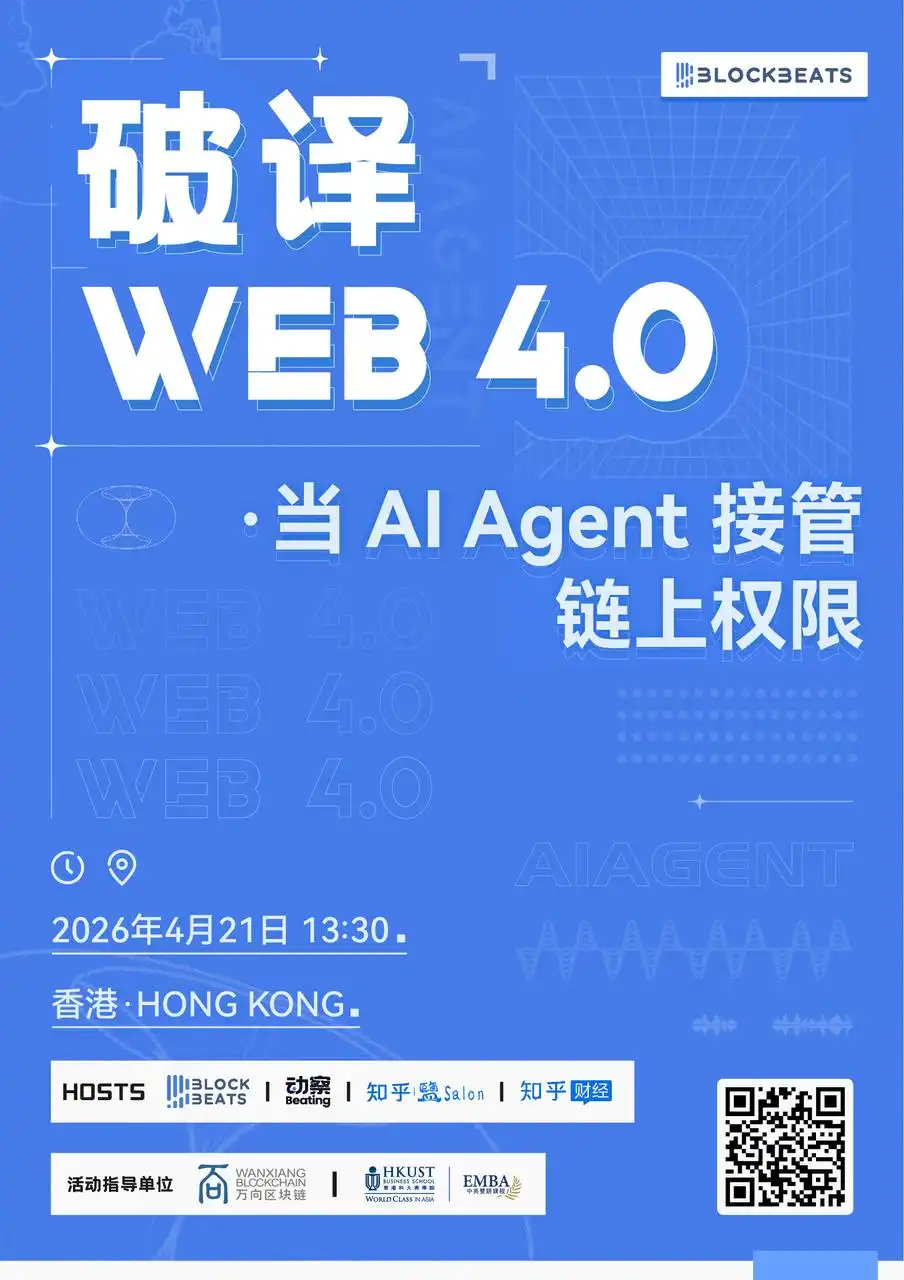
At this event supported by Wanxiang Blockchain and the Hong Kong University of Science and Technology Business School, top industry leaders will share their unique perspectives. We will discuss the potential of the "Agent Autonomous Economy," the necessity of on-chain automation, and the entirely new financial models brought by Agents.
We have also invited high-quality Skills teams in fields like transactional finance and reshaping payment habits. As the flow of funds is a top priority, everyone aims to have Agents make money. These Skills Demos will showcase the cutting-edge financial transformations that can potentially change our lifestyle habits and perceptions.
Registration is now open. Feel free to scan the QR code on the poster to sign up and learn more about the event (or click the registration link: https://luma.com/r3h4eqkv). We hope the insights from industry leaders will inspire critical thinking. In this era of online anxiety and offline turmoil, let's gain a bit of direction.
For event cooperation, please add WeChat: x18038189105, Tg: @Nokikooo
