DeFi's largest lending protocol is undergoing a silent security team walkout.
Yesterday, a company called Chaos Labs sent a farewell letter, announcing the termination of its partnership with Aave. Most users may not have heard of this name, but over the past three years, every collateralization rate, liquidation threshold, and risk parameter for every loan on Aave was set by this company.
They also built an automated system called Risk Oracle, which can adjust parameters in real time according to market conditions, enabling Aave to expand from a few markets to over 250 markets on 19 chains. Overseeing hundreds of billions of dollars in the pool for three years, with zero defaults.
In essence, what runs on Aave is smart contracts, but the actual numbers in the contracts have always been monitored by Chaos Labs.
CEO Omer Goldberg's farewell letter was well-written, and the achievements were detailed. TVL increased from $5.2 billion to over $26 billion, with total deposits exceeding $2.5 trillion and liquidations over $2 billion...
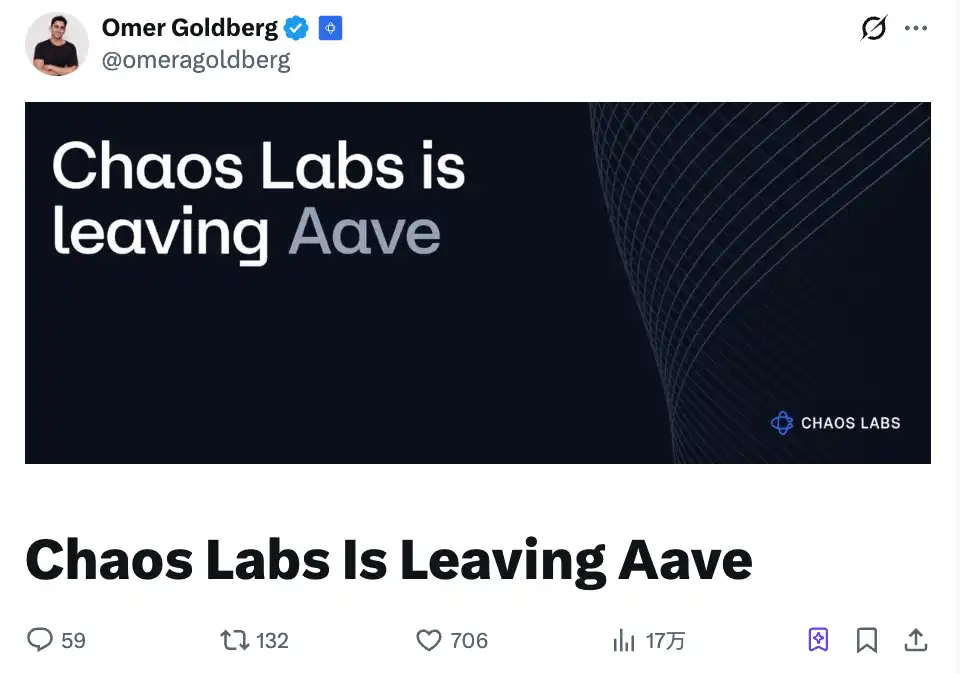
Then he said, "We proactively proposed to terminate the contract. No one pushed them, and the contract was not up for renewal. At the same time, Aave founder Stani Kulechov responded calmly, saying the protocol is operating as usual, and another risk service provider, LlamaRisk, will take over."
It sounds like nothing happened.
However, a risk control team that has been incident-free for three years voluntarily leaving the largest DeFi lending protocol is what traditional finance would call a bad omen.
In the statement, Goldberg said the disagreement was not about money but about the fundamental differences in risk management principles between the two parties.
Less Money, More Resentment
To retain the team, Aave Labs proposed increasing Chaos Labs' annual budget from $3 million to $5 million. However, Chaos Labs still decided to leave.
In the statement, Goldberg gave three reasons that must lead to the departure, but after reading them, you will find they all point to the same conclusion.
The first is money. Aave's full-year revenue in 2025 was $142 million, with a $3 million budget for risk, accounting for 2%. The traditional banking sector usually allocates 6% to 10% of its budget to compliance and risk management.
Goldberg mentioned that they had been losing money on this endeavor for the past three years, and even with the budget increased to $5 million, they were still operating at a loss. He believed a reasonable bottom line would be $8 million. Aave's treasury held $140 million, and Aave Labs had just approved a $50 million funding proposal for themselves, so it seems like the protocol is not broke, just reluctant to allocate that much to the security team.
The second is action. Aave is currently upgrading from V3 to V4, with a complete rewrite of the underlying architecture, smart contracts, and liquidation logic. Goldberg mentioned that the only thing V4 and V3 have in common is the name. During the upgrade, both systems will run in parallel, and the workload for risk management will not be halved but doubled.
The third is accountability. The legal responsibilities of DeFi risk professionals are currently undefined, with no regulatory framework or safe harbor provisions. When things are going smoothly, you are invisible, but when something goes wrong, you are the first to be held accountable. In Goldberg's own words, if the upside is marginal and the downside has no floor, then continuing to operate is inherently a bad risk management decision.
The author finds this statement hard to refute. A protocol with an annual revenue of $140 million, allocating a 2% budget to a team overseeing assets worth billions, and then telling them to do twice the work, with no legal protection if things go wrong.
What would you do in that situation?
Of course, the other side of the story is different. Aave Labs' founder Kulechov's response on X suggests that Chaos Labs has recently been scaling back its risk consultancy business and has already started reducing collaboration with other protocols.
Implicit in this is that the farewell letter's reasons are more like providing a respectable narrative for leaving.
Whether it's a disagreement in principles or a case of overpromising and underdelivering, outsiders cannot judge. But one thing is certain: Chaos Labs is not the only one who has left.
Encountering Overnight Rain in a Bear Market
Aave is still called Aave, but the group of people who built it have gradually left over the past two months.
In February this year, Aave V3's core development team, BGD Labs, announced that they would not renew their contract. This company was founded by Aave's former CTO, Ernesto Boado, and most of V3's code, governance system, and cross-chain deployment came from their hands. After four years, they left when their contract expired.
The reason given by BGD was straightforward. Aave Labs is consolidating power in its own hands, with V4 development, brand assets, and social accounts all controlled by Aave Labs. BGD felt they had no right to participate in the design but would be held responsible for the results. In a traditional company, this is called being sidelined.
A month later, ACI, the most active service provider in the Aave governance system, also announced their departure. This eight-person team had driven 61% of Aave's governance proposals over three years. Founder Marc Zeller stated directly in his farewell letter that Aave Labs could use its voting power to pass its own budget, rendering independent service providers meaningless in this system.
Two farewell letters in two months, one saying they were sidelined, the other saying the rules of the game were unfair.
Then in March this year, another incident occurred.
A configuration error in the risk management system built by Chaos Labs led to approximately $27 million in positions being erroneously liquidated, affecting at least 34 users. Chaos Labs stated that no bad debt was incurred, and affected users would be compensated.
Ultimately, no one bore legal responsibility for this incident because there is simply no legal definition of liability in DeFi.
However, when overseeing hundreds of billions of dollars, a single parameter error can result in a multimillion-dollar fund fluctuation, with virtually no legal protection for you. The risk management team emphasized this issue repeatedly in their farewell letter.
With this, in the V3 era, Aave operated on four pillars: development, governance, risk management, and financial growth. Now, the first three pillars have all departed.
In the risk management team's farewell letter, there is a metaphor called the Ship of Theseus. If every plank on a ship is replaced, is it still the same ship?
The name Aave still exists, the contracts are still running, and the TVL is still increasing. But the team writing the code has left, the team governing has left, and the team managing risk has left. Users continue to deposit and borrow money as usual, perhaps without knowing that everything under the ship has been completely overhauled.
What truly makes one uncomfortable about this situation is not who left but the fact that after they left, nothing changed.
The user opens the page, deposits, borrows, interest rates are normal, liquidation is normal, everything is as usual. If no one specifically reads the governance forum, most users wouldn't know what has happened in the past two months.
In the short term, maybe everything is indeed fine. Smart contracts will not stop because the risk team has left, and the set parameters will not change by themselves. Aave still has a risk service provider, LlamaRisk, so it's not completely exposed.
But risk management is not a one-time project. Setting parameters does not mean they will always be suitable; the market is changing, assets are changing, and on-chain attack vectors are also changing. Next time something similar happens, no one knows if the new team taking over can react as quickly.
Moreover, now is not a period of calm.
AAVE's token price has dropped from its high of $356 in August last year to around $96 now, a drop of over 70%. The entire DeFi lending track is shrinking, on-chain activity is decreasing, and protocol revenue is under pressure.
In a bull market, risk management is invisible, and no one applauds because "nothing happened today." In a bear market, risk management is truly needed because asset prices fluctuate sharply, liquidation density increases, the probability of a black swan event rises, precisely the stage that tests the risk team's experience and response speed the most.
Ironically, it is precisely at this stage that the most experienced group of people has left.
The risk team said a sentence in their farewell letter, which the author thinks is very accurate. The reason Aave can surpass those more aggressive competitors is not that it has more features, but because others blew up, and it didn't. In this market, surviving is the product.
The current issue is that the people who made it survive may no longer be there.
