24 hours ago, the Iranian Ministry of Foreign Affairs publicly announced the closure of the negotiation window, while Trump issued a tough statement saying, "If Iran does not open the Strait of Hormuz, it will destroy the entire civilization." American, Israeli, and Iranian missiles and drones were frequently flying, Iran's "Resistance Axis" network was actively harassing the Gulf region, and even the Strait of Mandeb was facing a blockade by Houthi forces.
At that time, the prediction market priced the probability of "US-Iran ceasefire by April 7th" at 4%.
It was in this geopolitical background that in less than 12 hours, the warring parties declared a ceasefire, each claiming a "victory." The single-digit ceasefire probability instantly surged to 99%, the crude oil index plummeted by 15%, and even now, the market is still repricing post-event information.
However, a group of people had already started positioning for this ceasefire last month. On March 26th, Beijing time, the prediction market monitoring channel PolyBeats sent out a flash news:
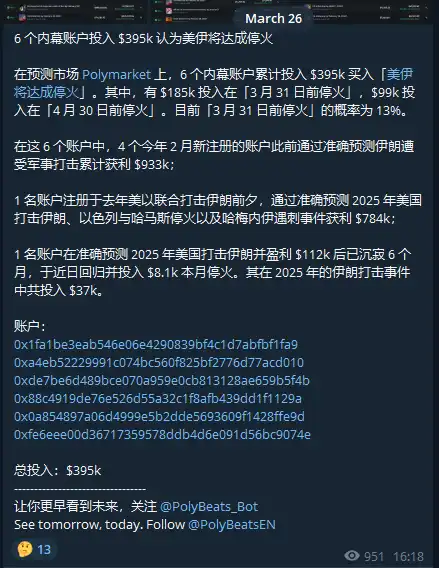
These individuals made $1 million from this ceasefire event. They are called "insiders" precisely because they have replicated such jaw-dropping trading operations multiple times.
A New Account Loaded $20,000 at the End of February, and Today Withdrew $400,000
Let's take one of these 6 accounts as an example.
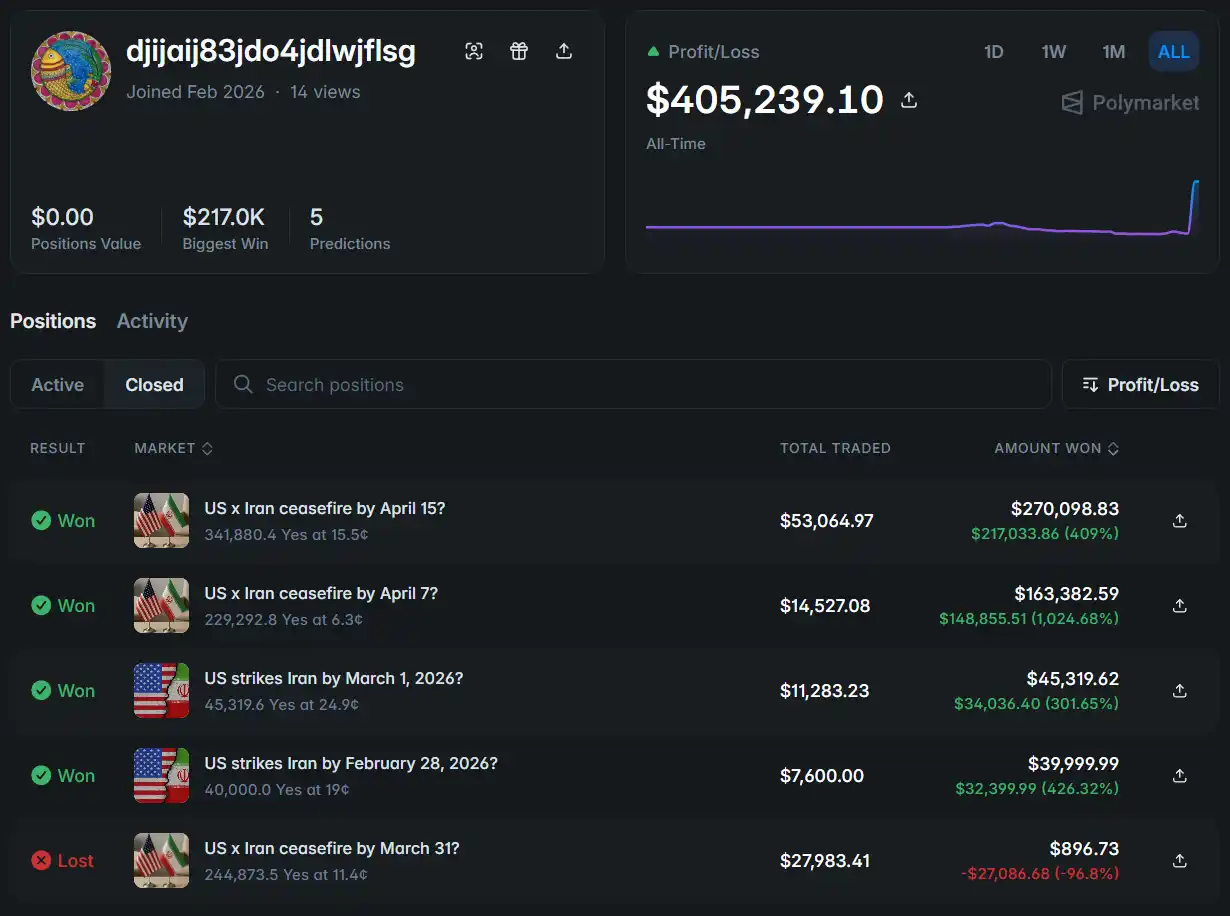
This account was registered just 6 hours before the start of this round of Iran conflict. After depositing nearly $20,000, the account holder used the entire $20,000 to "bet" that the United States would strike Iran in the next 48 hours.
The outcome of this "bet" is already known: 6 hours later, the U.S. and Israel jointly launched massive airstrikes on Tehran, with footage capturing American Tomahawk missiles directly hitting a girls' elementary school, resulting in at least 150 deaths of female students aged 7 to 12.
And this $20,000 "speculation" thus multiplied fivefold amidst the cries of the Iranian people.
3 weeks later, the account will use the entire nearly $100,000 principal plus interest to bet that the US and Iran will cease fire at different time points. His final bet was made at 5:00 AM on April 8th Beijing time.
1 hour and 32 minutes later, Trump posted on Truth Social announcing a "bilateral ceasefire" agreement.
This round of $100,000 "bet" once again enjoyed nearly 4 times the return, with $20,000 turning into 20 times its value in 5 weeks. Shortly after the ceasefire announcement, this account changed its username to a string of garbled characters and promptly cashed out.
Apart from this account, the profiles of 5 other accounts were eerily similar:
These accounts had been betting on the ceasefire since the end of March, which actually aligned perfectly with the content of multiple reports after this ceasefire: the US-Iran ceasefire had been quietly laid out in the diplomatic background a month ago. Under multiple mediation and diplomatic efforts, a 10-point proposal initially rejected by Trump quickly evolved into a "negotiable basis" in the past 48 hours.
These negotiation details, not fully known to the public, only appeared on prediction markets in the form of suspicious transactions driven by money trends. With this perspective, we will continue to use prediction market data to see which direction the two weeks after the ceasefire will take.
Crude Oil Index Plummets: Will the Hormuz Strait Reopen?
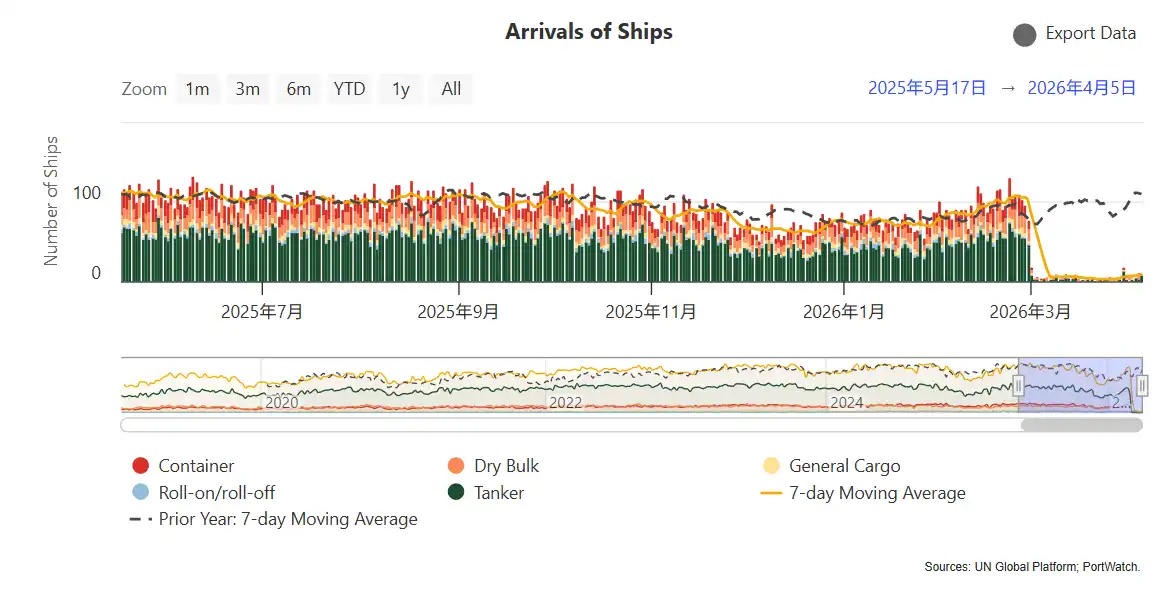
Since the start of the war, data from the global shipping data organization IWF shows that the number of vessels transiting the Hormuz Strait has plummeted from an average of about 100 ships pre-war to less than 5 ships on average in the past three weeks—a decrease of over 95%.
One of the most direct impacts of this ceasefire agreement is that the WTI crude oil price, which had surged around 70% since the start of the war, plummeted by 15% from yesterday's $112. The market's initial reaction to the ceasefire is seen as a signal that the Hormuz Strait is about to reopen.
The probability prediction market for the "reopening of the Strait of Hormuz this month" also saw a similar response: the announcement of a ceasefire agreement caused the previously 14% probability to surge to a high of 65%, currently at 46%.
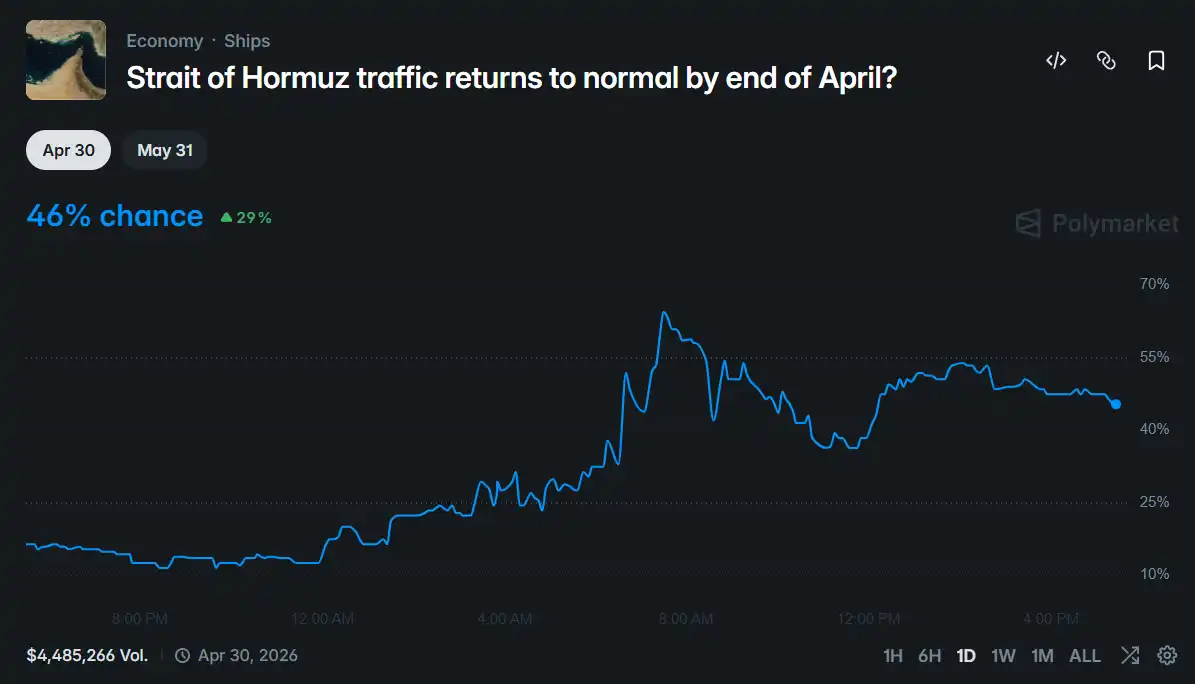
This data aligns well with the current geopolitical situation: factors such as shipowner confidence, insurance rates, and Iran's actual pace of openness are not as simple as a Trump post, and the current WTI crude oil price of $95 is still far from the pre-war level of around $55.
The Bad Debt of Enriched Uranium
What is most unclear about the ceasefire terms is not the Strait of Hormuz, but the nuclear issue. The starting point difference between the two sides can be described as "poles apart."
Prior to the war, the core of the U.S.-Iran negotiation breakdown lay here: the U.S. demanded Iran completely abandon its uranium enrichment capability, while Iran insisted on retaining the right to peaceful nuclear energy and used the "downblending" of 60% enriched uranium as a bargaining chip for full sanctions relief.
The outbreak of war itself has made this issue even more complex. According to the International Atomic Energy Agency (IAEA) records, Iran currently holds about 441 kilograms of 60% enriched uranium—using Iran's existing centrifuge capacity, theoretically, it would only take a few weeks to reach weapons-grade.
In the ceasefire statement, Trump claimed that "almost all points of contention between the U.S. and Iran have been agreed to in principle," but the White House has not yet disclosed any detailed terms, and Iran's 10-point proposal text is also very vague on the nuclear issue.
The probability on the prediction market for "U.S.-Iran nuclear agreement by April 30th" was only 2% before the ceasefire announcement, rising to 26% after the ceasefire.
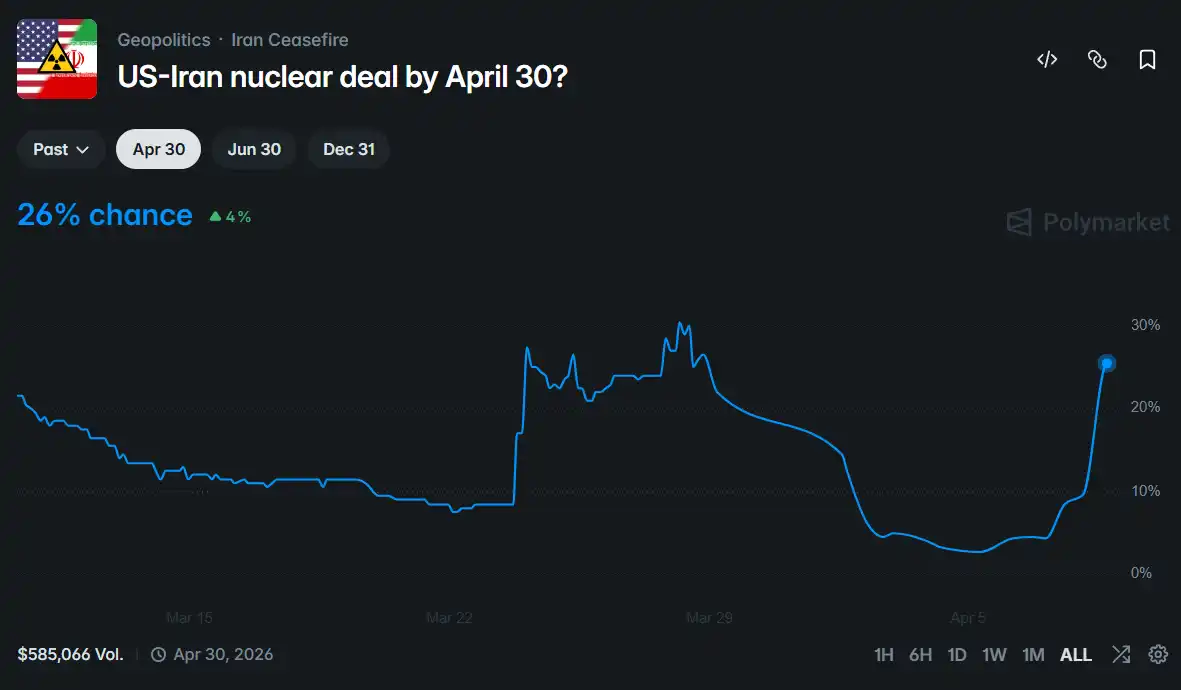
A 24% increase in probability is not insignificant, but the 76% "no" consensus accurately reflects the real situation of the nuclear issue: the ceasefire has opened the door to negotiations, but what's inside that door is the toughest nut to crack in this conflict.
The Palestinian Story, Replaying in Lebanon
The news between the U.S. and Iran has dominated all headlines in recent weeks, with many media outlets even completely overlooking an important participant in this round of ceasefire agreement reporting: Israel.
Israel did indeed agree to the ceasefire: Netanyahu's office's statement clearly stated, "Israel supports Trump's decision to pause strikes against Iran for two weeks, but—the ceasefire does not include Lebanon."
This directly contradicts what Pakistani Prime Minister Sharif said in the ceasefire announcement about "all parties in Lebanon and other areas," And over the past six weeks, Israel's actions in Lebanon have been much deeper than what the news reports have presented.
On March 1, on the same day as the U.S.-Israel joint strike against Iran, Israel began deploying ground forces to southern Lebanon. On March 16, the IDF announced the formal start of a ground invasion operation with the aim of occupying the entire region south of the Litani River and establishing a "forward defense zone."
Subsequently, Israel sent an additional 3 brigades to Lebanon, blowing up all major bridges over the Litani River to cut off the south's connection to the outside world. Israeli Defense Minister Katz explicitly stated that this operation is "just like what we did in Gaza" and declared that Lebanese southern residents would not be allowed to return home until the Hezbollah threat is eliminated.
Iran's 10-point ceasefire proposal explicitly calls for "halting the war on all members of the Axis of Resistance" — Hezbollah being a core part of Iran's proxy network. But Israel's position is equally clear: the Lebanon issue is not within the framework of this ceasefire.
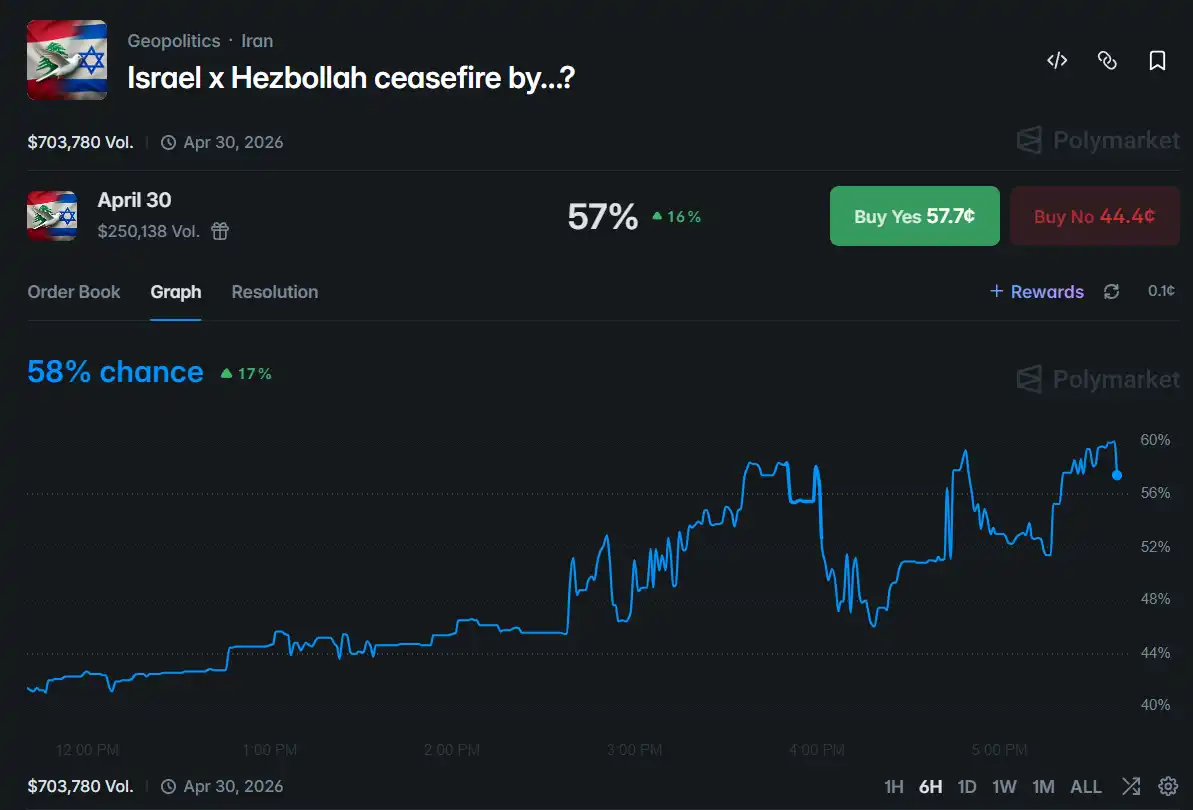
The prediction market currently puts the probability of an "Israel-Hezbollah ceasefire this month" at about 56%. This price reflects a reality: even if the U.S.-Iran ceasefire agreement explicitly states "including Lebanon," whether Israel will really back down is a completely separate variable.
This logic is not unfamiliar. After the 2023 Gaza ceasefire agreement was signed, Israel's military actions did not stop. The reality left from that 29-month ground operation, from ceasefire to today, can be copied word for word to Lebanon today: "ceasefire," "buffer zone," "temporary occupation," "waiting for the threat to be eliminated."
At a Security Council meeting on January 3, 2025, Palestinian Permanent Observer to the United Nations Riyad Mansour quoted Gaza doctor Mahmoud Abu Nujaila's message on a whiteboard:
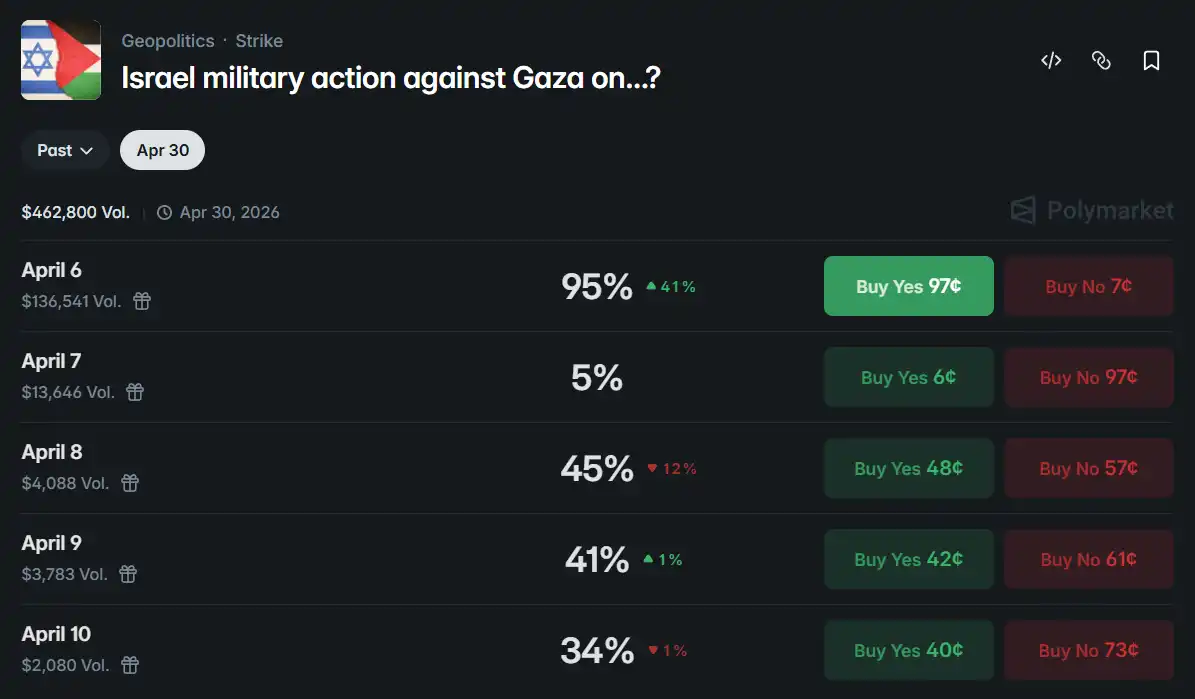
Since Trump launched the "20-point Gaza Peace Plan," international reporting on the Gaza issue has gradually been replaced by other narratives. As the humanitarian topic of Gaza fades from people's view, Israel, under the cover of the "peace plan," continues to heavily strike the Gaza area's "Hamas terrorist forces," with even daily settlement events on the prediction market.
The story of Palestine, starting from the ceasefire, remains unfinished to this day. The Lebanese version may have just opened its first page.
From Ceasefire to Permanent Peace: How Far Away Are We?
This ceasefire between the U.S. and Iran is the best option for both parties under current conditions.
For Iran, it is currently the moment with the most negotiation leverage throughout the entire war—the Strait of Hormuz blockade has pushed up global oil prices, the proxy network has not been completely dismantled, and the resistance narrative brought by the new leader has rallied domestic support. However, if the conflict continues, the positions of Gulf countries such as Saudi Arabia and the UAE will gradually align with the U.S. and Israel, eroding Iran's strategic advantage over time. Knowing when to stop is the rational choice at the moment.
For Trump, the ceasefire is also a card he urgently needs to play. The S&P 500 index has been continuously declining since the start of the war, gasoline prices have surged from $2.98 before the war to $3.98, and Trump's overall approval rating has fallen to 36%. He loudly proclaimed "no new wars" during his election campaign, but is now deeply involved in the Middle East conflict—ceasefire, at least in the narrative, is a passable answer he can present to the domestic voters.
However, Iran has a fundamental historical suspicion that cannot be dispelled by a two-week ceasefire: the last U.S.-Iran negotiation was described by all parties as "productive" and even "within reach of a historic agreement," but the U.S. and Israel launched a sudden attack on the negotiation table.
This time, Iran's acceptance of the ceasefire is not based on trust but on a calculation of interests. If the U.S. defaults again, Iran will be in a more favorable position in international public opinion than it is now; if the agreement is adhered to, Iran has secured the most favorable negotiation outcome under current conditions. This is a game choice that is not a loss no matter what.
But "not a loss" does not mean "moving towards peace."
On April 10, the Islamabad negotiations officially began. The nuclear issue, Hormuz, Hezbollah, and sanctions relief—each of these four cards, presented individually, is enough to cause the negotiations to collapse. Whether a two-week time frame is enough to even form a preliminary framework on these issues is still unknown.
In the prediction market, of the six insiders, only one person has left the gambling table. Where the remaining five place their next bets may be more worthy of attention than any diplomatic statement.
