Editor's Note: Recently, The New York Times published an in-depth investigative report, raising once again a question that has plagued the cryptocurrency industry for 17 years: Who is Satoshi Nakamoto?
Unlike past speculations based on scattered tips or single clues, this report unfolds along the Cypherpunks' historical archives. Through multiple comparisons of technical paths, writing styles, and behavioral trajectories, the clues gradually converge on a key figure: Adam Back.
From the technical combination of Hashcash and b-money to early conceptualizations of a decentralized architecture, and to the overlap of spelling habits and expression styles, the report attempts to construct a more systematic chain of reasoning.
The article does not provide the "final answer." As pointed out in the text, only Satoshi Nakamoto himself can achieve true identity confirmation through a private key signature. However, in the absence of direct evidence, this report offers a new approach—by delving into long-overlooked historical materials and microscopic details, it approaches an originally almost untouchable puzzle.
In the current context of Bitcoin gradually becoming a crucial variable in the global financial system, the significance of this question may have long transcended the "who wrote the code" itself. It is more about the starting point of a technical idea: what kind of personal experience, thought path, and historical background decentralization truly stems from.
Below is the original text:
On a fall evening in 2024, my wife and I were stuck on the Long Island Expressway. She was tired of the jazz-funk radio station I often played while driving, so she switched to a podcast.
It was "Hard Fork," the tech show from The New York Times, and the host was discussing a new HBO documentary that claimed to have uncovered the true identity of Bitcoin's anonymous creator, Satoshi Nakamoto.
I was immediately intrigued. I have always thought that "Who is Satoshi Nakamoto" is one of the most fascinating puzzles of this era and have tried to explore it, but to no avail. Two years ago, I even spent a few months researching for a related book but quickly realized my limitations and had to reluctantly give up.
Word on the street is that someone may have finally identified the elusive figure — the one who, with a stroke of genius, reshaped the financial system, birthed a $2.4 trillion industry, and almost instantly created one of the world's largest fortunes. I couldn't help but feel a mix of admiration and envy. Eager to watch the documentary, I logged into HBO Max as soon as I got home that evening and hit play.
In the end, I found the conclusion of "Money Electric: The Bitcoin Mystery" to be less than convincing: HBO pinned a Canadian software developer as Satoshi Nakamoto based on what seemed to be flimsy evidence. However, in this overall lighthearted and engaging documentary that swiftly navigates the crypto world, there was one segment that particularly caught my attention.
British cryptographer and key figure in the Bitcoin movement, Adam Back, sat on a park bench in Riga, Latvia, with his brown jacket casually unbuttoned over his shirt. The director casually mentioned a few "Satoshi candidates." When it came to him, Back noticeably tensed up, vehemently denied being Satoshi Nakamoto, and requested that the conversation not be put on the record.
I've encountered many liars and somewhat figured out some telltale signs to identify them. Back's demeanor at that moment — the shifting eyes, slightly awkward laughter, and the somewhat rigid movement of his left hand — struck me as suspicious. As the end credits rolled, I replayed that segment on my TV several times.

While pondering Back's reaction, I suddenly recalled another incident: an Australian impostor was sued for falsely claiming to be Satoshi Nakamoto. Could the evidence revealed in the case that was heard in London a few months ago help me unravel this mystery?
Anyone familiar with the Bitcoin "legend" will tell you that Satoshi Nakamoto took anonymity to almost unprecedented levels — leaving virtually no digital trace.
However, he did leave behind a trove of text: a nine-page whitepaper outlining his invention and a significant number of forum posts on Bitcointalk — an online community where users discussed Bitcoin software, its economic model, and ideas. During the impostor's civil trial, this text repository unexpectedly expanded dramatically: Finnish programmer Martti Malmi — a key figure in Bitcoin's early days and collaboration with Satoshi Nakamoto — publicly disclosed hundreds of emails exchanged between him and Nakamoto. While emails between Satoshi Nakamoto and other early Bitcoin contributors had previously leaked, they paled in comparison to Malmi's revelations this time. If Satoshi Nakamoto is ever to be unmasked, I believe the answer surely lies within these texts.
But then again, this path has probably been trodden before. Over the past 16 years, journalists, scholars, and countless web sleuths have tried to uncover Satoshi Nakamoto's identity. During this time, over a hundred names have been proposed: from an Irish cryptography student to an unemployed Japanese-American engineer, to a South African crime boss, and even the mathematician prototype depicted in the movie A Beautiful Mind.
The most intriguing theories often rely on certain "coincidences" — they happen to align with people's limited understanding of Satoshi Nakamoto: a specific coding style, a mysterious work history, a profound understanding of Bitcoin's core technology, and some form of anti-government worldview. But these speculations ultimately crumble in the face of absence of proof, or other contradictory evidence. Each failure, instead, has delighted many in the Bitcoin community. As they often say, only Satoshi Nakamoto himself, by transferring the Bitcoin he holds, can truly prove his identity; until then, all evidence can only be considered circumstantial.
Rationally, thinking one can unravel a puzzle that has puzzled many for years may be a bit presumptuous. But I yearn for the excitement of chasing a significant, intricate story. So, I decide to try again, to uncover the mysterious identity of this Bitcoin founder.
Clues
Two Fragile Leads
My first attempt is to find a way to narrow the field.
In Satoshi Nakamoto's email to Martti Malmi and his other texts, one thing stands out: his language is a mix of British spelling and expressions, interspersed with American usage. Given that many "Satoshi candidates" are Americans, some speculate that he deliberately used British expressions to disguise his writing style. But I have never subscribed to this view because Satoshi Nakamoto left a key clue.
In Bitcoin's first block (the genesis block), he embedded a newspaper headline: "The Times 03/Jan/2009 Chancellor on brink of second bailout for banks." This headline is from the UK edition of London's The Times newspaper. This leads me to believe that Satoshi Nakamoto is likely indeed from the UK.
Furthermore, Satoshi Nakamoto is highly likely a member of the Cypherpunks. This is a loosely knit group formed in the early 90s with an anarchist bent, seeking to use cryptography — the technology of protecting communication through code — to enable individuals to evade government surveillance and censorship.
Cypherpunks primarily communicated through a "mailing list." As a precursor to today's forums, the mailing list was essentially a mass email system where subscribers would receive large blocks of text in monospaced font in their inbox and would reply using "reply all" to continue the discussion.
In an era where Venmo and Apple Pay are now ubiquitous, it is hard to imagine that one of the cypherpunks' core concerns was the digitization of financial transactions. When you hand someone a $20 bill, no one knows the source of that money; but once you pay by check or credit card, the bank keeps an electronic record. Cypherpunks were worried that the government might use these records to track individuals' lives. Therefore, in their mailing list, people constantly discussed how to create "electronic cash" — a form of digital currency that could preserve cash-like anonymity. Some even proposed their own electronic cash schemes, but they never gained traction — until Bitcoin emerged.
In addition to the alignment on the "electronic cash" concept, there were other signs that Satoshi Nakamoto belonged to this group: he had posted his whitepaper on a branch of the cypherpunk mailing list called the "Cryptography" list and seemed familiar with two members of that community.
However, even at its peak in the late 90s, the cypherpunk following numbered around 2,000 people, which still meant a fairly large pool of candidates.
Armed with these somewhat tenuous clues, I began poring over all the text left by Satoshi Nakamoto, especially the emails made public by Martti Malmi, and compiled a list of terms and expressions that struck me as "anomalous." It felt like deciphering an unfamiliar dialect. Several times, I even questioned if I was engaged in a futile endeavor.
My list eventually grew to over a hundred terms and phrases, occupying several pages of a notebook. Some that particularly caught my attention included: "dang," "backup" (used as a verb, compounded into one word), "human friendly," "on principle," "burning the money," "abandonware," "hand-tuned," and "partial pre-image."
One phrase — "a menace to the network" — sounded like a line from a sci-fi movie; while the rest of the expressions vaguely hinted at a peculiar mix: part British upper class, part American rural colloquial, with a sprinkle of computer geek and cryptographer language habits.
I used the advanced search feature of social platform X to conduct a preliminary screening to see if those most frequently suspected of being Satoshi Nakamoto had used the keywords I marked. Not all "candidates" have an X account, so this is not a rigorous method. However, as I expected, one person highly overlapped with my keyword list — Adam Back.
As I stared at the long list of checkmarks under his name in my notebook, a surge of adrenaline rushed through me. My intuition seemed to have some basis at least. Back's word usage closely matched Satoshi's, perhaps not enough to convince a community that has been studying this issue for years, but I find it hard to believe this is just a coincidence.
Upon further examination of Back, I found that he indeed possesses several characteristics that align with Satoshi. Firstly, he is British and also a member of the "Cypherpunks." More importantly, he invented Hashcash — a system based on a proof-of-work puzzle, which Satoshi used to implement Bitcoin mining. In the Bitcoin whitepaper, Satoshi also explicitly referenced Back and his Hashcash work.
However, during the trial of that Australian impostor, Adam Back presented a set of emails showing that Satoshi had contacted him in August 2008, before releasing the Bitcoin whitepaper, to verify the reference to his Hashcash paper in the whitepaper. These emails seemingly almost prove that Back couldn't be Satoshi.
But then a different possibility crossed my mind: these emails could also be a disguise, sent by Back to himself to protect himself.
Into the Rabbit Hole of Cryptography
With thin-rimmed glasses, increasingly sparse gray hair, and a goatee, 55-year-old Adam Back looks like a slightly unkempt mathematician. Over the past decade, he has built a "small business empire" around Bitcoin and has become one of the most influential figures in this community.
Back has long been a popular choice among the "Satoshi candidates." However, unlike some other major suspects, he has not been subjected to in-depth media investigations — except for a video released in 2020 by an anonymous YouTuber (alias "Barely Sociable"), there has been almost no systematic coverage.
A year ago, I flew to Las Vegas to meet him. He was invited to speak at the Bitcoin2025 Conference held at the Venetian Resort. At that time, I was not sure if I had found the right person, so I did not plan to confront him immediately. I just wanted to get to know him first and learn more about his background. If the subsequent investigation holds up, I envisioned presenting all the evidence to him at some point for a showdown similar to a detective interrogating a suspect. But for now, I wanted to put him at ease and establish a basic level of trust.
I approached him after a forum ended. On stage, he confidently predicted that Bitcoin, which was priced around $108,000 at the time, would "easily reach $1 million" in the next five to ten years. (Ironically, the stage where he spoke was named the "Nakamoto Stage" by the organizers.) Even though we had already agreed on an interview beforehand, he still seemed slightly surprised when he saw me.

I only told Back that I was writing a report on the history of Bitcoin. But perhaps he had already sensed my true intent—I had contacted six former colleagues from three companies he had been involved with before. If he had any suspicions, he didn't show them. He remained patient and friendly throughout. It was hard to imagine that this softly spoken, seemingly unassuming middle-aged "tech geek" could be one of the richest people in the world. According to the Bitcoin community, Satoshi Nakamoto mined about 1.1 million bitcoins in the early days—an asset worth as much as $118 billion at the price during the conference.
When discussing Bitcoin, Back was quite talkative; however, he became much more cautious when I shifted the topic to his early years. Eventually, I managed to piece together some information from him: he was born in 1970 in London, his father was an entrepreneur, and his mother was a legal secretary. The family frequently moved, had strong opinions, and did not shy away from expressing them.
Back mentioned that he started self-learning programming on a Timex Sinclair personal computer at the age of 11 and became interested in cryptography during high school. While pursuing his Ph.D. in Computer Science at the University of Exeter, this interest gradually turned into a passion—a classmate introduced him to PGP (a free encryption program), widely used at the time by anti-nuclear activists and human rights organizations to secure files and emails from government surveillance.
Back was fascinated by the potential applications of PGP (Pretty Good Privacy). He said he spent almost all his time "diving down the cryptography rabbit hole" during his Ph.D. years. This obsession once derailed him significantly, to the point where he had to hastily complete his thesis in the last six months, an experience he likened to "an emergency landing of an airplane by a pilot."
By then, I had already understood that PGP relied on public-key cryptography. And Bitcoin is similarly based on this mechanism. A Bitcoin user has two "keys": a public key — used to generate an address, equivalent to a digital safe; and a private key — serving as the secret password to open the safe and control the assets inside.
I couldn't help but feel a profound meaning: Back's "hobby" during his graduate studies happened to align perfectly with the core cryptographic technology later adopted by Satoshi Nakamoto.
Back also told me that his doctoral thesis focused on distributed computing systems — software systems that rely on a set of independent computers (referred to as "nodes" in computer terms) running together. This also forms another key technological foundation of Bitcoin.
In addition, his thesis project was mainly done using the C++ language — the same programming language Satoshi Nakamoto used to write the initial version of Bitcoin.
Nearly two hours later, Back politely mentioned he had other arrangements that evening, so we kindly concluded the meeting. I told him I would reach out again if I had further questions.
Becoming a "Cypherpunk"
Prior to heading to Las Vegas, I had already started immersing myself in the archives of the Cypherpunks mailing list, trying to understand the mysterious underground world that nurtured Satoshi Nakamoto. Back in New York, I plunged back in once more.
Unlike social platforms like Facebook, the Cypherpunks mailing list was a decentralized space for communication. There, a group of privacy-focused cryptographic geeks gathered to freely discuss various disruptive ideas without fear of censorship. In this process, they unwittingly planted some technical seeds that would later change the course of financial history.
These discussion records were archived on some lesser-known websites. One of the sites greeted me with a logo of a skull and crossbones, along with a slogan: "Stand up, the only thing you're going to lose is the barbed wire fence!" I stared at thousands of emails filled with cryptographic terms that I could hardly understand completely.
Adam Back joined this mailing list in the summer of 1995 as he was nearing the completion of his graduate studies. He quickly became an active and outspoken participant, posting frequently on topics ranging from digital privacy to his own rather frugal lifestyle habits.
In some of his earliest posts, Adam Back had solved a cryptographic challenge — a task akin to a mathematical puzzle. This challenge was issued by Hal Finney, a cypherpunk from California who had been involved in PGP development. This also marked the beginning of an online friendship between the two: decades later, Back reminisced on social media about their multiple interactions both within and outside the mailing list, and he always admired Finney's focus and programming prowess.
Nakamoto had a friendly relationship with Finney. When Nakamoto released the Bitcoin whitepaper, Finney openly expressed his appreciation. Later, he actively participated in receiving Bitcoin, completing the first Bitcoin transaction in history. Although there is no evidence that Finney knew Nakamoto's true identity, a hint of their interaction suggests that Nakamoto was not unfamiliar with Finney.
In December 2010, Finney posted on Bitcointalk praising the Bitcoin code. Two hours later, Nakamoto replied, "Getting your approval is of great significance, Hal."
One thing that makes me think there may have been an earlier connection between Nakamoto and Finney is that, in an email to Martti Malmi, Nakamoto mentioned an electronic cash system designed by Finney—Reusable Proofs of Work (RPOW).
Similar to Bitcoin, RPOW also introduced the Hashcash mechanism in its design; however, it received little attention from the cryptography community. Only a handful of people discussed this system on the cypherpunks and Cryptography mailing lists.
And one of them was Adam Back.
A Gold Mine
Within the "Cypherpunks" group, Adam Back found like-minded people who shared his ideals. I can't help but imagine him at his home in London, dialing up to connect to the Internet after work, engaging in all-night discussions with members on the other side of the planet about various philosophical issues.
Like many of these "pen pals," Back believed in "crypto anarchy"—a concept that advocates using cryptography to separate individual life from state intervention.
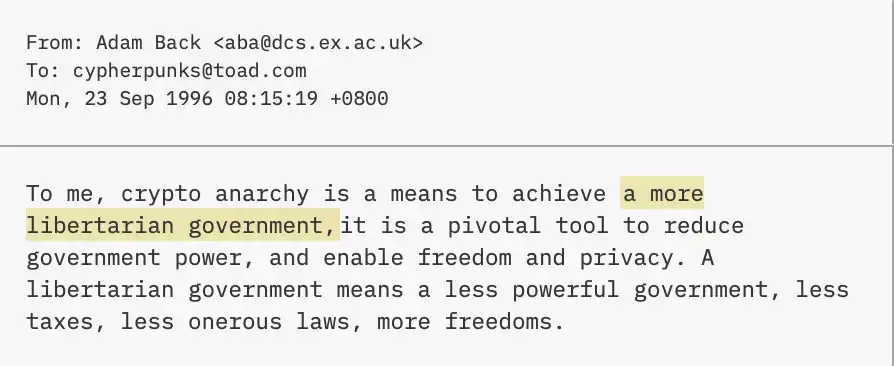
This reminds me of what Nakamoto said when launching Bitcoin:
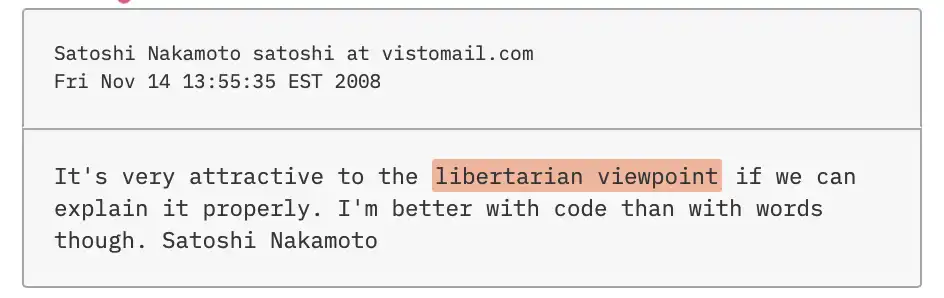
As a libertarian, Adam Back was deeply angered by the Clinton administration's criminal investigation of the PGP founder. At the time, the U.S. government considered encryption programs a vital part of national security and believed that publishing the PGP source code on the Internet was equivalent to exporting prohibited military materials.
As a result, Back launched a rather ironic protest: he printed a set of strong encryption algorithms on a T-shirt and sent them to other "Cypherpunks" members in other countries. His intention was clear—the U.S. export ban on sensitive encryption technology not only violated the principles of free speech but was also fundamentally unenforceable.
As I secretly admired the ingenuity of this "prank," I suddenly realized: Satoshi Nakamoto also used code to convey political messages. Satoshi Nakamoto most likely leveraged the headline from The Times embedded in the genesis block to express dissatisfaction with the UK government's bank bailout policy during the financial crisis at the time.
He also left another layer of "political metaphor" on a website commonly used by decentralization technology enthusiasts: he set his birthday as April 5, 1975. April 5 is the same day in 1933 when Franklin D. Roosevelt banned private gold ownership to devalue the dollar during the Great Depression; 1975 was the year this ban was lifted.
Financial commentator Dominic Frisby discovered this "Easter egg" over a decade ago and pointed out its meaning: Bitcoin is fundamentally a form of digital gold that neither the government can ban nor artificially devalue.
But it seems that no one noticed a brief post by Adam Back in 2002: "Just curious, what was the initial reason the US banned private gold ownership? It's really hard to understand..."
The Obsession with Spam
As I contemplated this peculiar coincidence repeatedly, I also noticed another similarity between Satoshi Nakamoto and Adam Back: they both have an almost obsessive focus on "spam."
Among the many "amateur projects" of the cypherpunk era, Back once operated an anonymous remailer service that could strip identity information from emails before forwarding them to enable anonymous communication. However, what infuriated him was that this service was quickly abused by spammers to relentlessly send useless information to others.
To address this issue, Back invented Hashcash in March 1997. The core idea was to charge a "postage fee" for every email sent through the service. This "postage fee" was paid in the form of Hashcash, requiring users to solve some small computational puzzles through calculation to obtain it. For regular users, these calculations only took a few seconds; but for spammers sending hundreds of thousands of emails in one go, it would incur significant computational costs, effectively curbing abuse.
As I reread the text left by Satoshi Nakamoto for the second and third time, I found the word "spam" almost everywhere. A rough count reveals that Satoshi Nakamoto mentioned it at least 24 times, and many of his points closely mirrored Back's earlier ideas.
Five months after launching Hashcash, Back proposed on the Cypherpunks mailing list that this mechanism might help filter emails from famous people. Then, in a post published on the Cryptography mailing list in January 2009, Satoshi Nakamoto also presented a similar idea—except this time, he used Bitcoin.
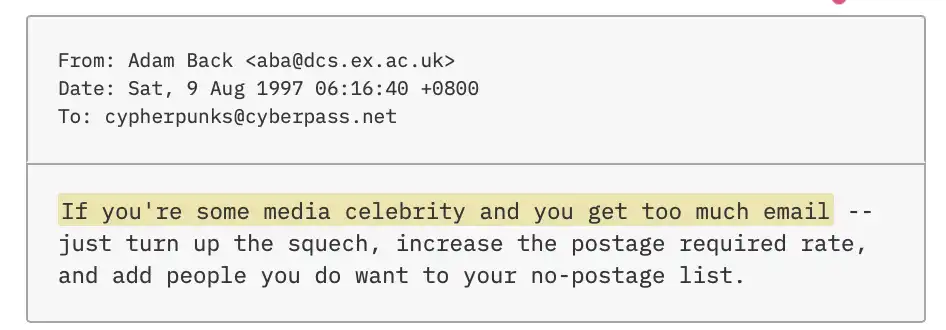
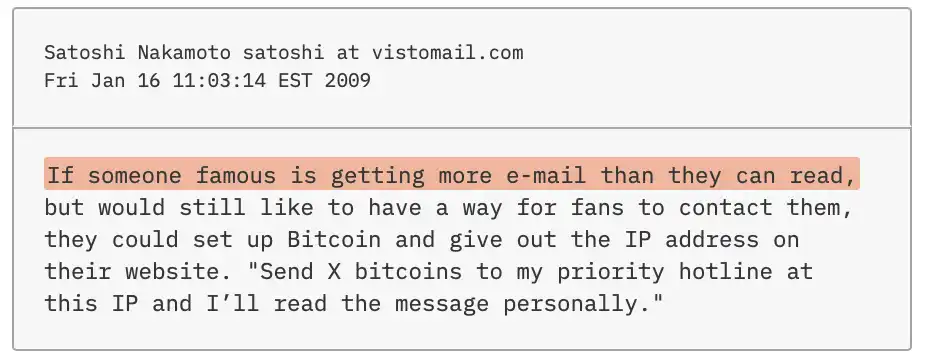
Without the long-standing "spam problem" occupying his mind, it's hard to see this use case as a natural application of Satoshi Nakamoto's new type of digital currency—and yet, this is precisely the issue that Adam Back has been thinking about for over a decade.
Satoshi Nakamoto also believed that Bitcoin might be able to reduce spam overall. In the days following the release of his white paper, he suggested that this system could potentially offer a new use case for those "botnets" controlled by hackers and used to send spam emails—by "switching to generating Bitcoin" instead.
At that time, this view didn't attract much attention, and spam continued to proliferate. However, four years later, Back almost identically expressed the same opinion on Bitcointalk: "If CPU/GPU mining based on Hashcash is more profitable than sending spam, maybe spam would decrease or even go negative. I think this is quite likely."
"Mr. Average"
As I searched for flaws in Satoshi Nakamoto's meticulous disguise, my progress was not smooth, and I never found truly decisive "smoking gun" evidence. The prevalent view is that he made two mistakes: one was a leaked IP address that seemed to locate him in Southern California at the time of the Bitcoin software's release, and the other was his email account being hacked. However, after spending weeks tracing these two leads, my conclusion is that they not only led nowhere but were likely not genuine "mistakes" from the outset. Faced with someone who has almost perfectly covered their tracks, where can I even begin?
Just as I pondered this question repeatedly, I realized that Adam Back is also extremely adept at remaining anonymous on the internet. He harbors a profound distrust of government surveillance and is almost constantly thinking about how to evade it. In fact, much like Satoshi Nakamoto, Back greatly advocates the use of pseudonyms.
In January 1998, he wrote: "You have to stay under the radar, basically 'invisible' to the government; the file the intelligence agencies have on you should just say 'Mr. Average,' appearing completely harmless. And then, you establish one or more 'alternate identities' for your real interests."
The "alter ego" chosen by Satoshi Nakamoto came from Japan. Interestingly, as early as 1997, when a Japanese Cypherpunks member discussed the establishment of Japan's first anonymous remailer service on a mailing list, Back had already shown interest in the country.

"Congratulations on launching an anonymous remailer service in a new jurisdiction!" Back responded at the time, "It would be nice to switch to a few jurisdictions — I wonder if Japan has any advantages in this regard? Are there some things legal in Japan but illegal in Europe or the United States?"
The Japanese cypherpunk did not reply. However, this did not stop Back from later doing some research on his own. If he did indeed do so, he might have discovered a company based in Tokyo called Anonymousspeech L.L.C., which provides anonymous mail and website hosting services. It was through this company that Satoshi Nakamoto registered the bitcoin.org domain and created two untraceable email accounts.
In 1999, Back moved to Montreal and joined a startup focused on privacy software. There, he was involved in the development of a privacy system called the Freedom Network, which allowed users to browse the internet anonymously. This system was later seen as a precursor to Tor — the latter hides network traffic through multi-layer encryption. The Bitcoin community widely believes that Satoshi Nakamoto used Tor to conceal his tracks.
Similar to Bitcoin, the Freedom Network was also a distributed computing system. Back and his colleagues sought to make it "immune" to government and corporate surveillance.
This is another common point he shares with Satoshi Nakamoto: his posts on Bitcointalk show that Satoshi Nakamoto had a deep understanding of network security and how to prevent vulnerabilities. The Bitcoin network is highly respected, in large part because of its resilience during years of hacking attacks.
Napster vs. Gnutella
During several months of in-depth study of the "Cypherpunks" mailing list archive, I sometimes lost my way in the research and ended up in some bizarre dead ends. For example, in response to early criticisms of the whitepaper on the Cryptography mailing list, Satoshi Nakamoto once wrote, "I could actually express that statement more strongly." I always felt like I had seen that sentence before, so I spent several evenings repeatedly searching through old posts in 1990s mailing lists, only to realize that it was just my illusion.
However, this "revisit" was not without its rewards. More similarities between Adam Back and Satoshi Nakamoto began to emerge. For example, both held a strong disdain for the copyright system. "Abolish patents and copyrights," Back wrote in September 1997.
It was also under this driving principle that he open-sourced his anti-spam tool, Hashcash.
Satoshi took a similar approach. He released the Bitcoin software under the MIT open-source license, allowing anyone to freely use, modify, and distribute it.
Under the "public domain innovation" concept, Back and Satoshi also both created email lists around their respective projects—Hashcash list and Bitcoin-dev list—where they released software updates, listed new features, and bug fixes. The format and style of these updates were surprisingly similar.
Satoshi's "Back-like bias" against copyright was also evident in other aspects. When he shared the Bitcoin logo design he created on Bitcointalk, he explicitly waived the copyright and encouraged others to "put improved design directly into the public domain."
As the early 21st century unfolded, copyright enforcement became a mainstream topic—reaching its peak when the popular file-sharing service Napster was forced to shut down after being sued by major record labels. Napster was a peer-to-peer software that allowed users to share content directly with each other, bypassing corporate intermediaries.
This outcome deeply shook Adam Back. He shared an article written by an intellectual property lawyer on the "Cypherpunks" email list, detailing various legal risks that peer-to-peer software developers might face. "After reading it, my conclusion was," Back wrote, "the safest, simplest thing is to anonymously publish such software."
Like Napster, Bitcoin is fundamentally peer-to-peer software. However, if we replace "record companies" with "governments," a similar scenario could easily replay. Once the founder's identity is revealed, government lawyers know who to go after; but if the identity remains hidden, there is no clear target for prosecution. If Back and Satoshi are indeed the same person, this may explain why Satoshi insisted so heavily on remaining anonymous.
Record companies protect their commercial interests, while governments have different motives—to maintain their monopoly on currency issuance. In this regard, Satoshi and Back are on the same page: they both saw Napster's downfall as a cautionary tale.
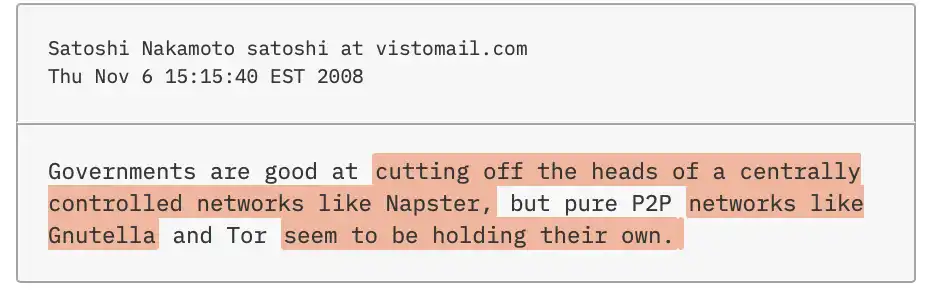
He was referring to the fact that, although Napster users were directly exchanging music files with each other, it still relied on a central server to keep track of "who owns which songs." In contrast, another file-sharing service, Gnutella, operated on a network composed of globally distributed independent computers — a structure reminiscent of Bitcoin's.
This also presents another intriguing coincidence: back in a May 2000 post, Adam Back had already made almost the exact same comparison.
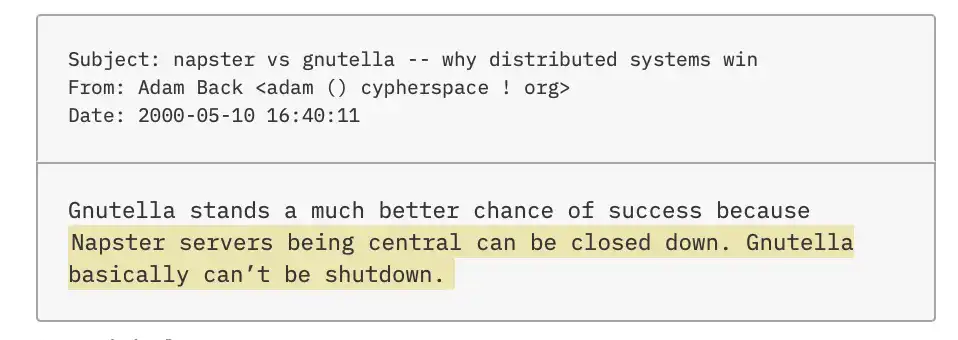
Moreover, Adam Back didn't just mention this occasionally — he made the same comparison three times on the "Cypherpunks" mailing list.
The Buried Roadmap
Outlined a Decade Before Bitcoin's Birth
While these similarities are certainly intriguing, I still lacked evidence directly linking Adam Back to Bitcoin's inception. That is until I discovered a series of posts he made on the "Cypherpunks" mailing list between 1997 and 1999 — a full decade before Bitcoin emerged.
On April 30, 1997, Back proposed building an "entirely off modern banking system" electronic cash system and envisioned it to have four key features: protecting the privacy of both parties in a payment; running distributed over a computer network for increased resistance to shutdowns; possessing intrinsic scarcity to prevent inflation; and not relying on trust in any individual or bank. Two days later, he added a fifth element: a protocol mechanism verifiable by the public.
All five of these elements later became core design principles of Bitcoin.
Four months later, Adam Back revisited the topic of electronic cash and introduced a new feature based on game theory. "An application I have been thinking of is to create a distributed bank system," he wrote, "ideally, all nodes in this system are peer-to-peer, and it requires collusion of k out of n nodes to breach the system."
Back was referring to the well-known Byzantine Generals' Problem — a long-standing computer science problem that plagued decentralized systems. In this analogy, n generals surround an enemy city and must attack simultaneously to succeed, but some of the k generals may be traitors who will sabotage the plan. Similarly, in a distributed computing network, a subset of malicious nodes may also disrupt the system.
The vision of Back was to build an electronic cash system with a large number of nodes distributed worldwide, making it difficult for anyone trying to disrupt the system to find a sufficient number of "conspirators."
This idea closely mirrors Satoshi Nakamoto's description in the whitepaper 11 years later: as long as "the majority of the computing power is controlled by nodes that are not cooperating to attack the network," the Bitcoin system can operate normally.
In a 1997 Cypherpunks post, Back mentioned that nodes could "come and go" without affecting the system's operation; whereas in the whitepaper, Satoshi Nakamoto wrote that nodes could "leave and rejoin the network at will."
Although the wording is slightly different, even non-top cryptographers can see that the two proposed essentially the same mechanism.
On December 6, 1998, Back once again discussed electronic cash, this time following a proposal by another cypherpunk, Wei Dai—b-money. As pointed out by YouTuber "Barely Sociable" in a 2020 video, Back quickly seized upon this proposal.
b-money used public-key cryptography to achieve account anonymity, thus protecting the privacy of both parties in a transaction, aligning with Back's earlier vision. Additionally, it had another feature that Back admired.
Anyone attempting to design digital currency would face a problem: how to issue new coins. Wei Dai proposed a mechanism where users solving a computational puzzle would receive newly minted b-money as a reward.
Adam Back speaking at a workshop in Tokyo in 2019. (Image source: Kiyoshi Ota/Pool)
The Hashcash invented by Back is very similar in mechanism: by solving a computational puzzle, users could earn the "right" to send emails. He further suggested that Hashcash could be "adapted" to serve as a mechanism for issuing the electronic currency proposed by Wei Dai.
This is particularly crucial because Satoshi Nakamoto referenced Wei Dai in the whitepaper and later explicitly described Bitcoin as "a proposal for b-money."
As I paused to think carefully, the resemblance was almost chilling: just as Back envisioned in 1998, Satoshi Nakamoto combined Hashcash with the concept of b-money to create Bitcoin. What are the odds of this convergence?
And that's not all. In his December 1998 comments on b-money, Back even anticipated the solution later used by Satoshi Nakamoto to address the inflation issue.
Any electronic currency issued through a "proof of work" system would face a problem: as chip power increases, solving the puzzle becomes easier, leading to a faster issuance rate and uncontrollable inflation. To tackle this issue, Back proposed that the computational difficulty required to issue each unit of b-money should "increase over time."
This is exactly the design Satoshi Nakamoto adopted in Bitcoin: he set the average block creation time to 10 minutes and dynamically adjusted the difficulty through an algorithm—when computing power increased and block generation sped up, the system automatically increased the puzzle difficulty to maintain a stable pace.
As if these "prophetic" insights weren't enough, Adam Back proposed another key concept in April 1999: for a distributed electronic cash system to function properly, every transaction must have a public, tamper-proof timestamp. Otherwise, the same coin could be double-spent, throwing the whole system into chaos.
Back's solution involved using hash trees—a structure that can compress large amounts of data into a single "digital fingerprint"—and publishing these fingerprints in classified ads in The New York Times.
Satoshi Nakamoto followed a similar approach in Bitcoin, but replaced the "newspaper announcement" step with the Hashcash mechanism: by intense computation, transactions are bundled into blocks to form a timestamp—since forging such computation is extremely costly in both resources and time, this timestamp becomes hard to tamper with.
Even regarding one of Bitcoin's most common criticisms later on—the energy consumption issue—Back had foreseen it.
In 1998 and 1999, he suggested that the energy consumed by combining Hashcash with an electronic cash system would likely still be lower than the overall energy consumption of the traditional banking system. A decade later, when an early reader raised a similar question while reading the Bitcoin whitepaper, Satoshi Nakamoto's response was almost identical to Back's original argument.
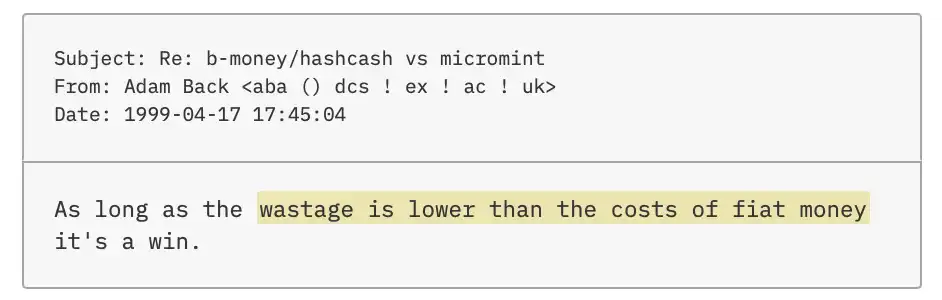
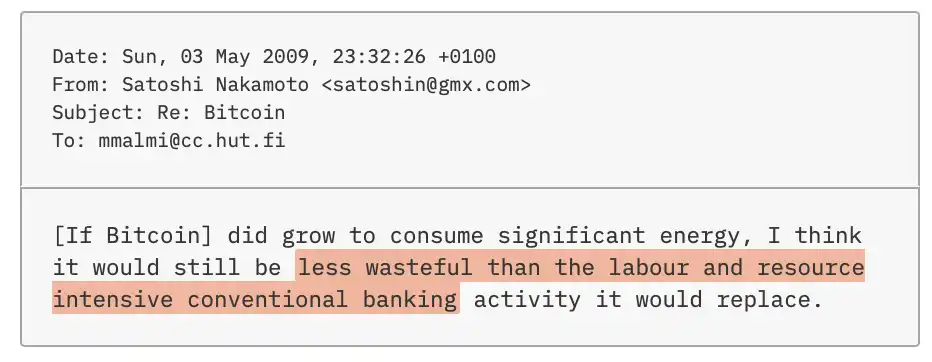
In summary, almost a decade before the birth of Bitcoin, Adam Back had already envisioned most of its core elements—even the logic defending its major controversy (high energy consumption) was in line with Satoshi Nakamoto's.
Radio Silence
One month after meeting in Las Vegas, I emailed Back to inquire about some of his professional background and why he had moved to Malta in 2009. I did not elaborate on my motivation for the questions, but some in the Bitcoin community noted that this European "tax haven" would be an ideal residence for Satoshi Nakamoto, who held a significant amount of Bitcoin.
The next day, Back replied to the email—still polite in tone, but clearly understanding the underlying implications of my questions. He explained that there were various reasons for moving to Malta, including the cost of living, the climate, and—yes—taxes. "People in the Bitcoin community like to play detective, but coincidences do exist and do not necessarily mean anything."
He clearly knew what I was trying to do. It was time to push a little further forward and pose the question that had been bothering me.
In the white paper, Satoshi Nakamoto cited both Hashcash and Wei Dai's b-money. However, during the trial of the Australian imposter Craig Wright, emails submitted by Adam Back indicated that in August 2008 when Satoshi Nakamoto contacted him to verify the Hashcash paper reference, he seemed unaware of the existence of b-money. The emails suggested that it was only after Back directed him to Wei Dai's website that Satoshi Nakamoto included b-money in the white paper.
However, this does not seem plausible to me. Back's Hashcash paper itself explicitly mentioned b-money as one of its potential applications. Since Satoshi Nakamoto intended to cite this paper, it would be logical to assume that he had already read its contents and therefore would not be unaware of b-money.
In 2020, Back himself acknowledged this contradiction. When he suggested on X that Satoshi Nakamoto might be an anonymous cypherpunk, a user raised a question: the anonymous poster had mentioned b-money long before Satoshi Nakamoto supposedly "learned" about the concept from Back years later.
"Indeed," Back responded, "but Satoshi Nakamoto could also have been deceiving me, pretending not to know about b-money." He further explained: "If Satoshi Nakamoto knew about some very obscure references (like a web page mentioned in the cypherpunk mailing list discussion of electronic cash), perhaps he wouldn't quote directly to avoid being reverse-triangulated to his identity through these clues."

People like Back — one of only six individuals to clearly discuss b-money on the Cypherpunks and Cryptography mailing lists, with as many as 60 mentions — have a particular motivation to avoid this "reverse targeting."
The more I think about it, the more suspicious I become: these emails were likely a carefully orchestrated "self-insert," using forged communications with Satoshi to deflect suspicion from himself.
So, I decided to request the metadata of these emails from Back. Metadata, like the envelope, postmark, and seal of a physical letter, can show the origin, sending time, and whether it has been tampered with. However, the email copies publicly disclosed during Craig Wright's London trial did not include this information.
I wasn't necessarily expecting the metadata to provide crucial clues. Satoshi had used an anonymously registered email service in Tokyo, which would mask the IP address; moreover, he likely accessed these services through Tor, further enhancing his anonymity. But I still hoped for a lucky break, perhaps uncovering some faint trails.
However, when I sent this request to Back, he did not respond. I wasn't sure if he was deliberately avoiding or simply busy with other matters, and I didn't want to immediately follow up to avoid alarming him, so I waited eight days before sending a second email — still no response.
I clearly touched on some sensitive point. But the question is: why? With Satoshi already taking such rigorous security measures, what else needs to be deliberately concealed? Unless... he did make some kind of mistake.
Satoshi Appears, Back Disappears
After releasing Bitcoin on Halloween 2008, Satoshi spent the next two and a half years working with a group of early enthusiasts to improve the system. These individuals were later known as the "Bitcoin Core developers," collaborating frequently with Satoshi via Bitcointalk and email, contributing their software engineering expertise. Then, on April 26, 2011, Satoshi famously "disappeared."
Adam Back's behavior pattern, to some extent, was quite the opposite.
For over a decade prior, whenever the topic of "digital currency" arose on Cypherpunks or Cryptography mailing lists, Back would almost always engage in discussions, often providing lengthy, detailed analyses. However, when Bitcoin — a realization closest to his early visions — actually emerged, Back was almost nowhere to be found.
Many years later, in a December 2013 episode of the "Let's Talk Bitcoin" podcast, he gave a completely different account: he told the host that when Bitcoin was released, he was "very interested in the technology" and had "participated" in the discussions happening on the Cryptography mailing list at the time.
I meticulously searched through the mailing list archives from the fall of 2008 to the winter of 2009, trying to find any trace of Adam Back's participation, but to no avail. In fact, he did not publicly mention Bitcoin until June 2011—that was already six weeks after Satoshi Nakamoto had "disappeared."
This long-time outspoken advocate for electronic cash, who had proposed ideas very similar to Bitcoin, showed almost no interest in the first few years after Bitcoin's emergence.
However, when he finally did get involved, the timing coincided with a new event significant enough to raise Satoshi Nakamoto's alert. On April 17, 2013, Argentine cryptographer Sergio Demian Lerner published a blog post revealing the scale of Satoshi Nakamoto's Bitcoin holdings. On the very same day, Back joined Bitcointalk.
A week later, after Lerner released a follow-up article, Back commented in the thread, saying, "If you feel you are already too close to the truth, maybe you should think for Satoshi's sake, to stop..."
A Sudden "Full-On" Dive
It all happened very suddenly. Adam Back almost overnight made a "full-on entry." Shortly after introducing himself on Bitcointalk, he began proposing complex system improvements; in less than two weeks, he publicly requested that Wikipedia restore an independent "Satoshi Nakamoto" entry (which had previously been deleted and merged into the Bitcoin page); and within 18 months, he founded the blockchain company Blockstream, dedicated to developing tools to make the Bitcoin network more user-friendly, faster, and more private.
This also marked the beginning of a new phase: Back rapidly gained influence, becoming one of the key figures in the still small-scale Bitcoin community at the time. To form the Blockstream team, he "poached" a group of top Bitcoin Core developers from companies like Google and Mozilla, granting him significant authority in this digital currency ecosystem.
At the same time, he quickly amassed wealth: over the next decade, Blockstream and its affiliated companies raised a total of $1 billion, with the company's valuation reaching $3.2 billion at one point.
All of this seems to almost perfectly align with a certain scenario—if Satoshi Nakamoto decided to "return to the stage" under a real identity, to retake control of the system he created, then his course of action would likely be like this.
In the fall of 2014, Adam Back and his founded Blockstream team released a whitepaper introducing a key innovation he proposed—Pegged Sidechains.
This paper, led by Back, referenced DigiCash. Founded by cryptographer David Chaum in the late 1980s, the company had launched an early electronic cash system. However, unlike Bitcoin, DigiCash relied on its proprietary central servers. When the company went bankrupt in 1998, its monetary system collapsed.
The paper bluntly stated, "Relying on a central server became the Achilles' heel of DigiCash." This was almost exactly the same as Satoshi Nakamoto's description of the reason for its failure five years earlier: "The main difference is that there is no central server. That's the fatal flaw in Chaumian systems."
A year later, in 2015, the Bitcoin community faced a serious split over the "block size debate." One faction, led by developers Gavin Andresen and Mike Hearn, advocated for a significant increase in block size to accommodate more transactions.
However, this proposal sparked intense controversy. Larger blocks meant significantly higher node operating costs—requiring more powerful hardware and faster network connections. Once ordinary users could not bear these costs, the number of nodes would decrease, and the network might become concentrated in a few large data centers. Once these centers colluded, the security of the Bitcoin network would be fundamentally threatened.
Back had a strong and unequivocal stance on this issue. On the Bitcoin-dev mailing list, he repeatedly posted against the scaling solution, with an increasingly intense tone.
Right at the height of the controversy, something unexpected happened.
The long-silent Satoshi Nakamoto suddenly reappeared on the mailing list, with his position aligning closely with Back's. This was his first "statement" after disappearing for over four years (excluding a brief reply from the previous year merely denying media exposure of his identity in five words).
At the time, many in the Bitcoin community doubted the authenticity of this "Satoshi email"—after all, his other email account had been hacked before. But Adam Back publicly endorsed it. In a series of tweets, he called the email's contents "spot on" and believed it "was in line with Satoshi's consistent views," even quoting from it multiple times.
In hindsight, Back's assessment is likely correct: to this day, there is no evidence to suggest that this email is forged, nor have any more emails from this account surfaced.
What's more intriguing is that the tone of this email closely mirrors Back's remarks in discussions from the weeks prior, yet hardly anyone noticed at the time. Like Back, Satoshi in the email emphasizes that Bitcoin's increasing centralization poses a security threat; he refers to the "big block proposal" as "very dangerous" — a phrase Back has also used repeatedly.
Furthermore, the email contains multiple sets of terms that align closely with Back's common expressions, such as "widespread consensus," "consensus rules," "technical," "trivial," "robust," and so on.
At the end of the email, Satoshi directly criticizes Gavin Andresen and Mike Hearn, calling them developers who tried to hijack Bitcoin through "populist means," and writes: "Seeing things fall apart at this point is really disappointing."
Four days later, in the same discussion thread, Back pens a line almost identical: "Very disappointing, Gavin and Mike."
Approaching the Truth
Another Possibility
I began deliberately looking for counterarguments to my own judgment. Late at night lying in bed, or in the morning shower, I repeatedly reasoned: where could things have gone wrong?
One compelling viewpoint I encountered in "The Mysterious Mr. Nakamoto" was particularly striking. Author Benjamin Wallace mentions that Adam Back is a "privacy absolutist," yet Bitcoin's design regarding privacy is relatively weak — the two seemingly don't align.
At first glance, this argument holds. However, upon closer inspection, the situation isn't that simple. Unlike some Cypherpunks who are skeptical of Bitcoin due to privacy inadequacies, Back does not dismiss this system. Instead, over the past decade, he has consistently driven a series of technological innovations at Blockstream aimed at enhancing Bitcoin's privacy capabilities. This, in turn, weakens the strength of the argument mentioned above.
Back himself had previously given another "proof of innocence" on X: when he first entered the Bitcoin community, he asked too many "basic questions" in the #bitcoin-wizards IRC channel, which did not meet Satoshi Nakamoto's technical standards.
The #bitcoin-wizards IRC channel is essentially a technical discussion chatroom where Bitcoin core developers (also known as "wizards") discuss together how to fix bugs and improve the software.
I carefully reviewed these chat logs, yet I hardly saw a trace of a "technical newbie." On the contrary, Adam Back's sensitivity to potential Bitcoin vulnerabilities was impressive—he was already highly focused on strengthening the system's security within a few weeks of joining the discussion. Some of the improvement proposals he made were so complex that they even exceeded the understanding of other developers.
I also noticed his extremely stern attitude towards other cryptocurrencies, even openly expressing a desire to "eliminate them all."
What about other "Satoshi candidates"? Is there anyone who fits this profile better than Back?
In 2015, The New York Times proposed a mainstream view: Satoshi Nakamoto might be Nick Szabo—a Hungarian-American computer scientist who proposed the "bit gold" concept in 1998, similar to Bitcoin. Szabo has long been at the top of the most popular speculation list.
However, in a recent heated debate on Bitcoin core software updates on X, it exposed a significant lack of understanding in some basic Bitcoin technical details, shaking the public's perception of him.
Two other frequently mentioned candidates are Hal Finney and software engineer, privacy advocate Len Sassaman.
About the Hal Finney hypothesis, one obvious issue is: in April 2009, he was photographed participating in a 10-mile road race, while almost at the same time, Satoshi Nakamoto was emailing and sending Bitcoin to others. More importantly, when Satoshi Nakamoto was last seen in August 2015, both Finney and Len Sassaman had passed away—Finney in 2014 due to ALS and Sassaman in 2011 by suicide.
As for the candidate proposed by the HBO documentary, Peter Todd, the core evidence comes from a discussion on Bitcointalk in 2010—Todd had "corrected" Satoshi Nakamoto on a technical detail. The documentary speculated that this might actually be Satoshi Nakamoto "reinforcing his own point of view under a different identity."
However, the problem with this reasoning is that it requires us to believe that a person who is extremely cautious about their online anonymity and operational security would make the most basic mistake of using their real identity to log in and post. Additionally, Todd was only 23 years old when the Bitcoin whitepaper was released, tasked with independently solving a problem that had puzzled many seasoned cryptographers, which itself seems somewhat unreasonable.
More tangible evidence comes from the timeline — after the documentary aired, Todd provided Wired with photos showing that at the times when Satoshi was active online, he was out skiing or spelunking.
Some have also suggested that Bitcoin was not the work of one individual but rather a small team effort. However, this claim is equally dubious. The more participants, the higher the likelihood of a secret being revealed. Yet, the mystery surrounding Satoshi's identity has remained almost airtight for the past 17 years.
Code Speaks Louder Than Words
Among all the candidates, Adam Back still appears to me as the most likely one. But at this stage, mere resemblance is no longer enough. I began searching for more compelling "forensic-grade" evidence.
One day, while perusing the Cypherpunks email archives, I suddenly noticed a detail — a moment that nearly made me jump out of my chair.
When Satoshi had explained to Hal Finney that if Bitcoin could be explained well, libertarians would easily embrace it, he added, "I'm better with code than with words."
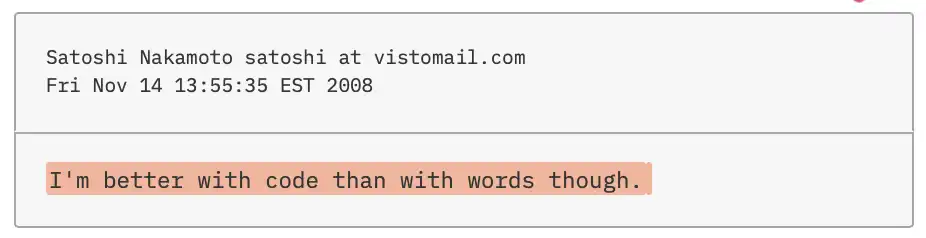
Adam Back, in a debate with another Cypherpunk about anonymity and freedom of speech, also expressed a similar sentiment in a comparable fashion:
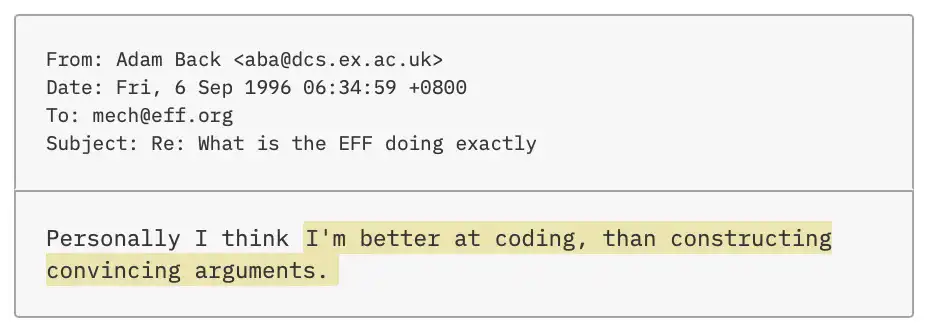
The more closely I looked, the more stylistic similarities I could discern.
Like Satoshi, Adam Back uses two spaces between sentences — an outdated writing convention that usually indicates an author over the age of 50. And Back is currently 55 years old.
Satoshi had complained on Bitcointalk about the difficulty of explaining his invention to the general public, using the British-flavored expletive "bloody." Yet, in multiple posts on X in October 2023, Back adamantly claimed he never used that word: "You can search it yourself; I never use that word."
However, I found a post from a 1998 Cypherpunks ma
