Editor's Note: From ceasefire to blockade, and now to tariff threats, the conflict surrounding Iran has not subsided but continues to escalate. From the Strait of Hormuz to the Red Sea, from energy pathways to trade order, the core of the situation is no longer localized military confrontation but a systemic game around "who controls the flow."
This article, using the "Rimland" strategy as a clue, points out that the United States is trying to escalate the conflict from a regional issue to a global agenda by enforcing a naval blockade and restructuring energy pathways, while also involving China. As sanctions and interception measures escalate, the once Middle East-centric confrontation is transforming into a structural shock that affects global energy, supply chains, and the financial system.
More importantly, the market has not fully digested this "domino effect" yet. The immediate fluctuation in oil prices is just the first step, and its transmission to liquidity, technology investment, household consumption, and even agricultural supply is just beginning to show. After the reassessment of energy prices, the real test is how the global economy will withstand the second-round impact caused by this.
This means that the current issue is no longer about whether the conflict will escalate, but about which paths the impact will spread along, and when the market will start paying for these as yet unpriced risks.
The following is the original text:
Well, the situation is now in front of us.
The tensions we raised last Wednesday have now proved to be irreconcilable.
Iran wants nuclear weapons and control of the strait, both of which Trump cannot accept. How large is the gap between these two "target circles"? It's so large that even Israel's war with Lebanon has not been brought into the discussion.
I won't claim to have judged accurately, but we may indeed have entered a "middle game." This is not a conflict that can be resolved in an afternoon. The core of the problem is very simple: who will control the world's most important waterway? And, is Iran's willingness to threaten its neighbors enough to gain bargaining chips for its nuclear weapons?
That is the key.
And what is now becoming clear is a whole set of strategic paths. Readers who have read through from "The Battle for the Dollar" to "Don't Take the Bait," and then to "Awakening the Hegemon" and "Fragile Peace" should already see the pattern.
Trump is executing a "Rimland" strategy.
Intercept Shipping. Threaten a 50% tariff on all countries providing weapons to Iran. Instead of attacking the heartland, control sea-based energy transport routes to drag China into the game. For every mine Iran lays and every oil tanker they attack, respond tenfold—seize their ships, control the tankers, and directly sell their oil.
Settle in USD.
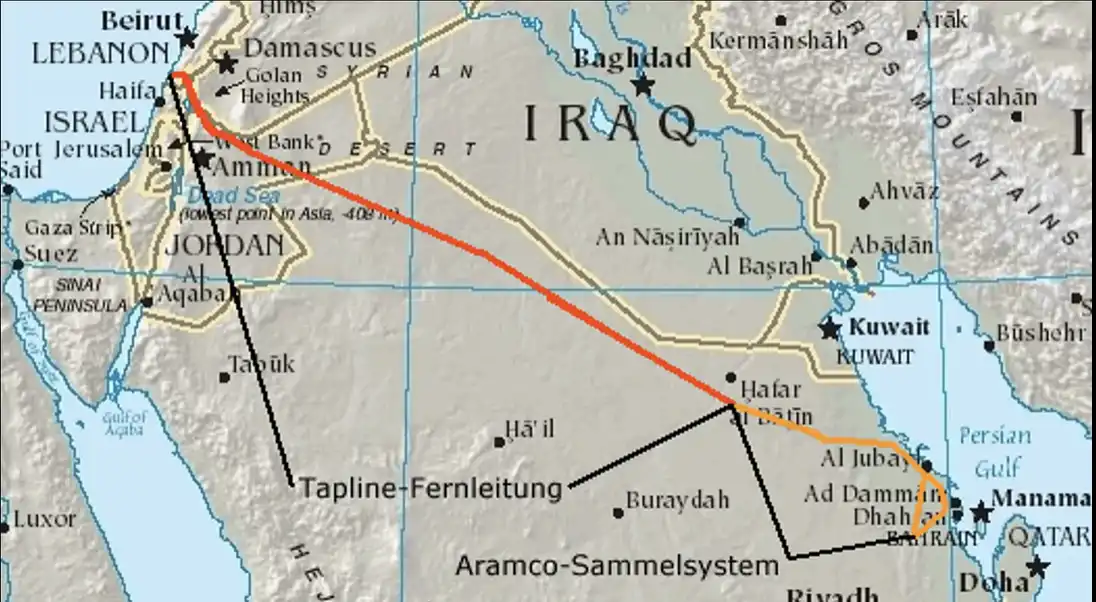
Next is the "Abraham Accord." Saudi oil is transported through Jordan to the port of Haifa; the Trans-Arabian Pipeline (Tapline) has been reactivated. A corridor consisting of physical infrastructure is connecting coastal countries into an energy network, completely bypassing the "heartland." This is the "Peripheral Zone Alliance" built with pipelines and steel.
In my view, the reason we've come to this point today is largely due to this process itself—Iran (and China) detonated Israel on October 7 through Hamas, disrupting the normalization process of this relationship. Once this process could move forward, an alternative trade route bypassing the Hormuz Strait and even the "Belt and Road" could have been established.
This also explains the discord between Washington and Brussels. The U.S. feels the weight of responsibility, while Europe seems to think it can negotiate privately for its own energy access routes on the one hand and let the "older brother" bear the cost of conflict. France, on the one hand, blocked relevant UN Security Council resolutions, negotiated bilateral passage arrangements through the Strait with all parties, and called for the formation of an "Independent State Alliance." This is a typical "heartland" mindset: trading with the inland power, avoiding direct conflict, as if the maritime routes will maintain themselves.
Trump just plugged this loophole—and in doing so, turned America's problem into a global problem.
As of the time of writing, crude oil prices have risen by over 6%, and the stock market has fallen by about 1%. The gains from last week's ceasefire appear highly likely to be quickly wiped out. I bought some VIX call options over the weekend, so you could say I have some bias.
The next developments will depend on a series of more fundamental questions:
· Can the ceasefire hold for another week, or will it break down in a "counterfactual" scenario?
· Trump has indicated that he will intercept ships that have paid a "transit fee" to Iran, does this include Chinese vessels? What will happen when they try to load oil from Kharg Island?
· He has also reiterated the threat of imposing a 50% tariff on any country providing weapons to Iran — does this mean a trade war is back on the table?
Then comes Iran's retaliation: it could activate the Houthi forces, which still have the capability to disrupt the Bab el-Mandeb strait. It is worth noting that most oil tankers transporting oil through the East-West pipeline in Saudi Arabia are Very Large Crude Carriers (VLCCs) that cannot pass through the Suez Canal. Once the Houthis escalate, it will not only affect Red Sea shipping but will also force these giant tankers carrying crucial oil to take longer detours.
The main storyline is: this conflict continues to escalate in scale and spillover scope.
By escalating the action to intercept all ships paying a "transit fee" to Iran and reiterating the tariff threat, Trump has explicitly brought China into this game. Beijing has been stockpiling oil for years to deal with such a scenario. But against the backdrop of a real estate-induced economic slowdown, how long can the Chinese markets maintain their "composure"? How likely is it that they will choose to escalate the confrontation to secure their energy supplies?
From Venezuela to Iran, the sequence of these actions is starting to look more and more like a deliberately crafted strategy.
The "Rimland" is making a comeback.
Next, there are interconnected market-level issues:
· How bad will the Monday opening be? The initial round of selling came mainly from short-term funds and retail investors buying puts. When will long-term funds start to view the volatility as uncontrollable, prompting them to sell off or hit risk limits?
· Last week, hedge funds quickly covered their positions of "long AI hardware, short software." But with rising oil prices, falling bonds, tightening liquidity, and the added risk of disruption in the Gulf helium supply chain (a critical material for chip manufacturing), is it enough to reprice the expected AI acceleration cycle?
· Prior to the conflict, the U.S. economy saw almost zero growth in the first quarter. With energy prices soaring, residents' disposable income being consumed by gasoline, heating, and aviation fuel — will households cut spending, or will they leverage further?
· The Fed meeting minutes show that the decision-makers are already discussing tightening policy to address energy-driven inflationary pressures. A new round of debate on "how to handle negative supply shocks" is unfolding. Faced with such a large-scale energy shock, can the Fed still "choose to ignore"?
Ultimately, these issues point to a larger "domino effect".
The "Rimland" strategy solves the energy and dollar issue but does not address the entire system supported by energy. The market is currently only pricing in the "first node" and has not transmitted to the "second node" yet. Oil prices can quickly reprice due to news, but agricultural production cycles do not. Urea prices are still at $700, and the USDA expects the smallest wheat planting area since 1919—this will not reverse due to a handshake between two diplomats. Farmers who couldn't afford fertilizer in March also cannot "replant" in April.
