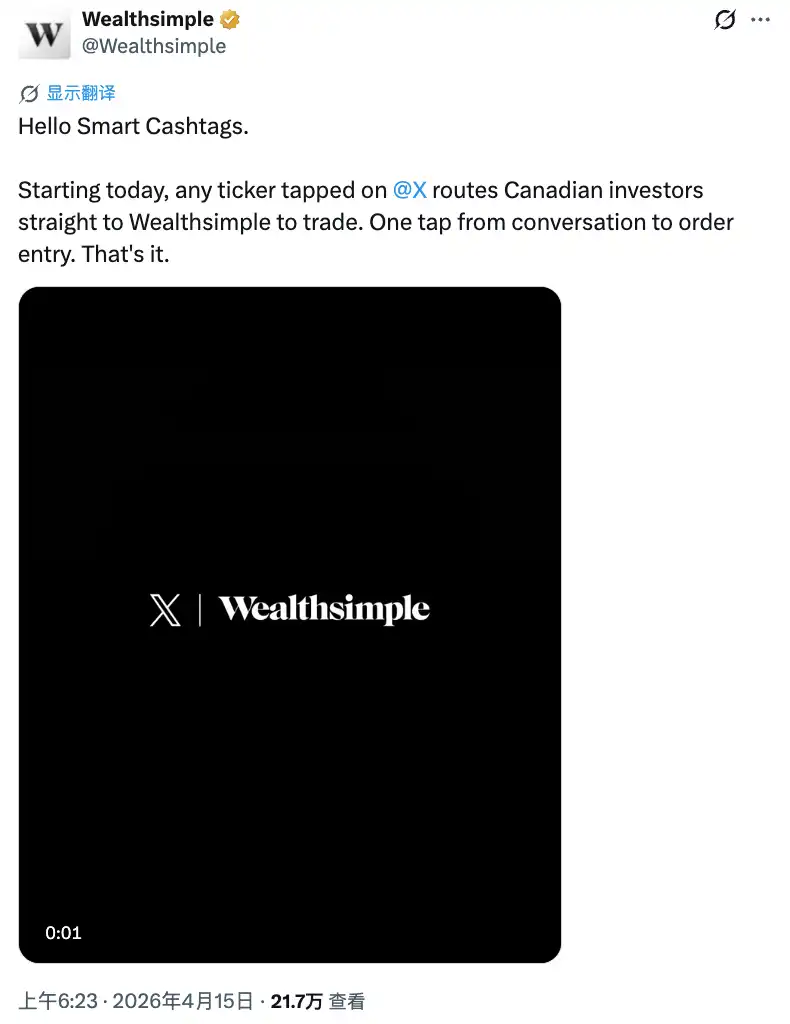
On April 14, X Platform launched the Cashtag feature on the iPhone in the United States and Canada. The usage is simple: typing $AAPL in a tweet turns this character string into a blue clickable link. Upon clicking, you will see Apple's real-time stock price chart, historical price trend, and all discussions related to $AAPL on X. If you are in Canada, you will also see a button to directly execute the trade on Wealthsimple.
What Can Cashtag Do?
It's not just about stocks. X's Cashtag also supports cryptocurrency. You can search for $BTC, $ETH, or directly enter the contract address of a Solana-based token to find its on-chain data. In other words, from mainstream blue-chip stocks to long-tail meme coins, this system aims to cover them all.
X's Product Manager Nikita Bier emphasized something during the feature release: X will not act as a broker and will not directly execute trades. X positions itself as a "data and discovery layer," responsible for presenting information, aggregating discussions, guiding users, with the actual order execution handled by third-party brokers.
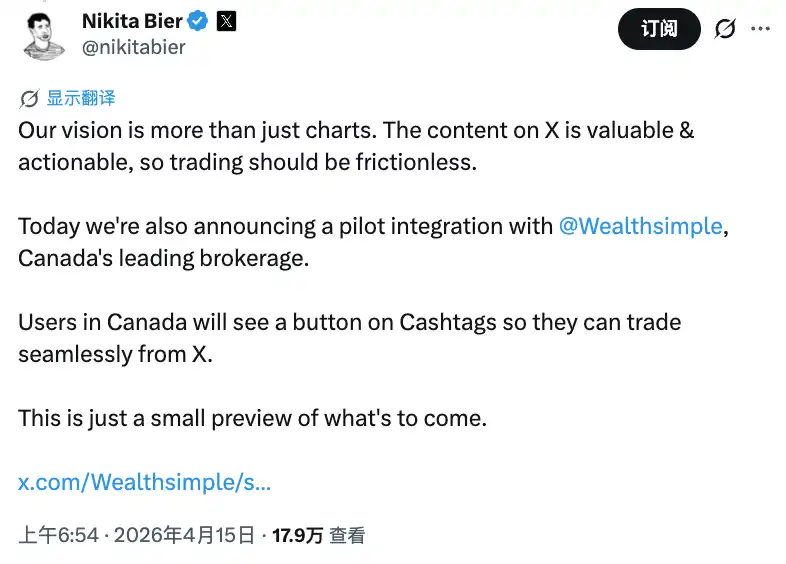
This positioning is crucial. If X were to act as a broker, it would need to undergo SEC broker-dealer license review, comply with FINRA requirements, and navigate a series of complex regulatory processes. By defining itself as a "data layer," where X only provides information display and trade execution happens elsewhere, the regulatory boundaries are much less defined.
However, from a user experience perspective, the entire path from seeing a tweet to completing a trade has been compressed into a few clicks. This is the first time on the X platform where there is no friction between discussion and action.
Its Origin Is Somewhat Ironic
The term "Cashtag" was not invented by X.
In 2008, a financial analyst and angel investor named Howard Lindzon created StockTwits, a social platform dedicated to serving investors. He introduced symbols like $AAPL, using $ at the beginning to turn stock tickers into clickable topic tags, allowing retail investors to discuss specific assets and track market sentiment. He gave this design a name: cashtag.
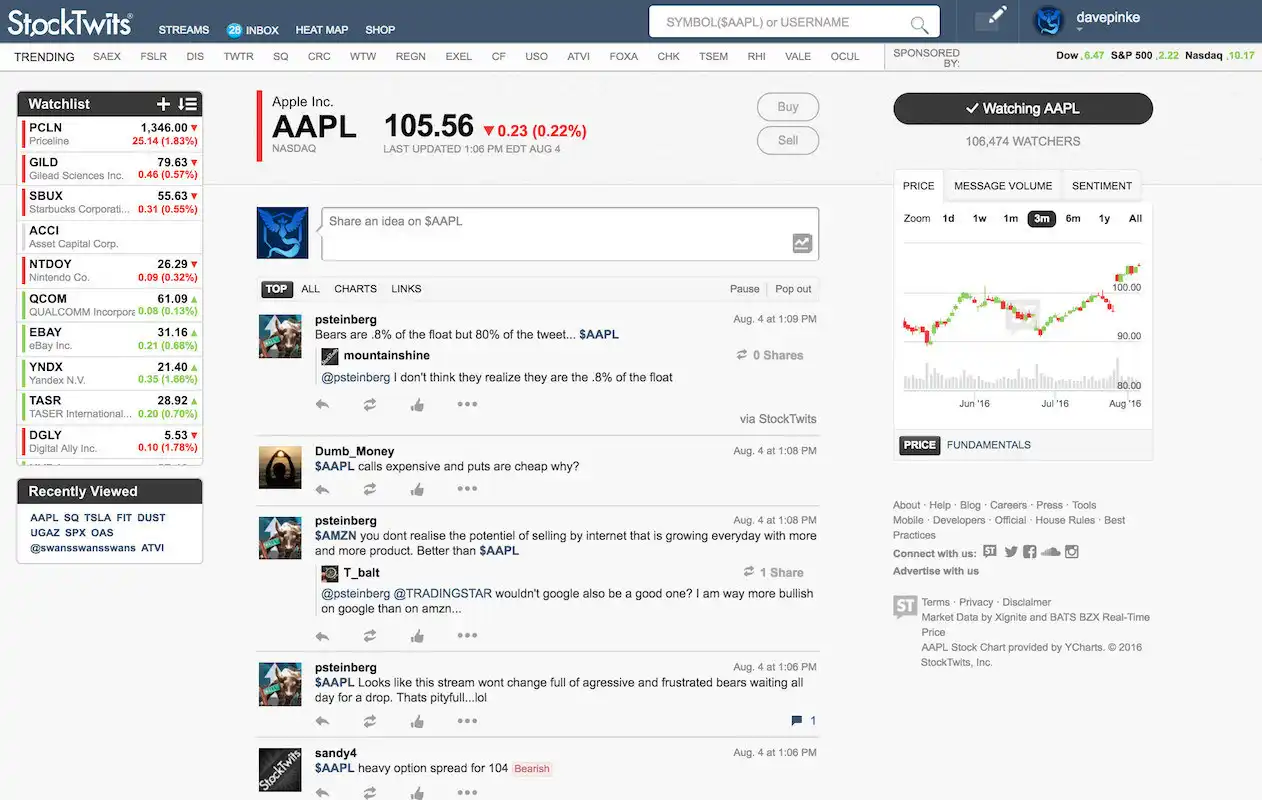
This idea has been circulating in a small circle for four years.
In July 2012, Twitter announced formal support for the cashtag. $AAPL on Twitter turned into a clickable blue link. Lindzon publicly expressed "disappointment," stating that Twitter "hijacked" his idea. However, he was powerless as the cashtag was not copyrighted, the $ symbol belonged to everyone, and Twitter did not owe him any explanation.
Over the next decade, a strange balance was struck between the two. StockTwits survived on the cashtag, but its traffic was far less than Twitter. While Twitter had the cashtag feature, it resembled more of a hashtag on Twitter rather than a true financial tool. Clicking on it only led to a topic page with no data, price, or any actionable items.
On April 14, 2026, Lindzon posted a tweet on his own X homepage, advertising the 2026 Cashtag Awards that StockTwits would host at the New York Stock Exchange.
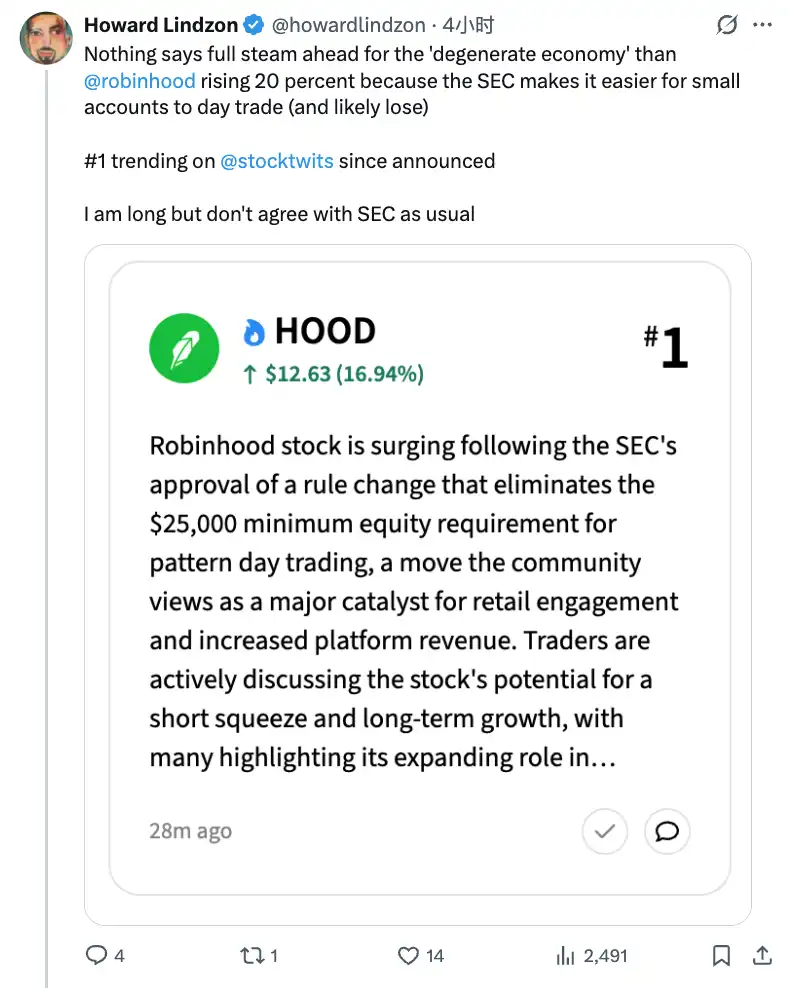
On the same day, X Platform made the cashtag truly actionable for the first time. The cashtag, invented, stolen, shelved for over a decade, was now weaponized right under its inventor's eyes, while the inventor himself was advertising for the other platform.
Why Wealthsimple?
The Cashtag feature was first launched in the United States and Canada, but only Canadian users could click on the cashtag to directly place orders with the brokerage. The reason is simple: Wealthsimple is a Canadian company, so it launched in Canada. The trading partner for the U.S. market has not yet been announced. But the interesting question is: Why Wealthsimple and not another Canadian financial institution?
Wealthsimple is Canada's largest online brokerage, which is its most direct identity. Founded in 2014, it now manages over $50 billion CAD in assets, with a high penetration rate among young Canadian investors. It holds both traditional securities licenses and a digital asset trading license (Wealthsimple Digital Assets), allowing it to handle both stocks and cryptocurrencies, both of which X's Cashtag must support. This requirement is not met by just any institution in Canada.
Meanwhile, Wealthsimple is also a "repeat offender" partner.
In March 2026, just a month before the announcement of the partnership with X, the Quebec Superior Court approved a class-action settlement against Wealthsimple's crypto business. The lawsuit was based on its promotion of "zero-commission" trades without clearly disclosing to users that it profits from the bid-ask spread. The final settlement amount was 750,000 CAD, resulting in an average of 3.34 CAD per investor. Wealthsimple did not admit to any wrongdoing, but the issue of information disclosure had become a public controversy.
Back in 2025, Wealthsimple experienced a data breach incident. A trusted third-party vendor's software package was attacked, leading to unauthorized access to some customers' social insurance numbers and account information. Wealthsimple took control of the situation within hours, completing full notifications and emergency response. From a crisis management perspective, it did not collapse.
To sum up Wealthsimple's status in one sentence: it has stumbled but also recovered. It knows where the regulatory boundaries lie and has real crisis management experience. For X, a new feature aiming to connect social discussion and trading access, such a partner, with a tested track record, actually poses a more foreseeable risk than an untested partner.
The real suspense lies in the U.S. market. Robinhood is testing its own social trading feature (Robinhood Social), Coinbase has more extensive crypto compliance experience but also more SEC friction. Who X chooses in the U.S. will be the true test of whether this model can succeed.
X's Financial Ambitions, Understanding the Timeline in One Picture
The launch of the Cashtag feature is the culmination of a tiered architecture assembly. Looking back at X's actions over the past 16 months, it's clear that each step has been precisely placed:
In January 2025, a partnership was signed with Visa to obtain the fiat-to-fiat transfer infrastructure;
In January 2026, Nikita Bier previewed Smart Cashtags, outlining the financial data layer;
In February, a proactive clarification that "X is not a broker," completing the regulatory separation;
In March, X Money officially announced its public testing plan, and the payment layer came to the surface;
On April 14, Cashtags went live, and on the same day, a partnership with Wealthsimple was announced—the data layer and the transaction layer connected for the first time.
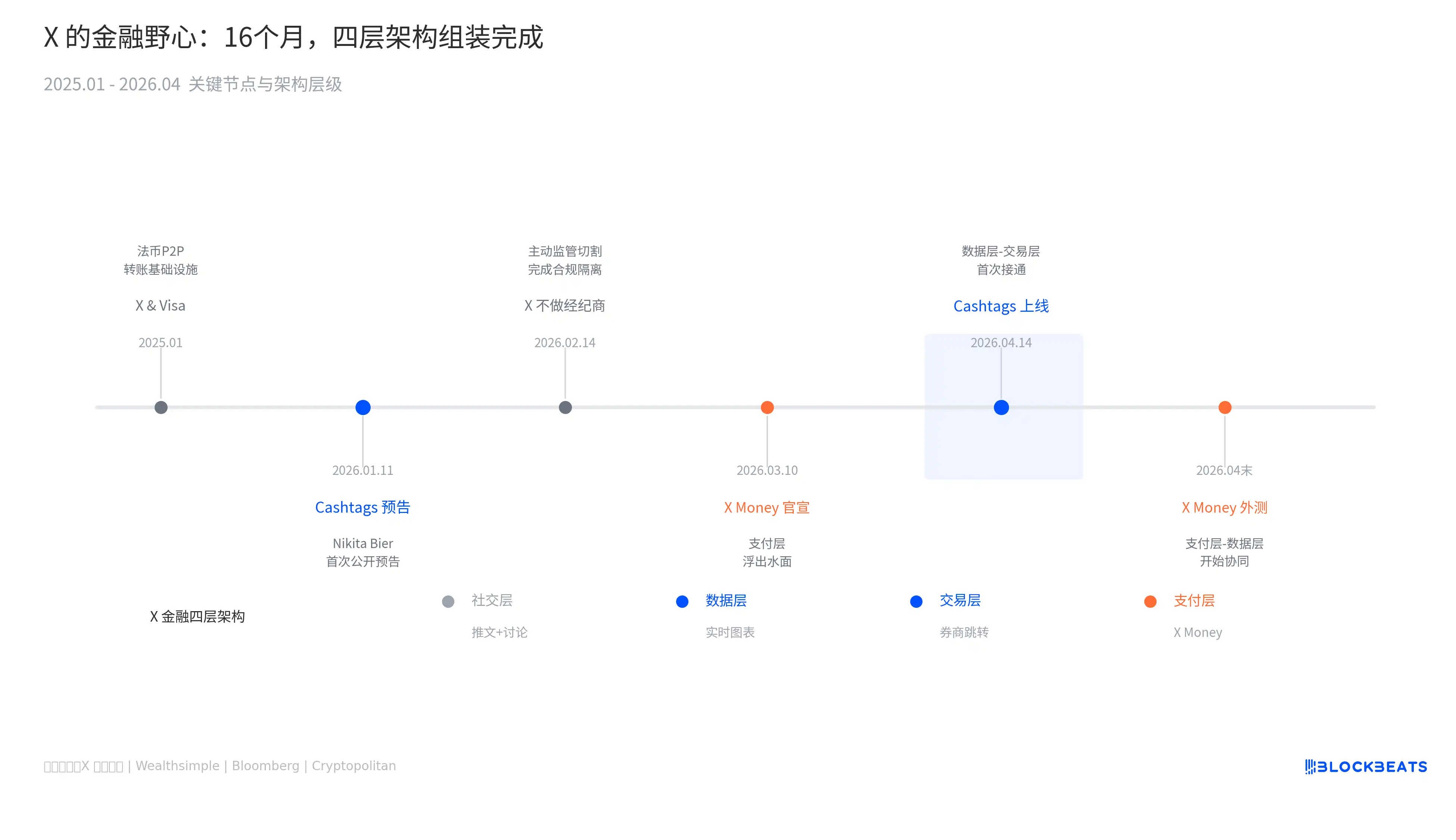
Stacking the four layers together: social layer (tweets + discussions), data layer (real-time charts), transaction layer (brokerage link-outs), payment layer (X Money P2P transfers + 6% APY savings account). Each layer individually has mature competitors, but together, no platform has done this before.
This is the most concrete realization of what Elon Musk has always referred to as a "super app." Starting from attention, first capturing all money-related discussions, and then gradually transforming these discussions into real fund flows. From Lindzon's first $AAPL on StockTwits in 2008 to today, where X platform allows hundreds of millions of users to buy stocks by clicking on this symbol directly, cashtag took 18 years to fulfill its destiny.
