Quantum security is no longer a topic to be slowly discussed.
Of course, this statement is not suggesting that we will wake up tomorrow morning to find all our cryptocurrency wallets emptied. The real meaning is that the entire industry can no longer treat this matter as a distant technical topic.
In the past, when the crypto community talked about quantum security, many people were quite relaxed. They knew it was important and that it would come sooner or later, but they always felt it was still far off. The article released by Google Research at the end of March 2026 shattered this sense of relaxation.
The article highlighted a key number: the future hardware requirements for a quantum computer to break elliptic curve cryptography are nearly 20 times lower than previous industry estimates. This is not an abstract academic conclusion; Bitcoin, Ethereum, and TRON's Binance Smart Chain all use the same signature scheme, all relying on elliptic curve cryptography.
Once a powerful enough quantum computer appears, any address that has transacted on-chain and has exposed public keys will face the real risk of having their private keys reverse-engineered and assets stolen. Even more dangerous, attackers can now record all exposed public keys on the chain and slowly decrypt them with a mature quantum computer in a so-called "harvest-now, decrypt-later" attack, meaning that today's data may no longer be secure in the future.
Even Google itself couldn't sit still and has laid out its post-quantum migration timetable. Post-quantum migration, in simple terms, is gradually transitioning today's password systems that protect data and account security to new solutions that can better withstand quantum computing in the future. Google has set its target timeline for 2029. The message is clear: there's no more room for uncertainty.
It is at this juncture that Justin Sun has put TRON's anti-quantum upgrade on the table. This is not just about making noise but a formal announcement to deploy a post-quantum signature scheme on the mainnet that complies with NIST standards, aiming to be the first mainstream public chain to truly implement this on the mainnet.
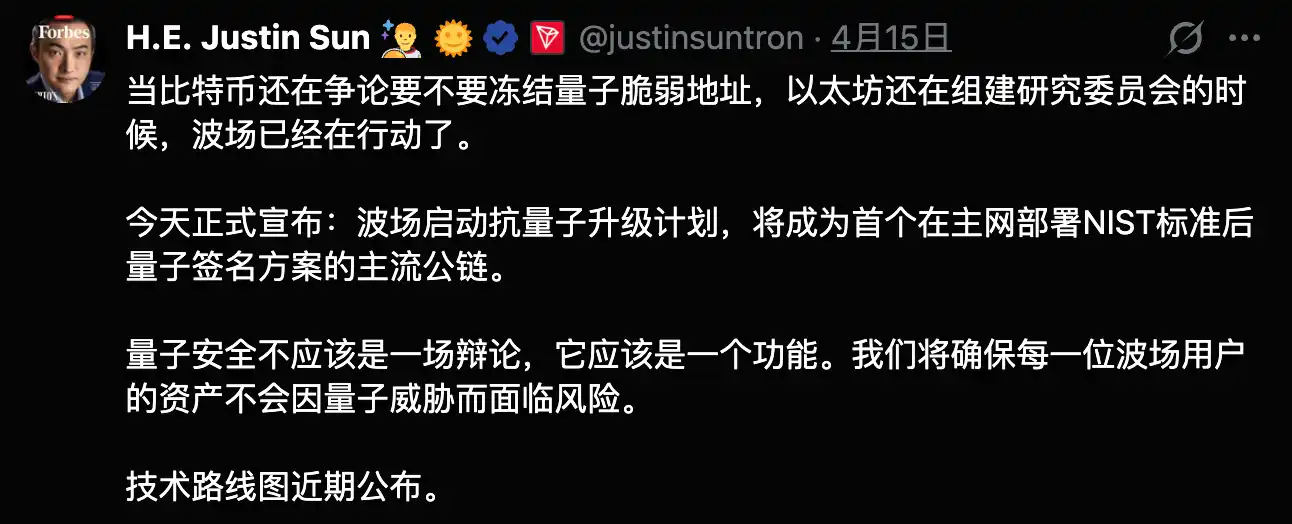
While Bitcoin is still debating and Ethereum is still researching, TRON is taking action
As mainstream public blockchains are still in varying discussions and explorations at different paces, market differentiation has gradually emerged. This differentiation is fundamentally the inevitable result of governance structure differences.
On the Bitcoin side, quantum security has escalated to the proposal level. On April 14th, Jameson Lopp and others submitted BIP-361, proposing a "Three-Stage Exit Mechanism" that essentially aims to provide an exit mechanism for the old signature scheme. Coins not migrated to quantum-resistant addresses may be frozen in the future. This proposal quickly sparked controversy. The reason is that the discussion is no longer just about technical risk assessment but has touched on Bitcoin's most core governance issue—who has the right to decide on the handling of existing assets.
In the extremely decentralized Bitcoin community, any protocol layer upgrade requires consensus from miners, core developers, and the entire community. This threshold has determined that Bitcoin's quantum security upgrade will be a protracted game.
Ethereum, on the other hand, follows a different rhythm. The Ethereum Foundation has already launched a dedicated research page this year called Post-Quantum Ethereum, laying out all quantum-resistant research, roadmap, and FAQs, indicating that it has officially entered the research phase. However, from research to mainnet implementation, based on past experience, each transition has been extremely time-consuming.
TRON, on the other hand, presents a different scenario. TRON employs a DPoS mechanism, with network governance overseen by 27 super representatives, making the decision-making process much shorter compared to Bitcoin and Ethereum. It is precisely because of this that TRON, leveraging the efficient execution capability granted by its DPoS governance structure, appears exceptionally fast. While it may not have been the first public chain to focus on quantum risks, it is likely the first mainstream public chain to truly execute this matter on the mainnet. Discussions within the industry about quantum security have long existed, but there are not many projects that have made tangible progress. For a network like TRON, which facilitates large-scale USDT settlements, taking the lead in defining a direction and initiating technical implementation is itself a clear strategic statement.
Some chains can be studied slowly, but not TRON
A glance at the data reveals its significance. According to DefiLlama statistics, the circulating supply of USDT on the TRON network has exceeded $86.4 billion, accounting for nearly half of the total issuance and becoming one of the most essential foundational networks for stablecoin circulation.
This figure implies that what flows on the TRON chain daily is a significant amount of real funds that can be redeemed in the real world. For networks of this kind, quantum security is not a technical bonus but a systemic baseline requirement. Once a quantum computer with cryptographic capabilities emerges, addresses with exposed public keys on the chain will face a direct static attack. Attackers may not even need to wait for a transaction to occur; they can simply extract public keys from historical on-chain data and execute offline attacks. The heavier the funds carried, the more significant the potential loss from this risk that cannot be ignored.
Therefore, the importance of this action goes beyond the technical aspect. What TRON represents today is not just the activity of a single public chain or the transient popularity of a particular ecosystem phase. With the development of stablecoins, it has long become the most core and prominent asset in the entire crypto industry. Whoever takes on the most stablecoin flow also significantly undertakes the most real and weighty financial activities in this industry.
By putting the quantum-resistant upgrade on the mainnet agenda this time, TRON's significance is not only to address its security weaknesses but to actively pave the way forward for the entire industry. Because the issue of quantum security will sooner or later fall on all major public chains. Standing in its current position, TRON's proactiveness serves as a role model.
What Truly Matters is to Start
Quantum resistance, simply put, is to gradually replace today's signature and account security schemes with new schemes that can better withstand quantum computing in the future. What TRON has mentioned this time is a post-quantum signature scheme that has already been standardized by NIST. NIST is the U.S. National Institute of Standards and Technology, and many foundational security standards will reference it. Since its post-quantum cryptography standards have been formally released, it means that this matter is no longer just a concept on paper, and the industry can actually start moving forward now.
Of course, TRON's roadmap has not been published yet, so the specific approach is still unknown to the public. The most commendable aspect of TRON this time is not about revealing all the details at once, but about setting the direction first, and officially putting this matter on the mainnet agenda.
Quantum security has never been a "problem that only exists in discussions"; once it enters the implementation stage, what will be adjusted is the underlying structure of the entire chain. TRON's proactive approach to pushing this matter forward is setting a precedent for the industry. As for the upcoming roadmap, we just need to wait and see. Quantum security can certainly continue to be discussed, but the ultimate goal of the discussion should be engineering, not "the next round of discussions."
Not Just About Speed, But Also About Future Preparedness
For a long time, the encryption industry has often judged public blockchains based on a core metric of "being fast enough." Similarly, in the AI industry, it has become about whether the model is fast enough, whether the product is fast enough. "Speed" is certainly important as it brings user experience, efficiency, and is easily noticeable. However, focusing solely on speed is now somewhat outdated. When a system begins to carry higher value and a wider range of use cases, "running fast" is only a basic capability, and "security" becomes the decisive threshold. For AI, this means how to prevent errors by agents (such as accidentally deleting user data) and mitigate the risk of data breaches; for the encryption industry, it means being able to prevent hacker attacks and safeguard the security of protocols and assets. The heavier the load, the less security is a bonus and more of a baseline requirement.
For public blockchains, this is particularly evident. What they carry on-chain is no longer just NFT images or various experimental data, but large-scale real-world funds, stablecoin assets that can circulate and be used in the real world. At this point, "speed" is still important but is no longer the decisive metric. The real key is whether it can proactively address potential risks and have the capability to deal with complex issues. Therefore, TRON's elevation of quantum resistance upgrade to the mainnet agenda this time is significant not only at a technical level but also in taking a step forward for the industry.
Justin Sun took the lead, set the direction, and pushed this matter from discussion to execution. For the entire TRON community, this reflects a sense of foresight and responsibility; for users of USDT, it is also a statement that someone has started to take action in advance for fund security, rather than passively remedying risks after they occur.
While most people are still discussing the future, TRON is already building for the future.
