Editor's Note: The story of stablecoins is evolving from being a "payment tool" to a new set of global financial infrastructure.
a16z attempts to dissect with a market map the financial technology stack stablecoins are reshaping: at the base are the divergence of general-purpose chains, payment-specific chains, and institutional networks; in the middle layer are bank connections, fiat on/off ramps, forex liquidity, and the licensing competition of stablecoin issuers; moving further up, there is the convergence of new banks, crypto wallets, corporate banking, credit, investment, and wealth management applications.
The core argument of the article is that the long-term value of stablecoins lies not only in making cross-border payments faster and cheaper but in turning the "dollar account" into a globally accessible financial onramp. For markets with weak local financial infrastructure such as Latin America, Africa, and Southeast Asia, stablecoins provide dollar savings, global receipts, supplier payments, and fund management capabilities; and once account relationships are established, higher-tier financial services like credit, investment, and insurance will also unfold.
This also means that stablecoins are not just a product evolution within the crypto industry but a structural change around financial infrastructure, the dollar's dominant position, and global capital flows. Traditional payment companies, banks, exchanges, regional liquidity providers, and on-chain financial protocols are all competing for key positions in this new tech stack. Whoever can control accounts, liquidity, compliance gateways, and credit capabilities may occupy a core node in the next-generation global financial system.
Below is the original article:
Stablecoins Are Restructuring the Global Financial Bedrock
The global financial system is being rebuilt on new infrastructure, and the speed of this process far exceeds what most outside the crypto industry realize.
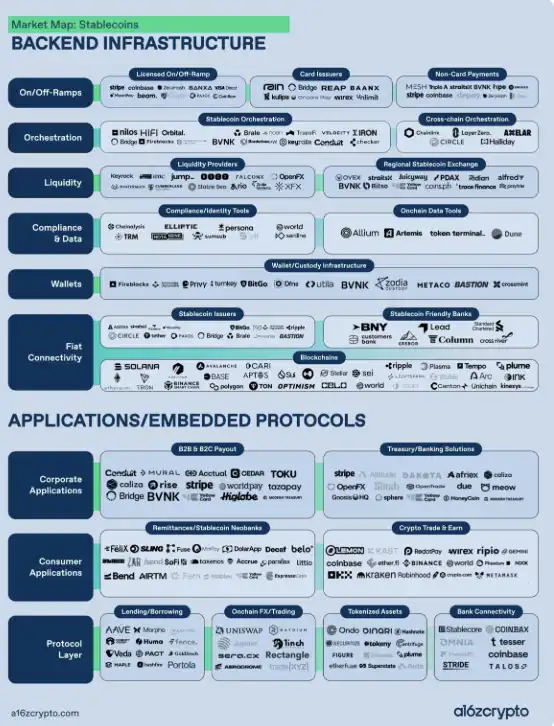
Stablecoins are the catalyst for this change. They have transitioned from a niche transaction tool to a foundational financial conduit and are becoming the base layer on which the next generation of global financial products is built. The market map accompanying this article presents our understanding of this transformation. Specific companies may change, distinctions between different categories may blur and continue to evolve, but more importantly, the underlying structural change: how the new tech stack for global finance is taking shape, which parts have matured, and which gaps still need to be filled.
The core logic is that stablecoins are driving a new form of Banking as a Service (BaaS). In the previous wave of BaaS, fintech companies mainly leased bank charters and connected to traditional core systems. However, this new wave is structurally different: enterprises are building on-chain infrastructure, using self-custodial wallets to reduce friction and decrease reliance on intermediaries; meanwhile, they are integrating basic financial modules such as accounts, payments, forex, and credit to create end-to-end financial products.
The result is that the capability, which required a large number of regional licenses and local bank partners to achieve just a decade ago, can now be accessed by any team as long as they have the right tech stack.
Stripe acquiring Bridge and Privy, Mastercard acquiring BVNK, all indicate that traditional giants are using a similar logic map to respond to this evolving landscape. They are implementing integrated strategies, aiming to secure key elements of the tech stack before the new infrastructure layer is fully formed.
These are just partial signals, but they are already enough to demonstrate that the transformation of finance to the blockchain has crossed an irreversible threshold. The current choice is not to wait and see but to actively adopt and embrace change; otherwise, one might be left behind.
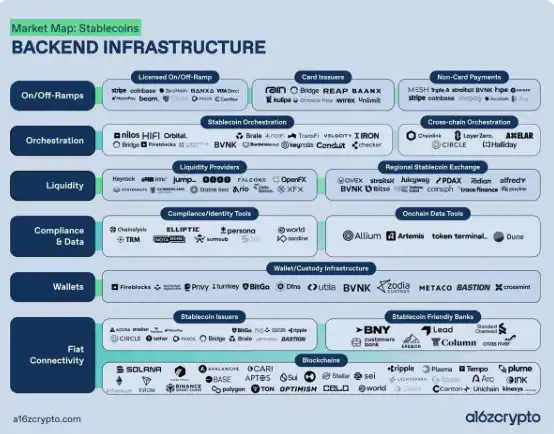
Blockchain: Three Categories
The assumption that "all blockchains are competing for the same use case" is being shattered. Today, three fundamentally different categories of blockchains have emerged. They correspond to different demand combinations, implying different performance trade-offs. Understanding these differences is crucial to understanding where fintech activities are migrating.
The first category is general-purpose public blockchains.
Solana, Ethereum, and their major L2s still form the core battlefield of the crypto capital market, carrying out activities such as transactions, lending, DeFi, etc. This is a vast and enduring market, but it does not encompass all the changes taking place.
The second category is payment-specific blockchains.
This is another type of network that is emerging, explicitly designed for financial service scenarios. Networks like Stripe's Tempo, Circle's Arc, are competing around features not specifically optimized by some general-purpose public chains: stablecoin-native gas fees, privacy protection, and most crucially—predictable transaction costs.
For a fintech company that needs to process millions of payments, being able to model costs is crucial. Companies being built in this area are betting on: blockchains designed for payment scenarios will become the preferred settlement layer of the next-generation financial infrastructure.
The third category is Institutional Networks.
Represented by networks like Canton, this category is designed for regulated entities. They require both programmability and privacy while complying with the legal framework. As banks and asset management institutions accelerate their adoption of these networks, this category may become an increasingly critical foundational layer, a trend we are just beginning to see.
Banking Layer: The Bottleneck is Loosening
For much of the past decade, the banking layer has been where crypto-native financial services hit a wall. Establishing banking partnerships has been challenging and easily lost, often a significant source of existential risk for companies in the space.
This situation has not entirely disappeared but has seen significant improvements. A group of crypto-friendly banks is actively bridging the gap between crypto-native infrastructure and traditional fiat systems.
What used to be the primary operational challenge for most participants, the on/off-ramp issue, is now becoming easier to navigate. Fiat on-ramp capability is crucial for stablecoin-native fintech operations, not only for payments but for the entire fintech stack.
Stablecoin Issuers: A Far-Reaching Licensing Race
The competition among stablecoin issuers has never been as fierce as it is now. Moreover, the focus of this competition is shifting clearly toward one direction: regulatory positioning. Since the passage of the GENIUS Act, issuers have been vying for the OCC national trust charter.
In the short term, the direct benefit of this charter is legitimacy—a federal-level endorsement that is crucial for regulatory agencies and institutional partners. However, in the long run, the stakes are much higher. If regulatory agencies ultimately allow OCC national bank charter holders direct access to the Fed's payment rails, early charter recipients will be integrated into the core of the financial system, positioning them to play a central role in the financial digitization transformation.
Therefore, this race is fundamentally more than just a battle of brands; it is about where you will ultimately sit in the payment hierarchy. And increasingly important is who will be the foundational layer for credit and capital market flourishing.
Liquidity Providers: The Last Mile Problem
Stablecoins have made significant progress in the "last mile" of cross-border payments. The "last mile" refers to the intermediate steps involved when funds are digitally transferred from one country to another. Stablecoins have brought faster settlement times, reduced reliance on correspondent bank accounts, and decreased friction in international transfers.
However, the remaining issue lies in the liquidity between stablecoins and local fiat currencies, especially in the context of emerging market fund flows. Liquidity along most geographical corridors is still shallow. Insufficient liquidity leads to slippage, delays, and unstable pricing. If these issues are not resolved, they will severely hinder the use of stablecoins in high-potential scenarios such as B2B payments.
This gap is now beginning to narrow through three main pathways:
First, there are forex service providers that are compatible with stablecoins, such as OpenFX and XFX;
Second, there are regional exchanges deeply integrated with the local fiat system, such as Bitso in Latin America, Yellowcard in Africa, and Coins.ph in Southeast Asia;
Third, over time, banks directly supporting forex transactions settled in stablecoins.
All three types of entities are essential. Forex service providers bring technical integration capabilities, regional exchanges bring local market depth, and banks bring balance sheet capabilities and correspondent banking relationships. No single channel can solve this gap alone.
Banking Integration: Unsexy But Key
The stablecoin infrastructure stack has been almost entirely built outside the traditional banking system, involving fintech firms, non-bank payment companies, and crypto-native entities. This has brought speed and openness but has also created a structural problem: the stablecoin infrastructure is not inherently compatible with the traditional core banking systems that most banks operate. Connecting the two requires a dedicated "translation layer."
Companies in the "banking integration" category play precisely this role. These companies are constructing an infrastructure layer that allows banks to offer stablecoin-related capabilities while keeping their existing systems, avoiding a potentially risky full system migration that most banks would be unwilling to undertake.
Some of the most forward-thinking participants in this space have already begun expanding their business scope from crypto capital markets and payments to other areas such as on-chain lending. In the future, banks will also look to extend stablecoin infrastructure into these areas.
From US Dollar Accounts to On-Chain Credit, the Application Layer Begins to Expand
Application Layer: Convergence and New Financial Vernacular
The application layer is being reshaped by two forces.
The first force is the convergence between fintech neobanks and crypto wallets.
Exchanges are incorporating virtual accounts, bank cards, and reward mechanisms, while neobanks are integrating crypto assets and traditional investment products. The boundaries between these two types of products are rapidly blurring, and the eventual form is likely to be a unified financial application: serving both crypto-native users and mainstream users through a single interface.
The winning companies in this competition are not necessarily those with the best product experience today, but those that can combine distribution capabilities, user trust, and a product offering that truly meets customer needs.
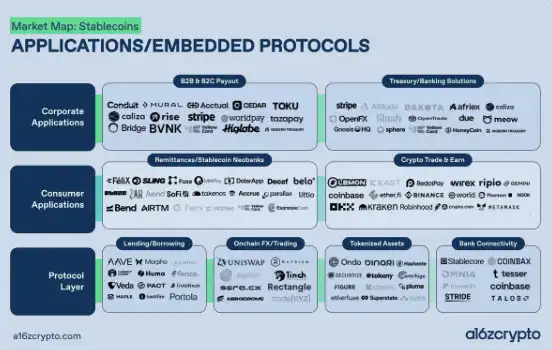
The second force at play is the adoption of stablecoins by corporate banking.
In markets where the local currency banking infrastructure is limited, unstable, or prohibitively expensive—such as in most of Latin America, sub-Saharan Africa, and Southeast Asia—stablecoins are enabling businesses to conduct USD-denominated transactions in ways that were previously difficult to achieve, including vendor payments, global receipts, and treasury management.
This story is less about crypto and more about USD access. Its true driving force is the real needs of businesses operating in weak or unstable local financial infrastructure.
But in the long run, the more significant change at the application layer is what comes after "accounts."
USD access is just the entry point. Once users hold a stable, USD-denominated balance—whether they are a small business owner in Lagos, a freelancer in Buenos Aires, or a saver in Jakarta—they gain access to a whole suite of financial products that have rarely been truly open to them in the past: credit, investment, wealth management, insurance.
The new banks and super apps that win the account relationship will have the opportunity to cross-sell across all these categories. And the market they face is precisely the customer base that the traditional financial system has never fully served. The payment layer is responsible for opening accounts, but the credit and investment layers are where the real business is built.
Credit Question: The Critical Second-Order Effect
If payments are the first act, credit is likely the second act, and its impact may be even more profound.
The traditional understanding of stablecoin growth often leads to a large-scale "narrow bank" model: USD is tokenized, held in wallets for settlement, and redeemable on demand. But this understanding overlooks a key question: what happens when stablecoin issuance truly reaches mass scale?
A world with trillions of USD stablecoin circulating balance also implies a massive demand: where will this capital go to generate returns? Companies holding stablecoin treasuries will seek more productive uses for these balances. Protocols will need liquidity. And end-users at the far end of the tech stack will eventually generate lending demand as well.
The result is almost inevitable: a new on-chain credit market will emerge. It is different from the self-referential trading products of early DeFi cycles—using crypto collateral to borrow crypto, then speculating on crypto—and closer to the productive credit economy that banks were originally designed to serve: capital formation, asset-backed loans, and operational capital for businesses in markets with inadequate or missing local banking infrastructure.
The early days of DeFi's rapid growth are giving way to a more enduring, mature form: the era of on-chain finance.
This transition bears resemblance to the development of the private credit market over the past decade. As banks withdrew from certain loan categories under regulatory pressure, private credit funds stepped in to fill the gap. Evolving from a niche alternative asset class to a market of trillions of dollars, they can now compete directly with syndicated loans.
The on-chain lending market structurally parallels this: capital is formed outside the traditional banking system to serve borrowers underserved by the traditional system. The key difference is that its underlying infrastructure is open, programmable, and possesses global reach, qualities private credit funds do not have.
Traditional credit management institutions have begun to take notice of this change. Those able to identify this trend early and build or acquire based on it will define the shape of the future on-chain capital markets.
The US Dollar's Dominance and Geopolitics
Within this market landscape lies a narrative larger than financial technology itself, pointing in two directions simultaneously.
For individuals and businesses accessing the new global financial system, this is a tangible economic empowerment. People can hedge against currency devaluation, access global payment rails, and conduct business using the world's most liquid currency. Today, a farmer south of the Sahara, a manufacturer in Southeast Asia, or a small importer in Latin America can hold, transact, and save in dollars without a U.S. bank account or correspondent banking relationships, bypassing the traditional gatekeepers that once made acquiring dollars a privilege rather than a public utility. This is truly a novel development.
For the United States, this amplifies existing power. The dominance of the US dollar has been maintained over the past century largely through a series of institutional arrangements: the International Monetary Fund, the World Bank, correspondent banking, and a web of bilateral agreements that give the US Treasury and the Fed outsized influence in global finance. Stablecoins have now added a new, more direct conduit: every wallet holding a dollar-backed stablecoin effectively becomes a new node within the dollar's financial network. For the first time, this system can settle value between any two points almost instantly and at minimal cost. The wider the adoption, the more valuable it becomes to all users, potentially deepening the dollar's penetration into economies that were previously underserved.
This is a far-reaching implication within the stablecoin narrative: as laws such as the GENIUS Act pass, the US government is not just regulating a new financial product. It is betting that stablecoin infrastructure can serve a long-term goal of maintaining the dollar's primacy. This bet unfolds against the backdrop of one of the most challenging periods to the dollar's leadership since the Bretton Woods system.
More Than Just Payments
The new technology stack for global finance is still under construction, and its impact goes far beyond the simple payment narratives.
What is happening here is a wholesale system upgrade. The underlying rails are open, programmable, and inherently interoperable; at the same time, they are increasingly able to reach areas, people, and use cases that the traditional systems were never designed to touch.
This includes not only low-cost global payments, but also: accessing dollars in markets where local banking infrastructure has failed; putting idle capital to work; providing credit to borrowers underserved by traditional financial systems; and offering investment products to billions who have never truly participated in capital markets.
The companies building on this stack today, across all its layers, will define the next phase of global finance and the shape of the global dollar economy.
Welcome to join the official BlockBeats community:
Telegram Subscription Group: https://t.me/theblockbeats
Telegram Discussion Group: https://t.me/BlockBeats_App
Official Twitter Account: https://twitter.com/BlockBeatsAsia
