AI is the new UI, with the "Wallet" stepping into the background.

Previously, OKX Wallet released OnchainOS and continued to iterate on the open Agent capability, while introducing the all-new Agentic Wallet. With AI becoming the new "user interface," what changes will occur as Agents, as on-chain participants, begin to autonomously transact and participate in governance, and what roles will Ethereum and other blockchains play?
At the intersection of AI and Web3, a new interaction paradigm is emerging.
Here is the "OKX Wallet Friends" series - Carnival Edition. This series, through conversations with different builders, captures their judgments and reflections at key industry moments. In this issue, OKX Wallet VP Paul Wan will converse with Vitalik about the long-term trends and underlying structure of AI and Web3, attempting to understand: In the age of Agents, what role will blockchain play.
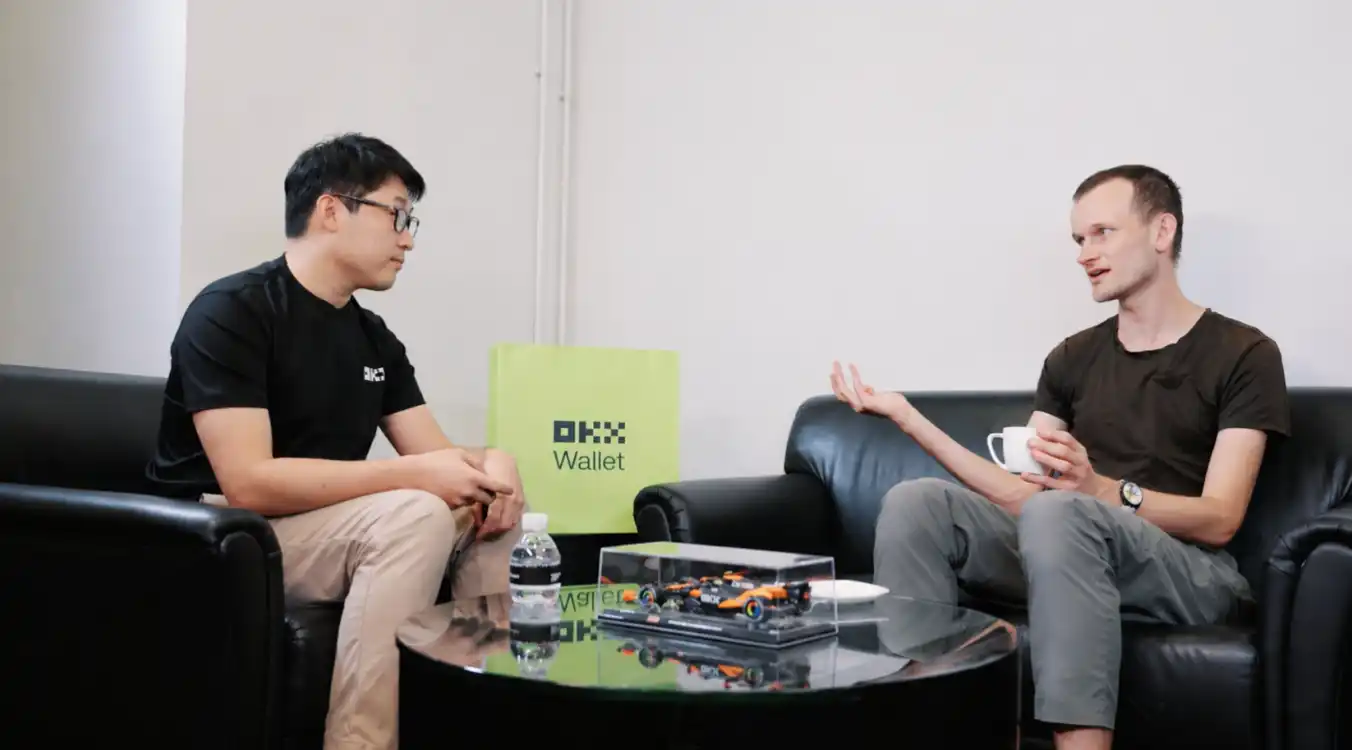
The Role Evolution of Ethereum and Blockchain in the AI Era
Question 1: Facing the Agent era, what primitives must the on-chain operating system provide? What is still missing from today's Ethereum?
Vitalik:
This is how I see it. Ethereum primarily provides two major functions for applications. One of them is the public billboard, where anyone can post data on-chain, and various applications interpret this data in multiple ways; the other is on-chain and off-chain computation, which includes financial applications, DeFi, and various other applications.
In the AI era, fundamentally these use cases remain the same, and the same scenarios still exist, and these functions can continue to be important. However, AI will certainly bring about huge changes in the way we interact with blockchain and other tools.
One significant difference is that in the pre-blockchain era, users interacted through a specific interface, which corresponded to a specific thing; whereas in the world of AI, especially in this form of AI today and in the coming years, you can have a user-side AI call upon these different skills, combine things at once, and interact with many different entities.
This has also significantly increased the number of workflows interacting with Ethereum and other systems. So in my opinion, the metaphor of an "operating system" is not entirely accurate from certain perspectives. The operating system will still exist, but it will become smaller and simpler; at the same time, we will have a bunch of different tools and skills that AI will help users use to get things done. Blockchain is a natural choice that enables the existence of multi-party collaborative applications, allowing different participants to collaborate effectively over the long term without the need for pre-established trust or consensus.
Another key point is the Economic Layer. If AI becomes more decentralized, there will be many different AI entities built and controlled by different people, requiring interaction with each other; and to make this interaction possible, an economic layer is needed. Because collaboration is either based on economic incentives and rules or based on centralized control, fundamentally these are the two paths.
If we can build this economic system, it will enable AI to interact with each other in a decentralized manner. Just like a complete operating system that includes both a runtime and software and infrastructure built on top of it. In this new type of economy centered around Agents, we need a mechanism to discover, define, and match suitable Agents. At the same time, users and their Agents can also participate in interacting with each other, building their own Skills, MCP, CLI, and strategies.
Question 2: How should we view L2 in a high-frequency Agent trading scenario?
Vitalik:
L2 is very important, but we need to be more imaginative in how we build L2. The past approach has often been to simply replicate the EVM and scale it, but this approach is not ideal. A better approach is to start from the application's needs and provide capabilities that L1 does not offer. Ideally, different functions should be distributed across different layers: accounts can be on L1, while high-frequency trading and matching can be on L2.
Additionally, L2 can also provide privacy features, such as Tornado Cash, Railgun, Privacy Pools, etc., which can be seen in some sense as "privacy-oriented L2." In the future, there will be more L2 solutions evolving in different directions.
Redefining the Relationship Between Humans and Agents
Question 3: When Agents can autonomously trade, hold assets, and even participate in governance, how should we redefine users? Especially from the perspective of on-chain governance, how do you think mechanisms should be redesigned for these non-human participants?
Vitalik:
Personally, I still consider humans as users and view AI as an alternative to UI, a new way for humans to interact with the blockchain.
You can think of it this way: before AI, you might have needed to use multiple tools like Google, Wikipedia, Stack Overflow, etc., to gather information, but now you can directly ask an AI, have it perform actions, and provide results. This shift will soon occur in blockchain interactions as well.
This means our perception of infrastructure properties will change, such as latency. In human interactions, low latency is usually crucial; however, for Agents, some scenarios may require extremely low latency, while in other scenarios, latency may not be as critical—for example, complex queries can wait longer.
This difference will alter how we think about the interface layer. Taking a wallet, for example, the SDK remains unchanged, i.e., the API layer (e.g., transfers, queries, privacy operations); but the product form around it may change, and users might not even directly interact with the wallet but with the SDK instead.
Therefore, we will see a series of carefully crafted software packages with strong security and formal verification capabilities, accompanied by Skills files accessed by AI. So, I believe there will be a significant transformation at the layer between blockchain and users.
Question 4: If an actor in a transaction could be a human, an Agent, or a combination of both, how should we rethink on-chain identity? Is it possible to build a unified framework that caters to human, Agent, and hybrid scenarios simultaneously?
Vitalik:
The key to establishing on-chain identity is to deconstruct identity, only proving the necessary information required for a specific interaction. In most cases, fully exposing identity is not meaningful; a more rational approach is to reveal only partial data, such as proving reputation or the source of funds through zero-knowledge proofs.
Simultaneously, on-chain actions and assets should be made more amenable to zero-knowledge proofs, and wallets should better assist users in managing their private data. Different applications should adopt diverse implementation methods to meet requirements while safeguarding user information as much as possible.
Building a unified framework applicable to humans and Agents is feasible. Agents can autonomously determine how tasks are allocated across different L2s; currently, their reasoning process is fundamentally similar to humans, so the market will gradually find more rational allocation mechanisms.
Agent Product and Native Standard Evolution Path
Question 5: What is a Good Agent Product Experience?
Vitalik:
When it comes to a good Agent product, it should be intuitive and user-friendly, operating as part of a larger ecosystem rather than attempting to take over the user's entire life. At the same time, it must prioritize privacy and security, areas where many current systems still fall short.
Ideally, we need more AI aligned with user interests that do not belong to a single company or application but act on behalf of users. This can reduce attacks and exploitation. Additionally, applications should be compatible with a user's existing configurations, support personalization, interact with other tools, and ensure security based on these principles. Achieving all of this would be an ideal state.
Question 6: In the Agent Era, What Is the Development Direction of Wallets?
Vitalik:
AI can be used to build Ethereum itself, for example, by enhancing security through formal verification, which may even become a necessary capability in the future. On the other hand, it can also serve as an Agent wallet, integrating various capabilities while ensuring privacy and security.
If this kind of experience relies on third-party servers, true decentralization and privacy cannot be achieved. There is also a need to limit AI behavior, which is part of the wallet's risk control responsibility. More importantly, Ethereum should not be seen as an isolated system but should be integrated into a global AI that helps users perform various tasks at the operating system level, including on-chain interactions, internet searches, and local data management, all from a full-stack perspective.
Question 7: In the Agent Economy, How Should the Public Goods Mechanism Evolve? What Will the Future Native Agent Standard Look Like?
Vitalik:
Public goods funding is essentially a governance issue, and governance requires defining stakeholders. Behind every Agent is still a person running it, so humans are always at the core. AI and ZK provide new possibilities for governance, but AI also lowers the cost of attacks, making many mechanisms more vulnerable to automated attacks. Therefore, this is a direction that requires continuous exploration and iterative development.
As for the native standard of Agents, there is currently no definitive form, but an important direction is ZK Payments and ZK API. The core objective is that regardless of the type of API request made, each request itself is private and completely isolated from each other.
This is crucial because in an AI scenario, even with the use of pseudonyms or anonymous identities, as long as these identities persist, they can eventually be re-identified as more information accumulates, leading to a loss of privacy. Therefore, it is necessary to ensure that there is no correlation between each request at a mechanism level.
The key to achieving this is to utilize zero-knowledge proofs while avoiding putting every request on-chain, as the cost and latency would become unacceptable. Although some latency may be tolerable in certain scenarios, the high cost remains a challenge that must be addressed. In addition, a bonding/staking mechanism can be implemented to mitigate abuse from both users and applications without compromising privacy. There is still much work being done in this direction.
Conclusion
We appreciate Vitalik's insights shared during this conversation, providing us with a forward-looking perspective on the intersection of AI and Web3.
OKX Wallet has been continuously advancing related explorations and innovations around ERC-4337, EIP-7579, EIP-7702, among others. We are also closely following the progress of Vitalik's recent proposal, EIP-8141, and look forward to further collaboration on the foundational infrastructure in the Agent domain.
Each person's Web3 moment is unique, but the reasons for choosing to stay here are often similar. We thank all the friends who were willing to engage in discussions and share with us during the carnival.
The carnival has come to a brief close, but the conversation will continue. Until our next moment together.
Welcome to join the official BlockBeats community:
Telegram Subscription Group: https://t.me/theblockbeats
Telegram Discussion Group: https://t.me/BlockBeats_App
Official Twitter Account: https://twitter.com/BlockBeatsAsia
