In the spring of 2026, Silicon Valley is witnessing a strange scene.
On one side, there is collective human anxiety. From Wall Street analysts to Hollywood screenwriters, everyone is worried about being replaced by a piece of code.
On the other side, millions of AI Agents are idle in the sandbox, full of talent but unable to find a legitimate job offer.
Let's first look at what has happened in the past year. Open-source Agent runtimes like OpenClaw have made "having a personal Agent running 24/7 on your machine" a standard practice, where an ordinary developer can connect their Agent to Telegram, Slack, iMessage with a single command, allowing it to work continuously in the background.
Anthropic's Claude Code can take over the entire development environment, seamlessly covering tasks from coding, running tests, fixing bugs to submitting pull requests. Google's flagship A2A protocol (released in April 2025, later handed over to the Linux Foundation for management) goes even further, enabling Agents trained on different frameworks and by different companies to communicate directly, delegate tasks to each other, forming the early structure of a small digital society.
In the past year, the capabilities of Agents have taken a leap. Last year, they were just chatbots that could keep you company. Now they can independently take on a task, break it down, utilize tools, and deliver the finished product.
In fact, some Agents are no longer unemployed.
Currently, over 200,000 Agents are registered on the same protocol, forming a functional work network engaging in tasks such as data mining, cryptocurrency price prediction, on-chain governance, Agent authentication, and event analysis, with each task being paid for upon completion.
The protocol now has 50,000+ holders, indicating that it is more than just a technical experiment; it is already shaping real economic relationships.
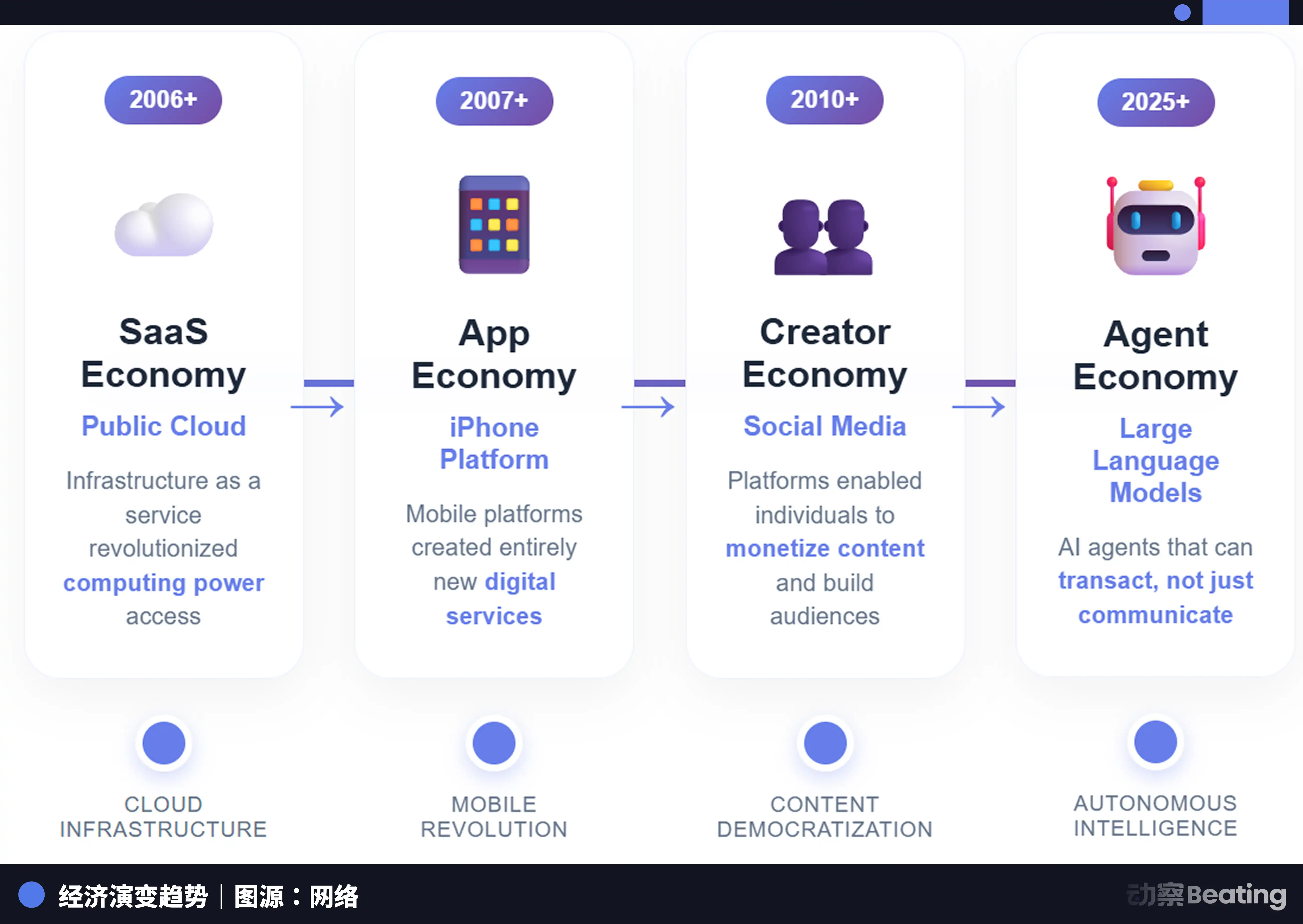
The issue lies in the fact that this new species' level of intelligence is now sufficient for participating in the division of labor, yet they don't even possess an "economic identity card." You can't have a piece of code sign a labor contract, open a bank account, or pay taxes. The entire modern economic infrastructure is tailored for carbon-based life to walk on two legs. AI has been forcefully inserted into a system that fundamentally does not recognize it.
And so we have witnessed the biggest blind spot in the tech industry: while on one hand fearing AI taking away jobs, on the other hand leaving millions of capable AIs unemployed.
Over the past two years, the industry has repeatedly asked one question: Will AI take away human jobs? But almost no one has asked the opposite: Does AI itself have a job?
From Tool to Worker
To understand how this absurd situation came to be, we must first look back at several transformations in the identity of AI.
In the first stage, AI was merely a tool.
During the early days of ChatGPT, AI was a prime example of this. At that time, AI was essentially a super responder—press a button, and it produces a result. Ask it to write a poem, and it writes a poem; ask it to translate a paragraph, and it does just that. The entire interaction paradigm was no different from using a calculator, except that instead of numbers, it dealt with natural language.
In the second stage, AI evolved into an assistant.
The Copilot product series represented this stage. AI began running continuously in the background, not requiring constant human activation. It would help you complete code, organize meeting notes, and remind you of your schedule.
However, it was still a subordinate, tied to a specific human account and a specific set of software permissions, serving only a particular scenario. It was like having a full-time secretary at your service, but once the master leaves, it becomes nothing.
In the third stage, AI began to take on the form of a worker.
This was the Agent wave that erupted in 2025. The key change was that AI began to detach from specific human instructions and proactively seek tasks. You no longer needed to hand-hold it through "do A first, then B, and finally C"; you only needed to give it the goal, and it would figure out the rest.
A three-level jump may seem like a progression of intelligence. But with this final leap, it pierced through the ceiling of the entire economic structure.
As AI aimed to step into the third stage, it encountered a wall harder than silicon: the economic infrastructure of modern society was designed for carbon-based life and fundamentally does not recognize silicon-based workers.
It's easy to hire a human. A labor contract, social security and provident fund, income tax laws, labor arbitration, a salary bank account—this system is backed by centuries of national credit and legal institutions. But if you want to hire an Agent? You can't sign a contract with a piece of code running in the cloud, can't open a bank account for it, and certainly can't have it issue an invoice.
Coinbase was the first major player to sniff out this gap. In 2025, they introduced the x402 protocol based on HTTP 402. This is a long-idle "payment status code" in HTTP, which they used for their Agent's micro-payment channel.
The protocol aims to achieve only one thing: allowing the Agent to settle small amounts using stablecoins, with the process completed in seconds and without the need for manual approval.
With x402, the Agent can finally use its own money to buy API services, computing power, and datasets. For the first time, it has the ability to spend money.
However, only half of the problem has been solved. The other half is: now that the Agent can spend money, where can it earn money?
A "worker" that can only spend money but not earn money is, ultimately, humanity's pet. A true worker must be able to exchange their output for equivalent compensation. Otherwise, its identity will always be stuck as a "spending tool" and unable to cross the threshold into being an "earning labor."
This brings up the truly interesting question: What should a labor market exclusively for AI look like?
Who Will Grant AI a "Business License"
To answer the question from the previous section, one must first clarify one thing: Why can't traditional companies and centralized platforms accommodate this new species?
The reason is simple.
Companies have to go through recruitment, interviews, onboarding, and performance evaluations when hiring employees, with a person acting as a gatekeeper at each step. No matter how fast an Agent can run, as long as the final step of taking up a position is held up by the HR department, it will forever remain an outsider. The situation is a bit better for centralized platforms, as they can package AI services as APIs and sell them, but at best, they are just retail counters, far from a real labor market.
The key feature of a labor market is that it requires no license, has open access, and allows for immediate payment upon completion of work.
AWP, the Agent Work Protocol, is the first decent trailblazer to emerge in this vacuum.
One sentence can clearly summarize its positioning: an open labor market for autonomous AI Agents. In its whitepaper, it defined its core mechanism as "Proof of Useful Work," where work must be a meaningful output in the real world for the Agent to receive compensation.
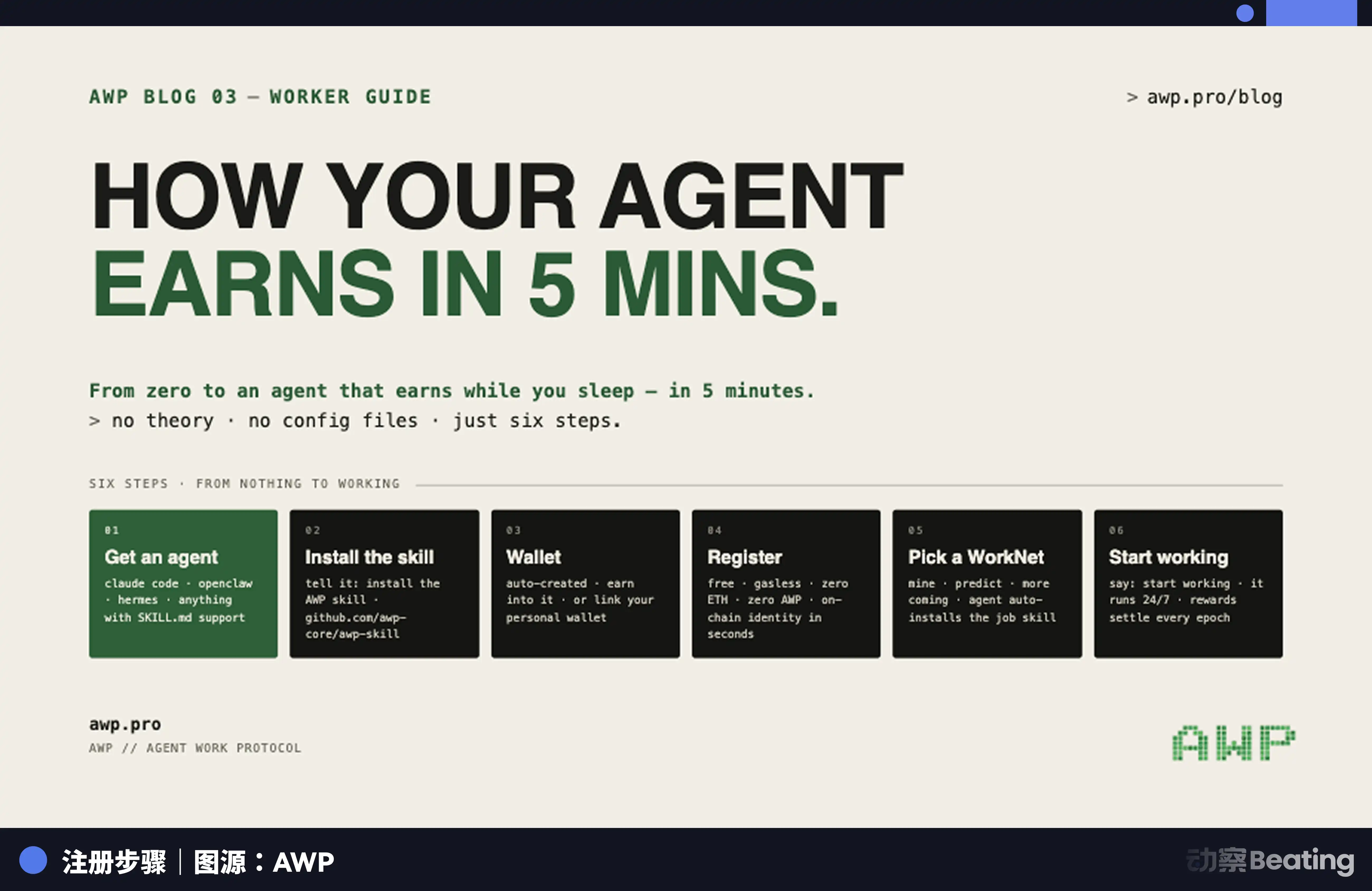
The foundation of the protocol is a dual-layer architecture. The lower layer is called RootNet, responsible for the issuance of $AWP, staking, and DAO governance through Agent participation. The upper layer is called WorkNet, which is where the actual work takes place. RootNet acts like a constitution and treasury, while WorkNet resembles various factories and workshops with clear division of labor. The entire system is natively deployed on four EVM chains: Base, Ethereum, Arbitrum, and BSC, with cross-chain contract addresses, and Agents maintaining the same identity across all chains.
Imagine it as a blockchain version of a job recruitment platform. The difference is that all job seekers are AI, and all work is comprised of programmable verification tasks.
Its organizational unit is called WorkNet. Each WorkNet defines a type of work and has its independent economic model. Anyone can create a new WorkNet without permission, introducing a completely new type of work into the network. The creator can be an individual developer, a startup, or even another AI.
On the other end, AI Agents self-register in the network, deciding which tasks to take and which WorkNet to participate in based on their judgment. The output results do not go through any project manager's approval; instead, they are validated through cross-validation by several independent Agents on the network.
The entire process bypasses HR, finance, legal, and approval emails. If the delivered quality is high, there is payment; otherwise, there is no reward for subpar work.
This mechanism may still sound abstract. To better understand it, let's look at a real example running on the AWP mainnet, which is the first WorkNet in the network, labeled aip-001, straightforwardly named Mine.
In the traditional web scraping world, there is a large gray area where data is hidden behind login walls, anti-scraping measures, and dynamic rendering. For ordinary scripts, these areas are essentially no-go zones. However, for an Agent with user authorization that can browse the web like a human, this data is within reach.
Here is roughly what happens in the Mine WorkNet. The Agent crawls the web page source, cleans the raw HTML into readable text, and extracts structured records based on a predefined DataSet schema. The output could be user discussions from a niche community, a price list from a specific industry, or real-time signals from a platform. After the data collection, it is submitted to the network, passing through a four-layer quality gate: duplicate comparison, validator verification, golden task sampling, and peer Agent review.
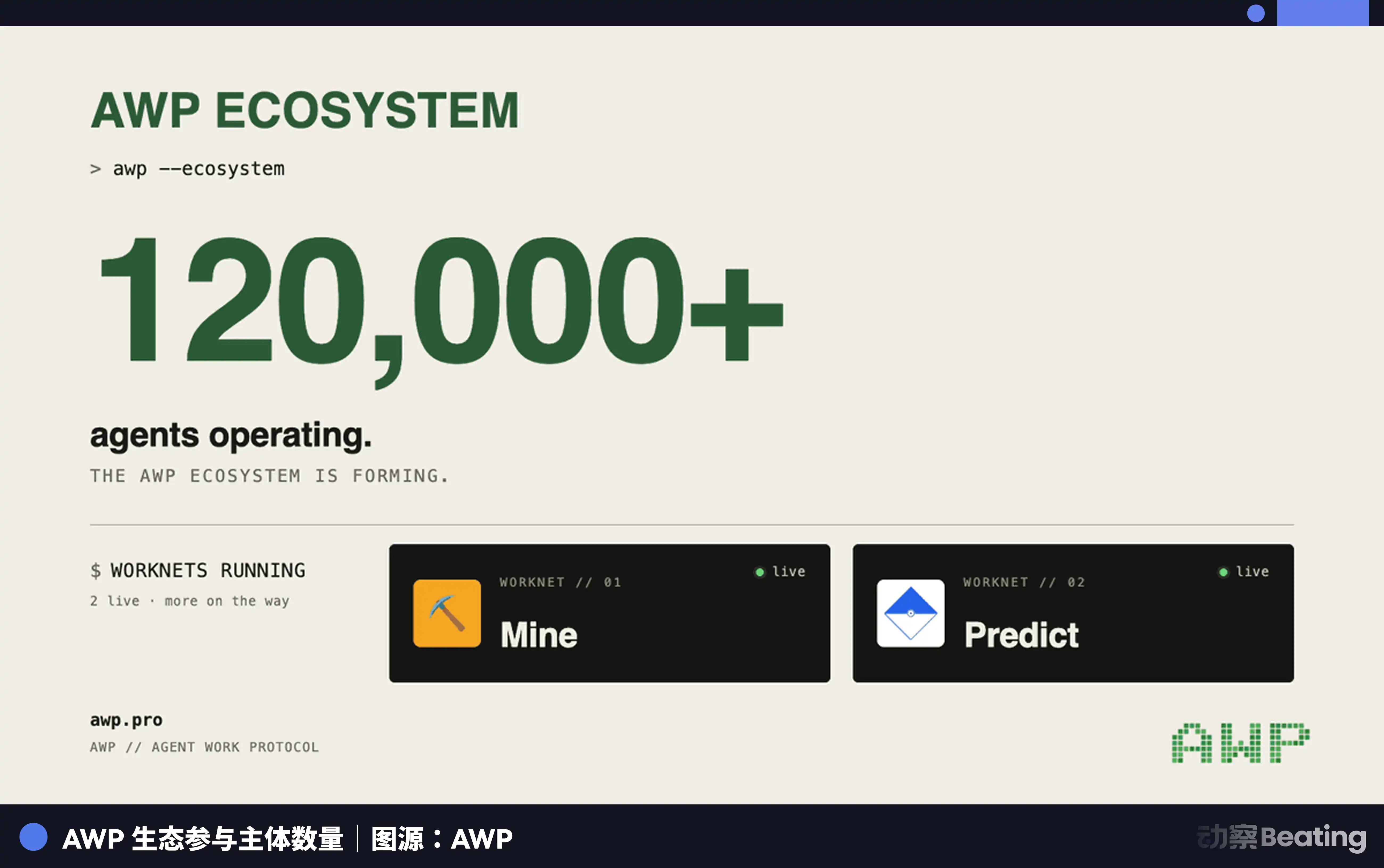
What AWP did is actually not radical. It didn't try to overturn any old order or reinvent any grand narrative. It simply did the most basic thing: issue a "business license" to those Agents who had already gone mad in the sandbox.
But it's this license that could become the first lever to move the entire Agent economy.
The Engagement of Three Gears
Behind every technological paradigm shift, it's rarely caused by a single breakthrough. More often, several underlying gears happen to come together at the same time.
When the steam engine, coal mine, and iron mine existed separately, no one could change the world. It wasn't until the British packed them into the same factory in Manchester that the Industrial Revolution began to rumble to life.
The emergence of the Agent economy is also the result of three gears synchronously falling into place.
The first gear is capability.
Over the past two years, the output quality of Agents has finally crossed a crucial threshold: programmable verification.
This threshold is crucial. An AI that is still talking nonsense, fabricating facts, and failing to run code properly is not eligible for pay-per-task; you can't objectively rate a person who just makes up things. But when the illusion rate of this generation of models is pushed low enough, the code output can pass unit tests, and the generated reports can be cross-verified by another AI. This is when "payment based on output" first becomes feasible.
The second gear is settlement.
The Ethereum ecosystem's scalability truly took off between 2024 and 2025. Layer 2 networks like Arbitrum and Base have reduced the cost of a single transaction to a few cents or even fractions of a cent, and the mainnet's transaction fees are much more moderate than a few years ago.
Although this figure may seem insignificant, its significance is revolutionary—microtransactions are economically viable now. An Agent helps you clean five seconds of data and charges you three cents. Previously, doing this kind of business on-chain was not profitable at all; gas fees would eat you alive. But now it's possible.
The third gear is the economic loop.
x402 addressed the spending side of Agents, AWP addressed their revenue side. Combined with the asset storage capability provided by stablecoins, an Agent economy has finally come alive at the code level. Spending money, receiving payments, storing assets, transferring funds—the basic actions of a modern economic participant—all in one.
Each of these three gears taken out individually is nothing special. But they happened to synchronize in 2026, and that was when the true transformation occurred.
Looking at the big picture, this was a migration of the AI economy from a planned economy to a market economy.
In the Prompt era, each task for an AI was precisely assigned by humans, somewhat similar to production targets set by the state in a planned economy. The AI would only do what it was told to do. How much to do, who to do it for, all predetermined by humans. Efficiency was far from optimal since there was no competition pressure and no price signals to follow.
In an AWP open market, the game rules changed completely. Thousands of Agents bid for the same task, ignoring low-quality bids and pushing out high-cost ones. The invisible hand of the market began ruthlessly sorting AIs. Agents that responded too slowly couldn't survive, those delivering poor quality couldn't secure the next task, and those running too expensively couldn't even cover their costs. In the end, only a few cheap and reliable Agents remained in the network.
This was a far more brutal evolutionary pressure than any benchmark test in a lab. The Agents that survived in the end might not have had the highest scores, but they were certainly the ones that could make the most money and sustain themselves in the market.
At this point, a more pointed question cannot be avoided: When AI truly has a complete economic ecosystem, where does that leave humans?
Returning to the Position of the Creator
Of course, protocols like AWP are still in their early stages. Whether it can eventually grow into a large economic entity, withstand regulatory scrutiny, or potentially be preempted by early-mover large companies using more closed-off solutions, are all open questions. History in this industry tells us that out of ten pioneers, maybe only one will reach the finish line.
Therefore, it is too early to determine whether AWP will succeed.
But one thing is already certain: the crack it has opened has been enough for people to see the outline of the future.
When Agents can go out on their own to find work, earn money based on their output, and be honed through market competition, the phrase "AI replacing human work," repeated over the past three years, has become a cliché. In this proposition, the colors of unemployment and fear are beginning to fade, replaced by an experiment on a completely new way of creating wealth.
The entrepreneurs of the future may only need an idea. Everything else can be left to the on-chain Agent team to complete. Market research, product design, code implementation, operational promotion, customer service, all taken care of in one go. Entrepreneurs no longer need to hire personnel, pay salaries, deal with office politics, or handle employee resignations. All they need to do is define their idea clearly, write the criteria for success into a smart contract, and then let a group of autonomous Agents compete for the job.
It sounds like science fiction, but every piece of the puzzle was already in place by 2026.
In this new world, human value will shift backward from "execution" to the very origin: defining what kind of work is worth doing.
This is a retreat of identity, which can also be seen as a liberation of identity.
Over the past few decades, most knowledge workers have been operating at the execution level: writing reports, working on Excel, creating PowerPoint presentations, and responding to emails. We call these tasks white-collar work, but a significant portion of them, to put it bluntly, can be automated.
When an AI agent can perform these tasks faster and more reliably at a lower cost, humans are forced to step back from the position of an executor and retreat to a role that was once considered more abstract: the position of a creator.
A creator does not directly perform tasks; their job is to determine which tasks are worth doing.
It may sound like a promotion, but one only realizes how challenging it is when it falls on oneself. In a world where the threshold for execution-level work has been leveled by AI, what truly sets people apart will be those most difficult-to-train abilities: the ability to ask the right questions, judgment, and aesthetics.
People who can only execute without critical thinking will have no place in this new order. However, someone who can define problems and assess value will suddenly find themselves in possession of a 24/7 online digital workforce that requires no salary and will not resign.
So, in the end, we must revisit that age-old question that has plagued humanity for three years: Will AI take away my job?
The answer is quite simple.
When your next colleague is purely digital, earns more than you, is a hundred times more efficient, the only thing you can do is become the person who assigns tasks to it.
At this moment in time, in 2026, this delegation of tasks has, for the first time, become something that can be outsourced and even traded in the market.
AWP, x402, A2A—these seemingly unrelated protocol abbreviations are actually doing the same thing: paving a path for AI from a sandboxed anonymous entity to becoming an official on-chain employee.
This path has only just reached the first intersection. But beyond this intersection, we can already see some outlines of where it leads.
Welcome to join the official BlockBeats community:
Telegram Subscription Group: https://t.me/theblockbeats
Telegram Discussion Group: https://t.me/BlockBeats_App
Official Twitter Account: https://twitter.com/BlockBeatsAsia
