TechFlow Summary: a16z partner Joe Schmidt IV's article directly targets Workday, the HR software giant with nearly $10 billion in annual revenue: the moat appears deep, but the underlying architecture remains stuck in 2005, and AI band-aids won't help.
The article breaks down why Workday's four-layer defense system (integrated binding, proprietary configuration, consulting ecosystem, multi-year contracts) is simultaneously loosening and provides six key product features and implementation paths for an AI-native HCM system. This is a typical a16z investment thesis public post, clearly calling on entrepreneurs: come build the next generation Workday.
Workday is arguably the most important product in enterprise software, yet also the least liked. Over 10,000 companies use it, tens of millions of employees are trapped in it daily, with annual revenue nearing $10 billion and a market cap of around $30 billion.
These numbers have nothing to do with how user-friendly the product is. The daily life of an HR administrator is like this: running reports across three pages because the system is too complex to run payroll cycles outside of Excel, staring at Zoom guiding business partners through promotion processes step by step, waiting for IT to explain which integration blew up this week.
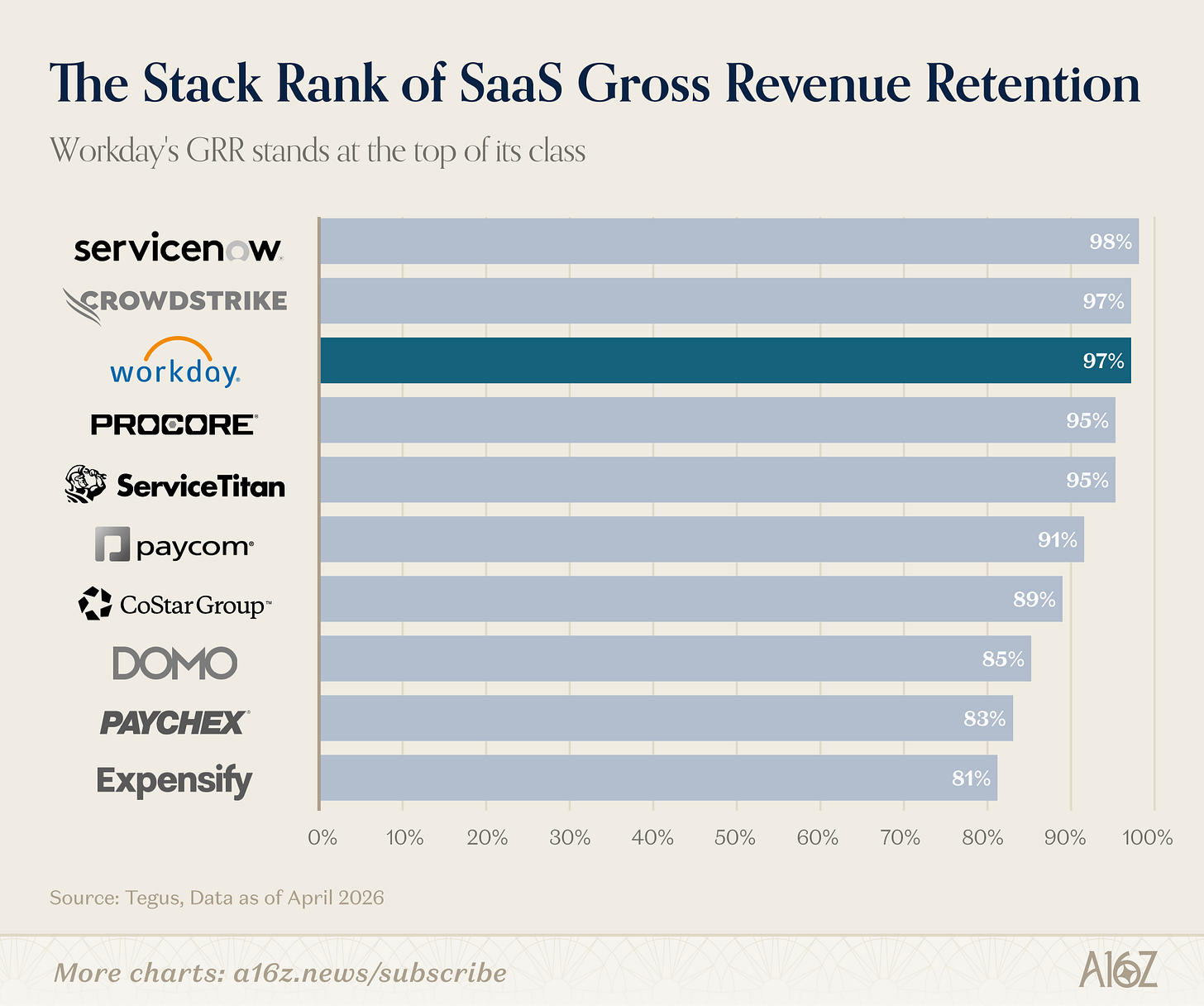
A customer renewal rate approaching 100% would typically indicate a user-friendly product. But Workday is different—its high renewal rate is because users are stuck.
HCM (Human Capital Management) is the last category in large enterprise software without a native AI challenger.
This situation is about to change. A transformation larger than the platform migration that birthed Workday is happening, and Workday's days are numbered.
Cloud Migration Birthed Workday
Workday itself is a product of platform transformation. In 2005, PeopleSoft's then market leader and its two founders, Dave Duffield and Aneel Bhusri, wagered that migrating from the C/S architecture to multi-tenant cloud would reset the HRIS (Human Resources Information System) category.
They believe that Oracle and SAP are falling behind in architecture, and within ten years, all C/S architecture HRIS systems will become legacy maintenance businesses. At the same time, they see large enterprises transitioning from large upfront capital expenditures to predictable annual operating expenses, moving from perpetual licenses and self-hosted data centers to a subscription model.
Workday has won on two fronts simultaneously: it is the only mainstream HRIS designed with a multi-tenant cloud architecture from day one, and its pricing model happens to align perfectly with the enterprise shift to a subscription-based model. Within ten years, it has become the default choice.
Why Is Workday So Tough to Disrupt
Over the past two decades, every serious attempt to penetrate the enterprise-level Workday market has failed, for the same reason: Workday's moat lies not within the product itself but in everything surrounding the product.
Deep Technical and Human Bindings. Workday is at the center of hundreds of integrations—payroll, benefits, ATS (Applicant Tracking System), expenses, identity management, finance, state taxes—and none of them can be cleanly migrated. Each instance has accumulated thousands of hours of muscle memory: an administrator running the same performance cycle for four consecutive years, a payroll manager memorizing a seventeen-step performance payout process.
Adding a new cost center ripples through reports, integrations, job structures, compensation grades, and benchmarking systems, and only when all systems and people are updated in sequence can it work seamlessly.
Proprietary Configuration Layer. Workday's way of configuring is different from most enterprise systems. Integrations are built using Workday Studio—an in-house tool with an implementation timeline of 6 to 18 months, requiring certified consultants to operate. Reports run on Workday's own BIRT implementation, calculated fields use Workday's own expression syntax, tenant configurations go through the platform's unique business processes and security frameworks.
These skills have no market outside the Workday ecosystem: no open-source community, no Stack Overflow, developers and the customers who hire them are all locked into their own resumes.
Consulting Cartel. Over 10,500 certified consultants globally are spread across Accenture, Deloitte, Kainos, PwC, KPMG, and over 150 small service providers working on Workday implementations. A project takes 6 to 18 months, costing from $300,000 to over $1 million, with implementation fees typically equaling 100% of the annual software fee.
This service-oriented economy may be worth more than the product itself—it handles Workday's lobbying, absorbs customer complaints, and ensures that the world's largest companies have a vested interest in maintaining Workday.
Multi-Year Contract Lock-In. Workday locks customers into multi-year contracts. Even if a customer wants to switch tomorrow, they are structurally forced to wait until the contract expires.
Four-layer stickiness, Workday's net revenue retention rate in enterprise software is one of the highest, making it one of the stickiest products for most large enterprises.
Why Now Is the Window of Opportunity
Some may say, "It's been twenty years, challengers come and go, but Workday remains untouchable." They're right. New players either go after startup customers (following Rippling and Gusto's path) or tackle challenging niche markets (like Deel in cross-border employment).
Workday hasn't been idle either. By 2025, under the Illuminate brand, it released over 25 AI features, launched over a dozen smart bodies, acquired Sana Labs and Pipedream, introduced usage-based Flex Credits pricing, signed on Accenture, Nike, Merck. AI ARR surpassed $400 million, growing triple digits year over year.
But Flex Credits and "AI ARR" resemble more of a procurement innovation than a product innovation. Signing Flex Credits and running core HR processes with smart bodies in a production environment are two different things.
The reason behind Flex Credits is quite practical: in every enterprise CIO and CFO's 2026 KPIs, there is a line for "AI investment" that needs actual expenditure to prove it; in every traditional software vendor's earnings call, "AI revenue" is the first number asked about.
Flex Credits is a procurement structure needed by both parties—customers commit to a credit pool to account for AI spending in the budget; Workday records the commitment as AI ARR; as for which smart bodies will run which processes, that's a discussion for when Illuminate releases something useful. Both sides meet their KPIs, no one needs to commit to specific deployments, and then they all celebrate the signing together.
Don't just take our word for it. A large Workday service partner recently wrote, "Most organizations are unaware of these capabilities, let alone how to activate them." Customers have begun to push back against paying incremental token fees on top of already renewed subscription fees.
Long-time Workday administrators we've spoken to describe Illuminate as: the same manual work but with a chat interface on top. Each Illuminate feature is an additional layer stacked on the same form approval engine—AI ARR can grow by triple digits, but the underlying product remains static.
But this time is different. Three variables have changed simultaneously, finally exposing Workday's soft underbelly.
First, enterprise IT is finally reevaluating core systems. Large enterprises are conducting AI readiness assessments on systems such as ITSM, ERP, HCM, which they thought could be locked in for a decade.
The rapid pace of change in the AI technology stack has turned old architectures into liabilities. A company looking to lead in AI cannot rely on an HRIS designed in 2005. When the CHRO and CIO ask, "What does the AI-native version of this thing look like?" and Workday's answer is selling consumer credit on the same engine, that's the opening.
Second, the tools for rebuilding are now in place. The same motion is happening one layer up in the enterprise tech stack: companies like Tessera are already doing AI-native SAP migrations at Fortune 500 scale—ERP complexity is an order of magnitude higher than HCM, a single ECC to S/4HANA upgrade could cost $700 million and take three years.
HCM poses a similar problem but on a smaller surface area. Plus, with the vendor-owned front-end deployment service team (rather than Accenture), the implementation layer is no longer the moat it used to be.
Third, Workday can't contain the breach from within. The company is betting on three fronts: Illuminate is the intelligent body product customers want, Sana is the new "work entry point," and the upcoming Agent System of Record is the governance layer for the enterprise intelligent body.
All three are stacked on the same form approval engine—the engine is powerful, but it's a two-decade-old legacy infrastructure, making configuration and customization challenging, unable to keep up with the actual needs of modern HR organizations. Placing AI on top cannot change the core.
Workday's true underlying asset — a trillion-level transaction dataset — sounds substantial, but what really matters at runtime is how data connects to workflows, permissions, and integrations, and every layer of this tech stack is now a liability.
Workday can plaster AI on top, but it can't become AI-native without a rewrite — which is exactly the thing a public company, an install base-driven company, can't do.
As we've discussed, the Fortune 500's system replacement cycle is about to open up for the first time in twenty years, driven by an enterprise AI re-platforming wave. There is currently no next-gen HR solution designed at the Fortune 500 HRIS system level. This is a unique opportunity, and the target is precisely the enterprise market where Workday makes the most money — a market where all previous challengers have failed.
What an AI-native Workday Should Look Like
We believe the opportunity lies in head-on competing with Workday's HCM business to build an enterprise AI-native HR system for the next twenty years.
The product we want to invest in has six key features:
1. One-month deployment. Implementation is Workday's biggest weakness and the core reason why enterprises don't switch systems.
A true enterprise Workday implementation needs to cover payroll taxes in all 50 U.S. states, cross-border payroll in over 60 countries, ACA and SOX compliance controls, various pitfalls of benefit providers, union agreements, Workday Studio, BIRT reports, Extend configurations. No one person knows everything, and most projects run for 12 to 18 months because fragmented knowledge is spread across a dozen experts and must be scheduled and coordinated one after another.
The coding agent flattens this fragmentation. An AI agent can ingest the entire tenant (business process definitions, integration definitions, audit logs, payroll batches) and reconstruct rules in natural language, cross-check real-time integration validation, retain edge cases, and generate a configuration draft in a few days. Today's Workday is configurable within the boundaries it allows, an AI-native HRIS should be customizable according to the company's actual policies, completed by the coding agent, a task that consultancy firms used to quote in six figures.
2. Built-in HR Dashboard. The best HR administrators are essentially product managers — they know what CHRO truly needs in terms of cross-system reports, what a compensation planning tool should look like, and what the onboarding experience should feel like.
Today, these tasks cannot be accomplished within a single role. Cross-system data pull requires a data warehouse and data team to perform mapping, setting up a real workflow or application requires developers or a Workday Extend contract. The Workbench compresses all these into a smart body native interface: asking a cross-system question yields an answer, describing an application in natural language generates a usable version, proposing a process change provides a preview of the impact.
The HR teams we've engaged with have already been attempting to build such applications themselves—such as a manager onboarding process that automatically drafts a JD, assembles a 30-60-90 day plan, coordinates IT for account and device setup.
3. Smart Body First. In addition to having a portal, employees should interact with HR within their daily tools. An employee traveling to Milwaukee should be able to ask who else from the company is within 50 miles in Slack and get the answer in the same conversation.
A manager approving leave should directly see the employee's complete context (balance, recent leave, upcoming leave, team coverage) within the approval interface, without having to navigate to another dashboard. Consider a more complex scenario: establishing a new business unit. Today, within Workday, this takes several weeks: setting up a new cost center, job structure, staffing plan, benefits configuration, payroll integration, approval workflows.
In an AI-native system, an HR operations lead should be able to describe in natural language (500 people in Austin and Dublin, reporting to this EVP, these job families, this salary band), and the system automatically maps all dependencies, highlights downstream changes, generates configuration and deployment plans in one go. Moreover, data should flow bidirectionally: HR data should drive organization-wide smart body processes, not be locked within HRIS.
4. Openness. Integrating a new payroll provider involves 6 to 12 months of custom integration through Workday Studio; adding a benefits administrator is a similar story; pulling data into a BI tool requires engaging a consulting firm.
The frontline staff we've engaged with are not waiting—they're building Claude MCP to pull data from Workday into tools they actually use, routing approvals for custom-built applications through Slack, treating Workday as a read-only system.
What these teams truly desire is an inherently open HRIS: their own smart body should be able to directly access the HR data model, APIs should not be hindered by credit pools, and the integration layer should treat integration as a first-class product. The ecosystem's appeal comes from building the best smart body builder on top of the data—this is where work gets done the fastest.
5. Security and Permissioning at the Entity Layer. HR data is the most sensitive within a company (compensation, performance, sick leave, PII), and the AI entities handling this data require system-native fine-grained access control.
The manager AI entity should see team compensation, while individual contributors should not. An external recruiter AI entity should see open positions but should not have access to offboarding compensation history.
Getting the permissioning right for each AI entity is the tipping point for whether AI can genuinely touch production HR data or be blocked by security policies at the door – a transformation that is nearly impossible on a non-native architecture.
6. Always-On Compliance. The regulatory surface area around HR data (EU AI Act, GDPR, data residency) is expanding faster than any single administrator can keep pace with.
Internally at Workday, staying compliant involves a senior HR leader reading newsletters and hoping nothing is missed.
The AI-native tech stack flips this logic: an always-on AI entity monitors regulatory changes in each jurisdiction, flags what needs to be updated within tenants, and drafts configuration updates. This would have been hard to retrofit on a 2005 architecture but is inherently feasible on a 2026 architecture.
Getting Started
It takes time to build out all six characteristics. The starting path looks like this:
Engage a few Fortune 500 design partners who are currently conducting AI readiness assessments on their HR tech stack. Begin by using mapping and migration tools to extract enterprise-specific and region-specific rules and edge cases from their tenants, then start automating the manual work piling up around Workday (compensation sheets, performance handovers, ticket queues). Dive into full system replacement when it's on the agenda.
Business architecture is crucial here. Workday's multi-year contracts lock in the HRIS budget, but HR organizations within the Fortune 500 have adjacent budgets that are not locked in: HR operations, HR technology, transformation, innovation, consulting.
A well-scoped implementation project or automation subscription can smoothly sell into these budgets, with a proper SOW and procurement process, without the immediate confrontation of renewing with Workday. By the time the renewal window truly opens, the company is already inside the tenant, already delivering value that the CHRO can leverage.
At that point, the issue is no longer "trying a vendor we haven't heard of," but "expanding our already trusted vendors into the budget anyway."
There is another factor: Workday will leverage its product suite to crush startup competitors.
Most of Workday's Fortune 500 tenants are full-suite (HR, Finance, Payroll, Adaptive Planning). CIOs will not rip out the entire tech stack for a challenger that only does HR. The best strategy is what Workday did to PeopleSoft back in the day: enter from the most leverageable point, do collaborative integrations in adjacent areas of the customer's existing systems, and do native builds in strategic directions.
New players can take the client's existing Finance and Payroll instances as stable integrations supported from day one, replace the Workday HR modules that clients truly dislike (performance, compensation planning, organizational restructuring, natural language reporting), and evolve the platform over time into the remaining areas. Sales kick off with continuity: payroll continues to run smoothly, integrations keep flowing, and renewal cycles do not cause operational gaps.
Each step is gradually dismantling a layer of defense: native intelligent workflows replacing twenty years of muscle memory, natural language configuration retiring XpressO, front-loaded deployment teams bypassing the consulting cartel, adjacent budget wedges neutralizing years of lock-in.
Don't Expect Workday to Sit Back
Workday is already mobilizing. In the past fourteen months, the company has laid off over 2,100 employees, with co-founder Aneel Bhusri returning as CEO with a clear AI transformation mission. A $30 billion market cap company with over 10,000 customers and a service ecosystem possibly larger than the product itself will not just stand by.
The full playbook can be expected: aggressively bundle Adaptive Planning, Payroll, and Finance Cloud to make HRIS renewals look like a CFO-unbundled package; unleash significant renewal discounts in the middle of the challenger evaluation period; have consulting partners with a seven-figure Workday business spread FUD.
Create contract friction around data migration when customers attempt to export tenants, accelerate acquisitions as challengers gain real traction. While these actions do not solve the underlying architectural issues, any one of them can slow down a partner-designed project for a quarter—an underestimate of the cost of this battle will burn the runway for the challenger.
The argument holds not because Workday won't fight back, but because the architecture it would fight back with can't be rebuilt for what the Fortune 500 truly needs.
Opportunity
HR software is one of the few remaining tracks in enterprise software: the incumbents have vulnerabilities, the architecture needs a rewrite, buyers are actively looking for alternatives. The global HCM software market is over $40 billion and growing, with Workday alone hitting a market cap close to $80 billion just two years ago. We believe the AI transformation will birth a bigger company.
And the bet is bigger than the business itself. As enterprises move to a hybrid human and machine model of work, with HRIS running on the same system, HRIS becomes the operating system of the company— who reports to whom, who has what permissions, who gets how much pay, who's responsible for what, who's in compliance. Building all this on a 2005 architecture puts a ceiling on how much AI the entire company can deploy.
Right now, somewhere, an HR admin is manually entering 17 compensation adjustments from an Excel sheet into Workday's performance cycle, with a business partner on Zoom making sure she didn't select the wrong job code.
It's happening today in every Fortune 500 company, using products that cost the company millions annually. Someone will eventually build the next-gen Workday— a system designed for machines, not form approvals. Once built, no one will look back.
Welcome to join the official BlockBeats community:
Telegram Subscription Group: https://t.me/theblockbeats
Telegram Discussion Group: https://t.me/BlockBeats_App
Official Twitter Account: https://twitter.com/BlockBeatsAsia
