Leopold Aschenbrenner's position has once again skyrocketed. As a hedge fund rookie, his investment thesis is being validated by the market.
Over the past few days, several stocks in Leopold's Situational Awareness LP portfolio have seen significant gains: Bloom Energy, Cipher Mining, Intel, Applied Digital, SanDisk, IREN, and other assets experienced daily increases of over 10%. This led the market to revisit his 13F report from the end of last year, attempting to understand why this former OpenAI researcher was able to early-spot the AI infrastructure trend.
His noteworthy approach lies not in the "young" and "wealthy" narrative tags but in the fact that he has provided a framework different from mainstream AI investments. While most people equate AI investment with companies like NVIDIA, Microsoft, OpenAI, and their modeling capabilities, Leopold's portfolio has bypassed the most crowded star assets and turned to Bloom Energy, CoreWeave, Core Scientific, Lumentum, Intel, Bitcoin mining firms, and power-related companies.
The AI narrative is shifting from "whose model is stronger" to "who can support the continued expansion of models." Training and inference require GPUs, GPUs require data centers, data centers require electricity, land, cooling, fiber optics, permits, and long-term power contracts. Leopold's bet is on the physical bottleneck that AI must overcome to continue growing. Fortune has also summarized his latest positions as follows: the former OpenAI researcher is translating his AGI thesis into a multi-billion-dollar bet on electricity, AI infrastructure, and crypto mining firms.
In early March, Dynam-Beating conducted an in-depth analysis of Leopold and his fund's positions and investment logic, sharing his vision of the future of AI competition. And all of this is being corroborated in reality: the AI narrative is shifting from models on the screen back to the land and power grid beneath our feet. In the future, the most valuable asset may not be the algorithm itself but the physical world that supports the algorithm's continued expansion.
Below is the original content from Dynam-Beating:
In February 2026, hedge fund Situational Awareness LP submitted its quarterly holdings report, revealing that as of the end of the fourth quarter of 2025, the fund's total market value of its U.S. stock holdings was $5.517 billion.
Wall Street manages trillions of dollars in assets, so $5.517 billion is just a drop in the ocean. However, this fund's AUM was less than $400 million just 12 months ago, and its founder and CIO is a young person born in 1999.
His name is Leopold Aschenbrenner. 27 years old.
Over 12 months, he grew this fund from $383 million to $5.517 billion, an increase of over 14 times. During the same period, the S&P 500 saw only single-digit growth.
What's even more surprising is his portfolio. Opening the quarterly holdings report, you won't find any of the AI darling companies that are usually making headlines in the financial news. Instead, there are companies working on fuel cells, Bitcoin miners who just emerged from bankruptcy, and semiconductor giants that the whole market is abandoning.
He claims his fund is focused on AI, but this doesn't look anything like a typical AI fund's portfolio. It looks more like a madman's shopping list.
But this "madman" also happens to be one of the earliest and deepest thinkers in the world to understand how AI will change the world. Before joining Wall Street, he was a researcher at OpenAI, contemplating how to ensure that AI, once smarter than humans, wouldn't go rogue. Later, he was ousted for saying the unspeakable, wrote a 165-page tome, and prophesied a future that most deemed absurd.
Eventually, he bet his entire net worth on it.
Breaking Down $5.517 Billion: What Did He Actually Buy
To truly grasp Leopold Aschenbrenner's investment genius, the most direct way is to open his holdings report and read line by line.
His largest holding is in Bloom Energy. The holding is valued at $876 million, representing 15.87% of the total portfolio.
This company specializes in fuel cells. More precisely, it produces something called "solid oxide fuel cells," which can directly convert natural gas into electricity with extremely high efficiency. The founder, KR Sridhar, was once an engineer for NASA's Mars exploration program and was named by Fortune magazine as one of the "five leading futurists creating tomorrow."
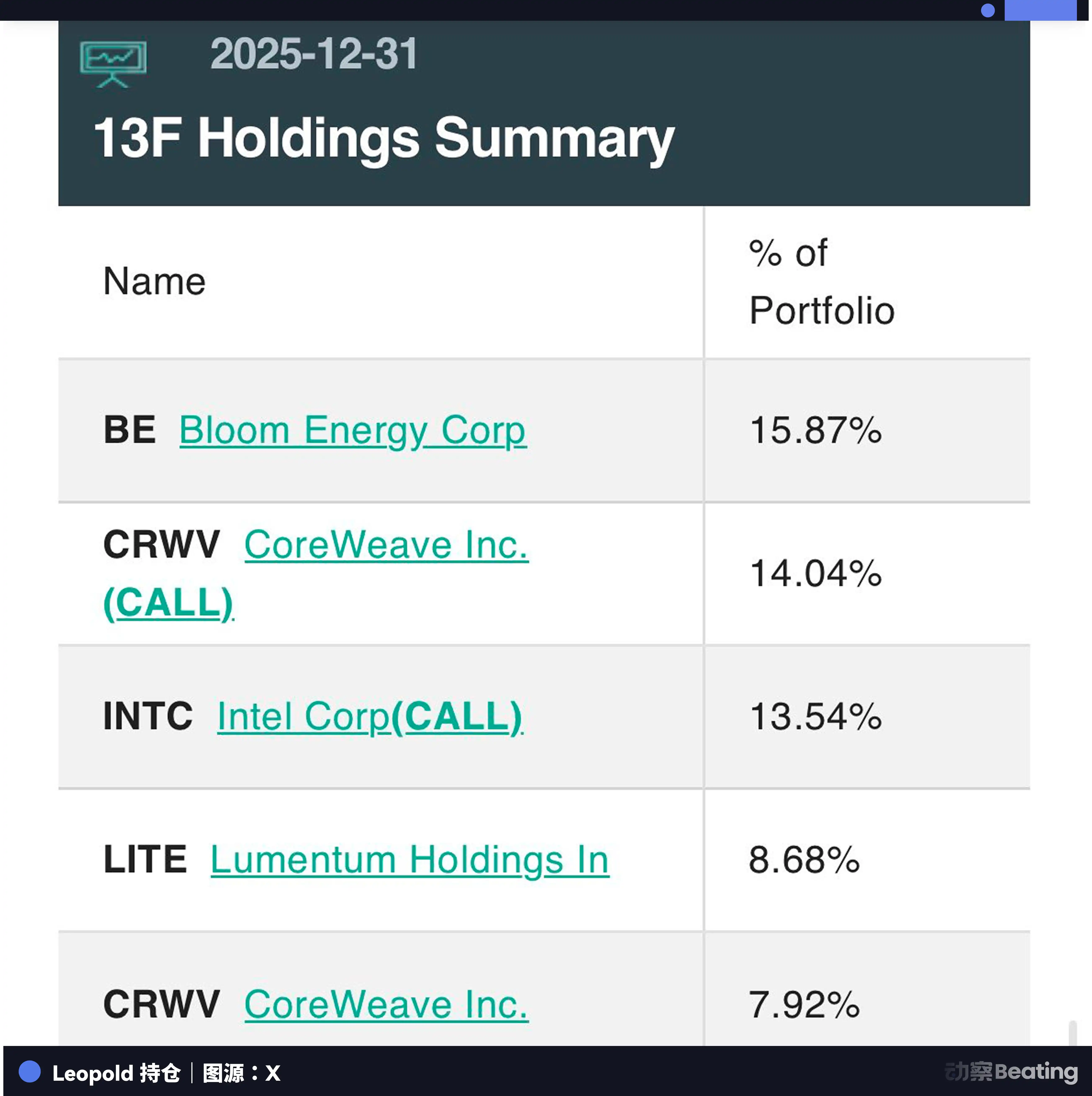
An AI fund that made its biggest bet on a power generation company.
According to Gartner's projection, global electricity consumption of AI-optimized servers will surge from 93 terawatt-hours in 2025 to 432 terawatt-hours in 2030, almost a fivefold increase over five years. The electrical grid power demand of U.S. data centers is set to nearly triple by 2030, reaching 134.4 gigawatts. The U.S. power infrastructure has an average age exceeding 25 years, with many components between 40 and 70 years old, far beyond their design life.
In other words, AI requires more electricity than the entire grid can provide. And the grid itself is so old that it's on the verge of falling apart.
In the AI era, the scarcest resource is not chips, but electricity.
Bloom Energy's fuel cells happen to bypass this bottleneck. They don't need to connect to the grid but generate power right next to data centers, running non-stop 24 hours a day. In 2025, Bloom Energy secured a contract from CoreWeave to provide fuel cells for its AI data center in Illinois.
Speaking of CoreWeave, this happens to be Leopold's second-largest holding.
He holds $7.74 billion worth of CoreWeave call options, along with $4.37 billion in common stock, totaling over $12 billion, representing 22% of the total portfolio. CoreWeave is a GPU cloud provider that transitioned from cryptocurrency mining farms.
In 2017, Mike Intrator, Brian Venturo, and a few others got together to mine Bitcoin. By 2018, the crypto market crashed, and mining was no longer profitable. However, they had a bunch of GPUs on hand. In 2019, they had a lightbulb moment: GPUs could do more than mine; they could also run AI.
So the company pivoted, shifting from mining to becoming an arms dealer for AI computing power. On March 27, 2025, CoreWeave went public on Nasdaq, raising $1.5 billion at $40 per share. A company that crawled out of the mining pit became a core supplier of AI infrastructure.
What Leopold is eyeing is CoreWeave's large number of GPUs and its deep ties with NVIDIA. In an era where computing power is productivity, whoever has the GPUs is king.
But what truly puzzles people is his third-largest holding: Intel. With a position value of $7.47 billion, all in call options, accounting for 13.54% of the total portfolio.
In 2025, Intel is one of the most disliked companies on Wall Street. Its stock price was halved from the 2024 peak, market share eroded by AMD and NVIDIA, and CEOs replaced repeatedly. Almost every analyst is saying Intel is done for.
Yet, at this very moment, Leopold heavily bought call options. This is an extremely aggressive move, betting that it will skyrocket if he's right, but go to zero if he's wrong.
What was his bet on? Just two words: foundry business.
In November 2024, the U.S. Department of Commerce announced that Intel would receive up to $7.86 billion in direct funding through the Chip and Science Act. The sole purpose of this money is to turn Intel into a domestic chip foundry, competing with TSMC.
Against the backdrop of U.S.-China tech decoupling, the U.S. needs a "local" player to manufacture chips. Despite Intel's lagging position, it is the only choice. Leopold's bet is not on Intel's technology but on America's national will.
Now, the subsequent holdings are even more intriguing. Core Scientific, holding $419 million; IREN, $329 million; Cipher Mining, $155 million; Riot Platforms, $78 million; Hut 8, $39.5 million.
These companies share a common feature: they are all Bitcoin mining companies.
Why would an AI fund invest in a bunch of Bitcoin miners?
It's simple because Bitcoin miners have the cheapest electricity and largest data center spaces across America.
Core Scientific has over 1,300 megawatts of power capacity. IREN plans to expand to 1.6 gigawatts in Oklahoma. These miners have long since secured the cheapest power resources globally and signed long-term power purchase agreements to survive the intense hash rate competition.
And now, what AI data centers lack the most are precisely power and space.
In 2022, Core Scientific filed for bankruptcy due to the crypto market crash. It emerged from Chapter 11 in January 2024 after restructuring, shedding about $1 billion in debt, and relisted on Nasdaq. It then inked a 12-year, $10.2 billion deal with CoreWeave to transform its mining facilities into AI data centers. To fully pivot, Core Scientific even plans to sell all its Bitcoin holdings.
IREN (formerly Iris Energy) struck a $9.7 billion AI deal with Microsoft, receiving a $1.9 billion advance payment. Cipher Mining signed a 15-year lease agreement with Amazon. Riot Platforms inked a 10-year, $311 million deal with AMD.
Overnight, Bitcoin miners have become the landlords of the AI era.
Now, let's complete this puzzle.
Bloom Energy provides power, CoreWeave provides GPU computing power, Bitcoin mining companies provide the venue and cheap electricity, Intel offers onshore chip manufacturing capability in the U.S. Add to that the fourth largest holding, Lumentum ($479 million, makes optical components, a key component for interconnecting AI data centers), the ninth largest holding, SanDisk ($250 million, data storage), and the eleventh largest holding, EQT Corp ($133 million, a natural gas producer providing fuel for fuel cells).
This is a complete AI infrastructure supply chain.
From power generation to transmission, to chip manufacturing, to GPU computing power, to data storage, to fiber optic interconnection. He has bought into every link.
And he did something else to make this logic even clearer. In the fourth quarter of 2025, he completely liquidated his positions in Nvidia, Broadcom, and Vistra. These three companies happened to be the biggest stars of the 2024 AI market.
He also shorted Infosys, one of India's largest IT outsourcing companies.
Selling off the hottest AI chip stocks, buying unwanted power plants and mines. Shorting traditional IT outsourcing because AI programming tools are making programmers more efficient, compressing the demand for outsourcing.
Every transaction points to the same conclusion: the bottleneck of AI is not in software, but in hardware; not in algorithms, but in power supply; not in cloud models, but in the physical world.
So the question arises: How did a 27-year-old man form this set of beliefs?
From the Son of an East German Doctor to the Rebel of OpenAI
Leopold Aschenbrenner was born in Germany, where both of his parents were doctors. His mother grew up in East Germany, his father in West Germany, and they met after the fall of the Berlin Wall. This family itself carries a mark of historical rupture—Cold War, division, reunion. His later obsession with geopolitical competition may find its initial seed here.
But Germany couldn't hold him. He later said in an interview, "I really wanted to leave Germany. If you're the kid in class with the most curiosity, wanting to learn more, teachers wouldn't encourage you; they would be jealous of you and try to suppress you."
He called this phenomenon the "Tall Poppy Syndrome," where whoever grows tall will be cut down.
At the age of 15, he convinced his parents to let him fly to the U.S. alone and attend Columbia University.
Attending college at 15 is unusual anywhere. But Leopold's performance at Columbia turned "unusual" into "legendary." He double-majored in Economics and Mathematical-Statistics, won every award available, such as the Albert Asher Green Memorial Prize, the Romine Economics Prize, and was inducted into the Junior Phi Beta Kappa Honor Society.
At 17, he wrote a paper on economic growth and existential risk. After reading it, renowned economist Tyler Cowen said, "When I read it, I couldn't believe it was written by a 17-year-old. If this were a Ph.D. thesis from MIT, I would be impressed as well."
At 19, he graduated from Columbia University as the Valedictorian, the highest honor for an undergraduate. In 2021, amidst a global pandemic, a 19-year-old German stood at Columbia's graduation ceremony to deliver the commencement speech on behalf of all graduates.
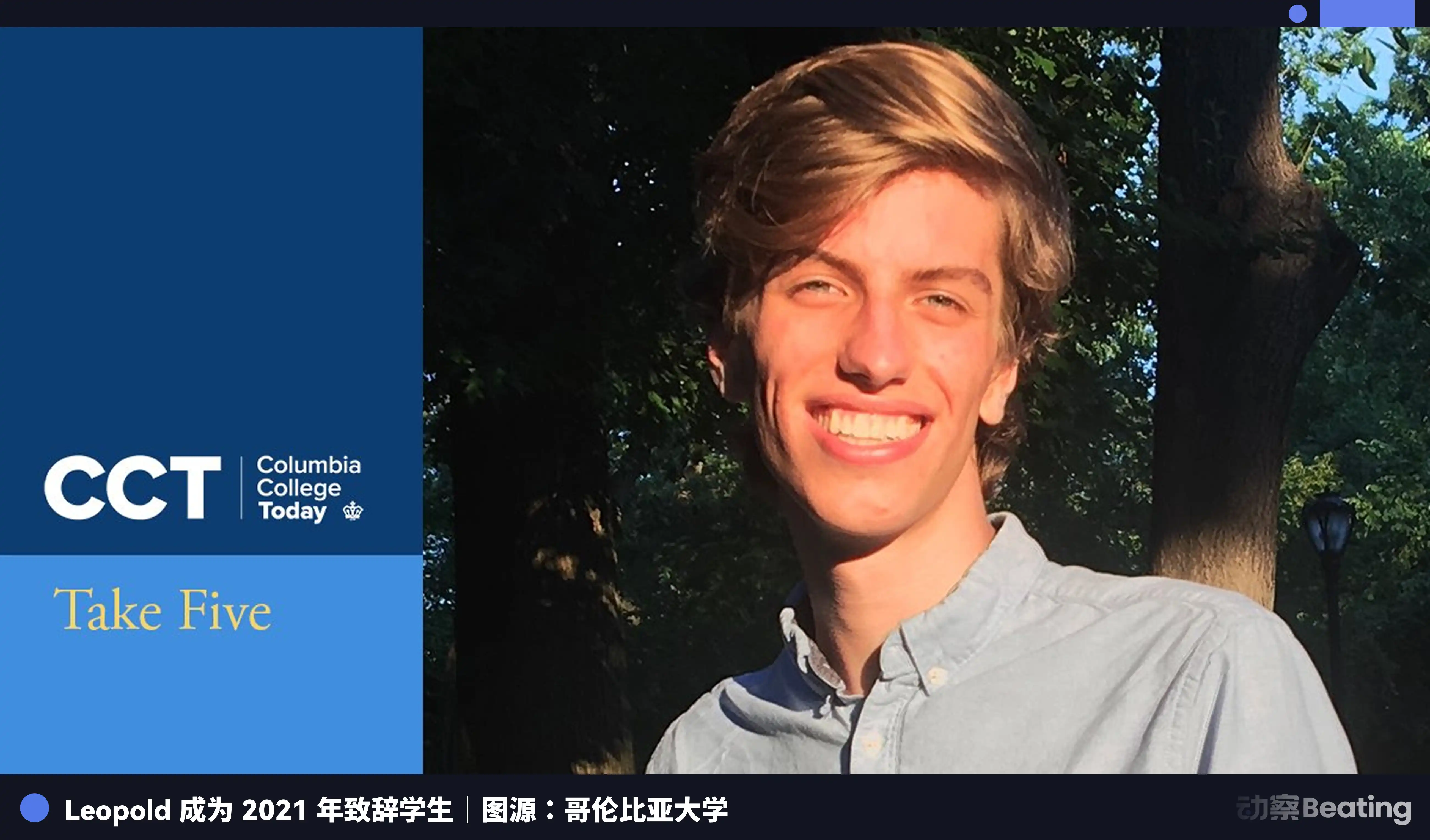
Tyler Cowen gave him one piece of advice: "Don't pursue a Ph.D. in Economics."
Cowen felt the economics academic world had become somewhat "decadent" and encouraged him to aim for greater things. Cowen also introduced him to Silicon Valley's "Twitter weirdo" culture, a group fascinated by AI, effective altruism, and the long-term future of humanity.
After graduation, Leopold first went to the Forethought Foundation, researching long-term economic growth and existential risk. He then joined the FTX Future Fund founded by SBF, working alongside key figures in the effective altruism movement like Nick Beckstead and William MacAskill. His title was "Economist at the Global Priorities Institute at the University of Oxford."
This experience was crucial. It meant that before entering the AI industry, Aschenbrenner had spent several years systematically pondering one question: what kind of events could fundamentally alter the course of human civilization.
And then, he joined OpenAI.
The specific timing is unknown, but he joined a special team - the Superalignment team. This team was established on July 5, 2023, co-led by OpenAI co-founder Ilya Sutskever and Alignment Team Lead Jan Leike. The goal is to solve the alignment problem of superintelligent AI within four years, ensuring that an AI much smarter than humans will still obey human commands.
OpenAI had promised to allocate 20% of its computing power to this team. However, between promise and reality gapes a chasm.
Leopold witnessed some troubling things within OpenAI. He submitted a security memo to the board, warning that the company's security measures were "grossly inadequate" and could not prevent foreign governments from stealing crucial algorithmic secrets. The company's response caught him off guard. The HR department approached him, saying his concerns about espionage were "racist" and "not constructive." The company's lawyers questioned his views on AGI and the loyalty of his team.
In April 2024, OpenAI dismissed him for "leaking confidential information."
The so-called "leak" was his sharing of a brainstorming document on AGI security measures with three external researchers. Leopold argued that the document contained no sensitive information and that sharing such files internally for feedback was a common practice.
A month later, Ilya Sutskever left OpenAI. Three days later, Jan Leike followed suit. The Superalignment team was thus disbanded, and OpenAI's promised 20% computing power allocation was never fulfilled.
A team researching "how to control superintelligent AI" was dissolved by the very company creating superintelligent AI.
The irony of the situation cannot be overstated. But for Leopold, being fired turned into a form of liberation. He was no longer in the employ of anyone, no longer needed to carefully word his internal memos. He could now say what he truly wanted to say to the world.
On June 4, 2024, he published a 165-page article on a website called situational-awareness.ai. The title was "Situational Awareness: The Decade Ahead."
Prophecy of 165 Pages
To understand Leopold's investment logic, you must first decipher this tome of 165 pages. For that $5.5 billion position, it is the financial translation of these 165 pages of text.
The core argument of the tome can be summarized in one sentence: AGI (Artificial General Intelligence) is very likely to be achieved by 2027.
This assessment sounded like madness in June 2024. However, Leopold's reasoning is straightforward: think in orders of magnitude.
From GPT-2 to GPT-4, AI's capabilities underwent a qualitative leap, from a preschooler to a clever high schooler. Behind this leap is approximately a 100,000-fold (5 orders of magnitude) increase in effective computation. This growth comes from the stacking of physical computing power, improvements in algorithm efficiency, and the unleashing of capabilities from model "unbinds."
His prediction is that by 2027, a similar scale of growth will occur again. Regarding physical computing power, the computational resources used to train cutting-edge models will be 100 times greater than GPT-4. In terms of algorithm efficiency, there will be an approximate 0.5-order of magnitude increase annually, accumulating about 100 times in four years. When combined with the gains from "unbinds," AI will transition from a chatbot to an intelligent entity capable of tool use and autonomous action, another order of magnitude leap.
Three 100-fold increases stacked together result in another 100,000-fold leap, another qualitative jump. From surpassing humans to beyond.
What truly captivates the reader in this article is the series of consequences he deduced from this prediction.
The first consequence: a trillion-dollar-scale computing cluster.
He wrote that in the past year, Silicon Valley's discussion has shifted from a $10 billion computing cluster to a $100 billion cluster, and now to the recent trillion-dollar cluster. Every six months, an additional zero appears on the board's plans. By the end of this decade, there will be hundreds of millions of GPUs put into operation.
This prediction sounded exaggerated in June 2024. However, in January 2025, the Trump administration announced the Stargate project, jointly funded by SoftBank, OpenAI, Oracle, and MGX, planning to invest $500 billion over four years in building AI infrastructure in the United States. The first tranche of funds deployed immediately was $100 billion. Construction has already begun in Texas.
He referred to in his magnum opus as the "trillion-dollar cluster," which became the White House's official plan just six months later.
The second consequence: a power crisis.
How much electricity do hundreds of millions of GPUs need? Leopold's answer is: the United States' electricity production capacity needs to be increased by several tens of percentage points.
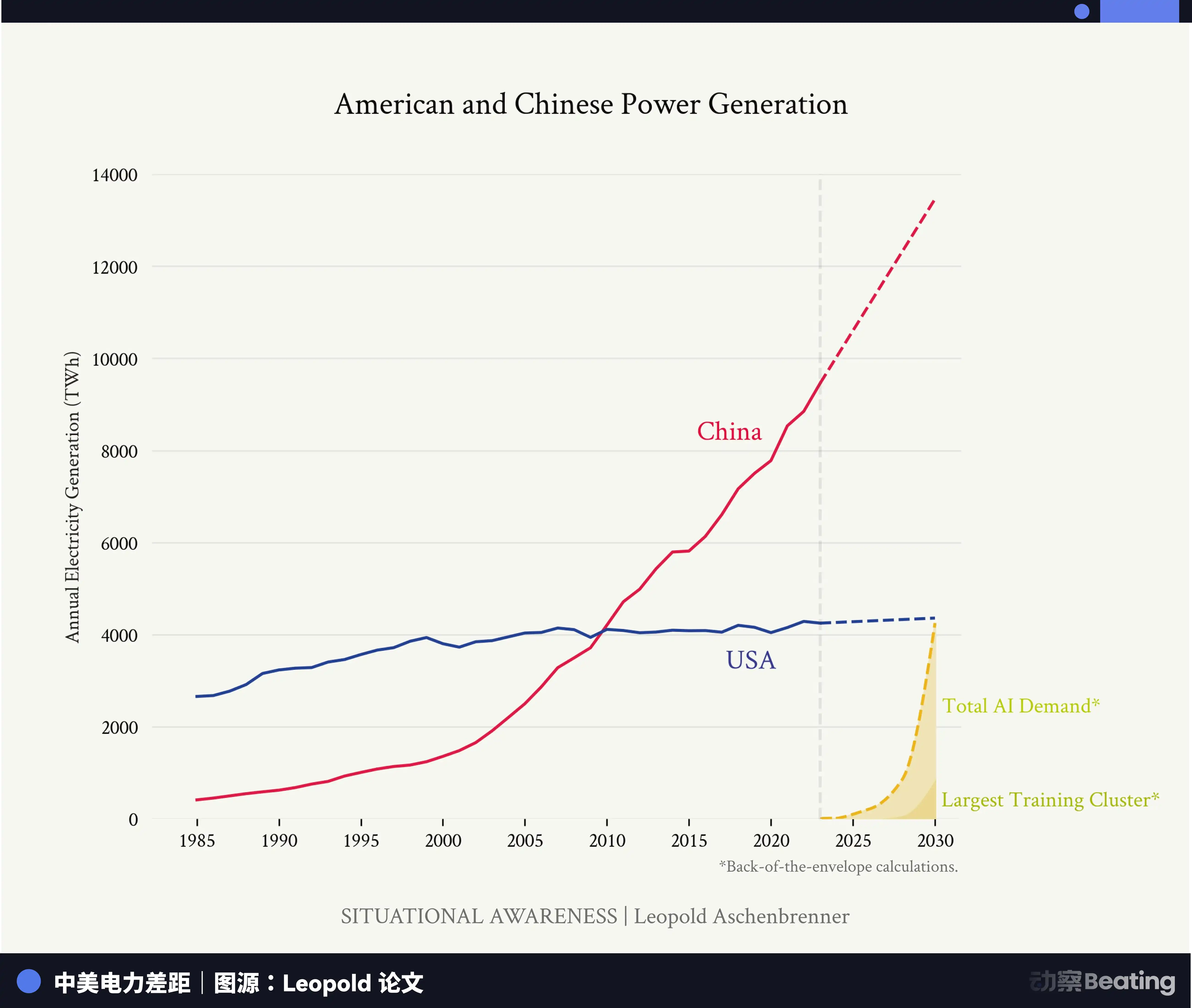
The data confirmed his assessment. In 2024, the combined capital expenditure of Amazon, Microsoft, Google, and Meta exceeded $200 billion, a 62% increase from 2023. Among them, Amazon alone spent $85.8 billion, a 78% year-on-year increase. By 2025, Amazon's capital expenditure is expected to exceed $100 billion.
Most of this money is spent on data centers and power infrastructure.
Microsoft even did something unimaginable ten years ago: it signed a 20-year power purchase agreement with Constellation Energy to restart the Three Mile Island nuclear power plant.
Yes, that's the very same Three Mile Island that experienced the worst nuclear accident in U.S. history in 1979.
This nuclear plant is set to reopen in 2028, renamed the Crane Clean Energy Center, dedicated to powering Microsoft's data centers. Constellation Energy's CEO, Joe Dominguez, said, "Providing power for critical industries, including data centers, requires abundant, carbon-free, and reliable energy around the clock, every day. Nuclear power is the only energy source that can consistently deliver on this commitment."
When a software company starts restarting a nuclear power plant, you know that electricity has shifted from an infrastructure problem to a strategic resource concern.
The third consequence: geopolitical competition.
The most controversial part of the magnum opus is when Leopold, in near-Cold War language, defines the AGI race as a struggle for the very survival of the "free world." He harshly criticizes the security measures of the top AI labs in the United States, deeming them virtually non-existent. He argues that AI algorithms and model weights must be treated as the highest national secrets.
He even predicts that the U.S. government will eventually have to launch a national AGI project similar to the "Manhattan Project."
These arguments have sparked intense debate. Critics argue that he oversimplifies the complexities of geopolitics and provides a rationale for unbridled accelerated development through a panic narrative.
However, some also believe that he has spoken the truth. Anthropic's Dario Amodei and OpenAI's Sam Altman also believe that AGI will soon become a reality.
The true value of The Ten Thousand Word Report lies not in whether its predictions are 100% accurate, but in providing a comprehensive, actionable framework.
If AGI does indeed arrive around 2027, then before that,
what does the world need? It needs massive computing power.
What does computing power need? It needs GPUs.
What do GPUs need? They need electricity.
Where does the electricity come from? From power plants, nuclear power plants, and from Bitcoin mining farms with cheap electricity.
Where are the chips made? At TSMC.
But what if there is a decoupling between the U.S. and China? Then we would need Intel.
How do data centers connect with each other? They need optical components—Lumentum.
Where is the data stored? It needs storage—SanDisk.
You see, this is the logic of that position report.
The Ten Thousand Word Report is the map, and the positions are the route. Leopold translated the 165-page macro forecast into an investment portfolio that can be bet with real money. Each buy corresponds to a point in the Ten Thousand Word Report. Each sell corresponds to an assumption he believes the market has mispriced.
But having just a map is not enough. In the real market, you need one more thing: when everyone says you are wrong, continue to believe that you are right.
This ability was severely tested on January 27, 2025.
DeepSeek Impact
On January 27, 2025, the release of DeepSeek's DeepSeek-R1 model plunged the entire Wall Street into panic. This model's performance was close to OpenAI's o1, but its operating costs were 20 to 50 times cheaper. What was even more astonishing was that its predecessor model, DeepSeek-V3, was reportedly trained for less than $6 million and was still using the sanctioned, performance-constrained Nvidia H800 chip.
The market's logic collapsed in an instant.
If the Chinese can train a top model with $6 million and a stripped-down chip, what does the hundreds of billions of dollars that American tech giants pour in every year amount to? Do those trillion-dollar compute cluster plans still make sense? Will there be a cliff-like drop in GPU demand?
Panic spread like a plague. NVIDIA's stock price plummeted nearly 17%, causing a one-day market cap loss of $593 billion, the largest single-day market cap loss in Wall Street history. The Philadelphia Semiconductor Index dropped by 9.2%, marking its biggest one-day decline since the March 2020 pandemic panic. Broadcom fell by 17.4%, Marvell by 19.1%, Oracle by 13.8%.
The sell-off began in Asia, spread to Europe, and finally ignited in the U.S. In just one day, nearly a trillion dollars in market value evaporated from only the Nasdaq 100 index constituents.
Silicon Valley venture capital pioneer Marc Andreessen called DeepSeek AI's "Sputnik moment" on Twitter, stating, "This is one of the most amazing and impressive breakthroughs I've ever seen, and as an open-source project, it's a gift to the world."
For Leopold's fund, this day should have been a disaster. His portfolio was entirely in AI infrastructure stocks, and the market was questioning the entire logic of AI infrastructure.
However, according to Fortune magazine, an investor at Situational Awareness LP revealed that on that day, during the market's panic selling, large tech funds called to inquire about the situation. The answer they received was five words:
"Leopold says it's fine."
Why was Leopold so calm? Because in his view, the emergence of DeepSeek not only did not overturn his logic but rather affirmed it.
At the core of his lengthy thesis is one argument: AI progress will not slow down, only accelerate.
Algorithmic efficiency improvement is one of the three major engines driving AI development. DeepSeek trained a stronger model with less money and a weaker chip, proving that algorithm efficiency is rapidly increasing. The higher the algorithm efficiency, the stronger AI can be produced with the same compute power, which will stimulate more demand for compute power rather than reduce it.
Using the framework from his magnum opus: DeepSeek didn't prove that "we don't need that many GPUs," but rather proved that "each GPU became more valuable." When you can train better models with less money, you don't stop; you train more, bigger, stronger models.
The panic stemmed from the fear that "demand will disappear." However, those who truly understand AI know that cost reduction never eliminates demand; it only creates greater demand.
Leopold bought against the panic. The market quickly proved him right. NVIDIA and the entire AI sector rebounded rapidly in the following weeks, reaching even higher levels than before the crash.
In the world of investment, belief is the scarcest asset. Not because forming beliefs is difficult, but because persisting in belief when everyone tells you that you are wrong is almost against human nature.
The Limits of the Physical World
Leopold Aschenbrenner's story could certainly be simplified into a feel-good tale of a teenage genius striking it rich. But focusing solely on the money would miss the true value of this story.
What he truly got right was that while everyone was fixated on the code and model parameters on their screens, he shifted his gaze to the smokestacks of power plants, the substations of mines, and the fiber optic cables spanning continents.
By 2024, the world was debating how powerful GPT-5 would be, how realistic Sora's generated videos could be, and when AI would replace programmers. These discussions were certainly important. But Leopold posed a more fundamental question: how much electricity do these things need? Where does the electricity come from?
While this question may sound too simplistic, it was precisely this simple question that pointed to the greatest investment opportunity of the AI era.
AI is growing at an exponential rate, yet the physical infrastructure supporting it remains in the last century. Leopold saw this gap. And along this gap, he traced it all the way to the limits of the physical world. At each step, starting from a physical bottleneck, he found companies that addressed this bottleneck and then made bets.
The essence of this methodology is not actually new. During the 19th-century California Gold Rush, those who made the most money were not the gold miners but the ones selling shovels and blue jeans. Levi Strauss made his fortune back then.
But knowing this truth is one thing; executing it in the AI era is another.
Because to execute it, you need to have both abilities at the same time: one is a deep understanding of technological trends, knowing the development path of AI and the resource requirements; the other is a specific understanding of the physical world, knowing where electricity comes from, how data centers are built, and how fiber optics are laid.
The former requires you to have spent time in OpenAI's lab, and the latter requires you to be willing to squat down and study the power contracts of a bankrupt mining company.
Technologists understand AI but not the electricity market. Finance professionals understand the market but not the physical constraints of AI. Leopold happens to have both.
But more important than ability is perspective.
A line from his lengthy document is often quoted: "You can see the future first in San Francisco." The implication of this statement is: the future is not evenly distributed.
The essence of investment is to find price discrepancies in a future that has already arrived but is not yet evenly distributed.
Leopold has personally witnessed the capability curve of AI in OpenAI's lab; he knows that GPT-4 is not the end but the beginning, he knows that there will be larger models, more computing power, and more insane capital investment to follow. Meanwhile, the market is still debating whether "AI is a bubble."
This is the discrepancy. What he did was turn this discrepancy into $5.5 billion.
Welcome to join the official BlockBeats community:
Telegram Subscription Group: https://t.me/theblockbeats
Telegram Discussion Group: https://t.me/BlockBeats_App
Official Twitter Account: https://twitter.com/BlockBeatsAsia
