Editor's Note: NVIDIA was once the most prominent winner in the AI infrastructure cycle, but the latest round of chip trends is showing that the bottleneck of AI lies not only in GPUs but also in storage.
Over the past year, global capital expenditure has continued to flow into AI, first driving up the demand for high-bandwidth memory such as HBM, and then squeezing the supply of traditional DRAM and NAND flash memory. As large model training requires GPUs paired with HBM and as inference demand drives the expansion of general-purpose servers, memory chips have transitioned from a cyclical industry to one of the scarcest and most profitable links in the AI industry chain.
This is also the reason for the collective performance surge of Samsung, SK Hynix, and Micron. Memory chip prices surged nearly 100% in the first quarter, propelling Samsung's net profit to over $30 billion in the first quarter, with the semiconductor business contributing the vast majority of the profit; memory chip prices rose nearly twofold in the first three months of 2026, far exceeding the market's original expectations. More importantly, this is not simply a short-term price hike trend but a repricing of the supply-demand structure: the new wafer fab construction cycle is lengthy, HBM occupies more capacity, and traditional storage supply has been further compressed.
Against this backdrop, memory chips are transforming from "complementary components" to "strategic resources." Server, PC, and smartphone manufacturers are starting to pay a premium to secure capacity, even accepting five-year contracts, prepayments, and co-investment in building fabs. Supply relationships that were previously maintained through handshake agreements are shifting to more tightly bound long-term commitments. In other words, AI competition is no longer just among models, computing power, and cloud platforms but is also evolving into a battle for the underlying supply chain.
What is most noteworthy is not how much money memory chip companies have made this year, but how the bottleneck of AI infrastructure is shifting from single computing power to a broader hardware system. GPUs determine whether a model can be trained, HBM determines whether data can be exchanged at high speed, while DRAM and NAND affect the cost structure of inference and server expansion. As more and more companies believe that "whoever controls storage supply can control AI," the windfall period for memory chips is actually a signal that the AI infrastructure is entering a resource race stage.
The following is the original text:
Ranked by Net Profit, Breaking Into the Global Top 20 Chip Manufacturers.
By the end of last year, global investment in artificial intelligence had already propelled the memory chip industry into a round of "super boom cycle." Profits hit a record high, and prices are expected to rise another 50% in the first quarter of 2026 compared to the previous quarter.
However, the development did not stop there. The reality is even better, and much better.
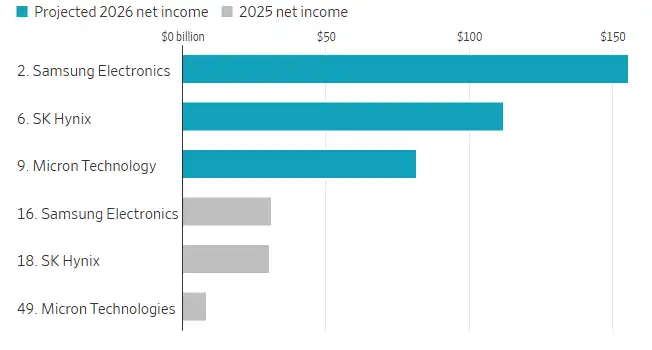
On Thursday, Samsung Electronics announced a first-quarter net profit of over $30 billion. This not only far exceeded its previous single-quarter profit record but also almost approached the annual profit peak set by the South Korean company in the past. Approximately 94% of Samsung's first-quarter operating profit came from its semiconductor business.
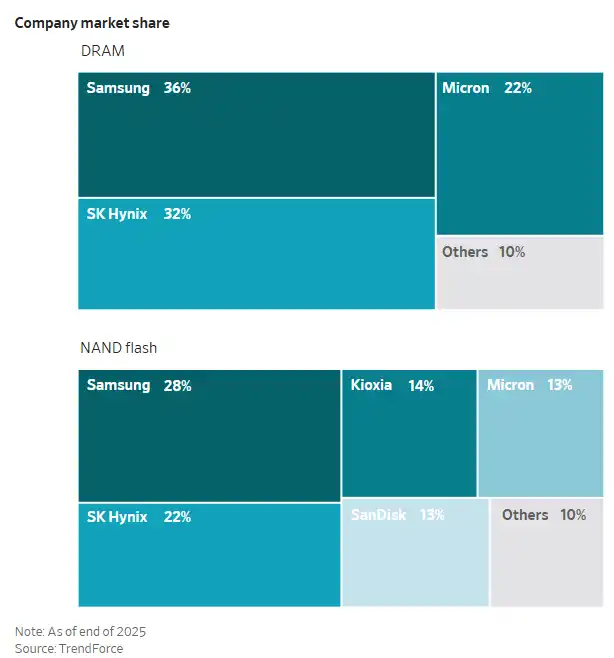
Samsung's main competitors in the memory chip field—South Korea's SK Hynix and the U.S.'s Micron Technology—have also recently delivered equally surprising performances. These three companies dominate the global memory market, and memory chips, along with NVIDIA's processor chips, are used for AI computing.
Annual Net Profit of Semiconductor Companies
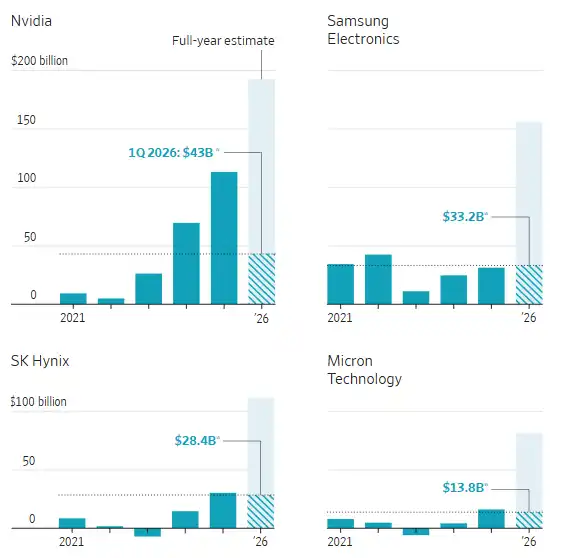
Although the market is increasingly worried about whether AI services will eventually bring substantial profits, companies involved in the related infrastructure construction have already reaped an epic windfall.
And this historic rally seems to show no signs of ending in the short term. Jaejune Kim, Samsung's EVP of the Memory Business, said during Thursday's earnings call that based on the orders already booked by Samsung, the supply shortage is expected to worsen further next year. He said, "The current available capacity is far from enough to meet customer demand."
So far this year, Samsung's stock price has risen by 72%. SK Hynix's stock price has risen by 90%, and Micron has risen by 65%.
Company Market Share
According to the data from technology market research firm TrendForce, during the first quarter of 2026, the price of storage chips increased by nearly 100% compared to the previous quarter, approximately twice the initial expected increase.
In recent years, storage chip manufacturers have been prioritizing the production of dedicated storage chips for AI, known as High Bandwidth Memory (HBM). This has in turn constrained the supply of traditional storage chips used in smartphones, PCs, and general-purpose servers. Training large language models typically requires pairing NVIDIA's Graphics Processing Units (GPUs) with HBM.
More recently, there has been a rise in inference demand. Inference refers to the computational process where a pre-trained AI model responds to user queries. This has driven the growth in general server demand, which in turn has elevated the profit margins of Samsung, SK Hynix, and Micron, who produce the traditional storage chips used in general servers.
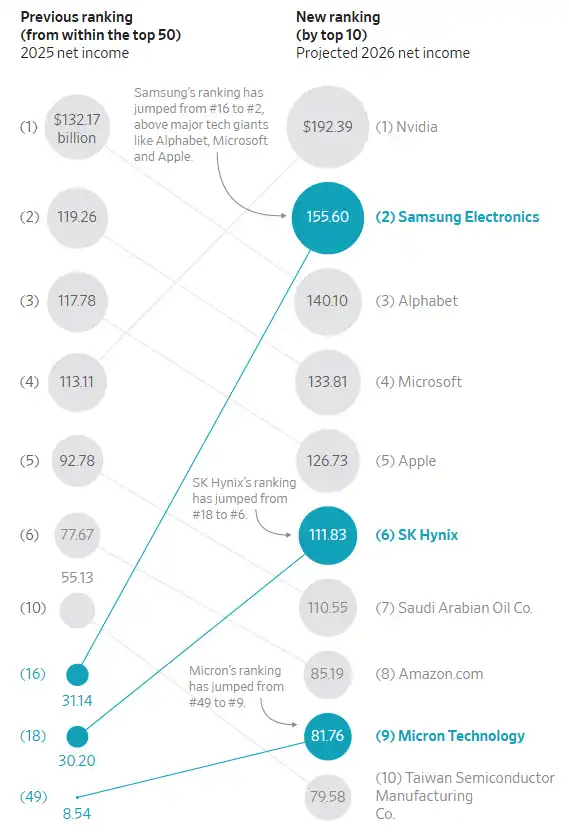
According to FactSet's estimates, these three companies are expected to collectively achieve approximately $350 billion in net profit in 2026. Each of them is poised to enter the top ten list of the world's most profitable publicly traded companies, with Samsung expected to surpass Alphabet, Microsoft, and Apple to claim the second spot. A year ago, none of these memory chip manufacturers were in the top ten.
Top Chipmakers by Net Profit
Building a chip manufacturing plant, also known as a fab, could cost over $20 billion and take several years to complete. Industry analysts indicate that Samsung, SK Hynix, and Micron are all constructing new fabs, but the full capacity is likely to be realized only by the end of 2027 or 2028. Meanwhile, many production lines have been allocated to HBM, which occupies more capacity compared to traditional storage chips.
Storage chips are mainly divided into two categories: DRAM, used for temporary storage in servers, PCs, and other electronic devices to enable faster data processing, and NAND flash, used for long-term data storage such as storing photos in smartphones.
HBM is produced by stacking layers of DRAM chips, which are then packaged together with processors produced by companies like NVIDIA to accelerate AI computations. NVIDIA has close collaborations with Samsung, SK Hynix, and Micron.
Counterpoint semiconductor research analyst MS Hwang stated that the operating profit margins of these two types of storage chips have roughly doubled compared to typical levels, with the DRAM margin reaching around 80% and NAND flash reaching up to 60%.
Memory Chip Contract Pricing
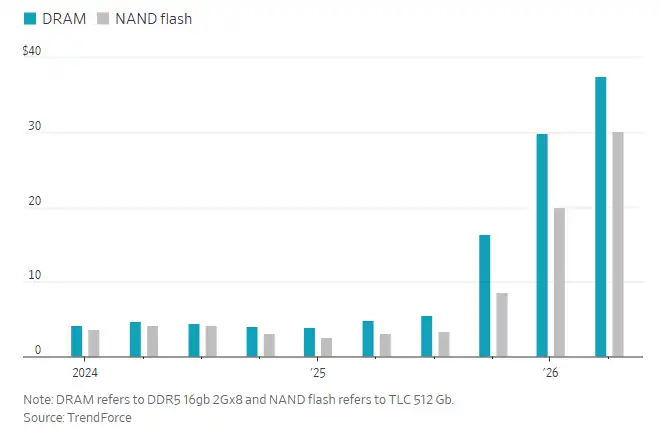
Hwang from Counterpoint added that many major companies in the server, PC, and smartphone fields are paying a premium to procure memory chips in large quantities to secure more supply and restrict competitors' access to capacity. He said, "The underlying logic is, whoever controls memory supply can dominate AI."
Executive Vice President Marcus Chen of global electronic components distributor Fusion Worldwide said, "What we're seeing today is the most severe memory shortage in the history of the market." Most of Chen's clients are currently only able to receive 30% to 50% of the memory chips they need. "Some clients are getting even less," he said.
For a long time, customers and memory chip manufacturers have relied mainly on handshake agreements to ensure long-term supply; but now, in some cases, both parties are turning to enforceable formal contracts. Citigroup semiconductor analyst Peter Lee said that some contracts have terms as long as five years and require customers to prepay about 30% of the cost or share the investment cost of building new memory chip factories. Lee said, "We've seen customers willing to go to this extent."
Welcome to join the official BlockBeats community:
Telegram Subscription Group: https://t.me/theblockbeats
Telegram Discussion Group: https://t.me/BlockBeats_App
Official Twitter Account: https://twitter.com/BlockBeatsAsia
