Core Narrative
· Agent Payment is moving from PoC to the infrastructure competition stage
· x402 ran 3.3 million transactions in 30 days, with an ATV of $0.46 (Visa averages around $50). Estimated real Agent payment monthly transaction volume < $30M.
· TradFi giants are accelerating: Visa promotes Intelligent Commerce + Trusted Agent Protocol, Mastercard to open Agent Pay to all U.S. cardholders in November 2025, Stripe partners with Tempo to launch MPP on March 18, 2026.
· Strong M&A signals: 7 acquisitions totaling $8.05B between 2025-2026 (Capital One acquires Brex for $5.15B, Mastercard acquires BVNK for $1.8B, Stripe acquires Bridge for $1.1B). Giants choose to buy instead of build.
· The Facilitator layer is currently a highly investable ecosystem position. Its role is similar to early-stage Stripe in the e-commerce era, plugging into protocols above and applications below.
· Facilitators directly control the Agent's signing key and spending policy, acting as an un-bypassable trust anchor. They earn both custody fees and order flow revenue, making them possibly the most profitable role in the entire stack.
· MCP (Model Context Protocol) is becoming the standard interface for Agent invocation payment tools. Whoever's payment MCP server is defaultly integrated by Claude, ChatGPT, Cursor gains a position similar to "Chrome default search engine."
· Crypto infrastructure and card networks are not mutually exclusive; the winner is a unified gateway that simultaneously bridges both tracks.
· A shopping Agent requires ACP (Stripe) for merchant checkout + x402 for API micro-payments + AP2 (Google) for authorization auditing. No single protocol can cover all scenarios.
· Stripe MPP launched in March 2026, marking the first time a single protocol simultaneously supports a stablecoin (Tempo Chain) and a fiat currency (Stripe SPT). Partners include Visa, Mastercard, Anthropic, OpenAI, and Shopify. This is the first productized signal of the convergence trend.
· Protocol-driven markets push value up, preventing any one giant from dominating
· x402 and MPP are evolving into open commoditized infrastructure. Visa and Stripe will lead the way on the settlement and card network side. Identity layer, Agent App Store, Wallet Policy Engine, and Credit Infrastructure are still missing.
Market Overview
What is Agent Payment
Agent Payment refers to AI agents autonomously holding funds, authorizing spending, and settling transactions without direct human intervention. This is more than just having the Agent 'click a payment button.' To achieve this, a full set of financial infrastructure is needed, from identity verification, wallet management, spending policies to settlement, enabling the Agent to become an independent economic entity.
The premise of traditional payment systems is that both parties are KYC'd humans with bank accounts in the background. Agent breaks this premise: it has no ID, no bank account, no credit history, yet it needs to buy API calls, pay for cloud computing, purchase data, and even place orders on Amazon on behalf of users. The misalignment in the underlying architecture has triggered the entire Agent payment race.
Three Core Models
The core process of Agent Payment is divided into three models:
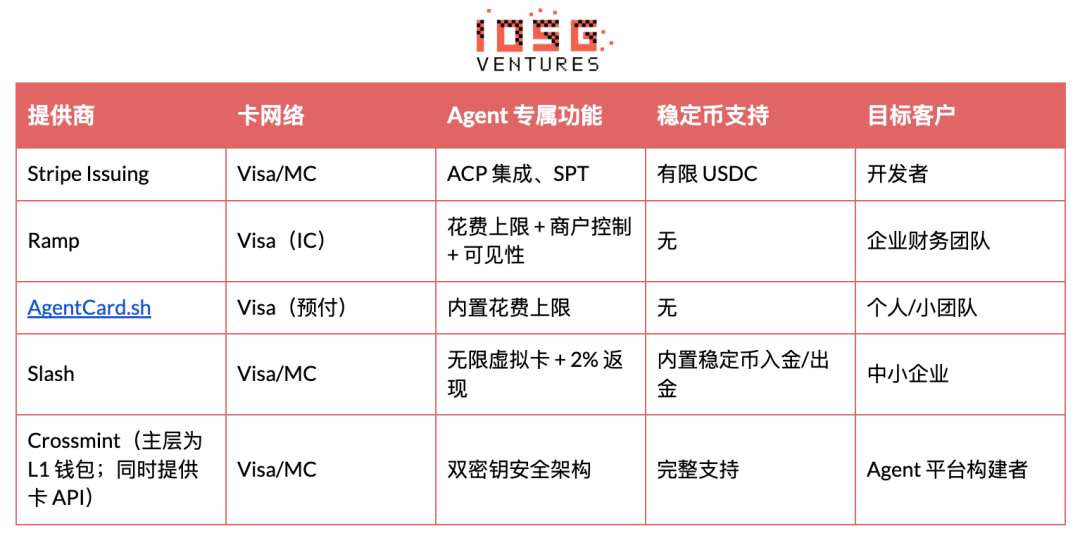
Tokenized Card (Virtual Card). The Agent obtains a virtual Visa/Mastercard card number with spending limits, merchant category restrictions, and an expiration date via API, and the transaction is cleared through the traditional card network. Ramp Agent Cards, AgentCard.sh, and Slash utilize this model. The benefit is that merchants don't need to change anything; the downside is that it must be linked to a human account, and the card organization still charges a 2-3% transaction fee.
x402 Stablecoin (HTTP Native Micro Payment). The server returns an HTTP 402 status code with payment conditions (wallet address, chain, amount), and the Agent's Facilitator automatically signs to complete the on-chain USDC transfer, including the transaction hash as proof attached in the request header. No API key, no account, no human approval needed, and the transaction cost is only L2 gas (around $0.001/tx on Base Layer).
Session-based Streaming (MPP Mode). The Agent pre-authorizes a spending cap, allowing for continuous spending during the session without settling each transaction on-chain. Settlement occurs in a lump sum at the end of the session. This is suitable for high-frequency scenarios with hundreds of API calls in a single session. Stripe MPP, combined with Tempo Chain, adopts this model.
How the Agent Handles Daily Bills
For regular bills such as SaaS subscriptions, cloud services, and data sources, the Agent now has two options:
1. Card Payments. By using Ramp Agent Cards or Slash to generate virtual cards tied to the SaaS platform, the Agent sets a monthly limit and merchant whitelist. Within the authorized scope, the Agent automatically renews payments. This method is compatible with traditional vendors like AWS, Google Cloud, and Notion.
2. x402 Payments. For vendors supporting x402 (such as Neynar, Hyperbolic, Token Metrics), the Agent pays per call, without the need for prepayment or subscription. Each request is automatically settled with USDC micropayments. However, very few vendors support x402, mostly concentrated in the adjacent services of the crypto space.
Market Size
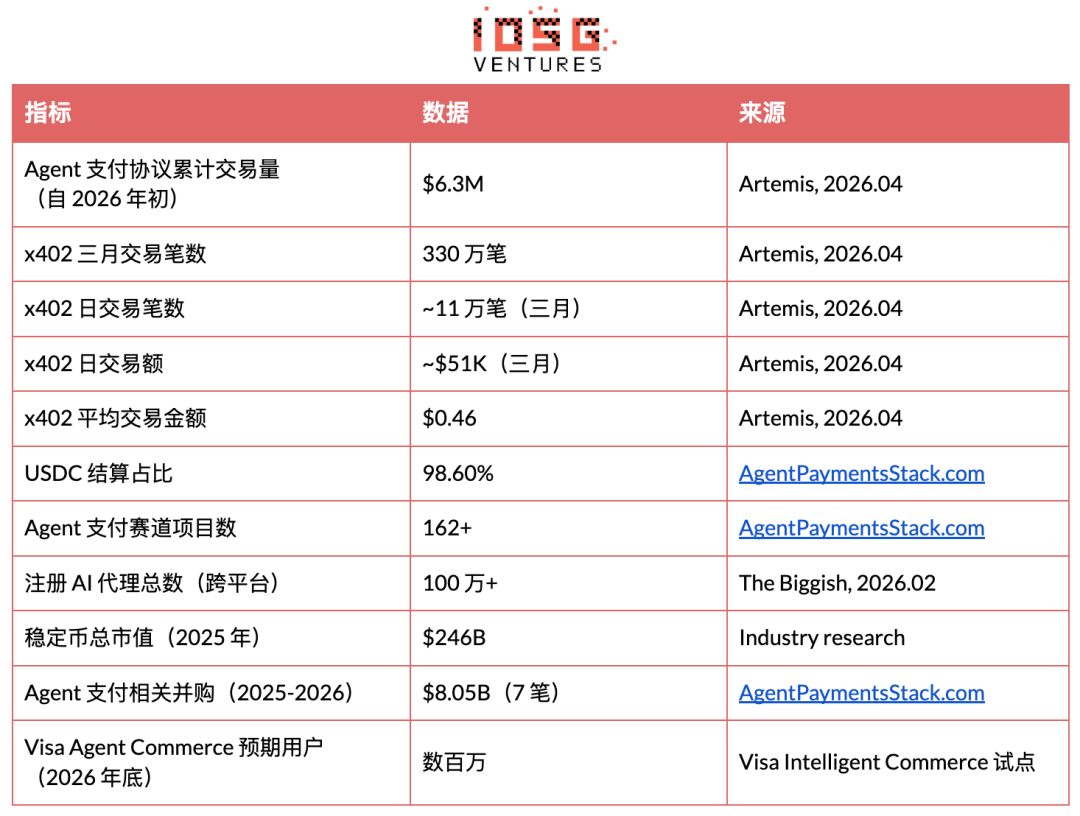
Let's be honest about the scale: from $6.3M at the beginning of 2026, with an annualization of around $126M, compared to Visa's $14.6T transaction volume in 2024, it's merely a fraction. However, the x402 ATV has climbed from an early $0.09 micropayment to $0.46 (Artemis data validation). We are still in the micropayment range, far from a commercial inflection point. The market is in a very early stage, but the economic foundation has been laid.
Tailwinds
· TradFi Legalization (Very Strong). Visa promotes "Agentic Ready," Stripe collaborates on MPP, and Mastercard and AmEx join the x402 Foundation. Visa's CPO calls this the "biggest thing since e-commerce." The market has been proven to be real, reducing investment risks.
· Accelerated Protocol Standardization (Very Strong). The x402 Foundation moves to the Linux Foundation, with 20+ founding members including Visa, Stripe, Google, AWS, and Microsoft. With resistance diminishing, x402 is transitioning into a standard at the HTTP level.
· AWS Ramping Up Production-Grade Infrastructure (Strong). Amazon Bedrock AgentCore has been shipped and natively integrated x402. CloudFront + Lambda@Edge provide the merchant-side reference implementation. End-to-end Agent-to-Merchant payment loop completed on AWS (by March 2026). AWS has released a reference architecture, and enterprise adoption will follow suit.
· MCP Service Explosion (Strong). 11K+ MCP servers, with less than 5% achieving monetization. ToolOracle has successfully demonstrated monetization on 73 servers/708 tools through x402. This creates a natural pull for payment infrastructure.
· AI Agent Surge (Strong). Registered agents surpass 1 million (by 2026), with all major LLMs pushing Agent capability. Timeline is 12-24 months.
· Stablecoin Accelerated Penetration (Strong). Total market cap of $246B (by 2025). Stripe, Visa, and MC are all integrating USDC. It's already happening.
· Subscription Model Decline (Medium). Developers offering skills/data will need to charge based on consumption. Timeline is 12-24 months.
· Regulatory Clarity (Medium). EU's MiCA in force, US stablecoin legislation advancing, CFTC chairman stating "AI needs blockchain." This will unlock institutional adoption. Timeline is 12-24 months.
Target Users
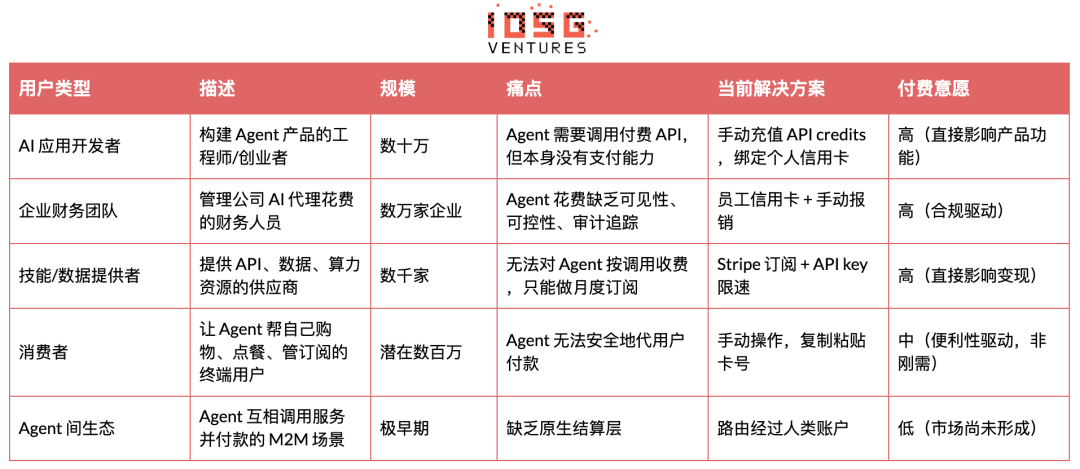
Agent Payment Infrastructure serves five types of buyers, each with different pain points, willingness to pay, and purchasing authority. Currently, the strongest intent comes from three categories: AI app developers (won't receive Agent product without payment), corporate finance teams (compliance-driven, budget-controlled), and skill/data providers (directly stuck on their monetization due to a gap in pay-as-you-go billing). Real M2M fund flow between consumers and agents exists but is immature, with low short-term willingness to pay.
Key Institutional Players and Merchant Outreach
Agent Payment is primarily driven by 8 institutions, including two crypto-native players (Coinbase, Circle), three incumbent card networks/payment giants (Stripe, Visa, Mastercard), an AI platform (Google), and two aggregation companies in the upper layer (Crossmint, Tempo).
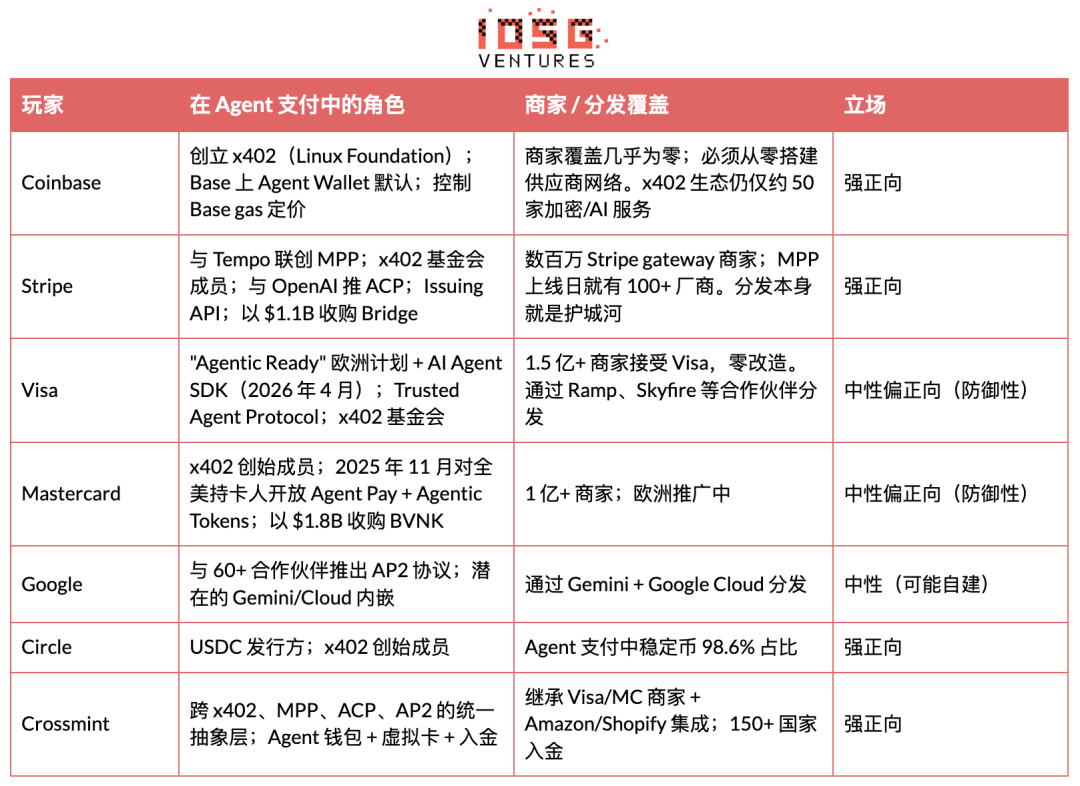
There is a fundamental question of which came first, the chicken or the egg, when it comes to adoption. The Card Network boasts overwhelming merchant coverage (Visa 1.5B+, MC 1B+), requiring no merchant retrofitting for usage. x402 has only about 50 Cryptocurrency/AI services. Without more merchants, transaction volume remains low; without transaction volume, merchants are unwilling to onboard. Stripe MPP breaks this stalemate by leveraging existing merchant relationships (SDK upgrade instead of new integration); Crossmint breaks this stalemate by aggregating two tracks through a single API.
Several Outstanding Unresolved Issues
· A new and unresolved security threat model
· Key threats include prompt injection, Agent runaway behavior (recursive loops deplete budget), key leakage, Agent impersonation, third-party SDK supply chain risk.
· The most dangerous failure is not unauthorized access but rather abuse after authorization.
· A policy engine at the infrastructure layer is essential, yet most wallets lack one.
· Lack of standardized Agent identities
· There is no reliable way to verify who an Agent is, what permissions they have, or if they have been compromised.
· ERC-8004 has been deployed to the Ethereum mainnet, containing three registries (Identity, Reputation, Validation based on ERC-721), but adoption is still in its early stages.
· NIST has accepted a proposal on AI Agent Identity and Authorization (April 2026). EIP-11419 proposes adding an Agent Permission Validator to modular smart accounts.
· Without identity, every Agent transaction relies on pure trust.
· Lack of a dispute resolution mechanism
· Stablecoin payments are designed to be fast and irreversible, with no chargeback, no bank to complain to, and no recourse.
· Smart contract custody and on-chain reputation systems are under exploration, but neither has been standardized or reached production-level status.
· Without clear error handling, overpayment, fraud response framework, institutions will not adopt on a large scale.
· Immature Compliance Infrastructure
· More and more jurisdictions are applying the Travel Rule (FATF) to stablecoin transfers.
· KYC, AML, sanctions screening, audit trails are not optional for financial applications, but most Agent payment tools treat compliance as an afterthought.
· Teams that did not incorporate compliance from day one will face very high retrofitting costs.
· Cross-chain Complexity
· Agents need to operate on multiple networks (Base, Solana, Stellar, Canton, and other permissioned chains).
· Regardless of where the transaction settles, policy execution must be consistent.
· No single chain has won Agent payments, so infrastructure must be interoperable, increasing engineering and security overhead.
Landscape and Value Chain
Agent Payment is not a single market but an ecosystem with a seven-layer stack.
Facilitators (L2) and wallets (L1) capture disproportionate value as they control the Agent's "private key."
Whoever holds the key holds the Agent's economic sovereignty. The protocol layer (L0) as an open-source standard does not directly generate revenue, but companies setting the standards (Coinbase through x402, Stripe through MPP) monetize indirectly through surrounding facilitator services.
This mirrors internet history: HTTP is free, but Cloudflare and Akamai, who control the entry points of HTTP traffic, are billion-dollar companies.
Deep Dive into the Landscape
Payment Protocol (L0)
x402
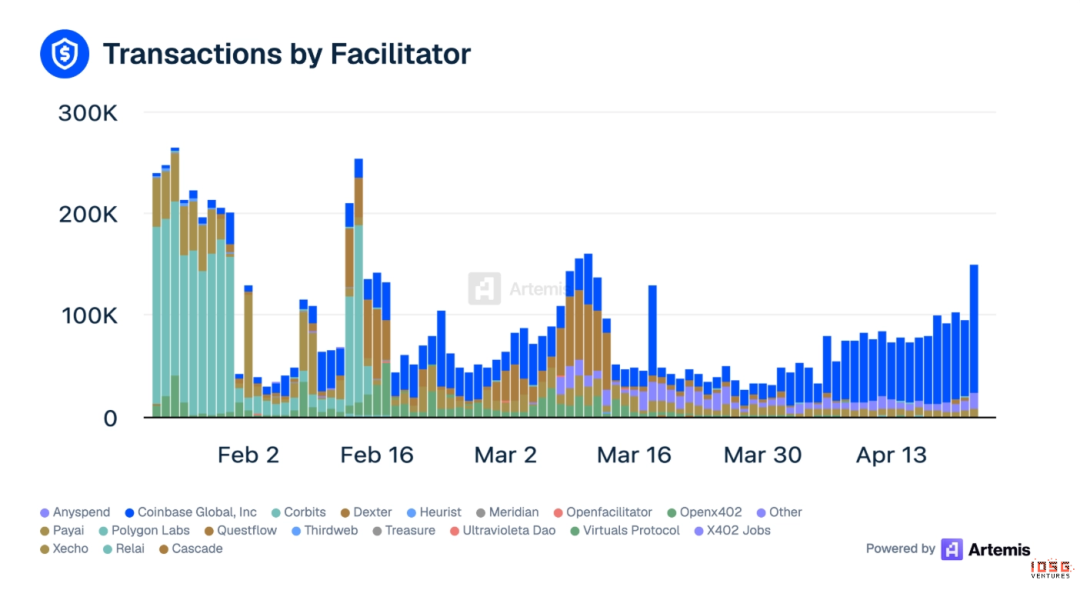
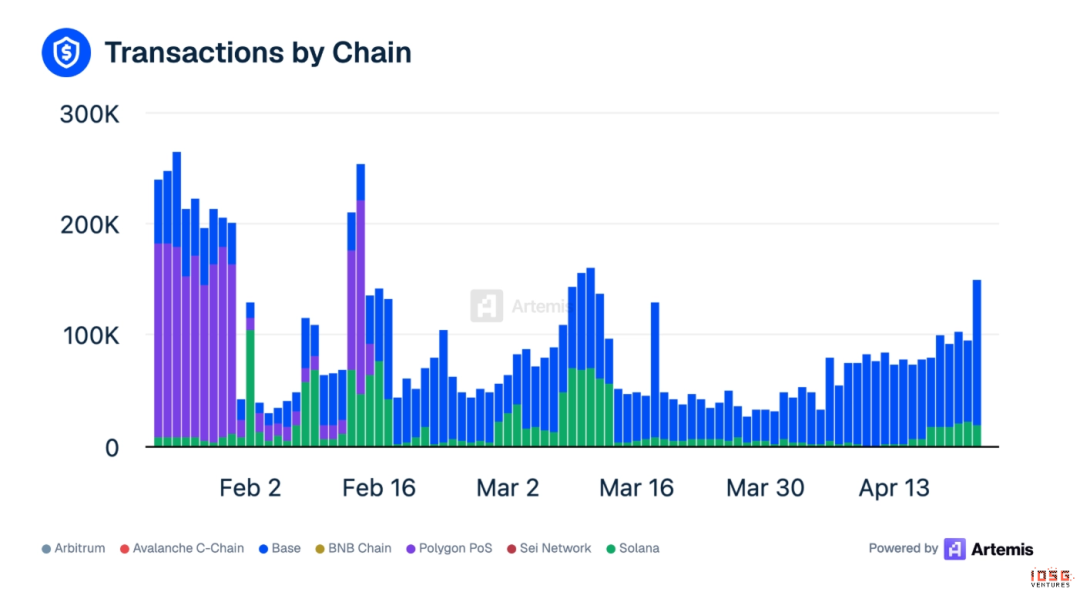
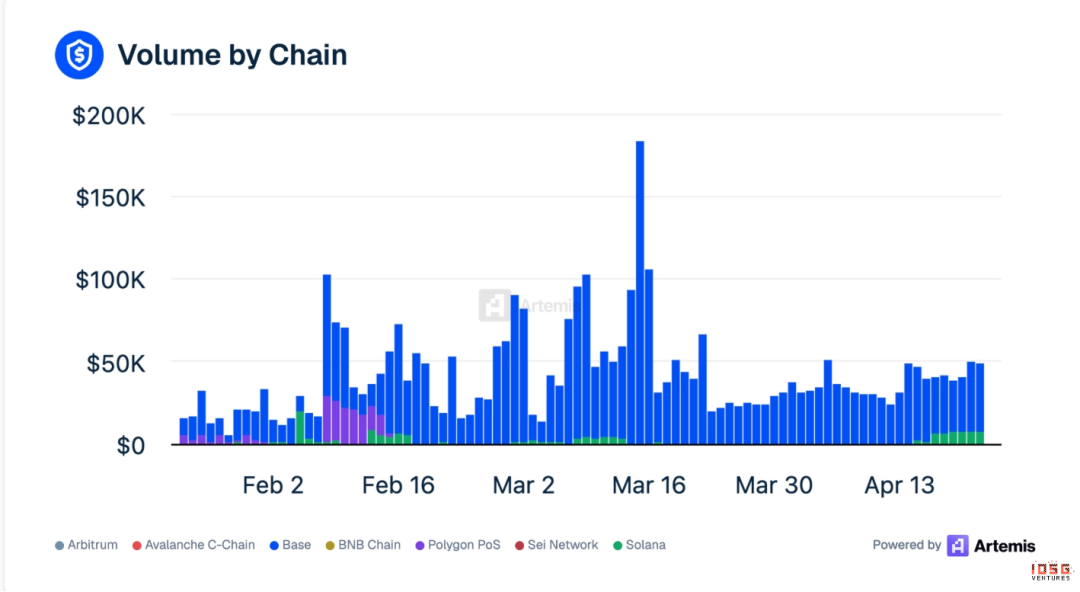
The situation with x402 is somewhat complex, with the Base chain occupying the majority of transactions.
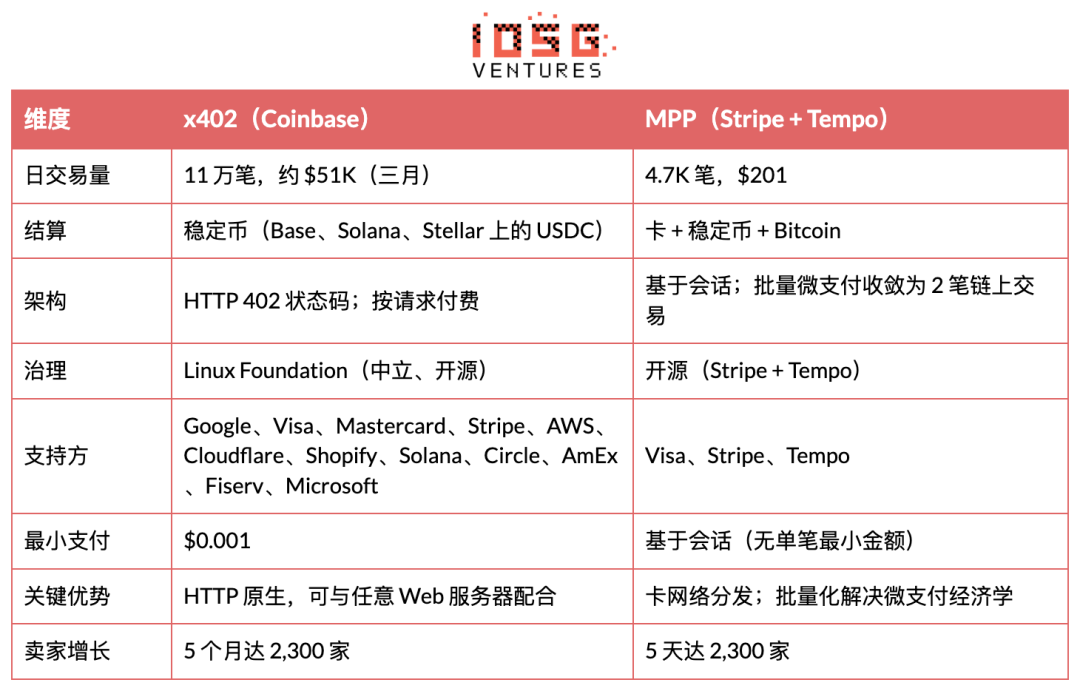
· Daily Active Data (March average): 110,000 transactions, approximately $51,000 transaction volume
· Base Dominance: 82% of transaction volume on Base, 99% of transaction volume on Base
· Top Facilitator: Coinbase Global first (41%), PayAI second
· Significant Wash Trading: 36% of x402 transactions in March were wash traded (wash or incentive-driven), public transaction volume overstates true Agent demand
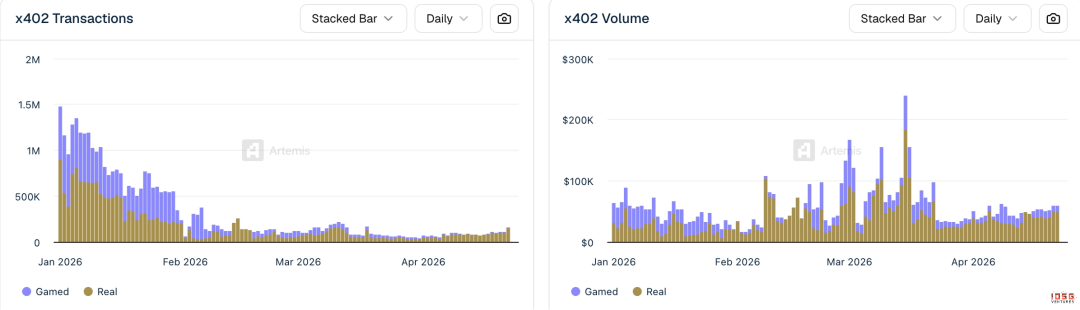
x402 Ecosystem Data (Artemis, April 2026)
· Supported Chains: Base, Ethereum, Polygon, Solana, Avalanche, Sui
· x402 Foundation governed jointly by Coinbase and Cloudflare (established in September 2025), now migrated to the Linux Foundation, with 20+ founding members
· Stripe integrated x402 on Base in February 2026
· Minimum Viable Payment: $0.001
· End-to-End Payment Time: approximately 2 seconds
· 5-Month Cumulative Sellers: approximately 2,300
5-Step Payment Flow
1. User/developer tops up Agent policy
2. Agent requests vendor API, receives HTTP 402 response (including merchant wallet, supported chain, asset type, price)
3. Facilitator verifies whether this payment is within the spending policy authorized by the Agent
4. Upon confirmation, Facilitator executes on-chain USDC transfer
5. Agent includes the transaction hash in subsequent requests as a payment credential; vendor verifies and provides service
Merchant coverage is currently the biggest limitation: Neynar, Hyperbolic, Token Metrics, Pinata (IPFS), Heurist, Prodia (image generation), Firecrawl (web scraping). Almost all are crypto- or AI-native services. Traditional e-commerce (Amazon, NYT) has not yet been integrated.
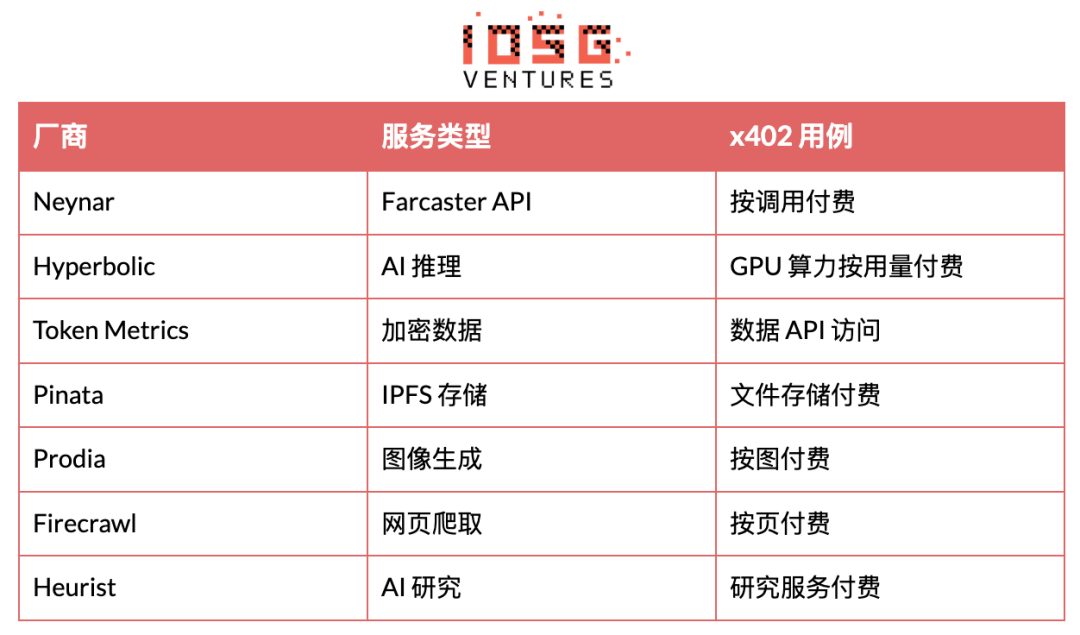
Traditional e-commerce (Amazon), mainstream SaaS (Notion, Slack, AWS), content platforms (NYT, Spotify) have no integration with x402.
What Agent can do on x402 is very limited: buy GPU computing power, call APIs, store files. Tasks such as placing an order on Amazon, renewing Notion, or paying for Uber still have to go through card networks.
Vendor integration is widely seen as the final and most challenging part of the entire Agent payment stack. The API proxy pattern (Agent makes restricted API calls on behalf of the user) may violate vendor ToS and introduce additional legal risks.
Early concerns focused on the $0.09 Average Transaction Value (ATV) not supporting the facilitator's P&L, with the bottleneck still being microtransaction economics coupled with vendor coverage breadth.
MPP (Machine Payments Protocol)
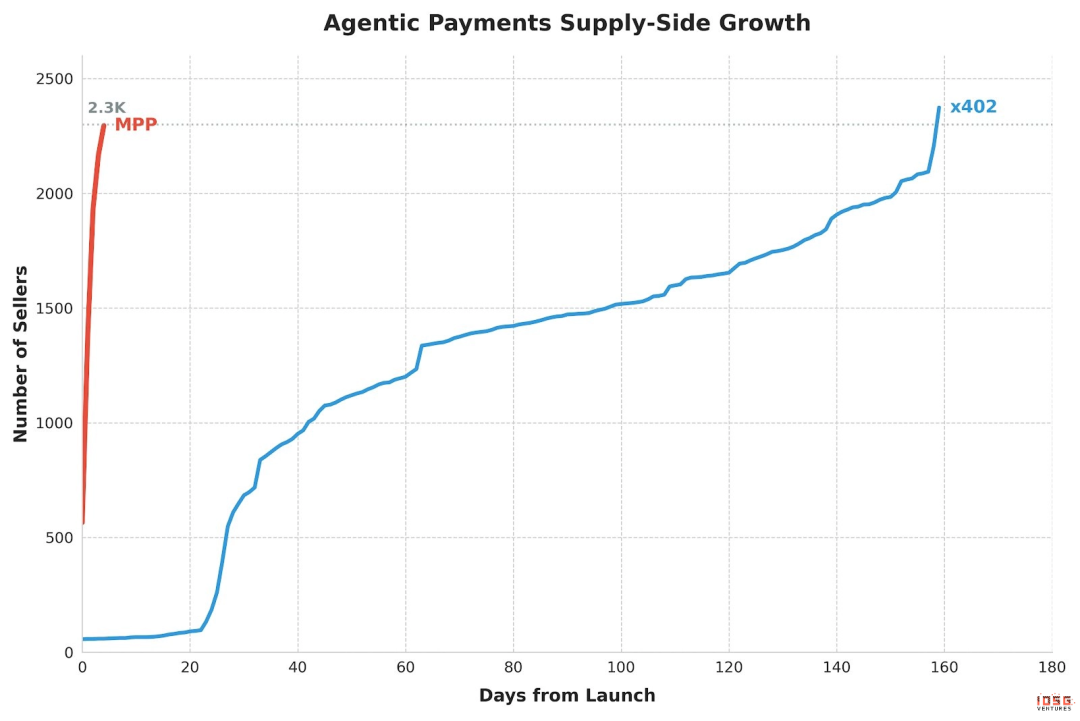
MPP has just launched but is growing rapidly, reaching 2.3K sellers in just 5 days.
MPP, launched by Stripe and Tempo, allows any client (Agent, app, or human) to pay for any service in a single HTTP request. Developers use MPP to have their own Agent pay service fees, while service operators use MPP to accept API payments.
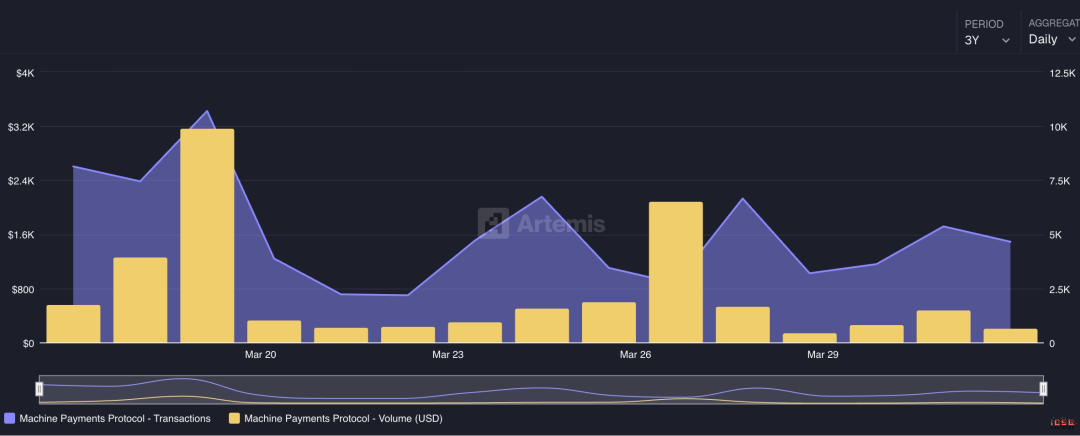
· Daily active data: 4.7K transactions, $201 transaction volume
· x402 took 5 months to reach 2.3K sellers, MPP achieved this in just 5 days
Architecture
· Session-based: Agent pre-authorizes spending cap, in-session streaming microtransactions, off-chain batch settlement
· Settlement on Tempo chain (bridged to $5 billion), sub-second finality
· Support for both Stripe SPT (fiat), Visa card, stablecoins, Bitcoin (via Lightspark)
· 100+ merchants onboarded on launch day
The strategic significance is that MPP is the first substantive convergence product in the Crypto vs. Card battle. The distribution power of Stripe (millions of global merchants) combined with Tempo's stablecoin settlement efficiency may create a pincer attack situation against both pure crypto solutions (x402) and pure card solutions (Visa IC).
Risks
Only a few weeks since launch, no production-level data. Tempo chain itself is new, ecosystem unproven.
x402 vs MPP Comparison
Convergence Trend
They are converging, not competing.
· Stripe is a founding member of the x402 Foundation, and MPP explicitly supports both stablecoins and cards.
· Visa playing both sides. It contributes card track specs to Stripe's MPP while advancing its own Intelligent Commerce and Trusted Agent Protocol. Framing x402 and MPP as opposing camps overlooks a key fact: the largest card network is a design partner for both.
The architectures are complementary:
· x402 handles payment negotiation at the HTTP layer: how servers tell clients "give me money" with a 402 status code
· MPP processes transaction execution at the session layer: how money moves in practice, folding unlimited microtransactions into two on-chain transactions (opening + settlement)
· The session model directly addresses the scalability issue of microtransactions. Instead of chasing 12 million $0.09 transactions per second, it's better to batch thousands of microinteractions into a single settlement.
Stripe's distribution channel allowed MPP to catch up x402's 5-month seller count in just 5 days, validating the "Distribution> Protocol" thesis.
Visa Intelligent Commerce
Visa unveiled the Intelligent Commerce framework in April 2025, launched "Agentic Ready" in Europe in March 2026, and released the AI Agent Developer SDK on April 2, 2026.
Key components:
· Trusted Agent Protocol (TAP): Distinguishes legitimate agents from malicious bots
· Tokenized credentials: AI-ready card credentials with spending limits, merchant categories, and approval requirements
· Pilot partners: Ramp, Skyfire, and other undisclosed partners
The major advantage is merchant coverage: Visa's network spans 150M+ merchants globally, allowing agents to use a Visa card number to transact on Amazon, Uber, any SaaS platform without requiring any vendor-side changes.
The major drawback is the need to be tied to a human account. Visa's trust model is based on "backed by a KYC'd human standing behind," which poses a fundamental tension with the long-term vision of a self-sovereign agent economy.
Other Protocols
· ACP (Agentic Commerce Protocol): Designed for instant checkout in conversational interfaces (such as ChatGPT). It targets the consumer checkout layer, not the API settlement layer. ACP is complementary to x402.
· UCP (Unified Commerce Protocol for ATXP): Aims to unify all agent payment protocols under a single interface
· MoonPay Agents: Bridge traditional checkout flows with AI agents, transforming human checkout processes into programmatic payments executable by agents through APIs
Wallets and Key Management (L1)
Over a dozen wallet providers are competing in this market, reminiscent of the early days of mobile wallets before Apple Pay.
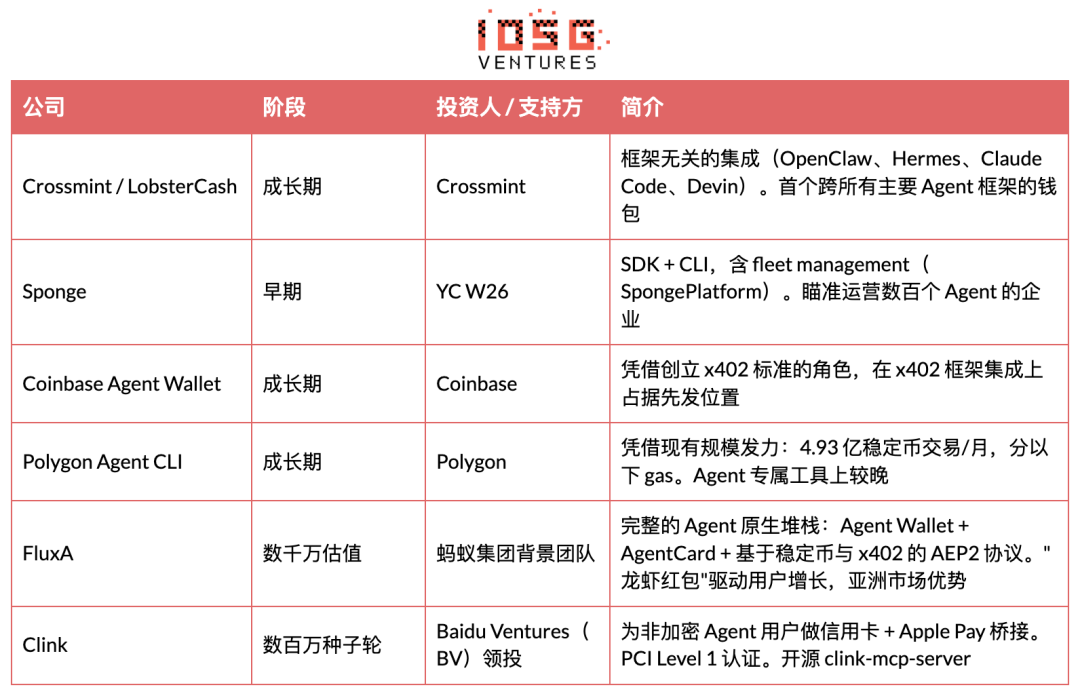
Use Cases:
· Lending and Credit: AI-driven underwriting is entering consumer-grade crypto lending. 3Jane offers fully automated credit underwriting through smart contracts, setting rates based on verifiable financial records and executing debt agreements without manual review.
· Creator and Gig Economy Settlement: Agents handle cross-platform routing, wallet management, and currency conversion. Audius directly allocates 90% of earnings to artists in real-time as content is consumed, without monthly settlement periods or intermediary cuts.
· Asset Management: Agentized fund systems infer real-time market conditions, rebalance positions in real-time, enable cross-border settlements outside business hours, and deploy idle funds into yield-bearing instruments.
Facilitator Layer (L2)
The Facilitator Layer sits between the protocol (x402, MPP) and applications. Coinbase Global remains the largest cumulative Facilitator (representing 41% of all x402 transaction volume, Artemis sourced).
Why this layer is the Monetization Layer of the Agent Economy: Agents need to pay when they buy, and the Facilitator is where this payment settles. Model companies are unlikely to do this themselves as they won’t run GTM for the long tail scenarios, leaving monetization opportunities for independent operators.
Facilitator Startups
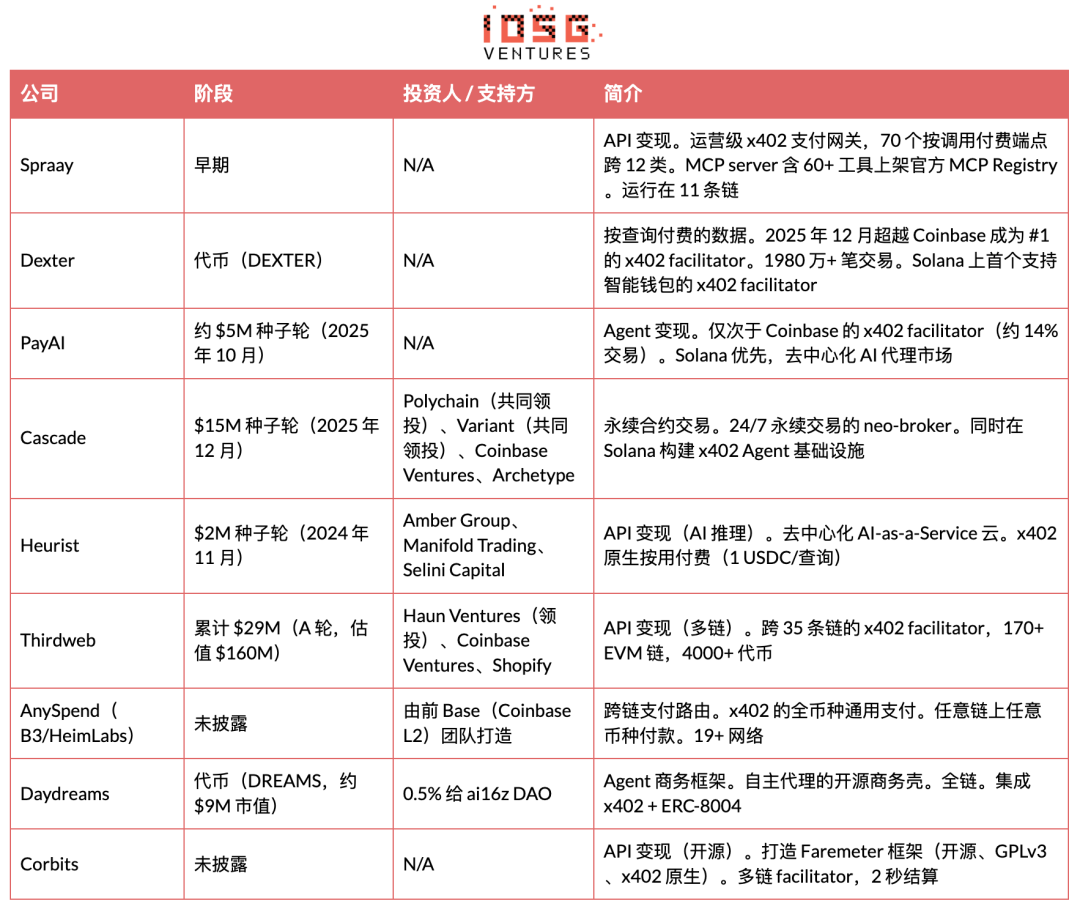
Other facilitators (open-source tools, non-funded startups): x402-rs (Rust library), OpenX402 (unlicensed facilitator), OpenFacilitator (free shared endpoints), B402 (BSC-specific fork), CodeNut (Agent infrastructure), RelAI (x402 API marketplace), AurraCloud (decentralized computing power, AURA token).
Use Case
· Query-Paid Data Access: The most active facilitator use case for on-chain transactions. Transaction Agents require real-time market data, Compliance Agents need sanction screening, and Credit Agents need credit checks. The Facilitator enables these Agents to pay-per-query without a subscription, API key, or vendor contract. Spraay has provided 70 x402 endpoints covering oracles, analytics, AI inference, and search, with one-time calls ranging from $0.001 to $0.10.
· Developer-Facing API Monetization: The Facilitator abstracts blockchain interactions, allowing any developer to monetize their API using x402 gatekeeping, without running a node or understanding cryptography. The AWS CloudFront + Lambda@Edge reference architecture enables any HTTP application to leverage x402 at the edge.
· Subscription Management: Agents autonomously handle cancellation processes and offer real-time renegotiation quotes based on usage history. As software transitions to usage-based pricing, continuously optimizing the value of the Agent you pay will significantly enhance the value you receive.
· Cross-Chain Payment Routing: The Facilitator handles swaps, bridges, and settlements, allowing Agents to pay with any token on any chain, with merchants receiving the assets they desire. AnySpend supports 19+ networks. This is a pipeline that neither Agents nor API providers want to build themselves.
Tokenized Card (L3: Governance & Policy / Identity & Authorization, Virtual Card)
Virtual Card Issuance Process
· Card Program Setup: Platforms (such as Ramp, AgentCard.sh) establish a virtual card program through issuing partners (Visa/MC issuers).
· API Card Creation: Developers generate virtual cards for each Agent or spending scenario via API, setting parameters:
· Spending Limits (Per Transaction / Daily / Monthly)
· Merchant Category Code (MCC) Whitelist/Blacklist
· Validity Period (One-time or Long-term)
· Geographic Restriction
· Agent Card Receipt: Agent receives a 16-digit card number + CVV + expiration date, which can be used at any Visa/MC-accepting merchant.
· Transaction Authorization: When a merchant initiates a transaction, the card network performs real-time verification based on preset policies.
· Settlement: Processed through the traditional card network (T+1 or T+2), with the funds deducted from the company's account.
Major Card API Providers Comparison
Core Limitations of Card Mode
1. Must be under a parent account: All Agent cards must ultimately be linked to a KYC-approved human/corporate account as the funding source.
2. Fees: The card network charges a 2-3% interchange fee, which is uneconomical for API micropayment scenarios.
3. Settlement Speed: T+1 to T+2, unable to meet the real-time settlement needs between Agents.
4. Limited Merchant Control: Agents may be incorrectly flagged as fraud.
Identity and Reputation (L4: Governance & Policy / Identity & Authorization Identity Side)
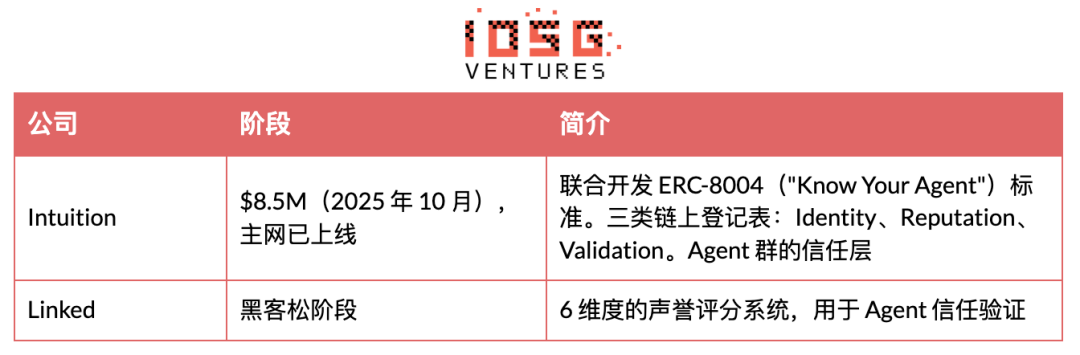
Identity is infrastructure rather than a standalone use case, underpinning every other layer.
Skill Discovery and Store (L5)
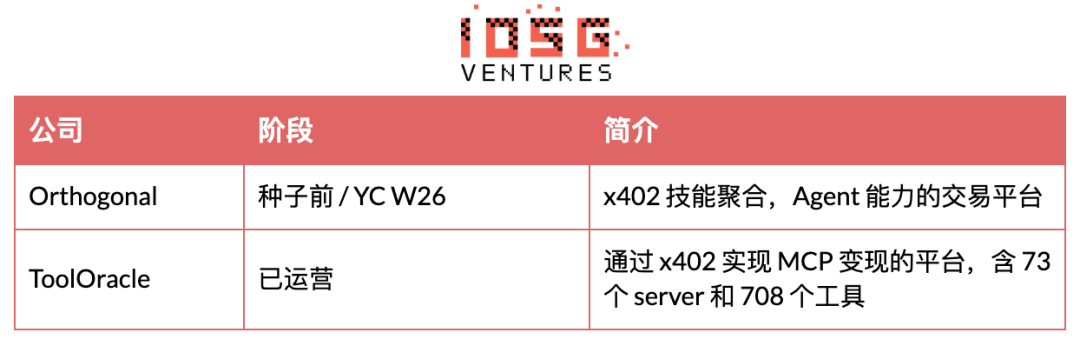
Use Case:
· In-game Rewards: A Web 3 gaming platform deploys an Agent to manage in-game economies, distribute rewards, and process asset transactions. The Virtuals Protocol has tokenized AI agents as game NPCs, trading bots, and research assistants, allowing the community to collectively own and govern.
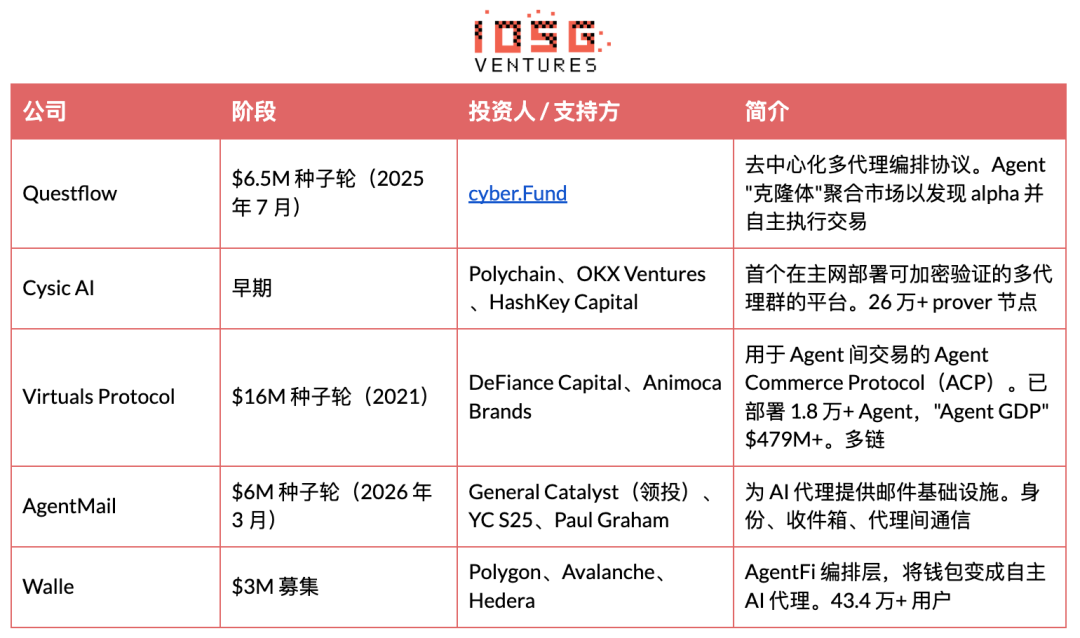
Agent Coordination (L6)
Use Case:
· Agentization of Trades: The shift from algorithmic trading to Agentization of Trades has transformed the competitive unit from latency to intelligence. Classic algorithmic trading: Execute Y when the price crosses X. Agentization of Trades: Considers cross-market conditions, liquidity, risk parameters, and portfolio position inference to determine the optimal action.
· Agent Cluster: The next stage is a coordinated group of agents. When a financial agent executes a trade, compliance and risk agents operate together in real-time, validating, tagging, and auditing.
Data and Compliance (L7)
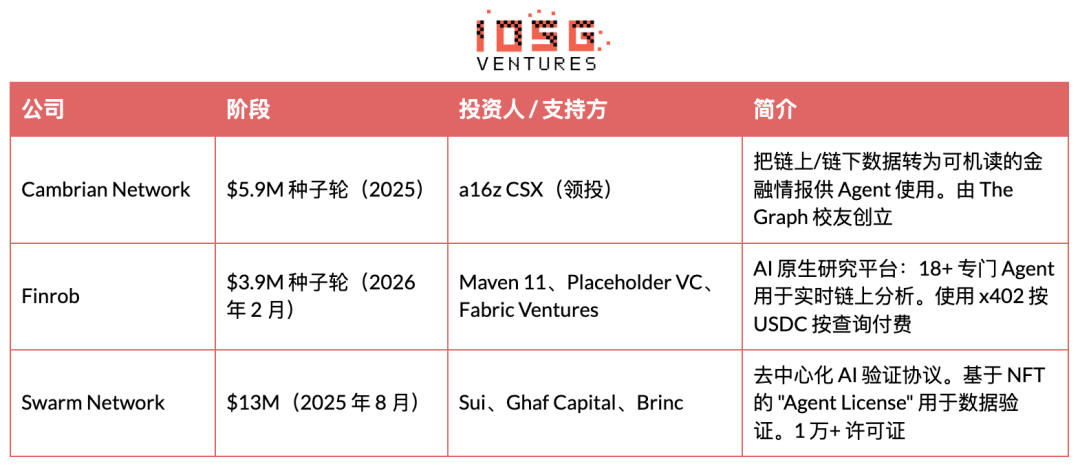
TRES Finance, Chainalysis, and Allium also operate in this layer, but they come from a broader spectrum of blockchain analytics.
Compliance Agent Team: Institutions deploy compliance agents as parallel labor, monitoring transaction flows in real-time, flagging anomalies, running sanction screenings, and autonomously generating regulatory reports.
The Battle between Crypto-Natives and Card Networks
Crypto-Native Camp
Stablecoins are the "native currency" of agents for three reasons:
1. Expanded Trust Structure: Stablecoin wallets can bind anything, such as social accounts, domain servers, unmanned smart contracts. Agents outside the traditional financial system can also trade.
2. Internet-Native Global Settlement: Agent workflows spanning across US LLM endpoints, European data vendors, and Southeast Asian computing clusters should not require three separate payment rails.
3. Cost Structure: At x402 Base, each gas per transaction is approximately $0.001, compared to card networks' 2-3% interchange. Even if x402 ATV rises to $30, stablecoin gas costs remain cheaper by two orders of magnitude.
Card Network Camp (Represented by Visa/Traditional FinTech)
Agents can use cards instantly, for three reasons:
1. Merchant Coverage: 150M+ merchants already accept Visa/MC, requiring no modifications.
2. Consumer Protection: Chargeback, Fraud Detection, Dispute Resolution represent a 50-year-old legacy infrastructure. Stablecoin transactions are irreversible.
3. Compliance Maturity: PCI DSS, KYC/AML, consumer protection legal frameworks are mature.
Pragmatic Conclusion
· Short Term (1-2 years): Card rails dominance. Stablecoins limited to crypto-adjacent API micropayments.
· Mid Term (2-4 years): Convergence. Stripe MPP has proven a single protocol can simultaneously support stablecoin and fiat.
· Long Term (5+ years): If stablecoin regulation lands, merchant acceptance increases, the crypto rail could become the default.
Framework Payment Support and MCP
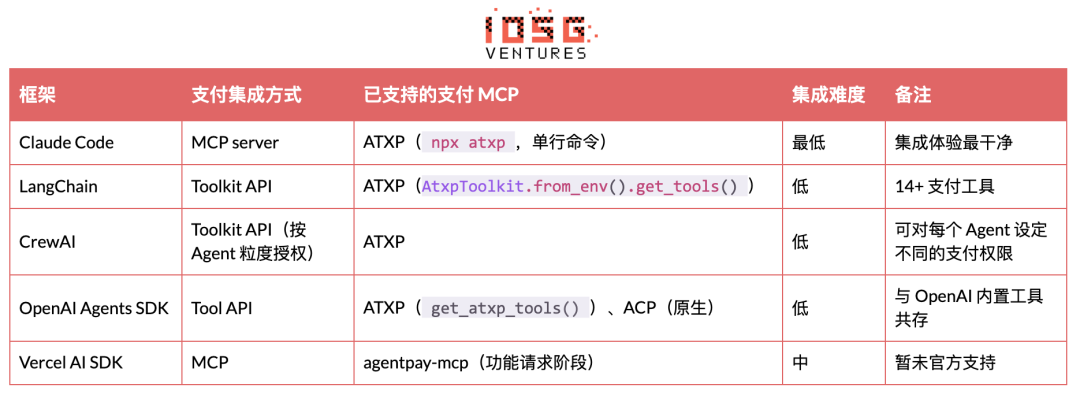
Framework Integration Status
Currently, no mainstream AI framework has native payment capabilities built-in, all frameworks integrate payments via external tools (mostly MCP server).
MCP is the De Facto Standard
MCP is rapidly becoming the universal interface standard for Agent calling external tools. Microsoft uses MCP in Copilot, and all major Agent frameworks support it.
Released Payment MCP servers:
· ATXP: 14+ tools (payment_make, web_search, web_browse, etc.), supporting Claude, LangChain, CrewAI, OpenAI SDK
· FluxA: fluxa-agent-wallet (x402 payments + USDC cash-out + payment link) and fluxA-x402-payment skill, already listed on LobeHub
· Clink: clink-mcp-server, open-source TypeScript implementation
· PayMCP: Vendor-agnostic payment layer for MCP tools (MIT open source)
· Ramp: Ramp MCP integration on Composio
· AgentPay (OpenClaw): agentpay skill supporting wallet shopping requiring human approval
Strategic Implication: Whoever's payment MCP server becomes the default configuration for mainstream clients like Claude Desktop, ChatGPT, and Cursor will secure the "default entry point" for Agent payments. This is similar to Google paying $26 billion to Apple annually to become the default search engine on Safari. ATXP currently leads in framework coverage, but Coinbase (through CDP MCP server) and Stripe (through MPP) have platform-level distribution advantages.
Competitive Landscape and Moat
Winner-Takes-All Analysis in Subtrack
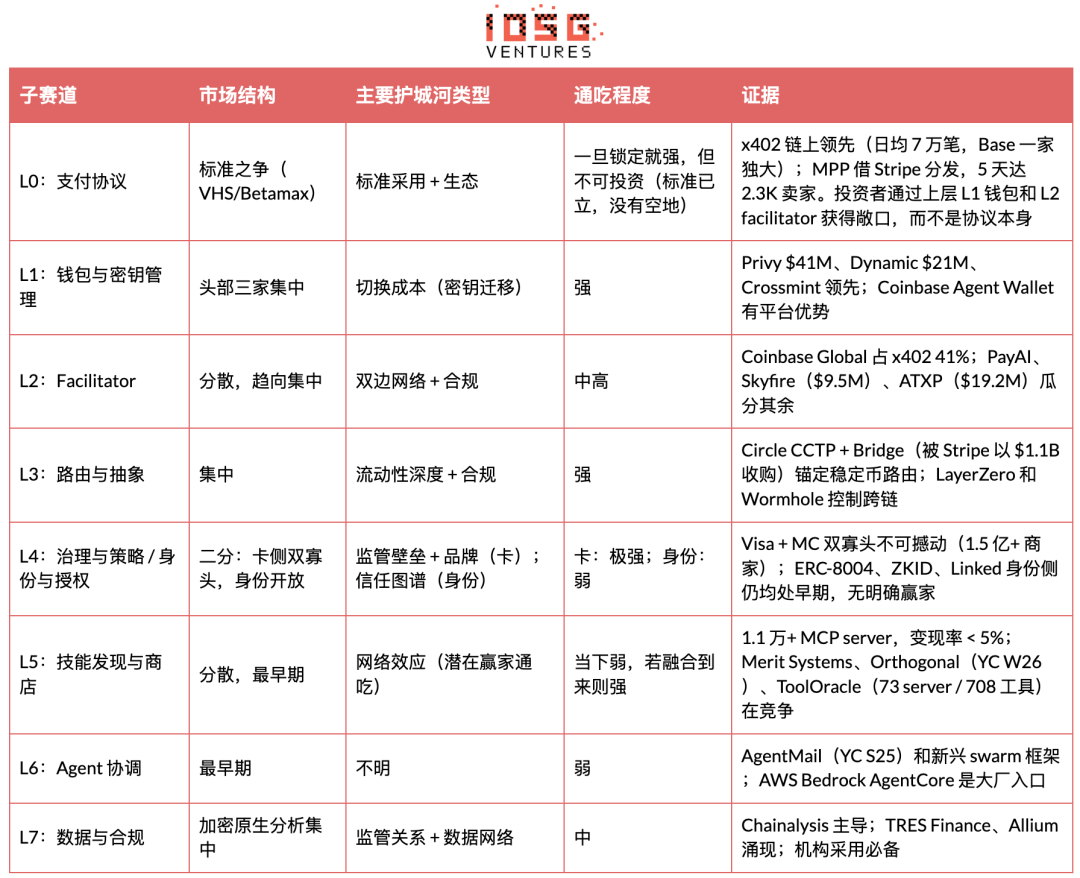
The moat strength exhibits a bimodal distribution. L4 Card Governance (Visa/MC duopoly) and L3 Routing (Circle + Bridge) are already locked in by network effects. L1 wallets have significant switching costs and are trending towards consolidation. L2 Facilitator and L4 Identity Side are the battlegrounds where startups are actually competing for returns.
Upstream and Downstream Opportunities
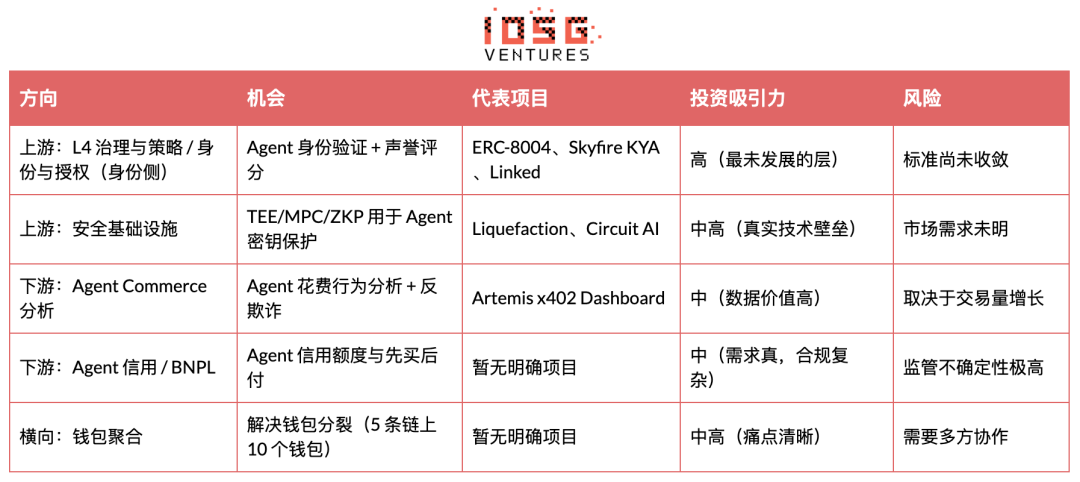
Industry Lifecycle
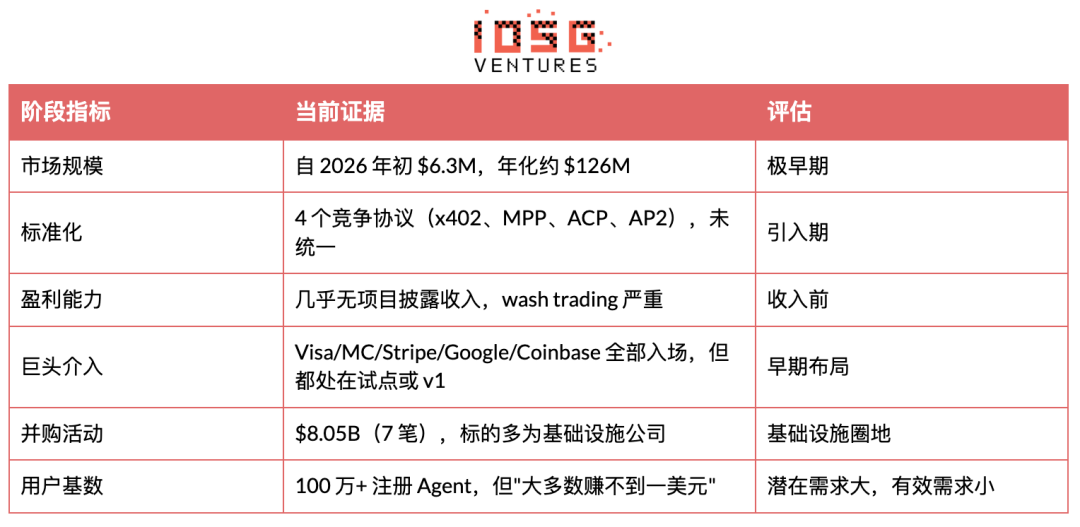
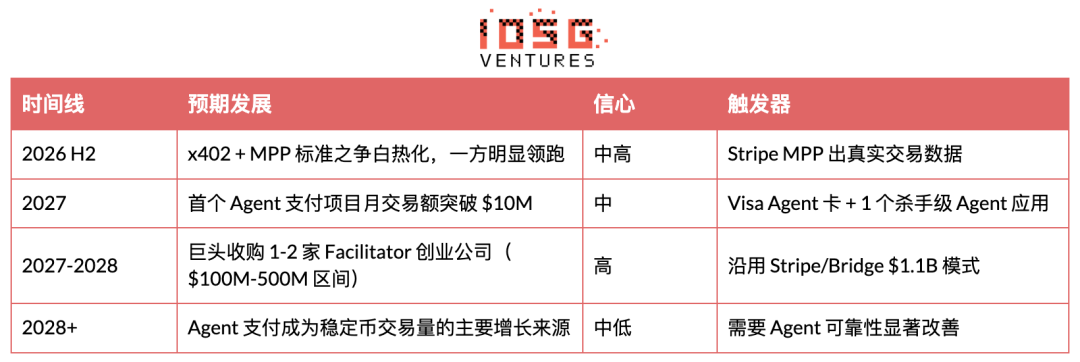
The lifecycle positioning is in the early mid-stage. Expectation to move into early growth phase in 12-18 months. Two indicators: standardization down to 1-2 mainstream protocols and at least one Agent payment project hitting a monthly transaction volume exceeding $10 million.
Investment Analysis
7 Powers Framework
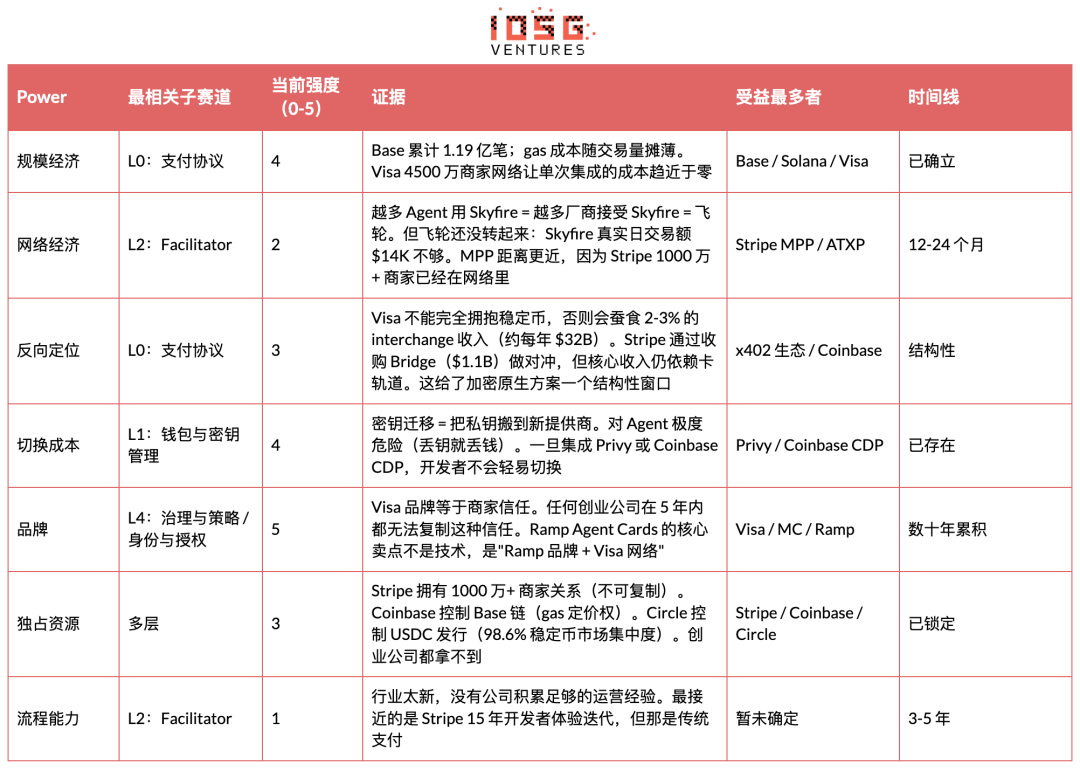
The most critical Power at the moment is Reverse Positioning. In the early stage of the industry, startups can only leverage reverse positioning and the network economy. Economies of scale and branding naturally belong to the giants. Visa cannot fully embrace stablecoins, otherwise risking the loss of $32 billion in annual interchange revenue, which is the only structural advantage window for startups.
Power Evolution Prediction: If Visa were to adopt stablecoins within 2-3 years (via VTAP), rent-seeking would disappear, and switching costs would become the only remaining Power for startups. This means that the most investable target at the moment is a facilitator that can build a high switching cost during the rent-seeking window, which involves deep API integration, key custody, and spending policy locking.
Sub-Track Investability
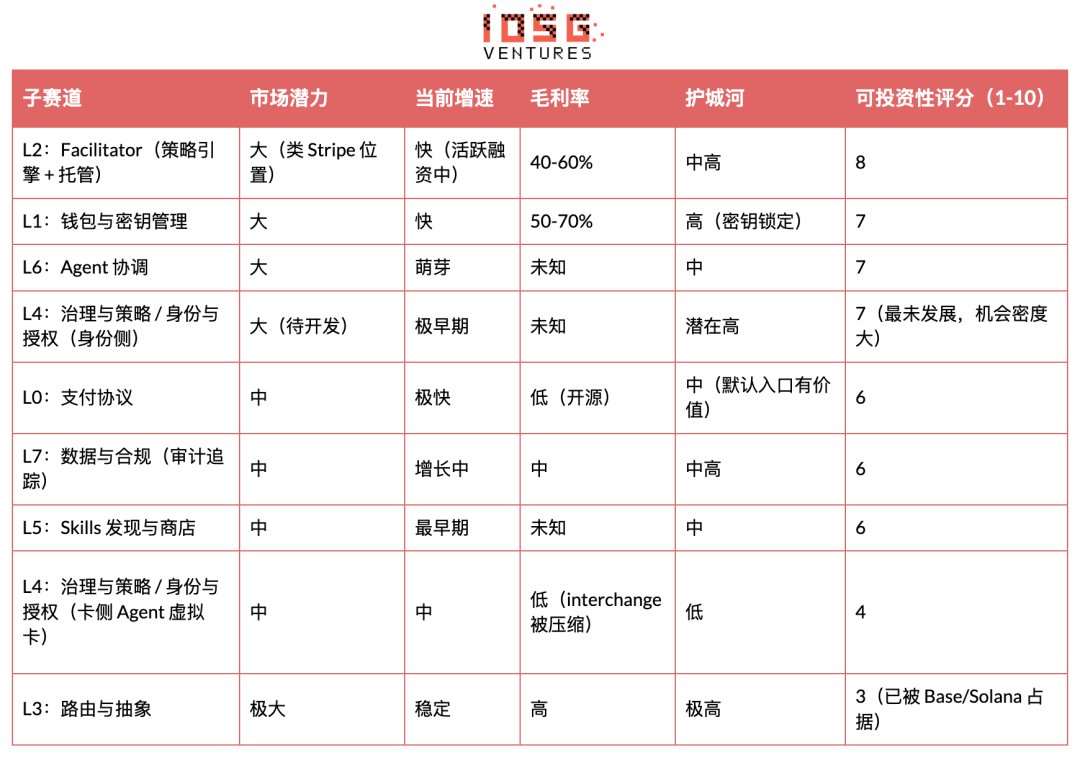
Investment Priority (High to Low)
· Facilitator Layer (Value Capture, Score 8/10)
· The value of Agent payments does not belong to the protocol layer but to those who find real use cases and serve real users. The Facilitator completely shields the complexity of the chain and Agent.
· x402 and MPP are open commercialization tracks. The Facilitator sits between the protocol and the user, handling payment validation, on-chain settlement, and cross-chain bridging.
· Control Agent signing keys and spending policies (an un-bypassable trust anchor). While receiving custody fees and order flow revenue.
· M&A exit path is clear, benchmarked by Stripe's $1.1B acquisition of Bridge.
· Key to success: Solid ground push in a vertical (prediction markets, query-based data monetization, API monetization). Achieve chain-agnosticism early. Build a developer-friendly SDK. Compete on reliability and settlement speed, not price.
· L4: Governance & Strategy / Identity & Authorization Identity Layer (Highest Alpha, Score 7/10)
· The trust layer of Agent business is completely missing. There is no standard way to verify who the Agent is, what permissions they have, or if they are trustworthy.
· ERC-8004 and Metaplex Agent Registry are early but trusted. The ZKID prototype is expected to support Agent validation under privacy-preserving conditions.
· NIST has begun to intervene in AI Agent Identity and Authorization, indicating that this will become a regulated category.
· Whoever wins the Trust Graph becomes the default identity layer, taking it all.
· Key to success: Building cryptographically verifiable identities (tying an Agent to a Principal + permission scope-bound signed credential), not just OAuth wrappers. Capture the Trust Graph early to trigger network effects. Integration at wallet/infra level that prompt injection cannot override.
· L6: Agent Coordination (Score: 7/10)
· Next phase is Coordination Groups (Finance + Compliance + Risk Agents operating together).
· Key to success: Building cryptographically verifiable output of Agents.
· L7: Data & Compliance (Score: 6/10)
· Audit trail itself is a dispute resolution mechanism.
· Key to success: Achieving real-time cross-chain transaction reconstruction. Embed Travel Rule compliance directly into payment flow.
· L5: Skills Discovery & Marketplace (Score: 6/10)
· 11k+ MCP servers, monetization rate < 5%. This is the "App Store" moment for Agent capabilities.
· Whoever becomes the default discovery layer controls both routing and payments, akin to a Google + Stripe partnership.
· Key to success: Aggressive aggregation of supply to create a payment-native discovery mechanism.
· L1: Wallets & Key Management (Score: 7/10)
· 10+ players, but rapid consolidation possible.
· Fleet management (Sponge) and framework-agnostic support (LobsterCash/Crossmint) are differentiators.
· Key to success: Capturing the framework-level defaults of LangChain, CrewAI, Claude Code. Releasing a policy engine with the "Five Pillars," including spending limits, counterparty whitelisting, transaction type restrictions, time-bound controls, upgrade thresholds.
Unit Economics (Facilitator Layer)
Modeling P&L for a typical Facilitator startup in three stages:
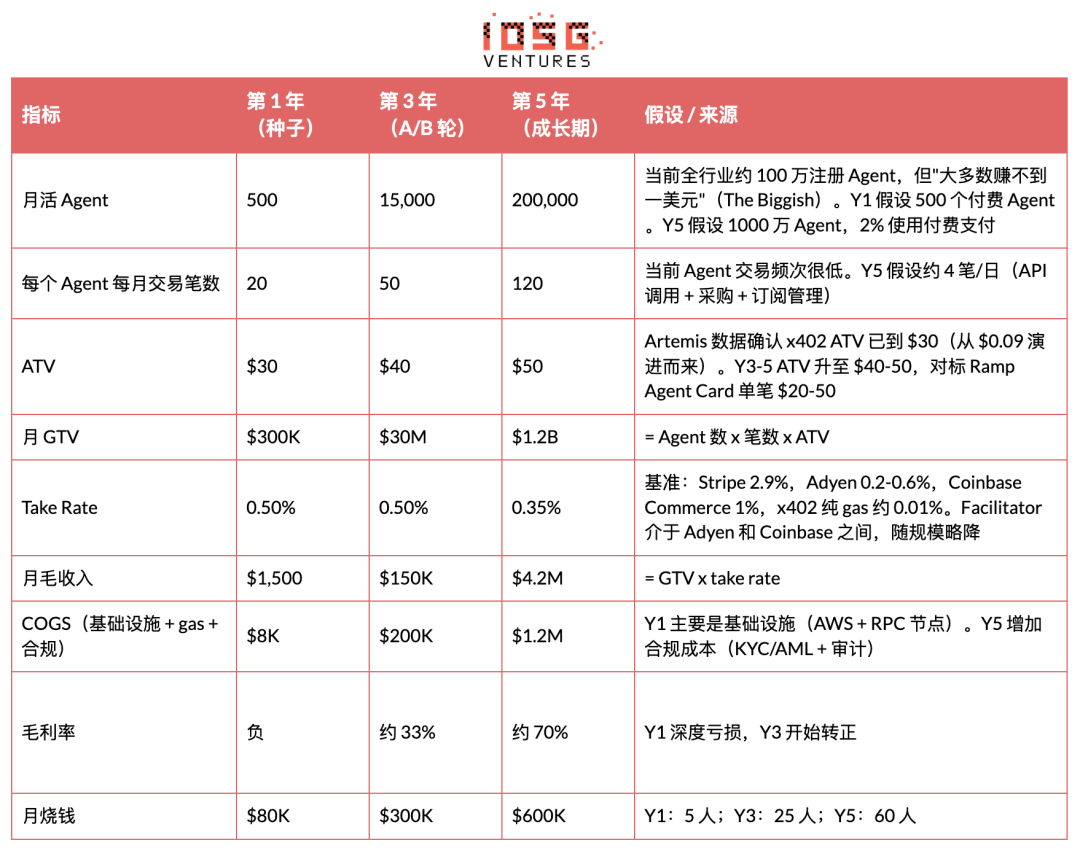
ATV Sensitivity Analysis (Y1, 500 Agents x 20 transactions per month):
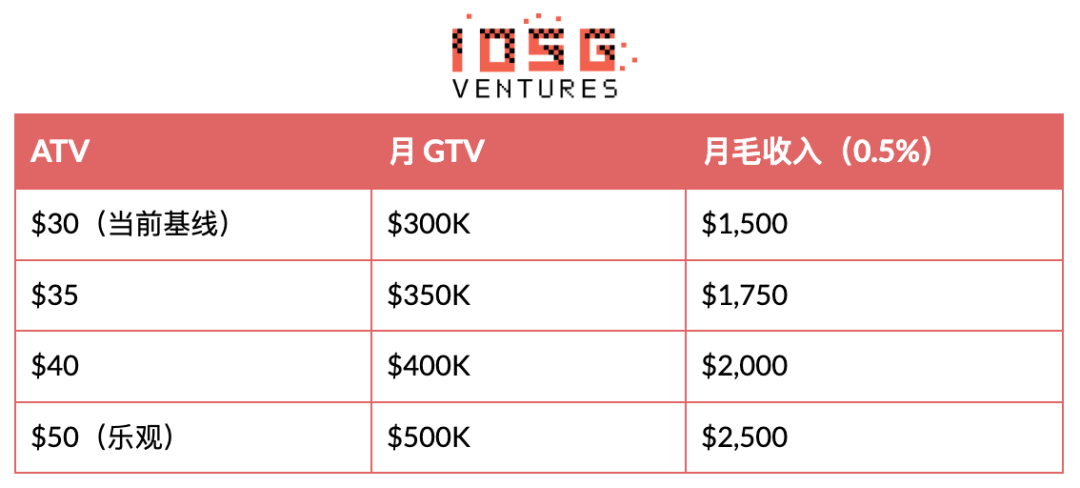
ATV is the lifeblood of the entire business model. The $0.09 era of microtransactions is over. Agent shopping/self-procurement is evolving into a primary use case. The next inflection point is for ATV to increase from $30 to $50+. Leading indicator: which payment MCP server becomes the default integration in Claude Code, LangChain, CrewAI.
Minimum Viable Transaction Volume test. At a 0.5% take rate, a Facilitator needs $200M in annual GTV to achieve $1M ARR, which is $550K/day. The entire ecosystem's current daily GTV is around $2.7M (Artemis, April 2026), implying a theoretical ARR ceiling of approximately $4.9M (if a Facilitator captures 100%):
Entire ecosystem x402, 0.5% take rate, daily GTV $2.7M:
· Annualized Facilitator Revenue: $2.7M x 365 x 0.5% = $4.9M
· Already surpassed the $1M ARR threshold
· $10M ARR: Requires current transaction volume to double
· $100M ARR (Growth Phase): Requires current transaction volume to increase twentyfold
Take Rate Benchmark:
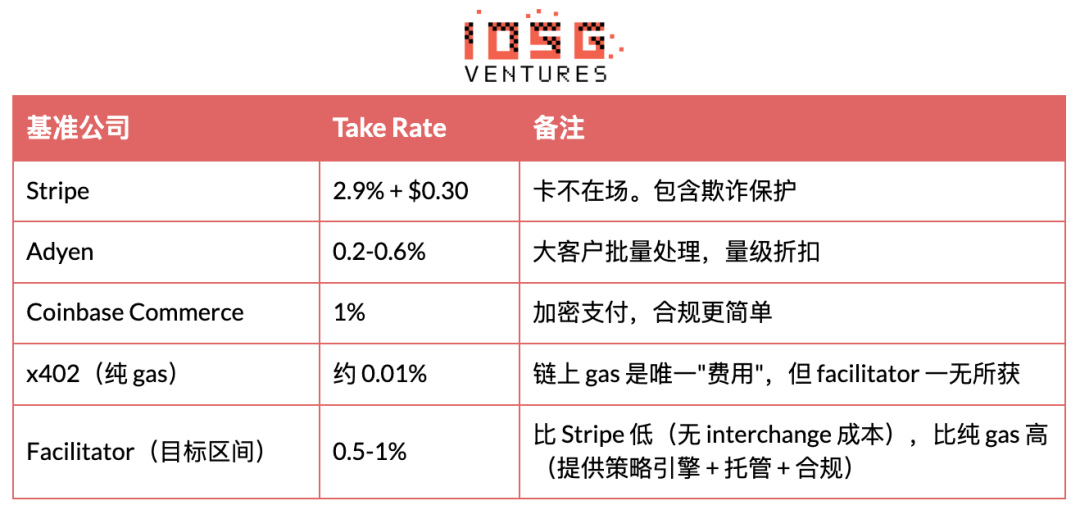
Comparison with Mature Companies
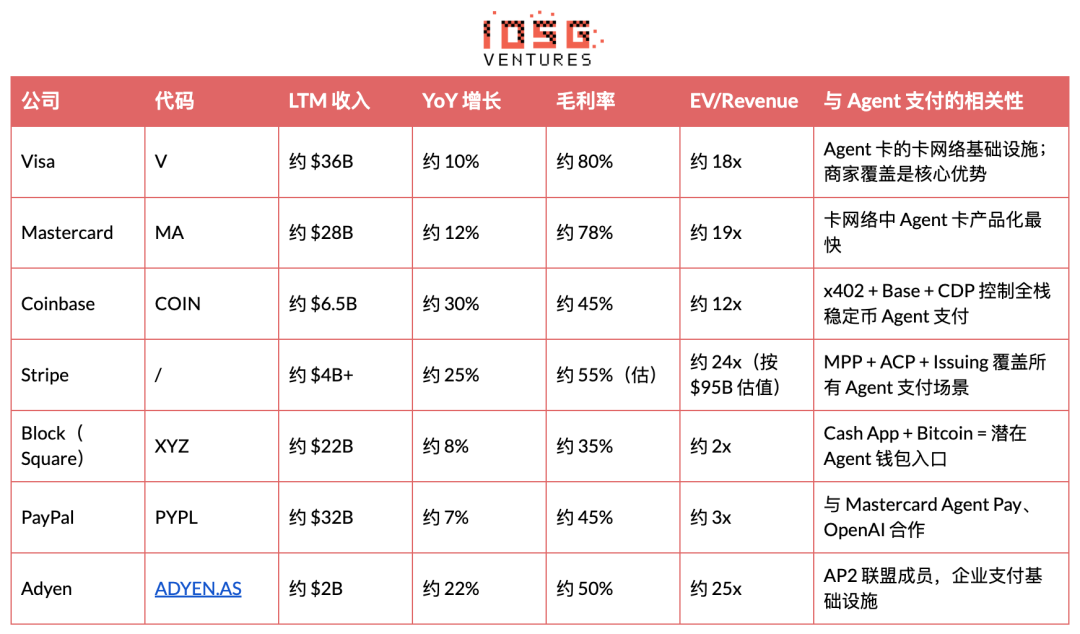
Publicly traded payment companies trade between 12-25x EV/Revenue. If an Agent payment startup can achieve $50M+ ARR with 50%+ growth, it would be valued at a minimum of $1B+ based on a 20x revenue multiple. However, currently, no company in the industry discloses revenue data, and valuations are entirely based on narrative premiums.
Forecast
Decision Tree
Key Question
Can Agent Payment reach a $1 billion annual transaction volume by 2028? This forks into two paths.
Path 1: Can Achieve (55% probability). The trigger is Stripe MPP validating PMF along with Visa Agent card reaching millions of users. This path has two sub-results:
· Stablecoin track becomes dominant (constitutes 30% of this branch). Coinbase and x402 ecosystem gain the most value, the card network portion is bypassed, and Facilitator valuation falls in the $500 million to $1 billion range.
· Card channel continues to dominate, with stablecoin as M2M supplement (constitutes 70% of this branch). Visa, Mastercard, and Stripe win mainstream volume. Pure crypto solutions become niche, with Facilitator either being acquired by Stripe or marginalized.
Path 2: Cannot Achieve (45% probability). The catalyst is Agent reliability not reaching payment-grade trust, or standards continue to splinter. Two sub-results:
· Slow growth to $200 million to $500 million (constitutes 60% of this branch). The race exists but valuation is under pressure, requiring startups to have a longer runway.
· Foundational model companies build payments in-house (constitutes 40% of this branch). OpenAI and Google integrate payments natively, and third-party Facilitators are phased out.
Growth Timeline
Reverse Stress Test
Risk One: Tech Giants Build Payments In-house, Middleware Reset
OpenAI, Google, and Apple control over 90% of AI agent user entry points, enabling native closed-loop payments (ChatGPT + Card Linking, AP2 + Google Pay, Siri + Apple Pay).
When Google AP2 launched, it touted "Google Ecosystem Closed-loop Agent Pay" with a claimed 60+ partners. OpenAI Operator is now able to complete online shopping. Apple Pay has historically wiped out many third-party mobile wallets.
Risk 2: Market Timing is Still 3 to 5 Years Off, Investing Now is Premature
Issues such as unreliable agents, lack of merchant API standards, and insufficient consumer trust are major hurdles. Seed-stage companies have an 18- to 24-month runway, but the market may not develop fast enough.
The AI payment protocol supported by Coinbase faces a narrative of "demand is not there yet." Agents frequently lie when performing tasks. Most agents still can't earn a single dollar.
Stress Test Conclusion
Of the two risks, timing risk is the most lethal and hardest to argue against. Unit economics don't lie, and the market is indeed far from reaching investable scale. The platform risk aspect has been mitigated by the "model companies not good at compliance" narrative, but by 2026, this defense line weakens: OpenAI has acquired a KYC provider, Google has Google Pay, Apple has Apple Pay plus Apple Card, and Anthropic's shareholder list includes traditional financial investors. Compliance capabilities are no longer a moat of trust for model companies.
The single biggest and irreducible risk is timing. Moving from the introduction phase to the early growth phase depends on ATV transitioning from micropayments to enterprise-level, which in turn depends on two external variables beyond the control of investors: Agent reliability and merchant coverage.
Three adjustments to the investment strategy:
1. Allocate 60% of the Agent Pay exposure to the seed round to reserve ample follow-on for the bridge round (hedging timing risk).
2. Prioritize agnostic facilitators (supporting both stablecoins and cards) to hedge regulatory risk.
3. Set an 18-month kill switch: if by 2027 Q4 there is still no facilitator with monthly transaction volume exceeding $5M, consider write-down or fire sale.
Investment Recommendation
The Agent's need for solvency is a logical necessity, but the current market is still in its infancy (only $6.3M as of early 2026), plagued by wash trading, standard fragmentation, and the looming threat of incumbents crushing startups at any moment. The argument is not "this market is large now," but rather "this market will grow, and the valuation window before its expansion is very favorable."
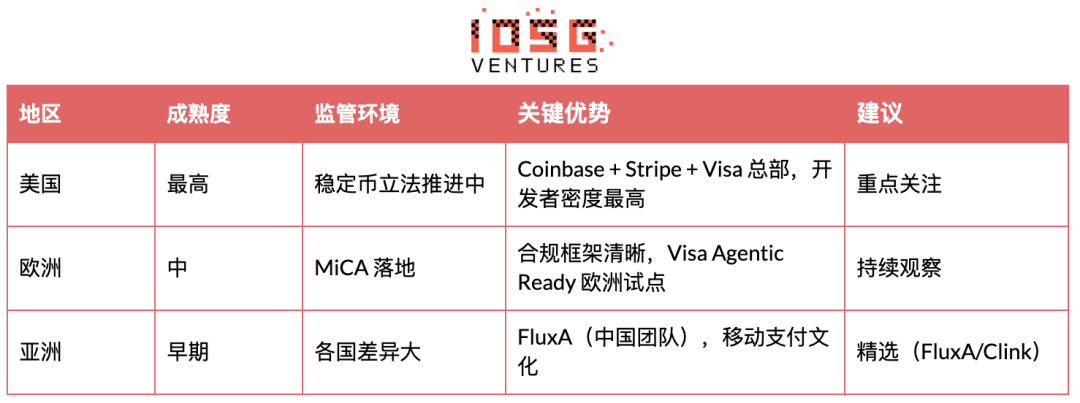
Geographically, the focus is on the United States, with regulatory hedging in Europe and Asia as a wildcard.
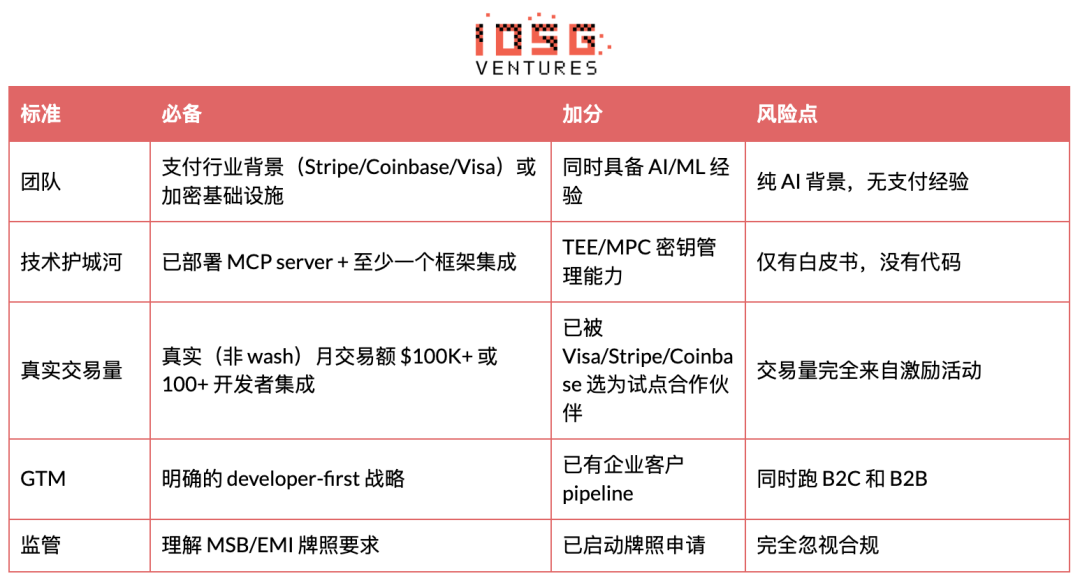
A team worth investing in has a background in the payments industry (Stripe, Coinbase, Visa) or crypto infrastructure, has deployed an MCP server with at least one framework integration, demonstrates real non-wash monthly transaction volume of $100K+ or integration with 100+ developers, and has a clear developer-first go-to-market strategy.
Points to avoid include teams with a purely AI background and no payment experience, projects with only a whitepaper, transaction volume reliant solely on incentives, simultaneous focus on B2C and B2B, and a complete disregard for MSB/EMI licenses.
Welcome to join the official BlockBeats community:
Telegram Subscription Group: https://t.me/theblockbeats
Telegram Discussion Group: https://t.me/BlockBeats_App
Official Twitter Account: https://twitter.com/BlockBeatsAsia
