Consensus Miami 2026 took place in Miami from May 5 to 7, 2026. The summit gathered over 20,000 attendees, including numerous institutional figures, federal policymakers, and pioneers in the crypto space, painting a picture of the convergence between traditional finance and digital assets. The conference focused on the deep integration of global institutional finance, autonomous AI agents, and cryptocurrency, emphasizing Miami's role as a global hub for tech finance.
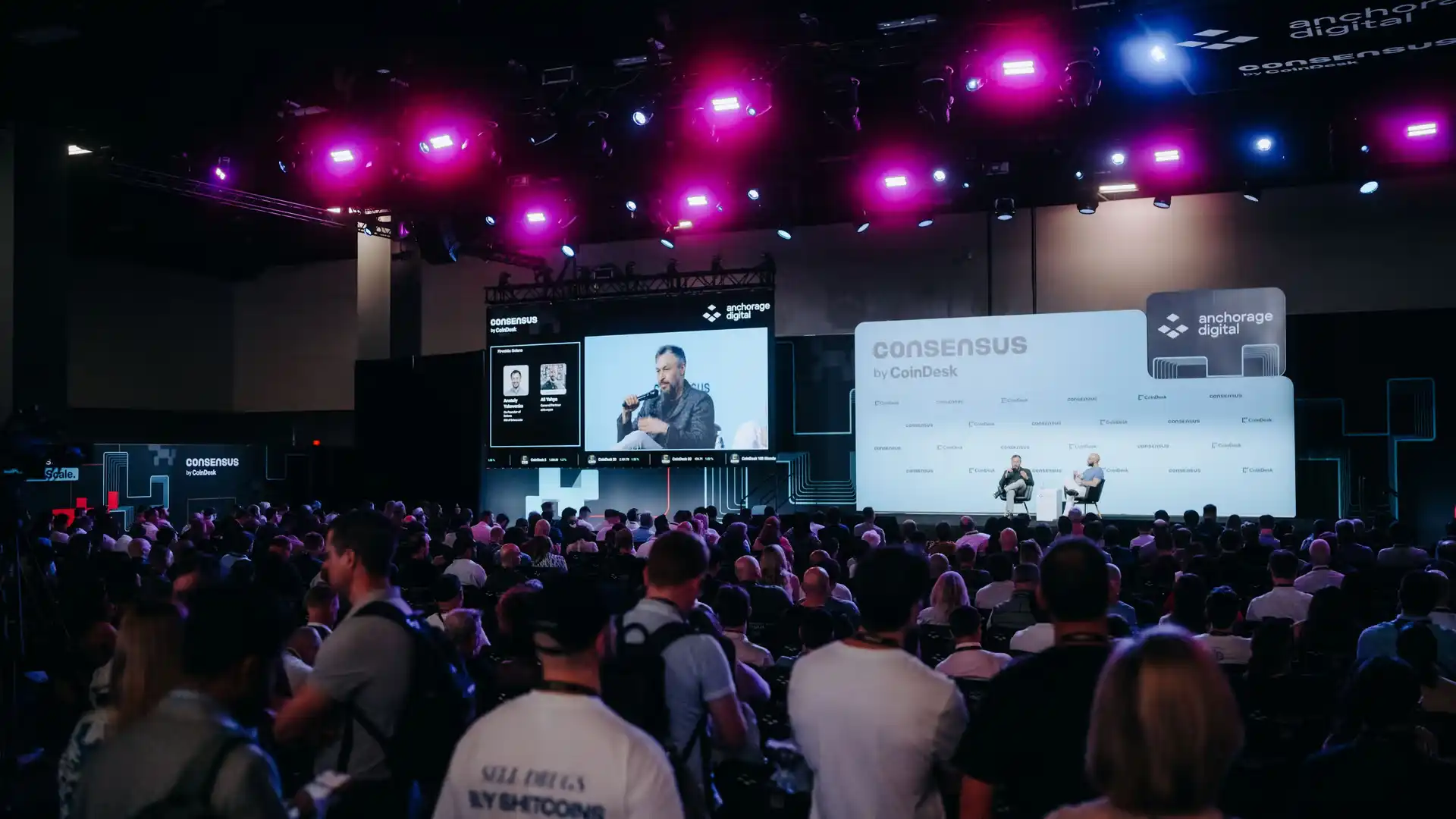
The agenda of Consensus Miami 2026 was tightly centered around the three core forces reshaping global finance: scalable cryptocurrency applications, institutional integration, and agent-based business. Speakers such as Arthur Hayes (Co-founder of BitMEX), Lily Liu (Chair of the Solana Foundation), and Jesse Pollak (EVP of Engineering at Coinbase) delivered keynote speeches or participated in fireside chats. Here are some key takeaways from the conference curated by BlockBetas:
May 7
Raoul Pal: Cryptocurrency is the "Universal Basic Equity" of the AI era, with Agents projected to represent three-fifths of DeFi users within five years
Raoul Pal, Co-founder and CEO of Real Vision, stated at Consensus Miami 2026:
Humanity is at an unprecedented inflection point, on the verge of encountering AGI entities that are smarter, more adaptable, and more powerful than humans, with AI capabilities currently doubling annually. By 2028, AI's annual production of text will surpass all human output in history, and this transformation will occur within 5 years.
As AI massively displaces labor, the solution is not the traditional concept of Universal Basic Income (UBI) but rather "Universal Basic Equity." For the first time in history, ordinary individuals can directly own the underlying network by holding tokens of the crypto infrastructure, benefiting in tandem with the expansion of Agent economies. Institutional involvement has not deviated from the crypto ethos; it has, in fact, allowed anyone globally to stand on equal footing with BlackRock by purchasing BTC, ETH, SOL, and more.
In a rapid-fire Q&A session, Pal indicated that if he had to choose only one, he would opt for Solana over Bitcoin and projected that within 5 years, Agents would outnumber humans as the primary user base of DeFi by a 3:2 ratio.
Arthur Hayes: Bitcoin Price is Influenced by Liquidity, Not Regulatory Favoritism
BitMEX co-founder Arthur Hayes stated at the Consensus 2026 conference:
The crypto industry does not need regulation, as regulation is largely irrelevant to Bitcoin's value proposition. The two core factors determining Bitcoin's price are only two: technical reliability and fiat liquidity, with the latter being the true driver.
Whether it was the quantitative easing during the Obama era, the "helicopter money" in Trump's first term, or the approximately $2.5 trillion reverse repo funds released by Treasury Secretary Yellen in the Biden era through short-term bond swaps for long-term debt, each round of monetary expansion has strongly correlated with Bitcoin's significant price surges. Despite the Trump administration signing crypto-related bills and sending clear signals of regulation, the price of Bitcoin has still dropped by about 25% in the past 18 months, proving that regulatory favoritism does not directly impact price increases; liquidity is the root cause.
The Trump family's prior experiences with derisking, asset freezes, and numerous lawsuits led them to recognize the value of Bitcoin as an asset free from government control. If Bitcoin were to end up as another derivative on a bank's balance sheet, it would lose its true essence.
Cardano Founder: By 2035, AI Agents' Importance to the Internet Will Surpass Humans, Tech Giants Like Google Are "Very Afraid"
Cardano founder Charles Hoskinson stated at the Consensus 2026 conference that by 2035, a majority of searches, transactions, and activities on the internet will be carried out by AI Agents rather than human users, profoundly disrupting the business models of tech giants like Google, Amazon, and Facebook.
Hoskinson mentioned that AI Agents do not click on ads and have no brand loyalty, thereby directly undermining platform models reliant on ad revenue. "Amazon, Google, Facebook are afraid of the Agent revolution because all their business models will be disrupted."
He believes that AI Agents will increasingly take on tasks in the crypto industry such as due diligence, transaction execution, and DeFi interactions, stating that AI is "one of the best things to happen to cryptocurrency," as it is poised to greatly improve the current complex user experience.
At the same time, Hoskinson emphasized that users should continue to control their own data, identity, and assets, rather than rely on custodial wallets or third-party platforms. He criticized the current overly fragmented nature of the crypto industry ecosystem, stating, "We have issued 11 million tokens over the years, we don’t need more tokens, what is needed now is collaboration."
In addition, he also mentioned that the attitude of traditional financial institutions is changing. Taking JPMorgan Chase as an example, "in the past, they would close users' cryptocurrency-related bank accounts, but now they are starting to roll out blockchain products."
Wall Street Clearing Giant DTCC Collaborating with Multiple Layer1 Blockchains to Drive On-Chain Corporate Actions like Dividends
Frank La Salla, CEO of the U.S. securities clearing giant DTCC (Depository Trust & Clearing Corporation), stated that the company is collaborating with multiple high-performance Layer1 blockchains to explore migrating complex corporate actions such as dividend payments and tender offers to on-chain processing.
La Salla, speaking at Consensus 2026, mentioned that most blockchains are still inefficient in handling corporate actions. DTCC processes millions of dividend payments daily, requiring a Layer1 network with high throughput and stability. DTCC is a key piece of U.S. capital markets infrastructure, processing around $20 trillion in U.S. Treasury and securities transactions daily.
The organization plans to launch a tokenized securities platform test in July this year, with a broader rollout scheduled for October. La Salla believes that "tokenized collateral" could be the first large-scale institutional use case for blockchain. In the future, Asian institutions could even access USD liquidity in real-time via on-chain collateral on a Sunday in New York.
However, he also cautioned that blockchain still faces challenges such as scalability, fragmented liquidity, and risk management, especially the efficiency of "netting" in the traditional financial system that is hard to replicate in a decentralized environment.
U.S. Senator: Cryptocurrency Market Structure Legislation Won't Pass Without Ethical Clauses
U.S. Senator Kirsten Gillibrand stated at the Consensus conference that cryptocurrency market structure legislation would not receive a vote without ethical clauses. She emphasized the need to prohibit members of Congress, senior government officials, and the President and Vice President from using their insider status to profit from the crypto industry. Currently, several Democratic senators have expressed concerns about President Trump and his family's crypto ties, with Bloomberg estimating Trump has made at least $1.4 billion through crypto investments.
The bill was previously blocked in the Senate due to stablecoin reward handling issues but has now reached a compromise. However, ethics clauses have become a new obstacle. Gillibrand stated that she is working with the White House and both parties to ensure the inclusion of relevant content and is pushing for consumer protection and anti-money laundering clauses to be added. The bill is expected to pass before the August recess.
May 6
CFTC Proposes Formal Rule to Confirm Safe Harbor for Unhosted Software Developers
The Chairman of the U.S. Commodity Futures Trading Commission (CFTC), Michael Selig, announced at the Consensus Miami conference that the agency is planning to formalize its friendly stance towards unhosted software developers through a proposed rule. In March, the CFTC had issued a no-action letter to the cryptocurrency wallet provider Phantom, clearly stating that self-hosted wallet software developers meeting certain conditions do not need to register as brokers. Compared to informal guidance, the CFTC prefers to quickly establish regulatory clarity through formal rulemaking to provide clear guidance to U.S. developers and promote the development and launch of relevant software.
This move aligns with similar guidance issued by the SEC last month — the SEC noted that interfaces like DeFi wallets are generally not considered brokers. Currently, both regulatory agencies are working to clarify the regulatory stance on software developers, which is beneficial for the development of unhosted wallets and DeFi tools in the U.S.
Kraken: IPO Preparation Approximately 80% Complete
Arjun Sethi, Co-CEO of Kraken, stated at the Consensus Miami conference that IPO preparations are "approximately 80% complete," with the company having submitted the application to the SEC and awaiting the right market opportunity.
Kraken had previously suspended its IPO plans in March.
Toly: Major Upgrade to Solana Network "Alpenglow" to Launch Earliest in Next Quarter
Toly, co-founder of Solana, announced at Consensus Miami 2026 that a significant upgrade to the Solana network, named "Alpenglow," is expected to be launched this year, possibly as early as the next quarter. Toly stated that the Alpenglow upgrade will bring transaction confirmation speeds close to the physical limit of "light speed," enhancing the network's speed, reliability, and transaction finality. This shift from Solana's early innovation to a more mature phase focusing on performance assurance and reliability is crucial for time-sensitive applications like financial applications.
May 5
Arthur Hayes: Shitcoins Will Not Die, Market Will Continue to Consolidate
Arthur Hayes stated at Consensus 2026 that although "99% of shitcoins may go to zero," this phenomenon is similar to historical turnover in the S&P 500 components and does not signify the end of the industry.
Hayes pointed out that since 1929, about 98% of the S&P 500 companies have been eliminated. Market clearing is part of a normal cycle, and the cryptocurrency ecosystem will continue to exist and evolve.
Welcome to join the official BlockBeats community:
Telegram Subscription Group: https://t.me/theblockbeats
Telegram Discussion Group: https://t.me/BlockBeats_App
Official Twitter Account: https://twitter.com/BlockBeatsAsia
