"Taking into account the time cost, the return on acting as a middleman is not as good as just getting a regular job."
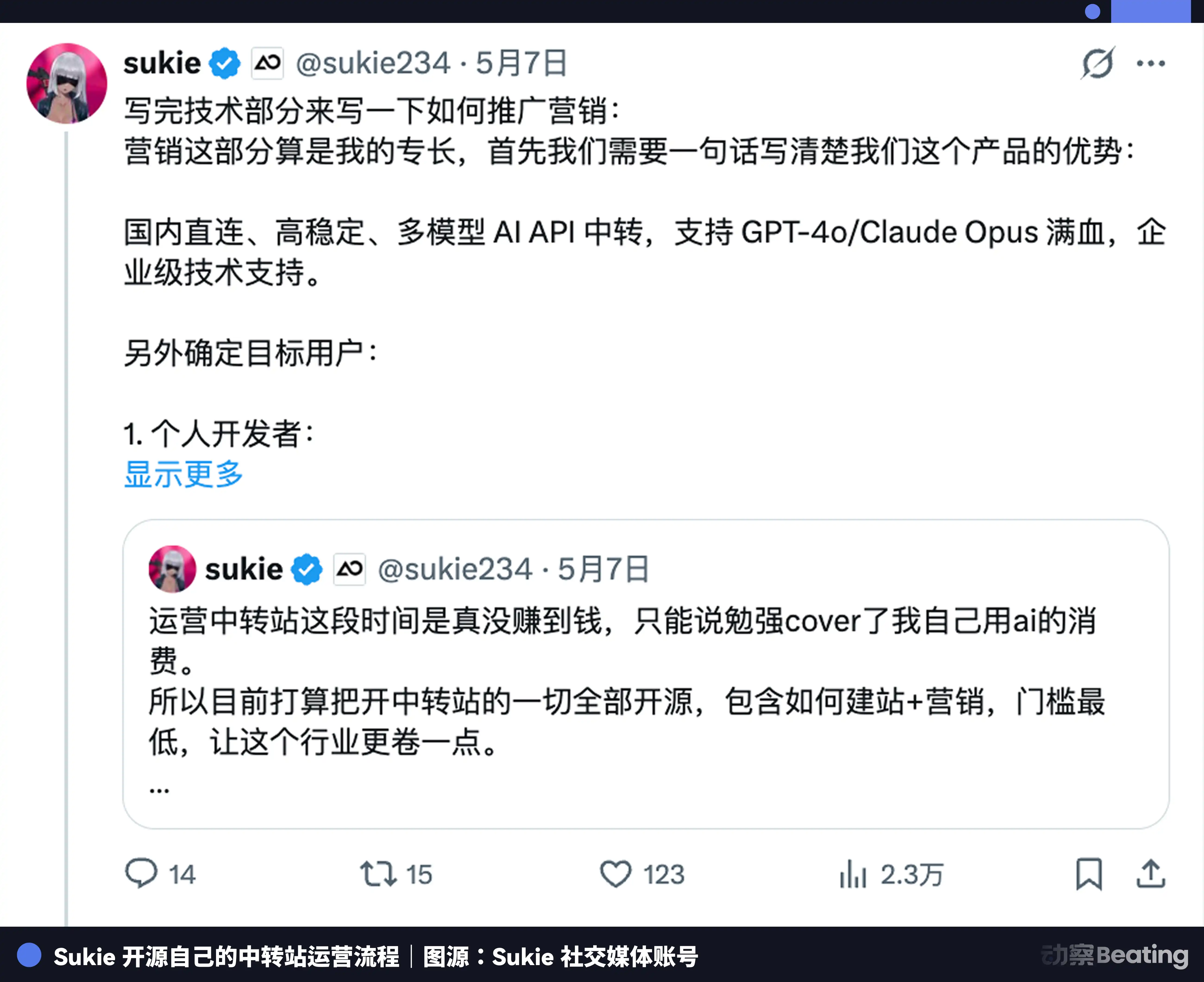
A few days ago, Sukie open-sourced the entire process of setting up her middleman station, from server procurement to technical configuration, and even customer acquisition through marketing, all documented in a tutorial. This post brought her dozens of new users in a single day on social media. We caught up with Sukie to discuss what she has seen differently from the outside after truly running this business.
Over the past year, the middleman track has gone through a complete cycle, from making a fortune in silence to fierce competition, and now to the entry of big players to reap the rewards. Beatings by Beating has previously reported on a site owner Mo who only operates on the B side ("After Claude Demands Real-Name Verification, One Middleman Station Owner's Ponderings"), her story showcases the daily operation of this business and the global AI access gap it touches upon. This time, the storyteller Sukie provides another perspective: that of a person with a complete business mindset, who, even after fully aligning technology, marketing, and compliance, still hasn't made a profit.
When the barrier to entry for a business is so low that anyone can join, and profits are destined to only grow through gray operations or ecosystem scams, where does that leave space for middleman station operators to independently operate in compliance?
Below is Sukie's account.
Compliant-Origin Accounts Are Expensive
Our account pool mainly has two sources: partners provide some from Singapore, and we register some ourselves.
Those registered by us follow the compliance path, using real payment methods and identity information to register. These accounts have a high cost and slow acquisition process, but they offer the best stability.
In the industry, there are also accounts with shady origins. Some people buy stolen accounts, use fake identities, or even mass register with bots. It's cheap, but the risk is high. Once these accounts are associated and traced back by the upstream platform, the entire account pool could be compromised.
This is also why our costs cannot be reduced; compliant-origin accounts are inherently expensive. This is a core contradiction in the middleman station industry: either cheap with compliance risks, or expensive but sustainable. We chose the latter.
By 2024, the industry still has a 30% to 40% gross profit margin. The first 20 sizable middleman stations are basically profitable, and the competition lies in stability and customer service experience, not price.
The turning point came in the second half of 2025. Wave after wave of new players entered the market, each wave driving prices lower. First at a 20% discount, then 30%, 40%, and by early 2026, some were able to purchase at half price or even one-third of the official price.
The current situation is that players willing to price products at a healthy gross margin cannot survive because users have left. Those selling at ultra-low prices also cannot survive because they cannot lower their costs to that level and can only rely on gray operations to sustain themselves.
From an industry perspective, if using a compliant source of accounts, along with the costs of labor and servers, the lowest profitable pricing is probably around a 20-30% discount off the official price. Below this range, either the source of the accounts is questionable, or it is a situation of burning through investor funds.
It is impossible to be profitable by pricing at 10% of the official price using compliant methods because the upstream account costs alone exceed 10%.
Within the developer community, there is word-of-mouth circulation. Users attracted in the short term by ultra-low prices quickly realize issues such as poor service quality, discrepancies in token counts, and inconsistent model outputs, leading to rapid churn. However, after churning, they leave with a distrust of the entire industry, harming the entire ecosystem.
Earning Chinese Yuan is Really Hard
My biggest mistake was being in the United States but choosing to earn Chinese Yuan.
Our costs are settled in US dollars, from the account pool to servers and payment channels, but our revenue is in Chinese Yuan, targeting the most price-sensitive group of developers in the Chinese market. Chinese users are extremely price-sensitive, and their willingness and ability to pay are not comparable to European and American customers.
Being in the United States, one should directly do business with European and American companies to earn US dollars. Selling to the Chinese market is equivalent to nullifying the advantage of geographical location, instead incurring losses due to exchange rates and payment issues.
There are problems with the payment chain, intense pricing competition, but the fundamental reason is the low spending ceiling of the customer base.
It's hard-earned money. From buying servers to getting the intermediary station up and running, a person with some technical knowledge can accomplish it in one or two weeks. The real energy and money consumption come from the operational aspects.
The biggest drain is maintaining the account pool. Accounts being blocked or frozen require daily monitoring and periodic replenishment of new accounts. The pool of a typical medium-sized intermediary station usually consists of several hundred to several thousand accounts.
Factors such as the risk control policies of the upstream platform, request patterns resembling human behavior, and the quality of account sources all contribute to the frequency of blocks. The combined effect of these factors results in a continual rise in the account blocking rate. Some accounts can remain active for months, while others may be blocked on the day of registration.
The second major drain is customer service. Users of the intermediary station are mostly developers, and their issues are very specific. For example, why is there a discrepancy in token counts? Why is the response slow? Why is this model showing errors today? Each question must be answered; otherwise, the reputation will suffer.
Small and medium-sized enterprises contribute the highest average order value, AI Shell Startup founders contribute the highest level of active usage, and individual developers contribute the largest user base but with the lowest unit price.
The most challenging group to serve is AI Shell Startup founders, who are extremely price-sensitive, constantly compare prices each month, have the lowest retention rates, and experience extreme fluctuations in requests. If a product suddenly becomes trending, the number of requests can increase a hundredfold in a day, causing the server pool to crash. Feedback is also rapid - a single comment in the developer community saying "it's not user-friendly" spreads much faster than feedback from B2B clients.
Surprisingly, the easiest group to serve is small and medium-sized enterprises with dedicated technical account managers. They have stable traffic, timely payments, request invoices and contracts, and after a few back-and-forths, a long-term partnership can be established.
Looking at the channels, it's also harder to earn in Chinese Yuan. This time, I open-sourced the Relay Station methodology on X and brought in dozens of new orders. Overseas developers have a willingness to pay and make decisions one order of magnitude faster than domestic ones. Community viral growth and agent distribution work best because the trust cost of the relay station is extremely high, and recommendations from acquaintances are over ten times more efficient than cold traffic.
SEO and RED are slow but steady channels. SEO users have the strongest purchase intent, but traffic is low, growth is slow, and it takes three to six months to see results. RED has high traffic, moderate conversion rates, and its users are mainly AI application layer developers and early-stage entrepreneurs.
The worst ROI comes from TikTok and Idle Fish. The TikTok algorithm is not friendly to technical content, so investing does not yield results as good as organic growth; Idle Fish users expect to solve problems for a few bucks, but our cost structure does not allow for pricing at that level. Many inquire but few place orders, and each consultation consumes time.
The third challenge is compliance and payments. Every cross-border payment must be handled carefully. For example, our academic clients require contracts, overseas clients use a USD channel, and domestic clients in RMB need to address entity and invoice issues. Each type of client has a separate compliance process.
Another issue is preventing token farming; as soon as we open up open source and free trials, there are people who immediately write scripts to mass-register and exploit free tokens, requiring us to update our defense strategy every week.
One thing that newcomers most often underestimate is the details of these operational areas. Low barriers to entry mean fast imitation, and fast imitation means no moat.
Make the Market Even More Dynamic
In the past two weeks, Mr. Sun, Mr. Fu Sheng, and even the Trump family have all entered the business of relay stations, marking a turning point in this business. Mr. Sun is known for privacy, anonymity, and the lowest prices, Mr. Fu Sheng offers an 15% discount throughout the store, and the Trump family provides a direct 35% discount. The most expensive package at $9999 comes with a ticket to the Mar-a-Lago Estate.
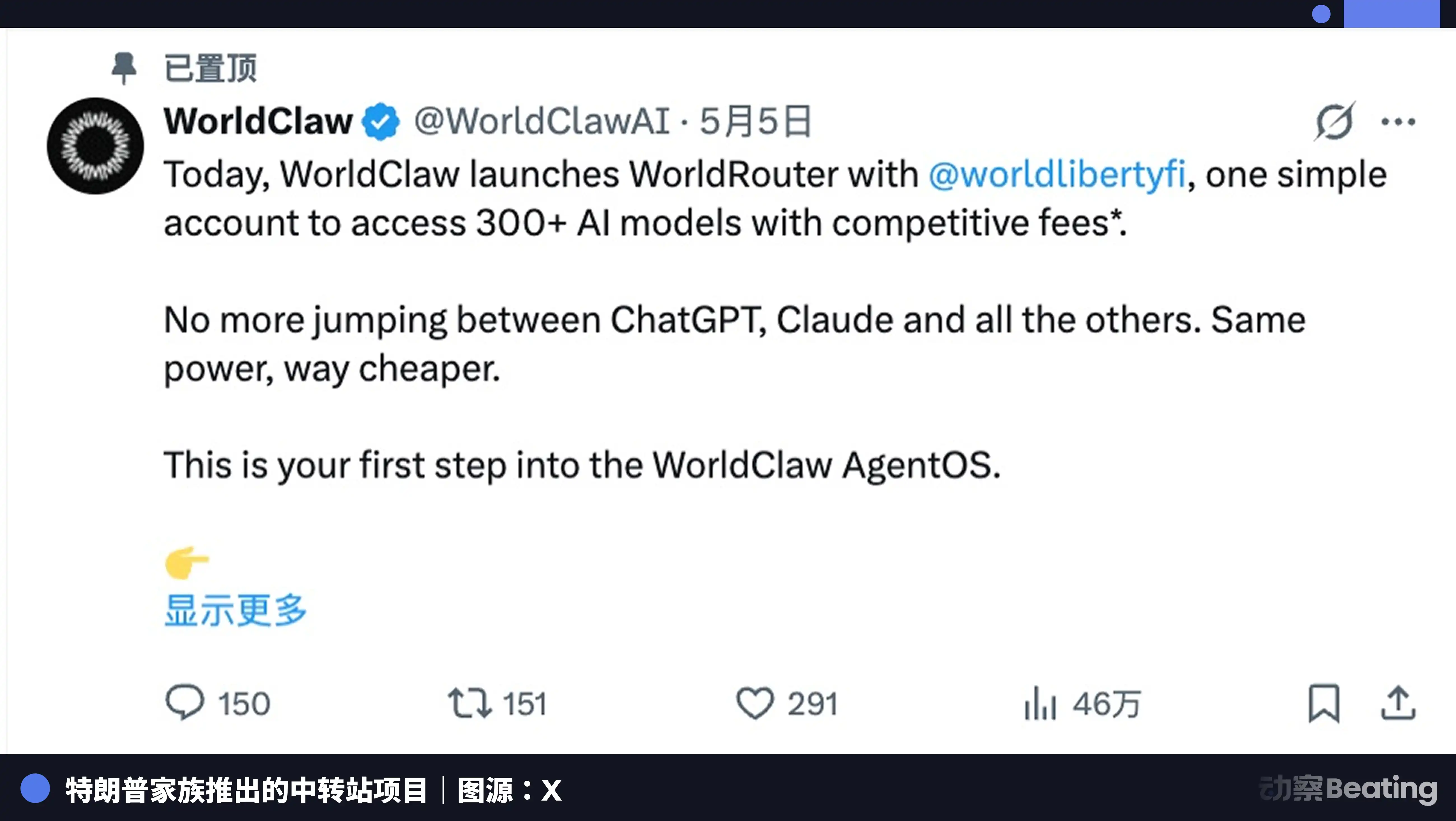
The three individuals targeted completely different customer bases, but fundamentally they all added a shell to the upstream model's API and resold it. None of them truly relied on arbitrage for a living.
Sun's main course is on-chain payment settlement, where the intermediary station's fees are settled via blockchain, effectively generating transaction volume for TRON. Fu Sheng's main course is the story of Cheetah Mobile's business transformation, telling the capital market a tale of AI. The Trump family's main course is the WLFI token and the USD1 stablecoin, with the intermediary station merely serving as a traffic acquisition tool.
For these three parties, arbitrage spread is not the source of profit at all. They can use the intermediary station to attract users at a loss, then earn money from the ecosystem, tokens, and branding of these users.
This is why this business is not friendly to individuals. Those making money in the industry are either profiting from the information asymmetry of gray operations, or using the intermediary station to feed a larger business. We are neither.
So, this is also why I chose to publicly disclose the intermediary station business. On the one hand, it can serve as a marketing tactic. The spread of the open-source post these days far exceeds that of previous promotional posts.
The second reason is to contribute to the industry. The intermediary station has been heavily demonized, with the outside world thinking it's all gray, shady, and fraudulent. However, there are people conducting this activity in a compliant manner. By openly sharing the setup process, we let more people know that the technology is not a black box.
The moat of this business was originally narrow, but some players engaged in black-box operations have maintained high margins through information asymmetry. After open-sourcing, retail investors can build it themselves, eliminating the premium on black-box players' technical barriers. What remains is the true capability of node stability, customer service experience, and regulatory compliance.
Therefore, the real implication of making the industry more transparent is to shift from the transparency of prices to the quality of services. For us, this is shifting the battlefield in our favor.
Continuing to compete on retail battlefield pricing is no longer meaningful. By open-sourcing the tool, allowing small players to build their own, we can instead focus on serving high-margin niche market customers.
However, I advise friends who are considering entering this field not to do so lightly.
If you only want to earn some pocket money, can use it yourself, and can sell to a few friends around you, you can try it out. The technical barrier is not high, running your own for personal use is convenient, and you can earn back server expenses.
If you want to make this a full-time entrepreneurial project, don't do it. Behind the high-end players are their ecosystems, and the ultra-low-price players are using shady means. You can't compete with them on price while staying compliant.
So if you are already in the game, focus on serving niche markets, such as B2B, academic institutions, or overseas markets.
There are too many promising areas in the AI industry to focus on. It's not necessary to bet on a track without a moat.
A transit station is just a stepping stone, not the final destination.
Welcome to join the official BlockBeats community:
Telegram Subscription Group: https://t.me/theblockbeats
Telegram Discussion Group: https://t.me/BlockBeats_App
Official Twitter Account: https://twitter.com/BlockBeatsAsia
