Editor's Note: Zcash has been seen as a pioneer in the privacy coin space, but has long been mired in governance deadlock and user growth challenges. After three years of adjustments, Zcash has undergone a transformation. ZODL founder (former ECC CEO) Josh Swihart has been a key driver of this transformation. This article is his systematic exposition of Zcash's past, present, and future. The following is the content details.
I very much enjoy reading various theories about Zcash's continued strength since the end of last year, but few have delved into its details. Looking back over the past three years, I will try to elucidate the reasons for Zcash's current strong development momentum and everything it has gone through to get to where it is today.
Three years ago, Zcash delivered world-changing cryptographic technology, but faced challenges. At that time, the ZEC transaction price lingered around $30 for a long time. Less than 11% of the supply was in the shielded pool. The community forums were a mess, filled with governance disputes and infighting. Two entities (ECC and the Zcash Foundation) had de facto veto power over protocol evolution through a US-based trademark agreement. Meanwhile, these two entities could also receive a development fund payout guaranteed to them regardless of performance.
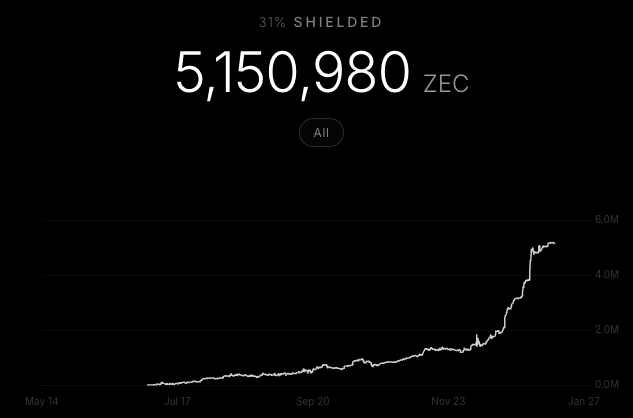
Today, ZEC is priced around $600, with a year-to-date increase of about 1500%. Approximately 31% (worth over $3 billion) of the funds are held in user-controlled shielded wallets. By mid-March, the percentage of shielded transactions had risen to 86.5%. Tachyon, an extension project aligned with community goals, has received funding support. NU6 completely abolished the direct funding model and reset the protocol's own development fund model. ZODL raised $25 million from institutions like Paradigm, a16z crypto, Winklevoss Capital, and Coinbase Ventures.
Everything has its causes. Here are the key turning points and reasons for accelerated growth.
Unlocking Governance Shackles
During the initial eight years, Zcash allocated 20% of each block reward to two fixed entities (later joined by the Zcash Community Development Fund). This created a problem of entrenched interests. These entities controlled governance without any pressure to increase their influence, and the community could not reallocate resources. During my tenure at ECC, I witnessed firsthand the negative impact of this distorted incentive mechanism.
A Turn of Events
Things took a different turn in May 2024 when ECC unilaterally announced it would no longer accept direct funding. This move brought to light a pressing issue: without the largest beneficiary onboard, the old model was unsustainable. NU6 modified direct funding, allocating 8% to the Zcash Community Grant Fund (ZCG) for ecosystem grants and putting another 12% into an agreement-controlled "vault" for retroactive distribution to significant contributors by ZEC holders.
This model came with a clear timeline. Both the 8% and 12% funds are set to expire at the end of 2028's third halvening. The community has the option to renew, although it is not guaranteed and requires overwhelming consensus within the community.
Subsequently, in August 2024, ECC formally issued a notice to terminate the trademark agreement, which granted ECC and ZF the "2-of-2 multisig control" over the protocol. Six months later, the Zcash Foundation (ZF) announced it would no longer use trademark rights to intervene in governance. The monopoly over Zcash governance was dismantled, allowing coin holders and other ecosystem stakeholders to finally have a say. No single entity, including ZF's ZCAP, could monopolize the interpretation of community sentiment.
Zcash had finally obtained its freedom.
Unleashing Product Constraints
In January 2024, we (then known as ECC) pivoted towards user growth, marking a fundamental shift from the previous years.
For years, the engineering team had focused on cryptographic research, core protocol, and enhancing privacy. While these efforts had made Zcash's privacy tech world-class, they had not attracted new users. In fact, by 2023, the community had started to shrink.
On the X platform, Zcash holders lamented price stagnation and regulatory pressures, questioning the future of a "privacy coin." At that time, 60% of tweets were negative or neutral. A survey initiated by ZURE (now known as @peacemongerz, the current ZODL CMO) revealed that ZEC holders had a Net Promoter Score (NPS) as low as -60, indicating extreme user dissatisfaction.
We listened and began developing products that users actually wanted. This has been our guiding light then and now, steering the development of the Zodl Wallet, Zallet CLI Wallet, and even the core protocol.
Zashi (later rebranded as Zodl) was launched in March 2024 as the most tangible embodiment of this new strategy: default anonymity, hardware wallet support, and cross-currency exchange support. We delivered a world-class privacy coin and packaged it in a user-friendly interface.
The impact is evident. By the end of 2025, the anonymous supply has grown from around 11% to about 30%, representing a more than 400% increase in ZEC absolute terms. Each token in the shielded pool is user self-custodied. In mid-March, anonymous transactions accounted for 86.5%. Since last October, the wallet has processed over $6 billion worth of ZEC exchanges. This is not wash trading on centralized exchanges, nor is it a stack of treasury assets; instead, real users have chosen privacy and custody of their own keys.
Unlocking the Narrative Handcuffs
Zcash has faced a positioning issue. The "privacy coin" label led to its delisting from exchanges, scrutiny from regulatory bodies, and avoidance by institutional investors. The project's true value was obscured: based on a Bitcoin-like monetary policy, it achieves verifiable and private payments through advanced cryptography.
Today, Zcash has become an unstoppable privacy currency. Zcash is the protocol, ZEC is the asset, and Zodl is the gateway to sovereignty through privacy, enabling freedom of speech, transactional freedom, and sovereignty independence. This is structural: a protocol governed by the community, a scarce asset for private store of value and payments, and a gateway that competes solely on product quality, not tied to protocol governance. This is the "trinity" of a privacy currency.
With this framework, exchanges, ETF issuers, and infrastructure providers can support the asset without taking a stance on how users interact with the protocol. This sets the stage for ZEC to enter the multi-chain ecosystem, get listed on Robinhood, have Multicoin disclose positions, have Grayscale submit a ETF application, and see Foundry launch mining pools. The value proposition that was previously inaccessible to allocators is now clear.
Unlocking the Organizational Handcuffs
In January 2026, following a dispute with Bootstrap (a U.S. 501(c)3 nonprofit organization) board, the entire ECC team collectively resigned and established the Zcash Open Development Lab (ZODL). The core of the dispute was about control: whether it belonged to a small group of non-operational board members or the team itself. The board prioritized self-interest, leading to the team's exodus and a fresh start under a mission-first organizational structure.
Nonprofits struggle to scale. Building consumer-grade products at the speed required by Zcash necessitates startup-like capital, rapid hiring, and efficient decision-making mechanisms. The $25 million funding ZODL received from institutions like Paradigm and a16z is a strong signal, affirming the team's commitment and mission to scale. Across the industry, the "Avengers" have assembled.
Current Market Sentiment
The most powerful sentiment indicator is the size of the shielded pool. Users do not move ZEC into shielded addresses for speculation. They do so out of trust and belief. The shielded pool has grown from 11% of the supply to 31%, representing hundreds of thousands of individual decisions to self-custody and protect privacy.
LunarCrush data shows that ZEC's discussion volume has increased by 15,245% in the past year, compared to Bitcoin's 190%. ZEC ranks second in the AltRank across the entire crypto market. The positive sentiment stands at 81%. GitHub contribution velocity has increased by about 20% year over year. Forum discussions have shifted from governance complaints to product and technical work.
What's next?
In summary, the recent focus is on user experience, scalability, and post-quantum readiness.
Zodl Wallet: We are further optimizing performance, adding more exchange options, fiat ramps, and user-requested features while keeping it simple and user-friendly. The @zkDragon team has also joined to help develop in-app staking features.
Scalability: With the block time reduced from 75 seconds to 25 seconds and the Tachyon project led by @ebfull, scalability will be significantly improved. Tachyon revolves around a stateless wallet refactored protocol carrying recursive zk-proof, eliminating long-standing synchronization bottlenecks, targeting Visa/Mastercard-level throughput. During this process, we will phase out the old zcashd nodes, migrating to the modern, Rust-written zebrad.
Post-Quantum: The "quantum recoverable" wallet is expected to be released within a month and achieve full post-quantum readiness in 12 to 18 months. This will shield user funds from the cryptographic upheavals the financial system will have to face in the next decade.
As the work matures, the next network upgrade will gradually translate these focus areas into protocol changes. Specific details are still being refined through ZIP discussions.
In conclusion, Zcash will be faster, more user-friendly, feature-rich, scalable, and post-quantum secure.
Welcome to join the official BlockBeats community:
Telegram Subscription Group: https://t.me/theblockbeats
Telegram Discussion Group: https://t.me/BlockBeats_App
Official Twitter Account: https://twitter.com/BlockBeatsAsia
