Article by Sleepy
Not long ago on a Saturday, in Buenos Aires, Argentina, a old chess club in the Almagro district held a tournament.
The same regular faces showed up for the tournament as usual, hunched over their boards, eyes fixed on the pieces. The players all liked to strike a pose of judging the world, even though they were just thinking about how to take down their opponent's knight.
On that day, a newcomer joined this community tournament, a man approaching sixty, of German descent, who ended up in third place. In one of the games, he sat across from a little girl. She stared at the board, her finger holding a piece, hesitating to make her move. Little did she know, the person sitting across from her was used to contemplating more than just the outcome of a single chess game.
This person was Peter Thiel, co-founder of PayPal, one of Facebook's earliest external investors, and one of the most generous donors to the Trump campaign.
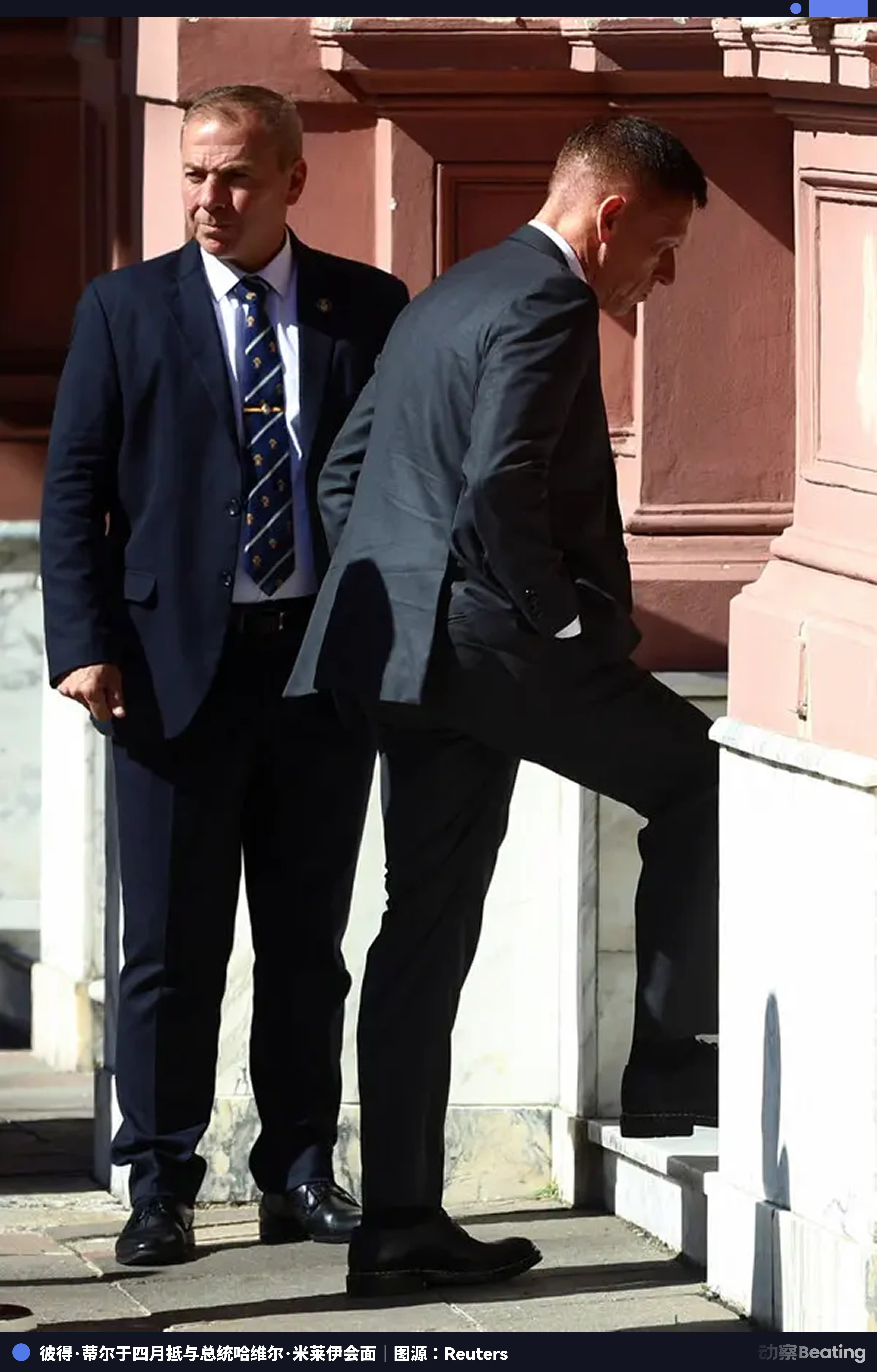
Just these past two months, he had moved from Los Angeles and Miami to settle on the other side of the Americas. He met with President Mile and his ministers, bought a mansion in an upscale neighborhood, enrolled his children in a local school, and even attended the national derby between River Plate and Boca Juniors.
One evening last month, by candlelight, he invited a group of Argentine economists and intellectuals to his home to discuss the country's history and economy. As the conversation flowed, it turned to his favorite topic of doomsday and the "adversary Christ," leaving some of the guests unsure how to respond.
The discussions of doomsday from the perspective of the wealthy and the less fortunate may seem like the same topic, but in reality, they are worlds apart.
Escape Route
Peter Thiel moved to Argentina to secure an escape route for himself before doomsday. This wasn't his first time doing so.
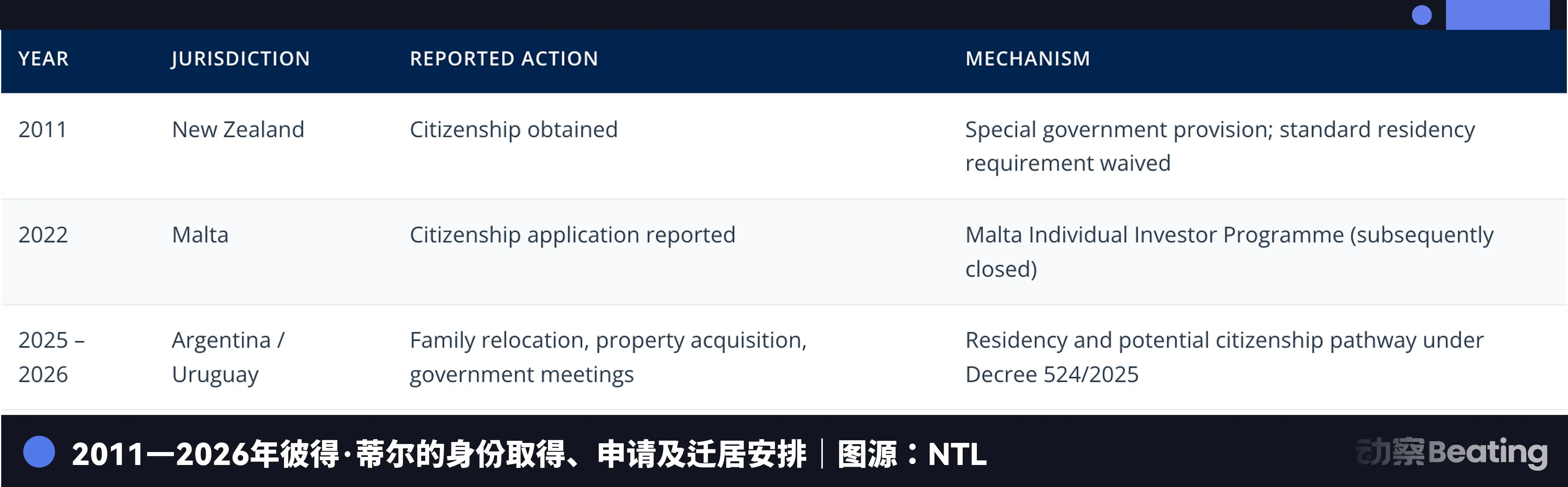
In 2011, after spending only twelve days in New Zealand, he obtained the country's citizenship. Logically, this was impossible, but he received special approval from the minister. In his application, he described the place as a "utopia" that he loved so much.
However, he kept this deep affection hidden. The citizenship was a secret for five or six years until the media revealed it in 2017. He purchased over 400 acres of land by a lake in Wanaka, in the South Island, and acquired a house in Queenstown. He even planned to carve out an underground shelter in the hillside that could house twenty-four people, but this plan was rejected by the local council in 2022.
It was also in that year that he applied for Maltese citizenship.
The wealthy planning escape routes is nothing new. Ancient Roman nobles would have country estates as a retreat during turbulent times, while modern-day tycoons hold assets in other countries to have a refuge if their home country faces turmoil.
Interestingly, this back door approach has become more thorough today, with professional teams and systematic methodologies. People can hold multiple nationalities, diversify their assets across continents, choose where to pay taxes, and even select a political climate that suits them best. Globalization was originally intended to facilitate the free flow of goods and capital, but unexpectedly, it has also granted a select few a right that was once only possessed by gods—the ability to choose which world they want to live in.
For ordinary people, moving to a foreign land means tearing apart their lives, relearning a new language, using their accent to sell themselves in a foreign land, proving to strangers from scratch that they are worth engaging with, and enduring long-term or permanent separation from their loved ones.
Peter Thiel is afraid of many things. For example, California is discussing a one-time wealth tax on billionaires, the risk of war in the Northern Hemisphere is increasing, and artificial intelligence may spiral out of control.
However, his fears are different from those of ordinary people. Ordinary people fear financial issues, war, being rapidly replaced in their profession by new technology, and their children growing up without finding a stable path. Yet, these fears cannot be mitigated by obtaining a second passport and a piece of land in the Southern Hemisphere.
Fear is universal. But what fear can bring in return is never distributed fairly.
Backlash
The United States that he wants to escape from is, ironically, one that he helped build.
For most of his life, Peter Thiel has been pitted against the same enemy. He does not believe in traditional politics, the compromises slowly reached by the majority, or in the old machine of the state having the ability to self-repair. What he wants is to go around and establish a new set of rules.
He has long treated "escaping politics" as a form of art. By "escaping politics," he does not mean seclusion or cynicism, but rather using capital and technology to establish his own rules in places where the long arm of government power has not yet reached.
In 2009, he wrote an article stating that he no longer believed that freedom and democracy could coexist and that the real solution was to be found in the internet, international waters, and outer space. In his vision, PayPal was not just a payment tool but also a global currency, and Facebook was not just a yearbook but more like an experiment in nation-building in cyberspace.
However, in the end, "escaping politics" itself became a form of politics for him. As long as there are taxes, borders, votes, and regulations in the world, politics will catch up. Thus, his attempt to bypass politics transformed into a bet on politics.
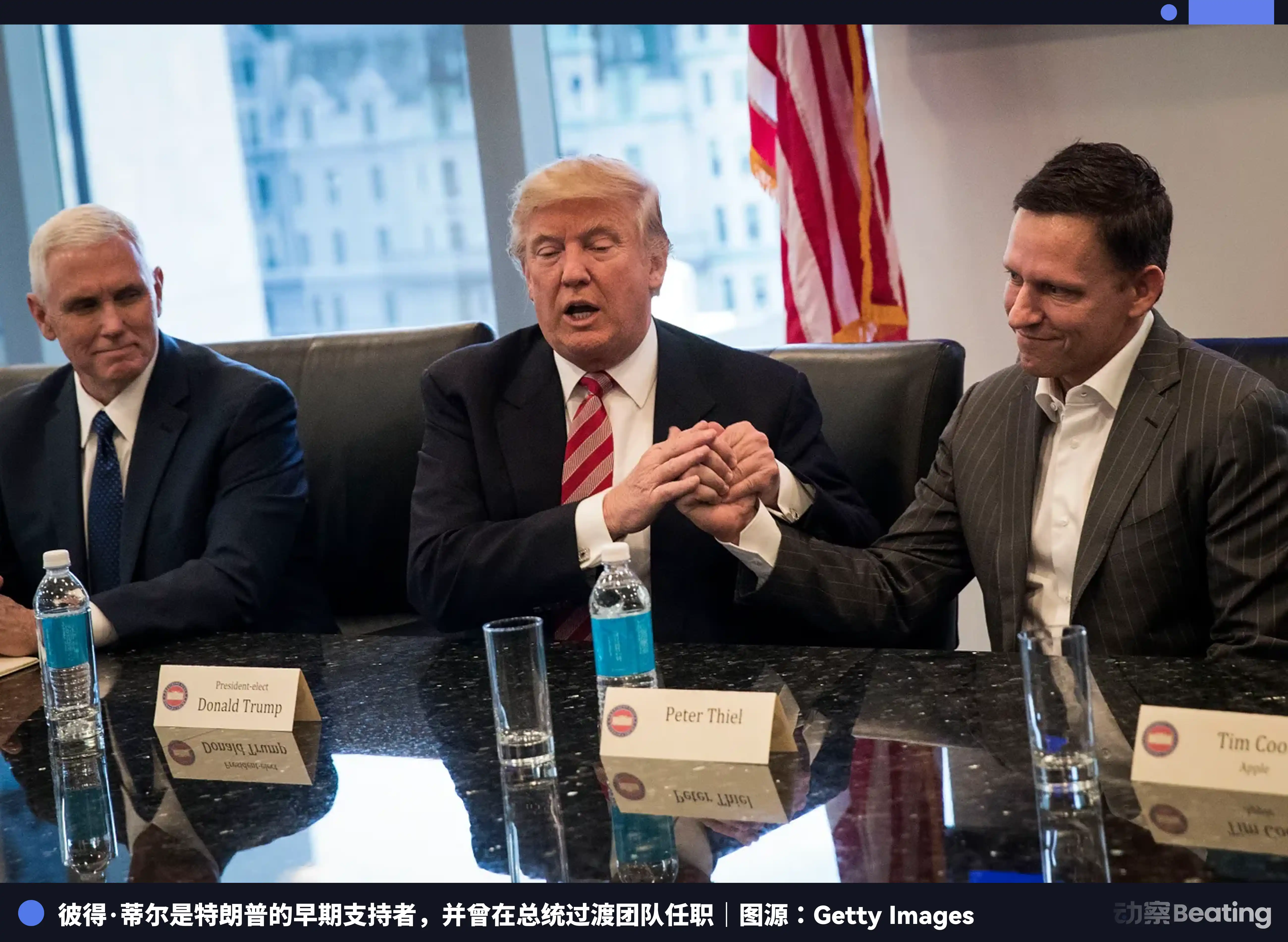
In 2016, most Silicon Valley tycoons kept a low profile to avoid Trump. Peter Thiel was one of the few who stood out, even personally running to support him at the Republican National Convention. Behind the scenes, he not only provided financial support but also lifted a young man, who had attended his lecture at Yale Law School and later worked at his company, step by step. The young man first entered the Senate and then the White House. That person is called Pence, who is the current Vice President of the United States. Some even say that the Republican Party is no longer the Republican Party and should be called the Thiel Party.
Elevating a comrade to the pinnacle of American power and then turning around to flee the country, the reason was precisely the word he loved to talk about: Antichrist.
The Antichrist in his words is not the kind of sinister demon with a grim face, quite the opposite. He is always smiling, talking about peace and love. This person will continuously use those fearsome things to scare you day and night, such as AI running amok, nuclear war, climate disasters. In the end, you will be frightened into willingly surrendering your freedom, just hoping he can give you stability.
When everyone surrenders their freedom, the whole world can be grasped by one hand, and doomsday will arrive. In a lecture in San Francisco, he said that the United States is both the wall blocking doomsday and doomsday itself.
He moved to Argentina, citing taxes as the reason, the same wealth tax mentioned earlier. California is discussing targeting billionaires for taxation, so he wanted to cleanly sever his tax ties with California before it took effect. This reason is respectable and easy to articulate, quite suitable for discussing at the dining table.
But he had prepared his exit strategy for fifteen years, holding several passports, owning houses and land in the Southern Hemisphere, so he wouldn't have to move overnight for a tax issue. He can afford that money and doesn't need to travel to the other end of the earth for it. The tax issue is more like an excuse; what truly scares him is that something he once wanted is growing into a beast beyond his personal control. From low regulation to weak public constraint, from anti-bureaucracy to more aggressive strongman politics, from technological efficiency to a data machine for immigration enforcement and national security.
What he wants to escape from is not an America unrelated to him but the America after his initial ideals were translated into reality.
Crystal Ball of True Knowledge
This beast not only exists in the religious metaphor of the Antichrist. It has a company, contracts, an interface, and also a name: Palantir.
Peter Thiel is not only a person who plans an exit strategy for himself but also created this eye to specifically watch those who cannot plan an exit.
He is the co-founder and chairman of Palantir. This company was founded in 2003 in Palo Alto, California, with seed money from In-Q-Tel, the venture capital arm of the Central Intelligence Agency.
After 9/11, Peter Thiel believed that if the various intelligence agencies had shared data back then, perhaps they could have prevented the terrorist attack. This idea itself was sincere, as many world-changing events often start with sincere intentions.
The company's name is derived from Tolkien's "The Lord of the Rings," specifically referring to the crystal ball that can see far into the distance. In the book, this was not a good thing. One of these fell into the hands of the dark lord Sauron, who used it to spy, sow discord, and corrupt his enemies. The most deceived was the White Wizard Saruman, the wisest of all, who gazed into the crystal ball, was gradually persuaded, and ultimately betrayed his allies.
That crystal ball indeed allows you to see far and see the truth, but all you see is what Sauron wants you to see.
The person who named the company could not have been unaware of this meaning.
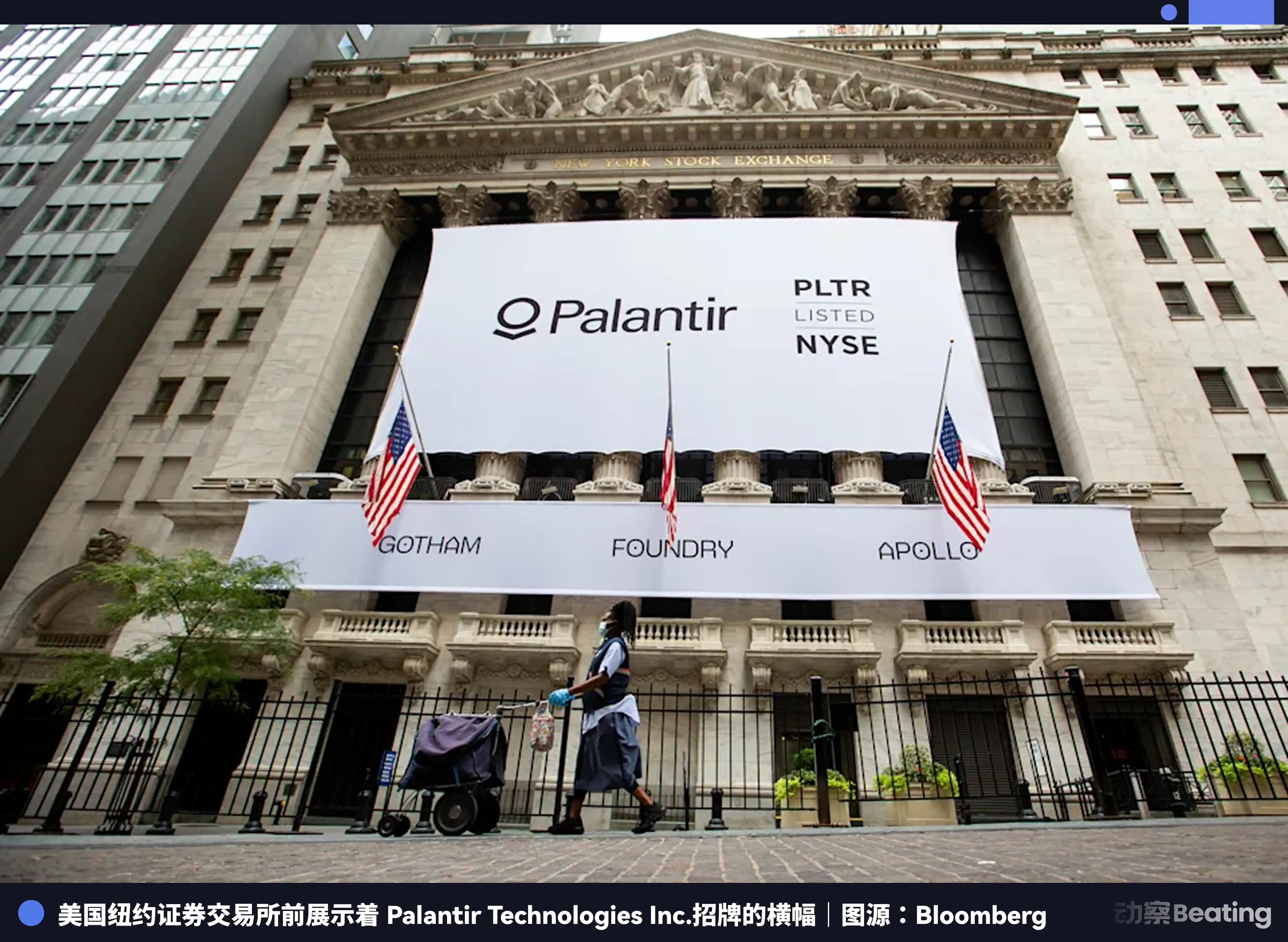
Today, the Pentagon, NATO, Immigration and Customs Enforcement (ICE), and the Federal Bureau of Investigation (FBI) all use Palantir's software. The U.S. Immigration and Customs Enforcement spent around $30 million on a system called ImmigrationOS, which enables them to more "efficiently" discover, track, and target individuals for deportation, a key part of large-scale expulsion.
"Efficiency" is a tricky word. No one wants to admit they are against efficiency, but behind efficiency often lie a host of questions, such as who is efficiency for, whose time is being saved, and whose fate is being hastened.
For the wealthy, efficiency means less tax friction and more escape routes. For law enforcement agencies, efficiency means quicker identification, faster tracking, and expedited processing. But for someone targeted by the system, efficiency may mean they have no opportunity to explain or appeal, and the entire process is data-driven, and procedurally sound.
Thus, we can see the same person, on one hand, preparing an escape route for themselves, with passports, estates, safe houses, ready to disappear at any moment; and at the same time, they have erected a massive spotlight, illuminating all those who cannot leave a way out. They fear the day the world is controlled by a single hand, but what they have built is precisely the hand that can help someone grasp the world.
Safe Haven
Having created that hand, they must also find a corner where that hand cannot reach them. Peter Thiel's choice of Argentina has its reasons. Far from the potential conflicts of the Northern Hemisphere, with vast grasslands and the expansive land of Patagonia providing a sense of security. But more importantly, this country is vigorously transforming itself into a place where outsiders are willing to come in and deposit their money.
Over a century ago, Argentina was one of the wealthiest nations on Earth.
In 1913, it was wealthier than France, Germany, with a per capita output close to Canada's. It was the golden age of Buenos Aires, with European immigrants arriving in droves, opera houses, boulevards, and Parisian-style apartment buildings erected one by one.
Then came a century-long decline. Round after round of hyperinflation turned the currency into paper money. In 2001, with a stroke of a pen, the government froze all citizens' bank accounts, requiring any withdrawal in US dollars to first be converted to the depreciating peso.
This decree was nicknamed "corralito," a word that originally referred to a livestock pen but also denotes a baby's playpen.
The dual meaning of this term was too fitting. A country that corralled its citizens' money like livestock while tenderly explaining, "This is to protect you; you are the nation's good child." Many people took to the streets to protest, and among the crowds, for every ten good children, seven were poor children.
Today, this country that once locked up its citizens' money is now trying to present itself as a safe haven, inviting others to deposit their money.
President Milae took office, promoting low taxes, relaxed regulations, pro-American policies, attracting investment, and anti-bureaucracy as his signature. This self-proclaimed "anarcho-capitalist" president, whose campaign prop was a chainsaw symbolizing budget cuts, slashing ministries, and trimming all the fat from the state to allow the market to take charge again. His Chief of Staff Adolni even stated in Congress, "All the billionaires around the world who are fed up with high taxes and regulations and want to escape their own country are welcome to Argentina."
But capital comes with its own demands. Along with the money, a new set of grand theories defining "progress," "modernity," and who deserves a good life came through the door. Where the money goes, this set of grand theories follows.
People Inside the Model
More interestingly, Argentina is not a technological vacuum. It is not a barren land without algorithms, models, or national engineering.
In late May, the Argentinian Ministry of Human Capital released a plan called "Social Digital Twinning," with President Milae personally endorsing it. The plan aims to use AI to replicate the entire society into a model, feeding data from various government and private channels to create a virtual Argentina. This will allow policies to be simulated and their effects assessed before implementation.
The Argentinian officials claim they are "ahead of the future," while President Milae declares, "The future does not wait for anyone."
It is currently just a vague plan. The budget, vendors, data sources, and oversight mechanisms are not clear. It is precisely because it is not clear that a serious question arises: What would real humans become if a country truly attempts to compress society into a model that is predictable, simulatable, and intervenable in advance?
Wang Xiaobo wrote about "A Lone Skater."
A pig, everything arranged for it by its owner, arranging its meals, sleep, fattening, and slaughter. From the perspective of the pig farm, this arrangement is very reasonable and efficient. The pig itself would certainly not agree, but that does not affect this arrangement. The reason the pig is a pig is that it cannot refuse the arrangements made for it by others, cannot say no, and cannot ask for an explanation.
The "social digital twin" is quite similar to a pigpen. The difference is that the object of the arrangement is a person, arranged by an algorithm, and the person being arranged is unaware of being arranged, and may even think of it as care.
Models love rules and fear exceptions. Yet human life is almost entirely made up of exceptions. A child dropping out of school may not necessarily be because the family does not value education; perhaps a parent fell ill, they moved, or they were in debt. A person losing their job may not necessarily be lazy; perhaps the entire industry was suddenly replaced, they are over 35 years old, or there is an elderly person at home who cannot be left alone.
These reasons cannot be quantified and do not fit into standardized forms. Yet whether a person is deserving of help is precisely hidden in these unquantifiable factors. Implementing one-size-fits-all solutions may clean up the data and increase efficiency. But that person disappears and becomes a neat data point, quietly waiting in the model for a seemingly rational arrangement.
Furthermore, if there are no boundaries to predictions, they can turn into commands. Today, they may calculate that you "may need assistance," tomorrow they may calculate that you "may cause trouble," and the day after tomorrow, they may decide that your whole family "is not worth further investment of resources."
Whose Future
By putting these few things together, we can see the rough outline of this era.
There is a group of people who are becoming increasingly agile in this era, able to disappear at any time, reappearing elsewhere at will, as if they have no connection to the land, institutions, or the fate of ordinary people.
There is another group of people becoming increasingly cumbersome, unable to move anywhere, leaving footprints with every step they take, with all their "civilian actions" such as residence, consumption, and socializing being recorded, analyzed, predicted, and prearranged.
What the system sees of ordinary people are risks, probabilities, and data, not hardships, grievances, and the lonely nights of insomnia. Being fully recorded by a machine is vastly different from being truly understood by society, and this will remain true in the future.
Looking back at that candlelight dinner. Till talked about the Antichrist, about his fear of totalitarianism, a fear that was not unfounded. But the world he was afraid of, a significant part of that world was a continent he himself had funded and built.
A person can genuinely fear something, while at the same time, genuinely ushering it in, and maintain a sincere blind spot about the relationship between these two things, leaving themselves a back door.
This era has quietly packaged the fears of a few into everyone's future. Billionaires fear taxation, so "regulation" became a shackle; capital finds consensus formation too slow, so "public discussion" became an inefficient euphemism; the Leviathan fears losing control, so more and more living people are turned into data, fed to a machine that predicts their fate for them.
This is a problem of mistaking the experiences of the powerful for the experiences of all. A person with an exit strategy naturally feels the world should run faster, as they are not afraid of being left behind; a person who can influence the rules naturally feels the fewer rules, the better, as their stability does not rely solely on rules. Yet the stability of many people ironically comes from those cumbersome, slow, troublesome old systems, which are the foundation on which many people stand firm in this world.
When they are cut down one by one, the first to stumble will not be the tycoon at the chess table, but the ordinary person across from the tycoon.
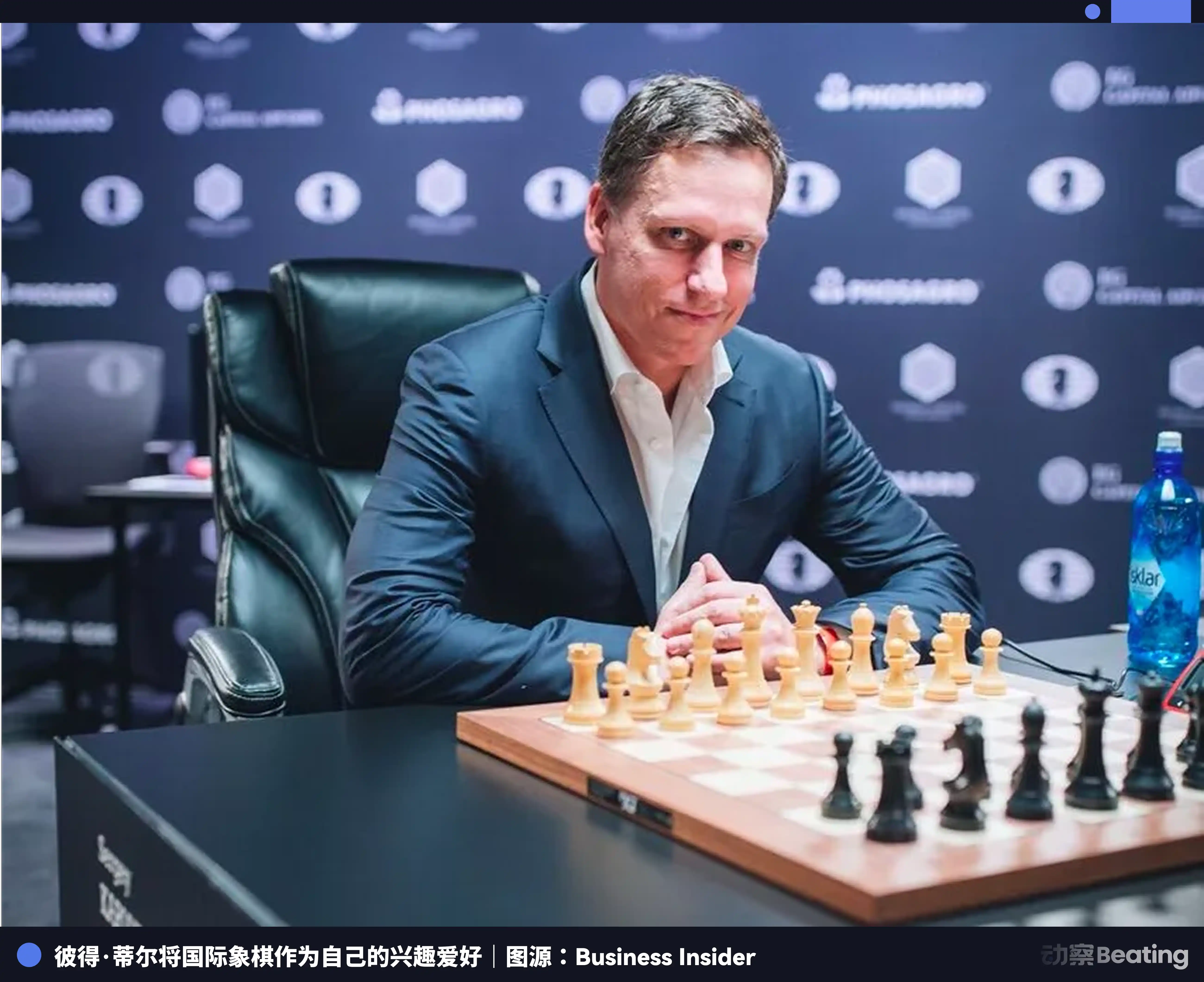
Back at that chess table.
The child is also calculating the next move, but that is just the next move on the board, losing and the pieces are reset for another game.
Peter Till's next move will fall into the system, into the days of those who have no chance to start over. He is seeking his move in Argentina, while the government moves the pieces for everyone through the system. And the child playing chess with Peter Till may one day find that their rent, their illness, the time they were wrongfully judged by the system, have long been a part of someone else's game. She does not know when she started playing that game, and she cannot upset the board.
Just like the pig in Wang Xiaobo's writing, no one ever asked if it wanted to live in the destiny set by others for it, but that pig eventually ran away.
It learned to mimic the sugar mill's steam whistle, jumping onto the roof every morning at ten, half an hour earlier than the real whistle. The people in the fields heard it and returned early with their tools. The leaders held a meeting and branded it as a "troublemaker disrupting spring plowing." Thirty-something people armed with pistols and rifles divided into two groups to capture it. It circled between the two groups' firepower, found a gap, and charged out.
But where could that child run to?
The future is not something that doesn't arrive. It's just that before it arrives, someone has to ask for us: this future, who is it really for?
Welcome to join the official BlockBeats community:
Telegram Subscription Group: https://t.me/theblockbeats
Telegram Discussion Group: https://t.me/BlockBeats_App
Official Twitter Account: https://twitter.com/BlockBeatsAsia
