Over the past few days, the world's largest on-chain perpetual contract platform has been undergoing a rare price discovery.
This platform is called Hyperliquid, and its token valuation has surpassed Solana, approaching BNB. At least in terms of token price, it has been keeping up with centralized exchanges like Binance.
However, a sword has always been hanging over Hyperliquid's head.
At the end of May, the CFTC approved, for the first time, a U.S.-based compliant perpetual contract. Many viewed this as another victory for Hyperliquid, unaware that the clear rules meant a more formidable set of enemies on the horizon, signaling the start of a protracted war.
CFTC Amnesty Contract
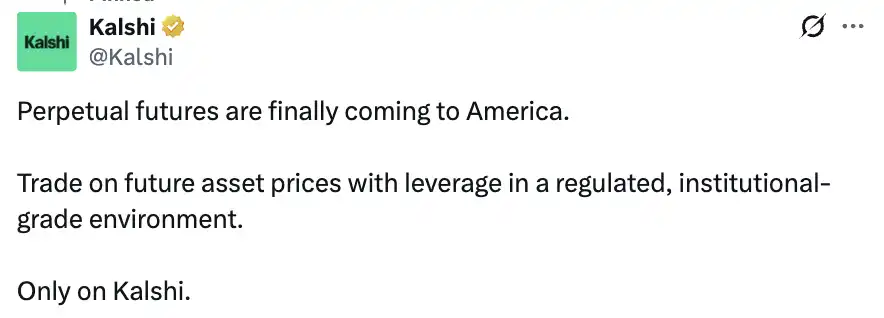
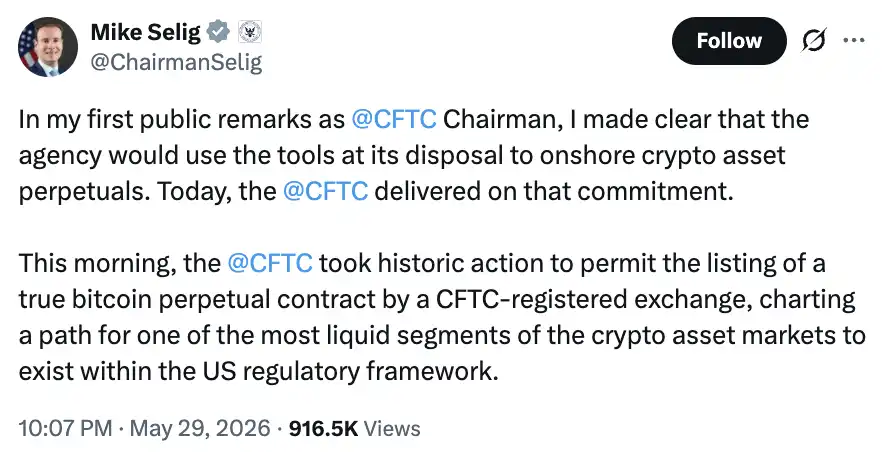
On May 29, the CFTC approved Kalshi to list the first true Bitcoin perpetual contract BTCPERP. On the same day, it issued a no-action letter to CFM under Coinbase, allowing the latter to onboard U.S. customers to global options and perpetual contracts through Coinbase's Bermuda entity, treated as "foreign futures," and permitting customers to collateralize with Bitcoin, Ethereum, and stablecoins. Complementary actions include a committee policy statement on perpetual contract listing, related interpretive guidance, and an employee manual covering 24/7 trading, clearing, and settlement.
CFTC Chair Selig stated in a column that the existence of perpetual contracts has never been the issue; the real problem is whether they operate under U.S. regulation, standards, and rule of law, or are driven to grow lawlessly overseas. Trump took credit on Truth Social, claiming the former administration's "anti-crypto army" nearly destroyed the U.S. crypto industry, and he rescued it.
The Hyperliquid Policy Center, Hyperliquid's lobbying organization, welcomed this while expressing hope that this framework would not only serve centralized intermediaries but also cover on-chain protocols that truly facilitate a large volume of perpetual contract trades.
Hyperliquid's biggest critic, former Multicoin partner Kyle, poured cold water on the Hyperliquid community: "What you are holding now is an assurance that no regulated U.S. company will ever distribute Hyperliquid's liquidity."
So what does CFTC approval really mean for Hyperliquid?
Offending CME Is More Terrifying Than Offending Binance
A perpetual contract is a type of futures contract with no expiration date. While traditional futures contracts require delivery or rolling over upon expiry, perpetual contracts do not expire. Instead, they rely on a "funding rate" to maintain balance, where both long and short positions regularly pay a fee to keep the contract price close to the spot price. This allows traders to hold a directional position with less capital in a 24/7 market, which is why perpetual contracts are much more popular in the crypto market than traditional futures.
Those familiar with operating trading platforms know that to legally operate a perpetual contract trading platform in the U.S., you need three types of businesses and licenses: DCM for the trading platform itself, DCO for the clearinghouse (a centralized clearing counterparty), and FCM for the intermediary broker. All three are indispensable.
However, the regulatory framework for operating a trading platform was designed in such a way that entities like Hyperliquid, which do not have DCO qualifications, were initially excluded from the list of broker-dealer access, as platforms like Perp DEX fundamentally do not rely on a "clearinghouse."
Prior to this policy adjustment, Coinbase, in order to compliantly launch perpetual contracts, first acquired a trading platform with a DCM, then leveraged the clearinghouse Nodal Clear to force-fit the product into a five-year cash-settled futures contract, using the clearinghouse's cash adjustment to simulate the funding rate.
The CFTC's new policy did not touch the current framework that relies on a "centralized clearinghouse."
Hyperliquid's envisioned "no clearinghouse" model has faced opposition from two giants in the traditional financial industry.
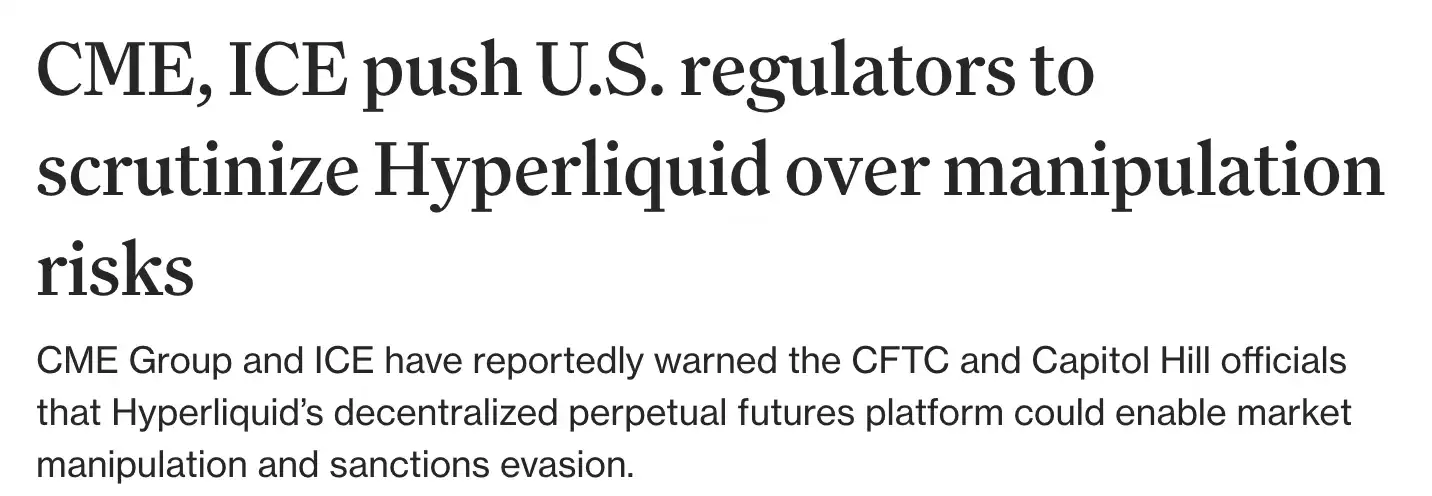
According to Bloomberg, the Chicago Mercantile Exchange (CME) and Intercontinental Exchange (ICE), the parent company of the New York Stock Exchange, have begun so-called "concern lobbying" in Capitol Hill. Their core demand is to forcibly fit Hyperliquid into the DCM registration framework, mandate KYC and AML, and increase trade monitoring and position limits.
CME and ICE are not players in the crypto world. CME's foundation lies in commodity and stock index futures, with contracts like oil, gold, agricultural products, interest rates, and stock indexes being its cash cows for decades. ICE holds a series of trading platforms, including the NYSE. Originally, Hyperliquid only dealt with perpetual contracts for crypto assets, keeping a clear distance from them.
What truly pushed Hyperliquid to the next level was the subsequent development of markets like TradeXYZ, built on the native "HIP-3" protocol. With HIP-3, anyone can launch new perpetual contracts on top of Hyperliquid's underlying liquidity. The underlying assets can be stocks, as well as real assets like crude oil and gold. During the Iran War, the trading volume of crude oil and gold perpetual contracts on TradeXYZ surged. Hyperliquid effectively moved CME's most profitable business onto the blockchain, enabling 24/7 trading, permissionless listing, and on-chain settlement.
Angering CME is much more dreadful than angering Binance.
Another looming concern is the age-old question: "Who will take the blame?"
The instinct of regulators is to find an entity to hold accountable: if something goes wrong, who should I summon, who should I penalize. In the traditional framework subject to regulation, visible and tangible intermediaries such as FCMs, DCOs, and DCMs are targeted; however, under the guise of "decentralization," the question of "who will take the blame" remains legally unanswered.
Hyperliquid is stuck in the middle; it is closed-source, initially having only a few validating nodes deployed in the same location. It is far from "unaccountable." However, it lacks a clear legal entity standing prominently like traditional trading platforms.
Recently, a SPACEX-USDH pre-IPO contract on Hyperliquid experienced a 45% flash crash within thirty minutes, as an oversized position wiped out the thin liquidity, resulting in losses for many users. The contract's design, with the often criticized "ADL" mechanism, inherently harms some retail investors' interests. A "non-accountable" trading platform is evidently not acceptable to the CFTC.
Lastly, the CFTC's recent action is not a formal rule but a combination of policy statements, a "no-action letter," and guidance. It lacks legal backing, meaning that the next CFTC chair could overturn everything with a single word. Until it becomes a formal rule or congressional legislation, all progress today is merely temporary.
Good News
The product form on which Hyperliquid relies is perpetual contracts with stablecoins as collateral. The CFTC's approval is akin to stamping the entire model. The question of whether the U.S. will blanket ban perpetual contracts is no longer a mystery. The biggest concern that has plagued this track for years has been eliminated.
The cake itself is still growing. Today, the vast majority of Americans, whether retail or institutional, have no idea what a perpetual contract is. Once the regulatory channel is opened, the market is poised to expand on an order of magnitude.
The profound benefits come from the CFTC's regulatory philosophy. The CFTC has never prescribed specific actions, only focusing on principles and outcomes: no market manipulation, no customer fund theft, and upholding market integrity. As long as you abide by these principles, whether you are a traditional trading platform or an on-chain protocol, theoretically, you can fall under its regulation. More importantly, once the CFTC gains jurisdiction, it is exclusive, with state laws and other regulations automatically giving way. For an industry that fears regulatory uncertainty the most, this kind of certainty is indispensable.
In addition, it is expected that the passed Clarity Act will include an "8-prong decentralization test." If a protocol passes this test, it can provide perpetual contract trading services without holding a clearing or trading license. This leaves a narrow path for Hyperliquid.
A well-known trader, Ansem, has put forward an optimistic narrative that has been recognized by many HL community members. He said, "If Hyperliquid becomes the underlying liquidity engine for various financial trading platforms, called upon by countless front-ends like AWS is to cloud computing, and its settlement stablecoin is USDC, then every increase in Hyperliquid's size is creating demand for the US Dollar out of thin air." A crypto-friendly government that understands this relationship should have no reason not to protect it.
Crossroads
Hyperliquid faces three paths ahead.
The first path is to maintain offshore status and "keep Americans out." Maintaining the status quo is not bad for Hyperliquid; liquidity is improving, 24/7 trading and pre-IPO contracts are increasing its visibility. But as Kyle said, choosing this path means you are a product that can attract users but can never be legally brought into the U.S. financial system.
The second path is full onshore. Hyperliquid has enough funds to acquire licenses, replicating Polymarket's strategy to create a clean Hyperliquid US. This means sacrificing "decentralization" and compromising on a framework centered around a "clearinghouse," while losing offshore liquidity.
The third path is to continue pursuing decentralization until passing the Clarity Act's "8-prong decentralization test." This path is the most attractive but also faces the greatest obstacles.
Since the TGE, the Hyperliquid network's validator nodes have expanded from single digits to 26, the majority of which are external teams. If Hyperliquid can accelerate its decentralization efforts, pass through this "narrow gate," it will become the first perpetual contract market not relying on a clearinghouse and accepted by the U.S. regulatory framework in a pure protocol form.
Welcome to join the official BlockBeats community:
Telegram Subscription Group: https://t.me/theblockbeats
Telegram Discussion Group: https://t.me/BlockBeats_App
Official Twitter Account: https://twitter.com/BlockBeatsAsia
