TL;DR
Over the past two years, the AI market has been focused on one question: Who can make the most money?
NVIDIA orders, cloud provider capital expenditures, data center construction, model company valuations, enterprise adoption speed have formed the backbone of this AI transaction cycle. Money is buying growth, betting on the profit pool, and discussing how much economic value AI can convert into company revenue.
But now, another question is starting to arise:
If AI truly creates unprecedented wealth, should this money belong only to the company, employees, and shareholders?
This is where the OpenAI Public Wealth Fund discussion is truly worth paying attention to.
It is not a finalized regulatory policy, nor is the U.S. government immediately "seizing AI company equity." More accurately, it is the first time the AI industry has put "how to allocate future excess returns" on the public policy table.
The counterintuitive aspect of this issue is that the market is not discussing distribution because it doubts AI's money-making potential. On the contrary, precisely because more and more people believe AI will earn a large amount of excess profit, the political system is starting to inquire: Can these profits only be enjoyed by a few companies and investors?
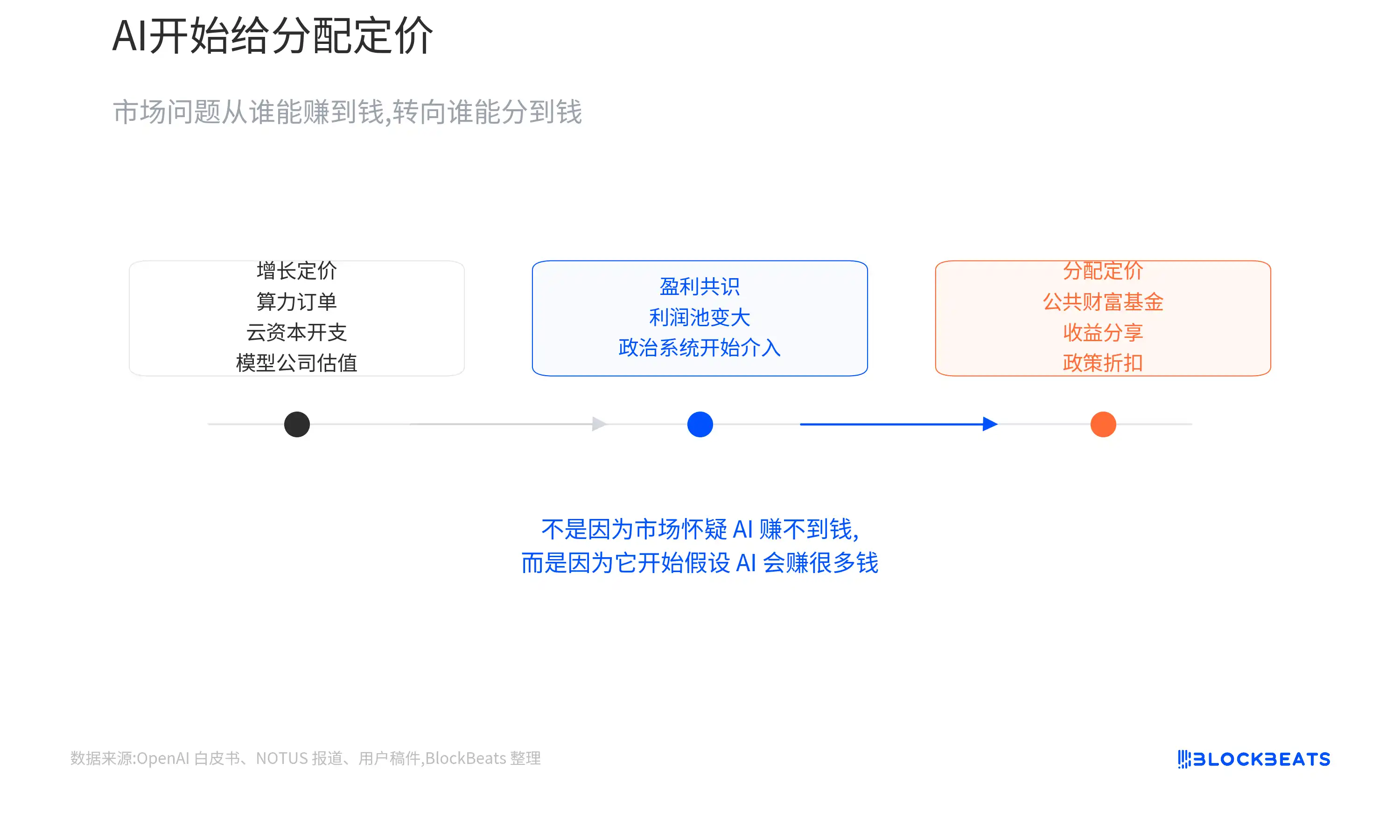
AI Transactions Starting to Incur a Policy Bill
Let's make the boundary of facts clear first.
According to a June 4th report by NOTUS, senior White House officials have had preliminary discussions with top AI companies regarding "voluntary equity transfer." This direction is similar to the Alaska Permanent Fund: where the government or a public trust holds a portion of assets, then shares some of the returns with residents.
In a white paper released by OpenAI in April, the idea of establishing a Public Wealth Fund was also proposed. Large-scale model companies can contribute to this fund through funding, equity, or other means, allowing ordinary households without direct holdings in tech stocks, VC assets, or private equity to also partake in AI's growth dividend.
Sanders' version is more radical. He advocates for large AI companies to transfer a higher proportion of ownership to the public and allow the public to have a certain level of governance. The "50% stock tax" and board seats mentioned in the material represent the most radical political proposals in this round of discussions.
However, these three issues should not be conflated.
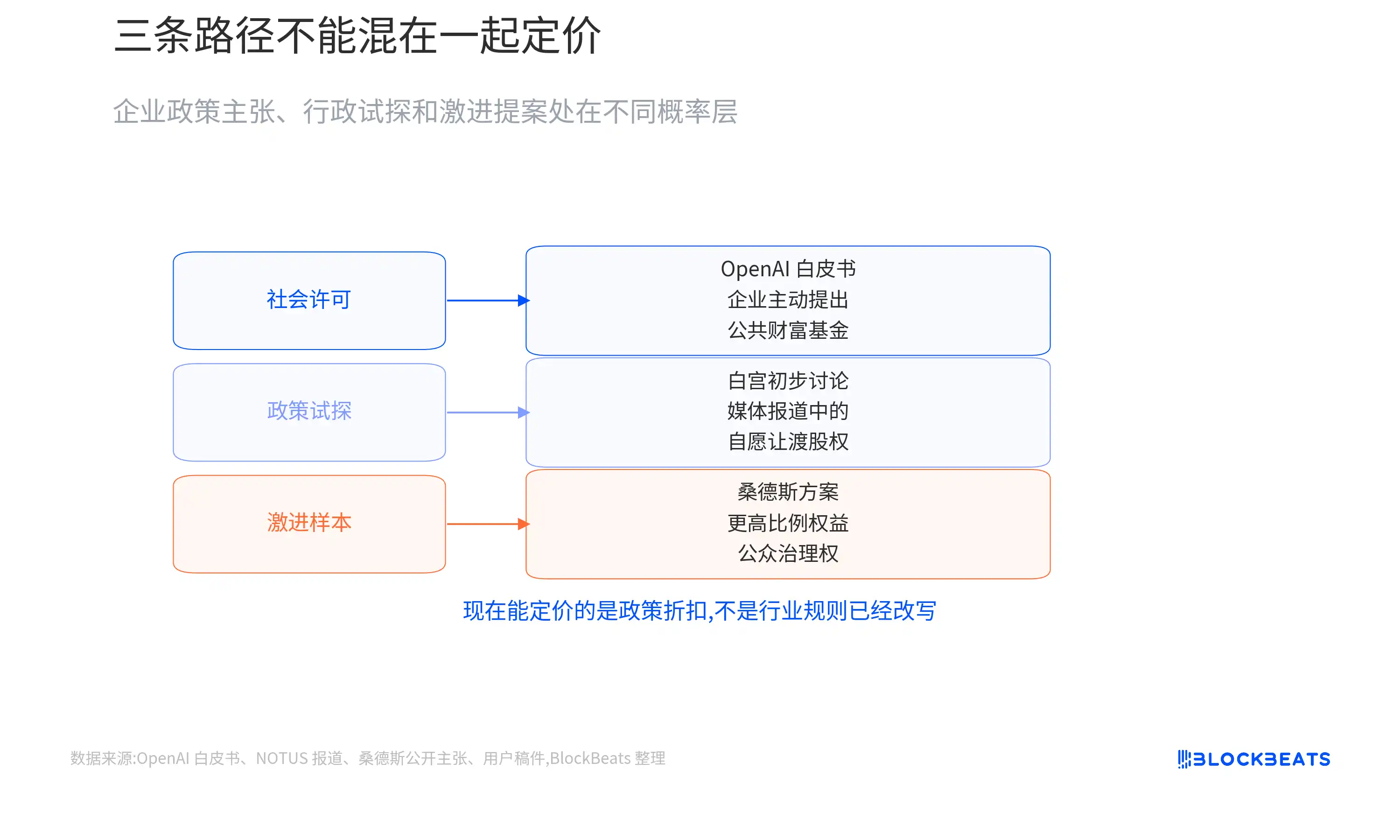
The White House discussions are still preliminary probes as reported by the media, with no formal percentages, legal structure, or timetable. The OpenAI whitepaper represents corporate policy proposals, not government documents. While Sanders' proposal is impactful, there is still a long way to go before it becomes actual policy.
Therefore, the most reasonable assessment at present is not "AI companies are to be nationalized," but rather a new variable emerging in the AI valuation table:
Would the most profitable AI companies of the future need to allocate a portion of their economic ownership to gain acceptance from society and regulatory bodies?
This has limited short-term impact on the secondary market. Publicly traded AI assets such as NVDA, MSFT, AMZN, GOOGL, META are still mainly driven by computational demand, cloud capital expenditures, order expectations, and profit realization.
However, the impact is more direct for pre-IPO AI companies.
If companies like OpenAI, Anthropic, xAI were to go public in the future, investors would not only ask how much money they can make, but also inquire: how much of this money needs to be shared with a public fund, government, or other public mechanisms?
This is not a realized valuation hit, but rather a new policy discount.
OpenAI's Purchase of Social License
OpenAI has actively proposed a public wealth fund, essentially purchasing "social license" for its future expansions.
The so-called social license is not an official license but rather the public, regulators, and political system's tolerance for a company's continued expansion. The more successful an AI company is, the sharper this issue becomes.
The more powerful the models become, the more discussions arise about replacing human labor. With higher valuations, the general public is more likely to perceive AI as a wealth machine enjoyed by a few companies, employees, and shareholders.
OpenAI is not facing the typical challenges of a tech company but rather a narrative pressure close to the level of the Industrial Revolution:
If AI truly alters productivity, who will share in this portion of the gains?
The OpenAI whitepaper emphasizes the need for the United States to maintain AI leadership while also acknowledging that automation could reshape a significant number of jobs. One of the proposed mitigation strategies is a Public Wealth Fund.
Translated into market language, OpenAI may hope to mitigate the more unpredictable political risks by acquiring a portion of controllable future economic interest.
If the narrative of "AI taking away jobs, with profits going to a few" is completely ignored, the future may bring higher taxes, stricter regulations, antitrust pressures, and even the obligation to disclose more complex policy risks during the IPO process.
Proactively designing a modest profit-sharing mechanism may shift the risk from "unknown political impact" to "long-term costs that can be estimated."
This is somewhat similar to a natural resources company entering a region and first designing a local employment, infrastructure, and revenue-sharing plan. The difference is that AI companies are not facing residents around a mine but rather the entire labor market and electorate.
What they need to address is not a one-time compensation but how future excess profits will be accepted by society.
5% Profit Sharing vs. 50% Mandatory Ownership Are Not the Same
The phrase "ceding ownership" can be intimidating, but the impact on valuation differs entirely based on the chosen path.
The first is when a company voluntarily allocates a small percentage of non-voting economic interest to inject into a public wealth fund.
If the percentage is limited and the rights are clear, it resembles a long-term policy cost. For instance, if a future AI company is valued at $1 trillion and allocates 5% economic interest to the public fund, it certainly dilutes existing shareholders, but the market can perceive it as a clear discount.
The second approach involves governments acquiring economic interest through industrial policies.
For example, certain subsidies, loans, or industry support may come with warrants, which entitle the holder to a portion of the equity returns based on agreed conditions. It's crucial to differentiate: warrants are not equivalent to direct ownership of common stock, and non-voting economic interest does not equate to board seats.
The former is more akin to fiscal sharing, while the latter enters the realm of corporate governance.
The third scenario is a Sanders-style mandatory high-percentage public ownership.
If large AI companies are required to relinquish a significant proportion of ownership and allow the public or government representatives on the board, the issue shifts from profit-sharing to matters of control, governance conflicts, and innovation incentives.
When the government acts as both a regulator and a shareholder, it introduces new conflicts of interest: is it prioritizing consumer protection and competition or safeguarding the value of its shareholding?
This is also why, although the radical proposal is highly viral, it cannot be taken as a high-probability pricing benchmark at present.
A more realistic scenario is still the repeated discussion of a small-scale, voluntary, primarily economically focused proposal. It may not be implemented immediately, but it will become an unavoidable issue in AI company financing, listing, and policy communication.
For OpenAI, what is truly sensitive is not "whether to share," but whether the sharing mechanism will affect the governance structure.
Microsoft, venture capitalists, employee stock ownership plans, and strategic investors will all be concerned: Will the public fund receive economic rights or voting rights? What percentage? Will it affect exit valuations? Will it change the pricing logic of future IPOs?
Enterprise clients will also ask: If the government becomes an economic beneficiary in some sense, will procurement, data governance, and regulatory neutrality become more complex?
Therefore, the market significance of this matter is not that AI company profits will be immediately cut off, but that the AI profit pool has been put into the public distribution framework for the first time.
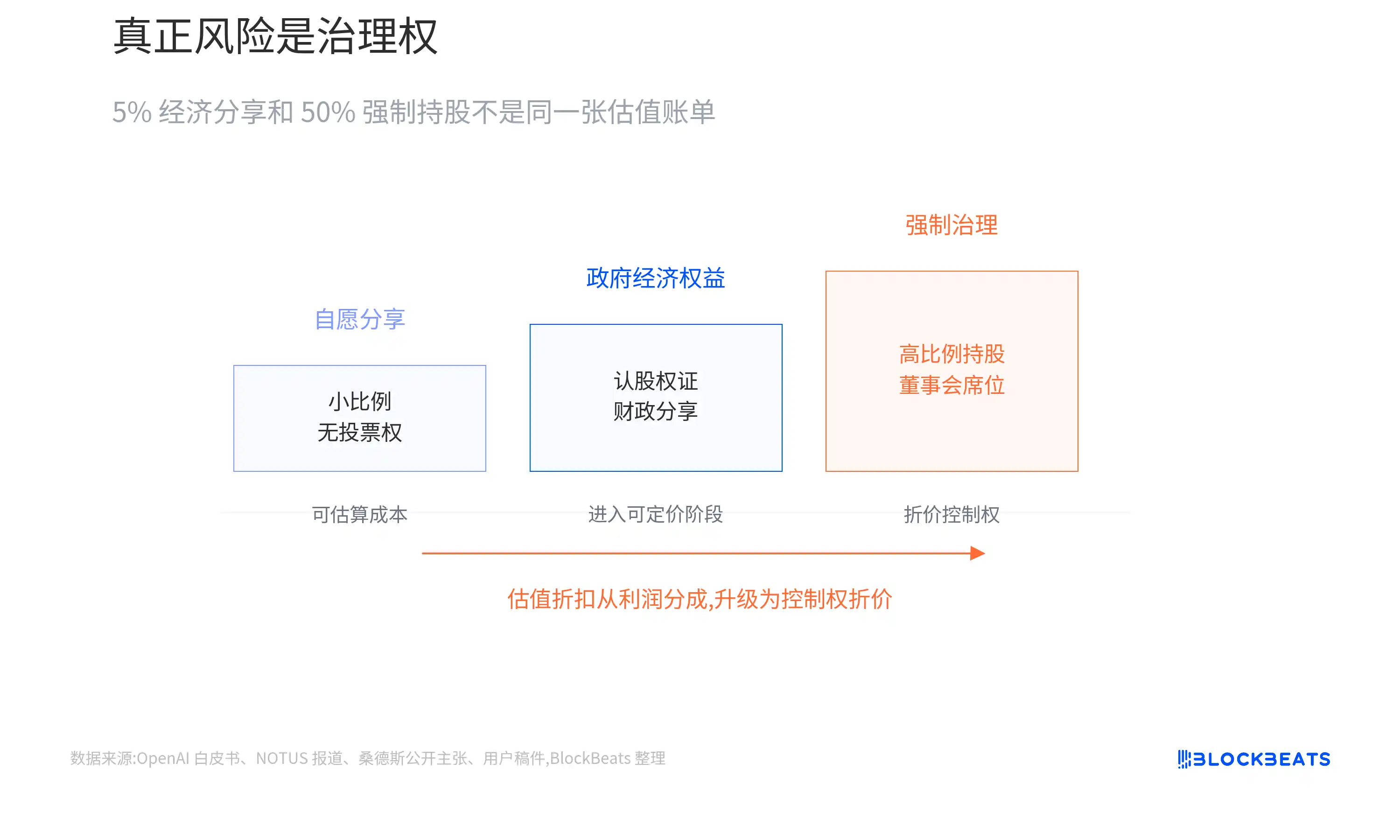
The real risk is for "voluntary sharing" to turn into "mandatory governance"
This line is still in its early stages.
The chain of evidence is already sufficient to show that the socialization of AI benefits is entering public policy experimentation; but it is not yet enough to demonstrate that the rules of the AI industry have changed.
The next four key observation points are:
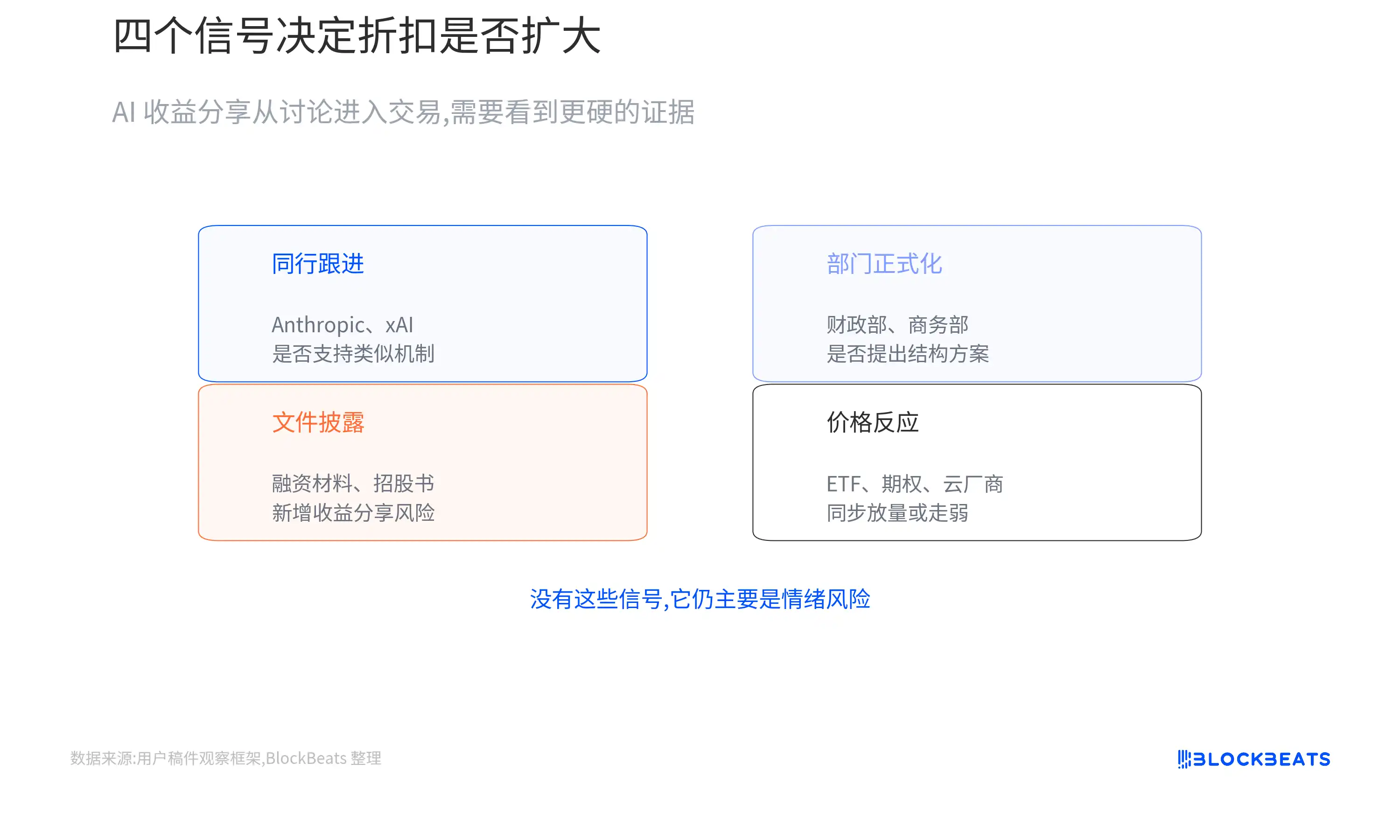
First, see if companies outside OpenAI follow suit:
If companies such as Anthropic, xAI, or other leading model companies also begin to support similar mechanisms, this could shift from OpenAI's single-company strategy to an industry negotiation framework. Conversely, if more companies publicly avoid or oppose it, the market is more likely to see it as OpenAI's unique practice.
Second, see if the White House and executive departments formalize:
If departments such as the Treasury, Commerce, National Economic Council, etc., start proposing fund structures, tax arrangements, or stock warrant schemes, policy experimentation will move into a stage where pricing is possible. If it remains at the level of meetings and media leaks, the main impact will be emotional risk.
Third, look at financing documents and future prospectuses:
If OpenAI and Anthropic were to add "Public Wealth Fund, Revenue Sharing, Government Economic Interest, Special Governance Arrangements," or other risk disclosures to their future fundraising materials or IPO filings, a valuation discount would only move from discussion to transaction.
Fourth, watch if the market price starts to reflect:
If AI-themed ETFs, Semiconductor ETFs, top cloud companies, or related options begin to exhibit trading volume amplification synchronized with policy news, rising volatility, or relative weakness to the broader market, it would indicate that capital is starting to treat this variable as a trading theme. There is currently no such evidence.
Therefore, there is no need to interpret this as a valuation collapse in the AI industry at present.
A more accurate way to put it is:
The AI market previously only priced in growth, and now it is starting to price in distribution.
If the final arrangement is just a small percentage, non-voting economic interest with clear disclosure, it resembles more of an insurance premium that AI companies pay for long-term expansion. There is a cost, but it is estimable, tradable, and acceptable.
However, if voluntary sharing is pushed into mandatory ownership due to political pressure, or even enters into board and governance arrangements, the valuation logic will significantly shift.
At that point, what the market will discount is no longer a portion of profits but the control of the company and its long-term growth flexibility.
Welcome to join the official BlockBeats community:
Telegram Subscription Group: https://t.me/theblockbeats
Telegram Discussion Group: https://t.me/BlockBeats_App
Official Twitter Account: https://twitter.com/BlockBeatsAsia
