

Nowadays, those AI companies, the thing they are most vocally cautious about is often the very thing they are relentlessly building.
When discussing risks in meetings, they talk more earnestly than anyone else, saying that this technology is advancing too rapidly and someone has to regulate it. After the meeting disperses, the model is still released as scheduled, each one more powerful than the last, with timelines getting tighter and tighter.
The same group of people, the same voices, warning in the morning and accelerating in the afternoon. If you say they are pretending, it doesn't seem like it, but the machine that is rolling forward is real, never stopping for a day, and running faster and faster.
Anthropic's latest released model, Fable 5, only lasted three days.
Launched on June 9th, taken down on June 12th. That afternoon, Anthropic received a call from the U.S. government, given 90 minutes. At five twenty-one in the evening, the official order arrived, stating that no foreign national, regardless of their location, could continue using this model, not even Anthropic's own foreign employees. The reason was national security.
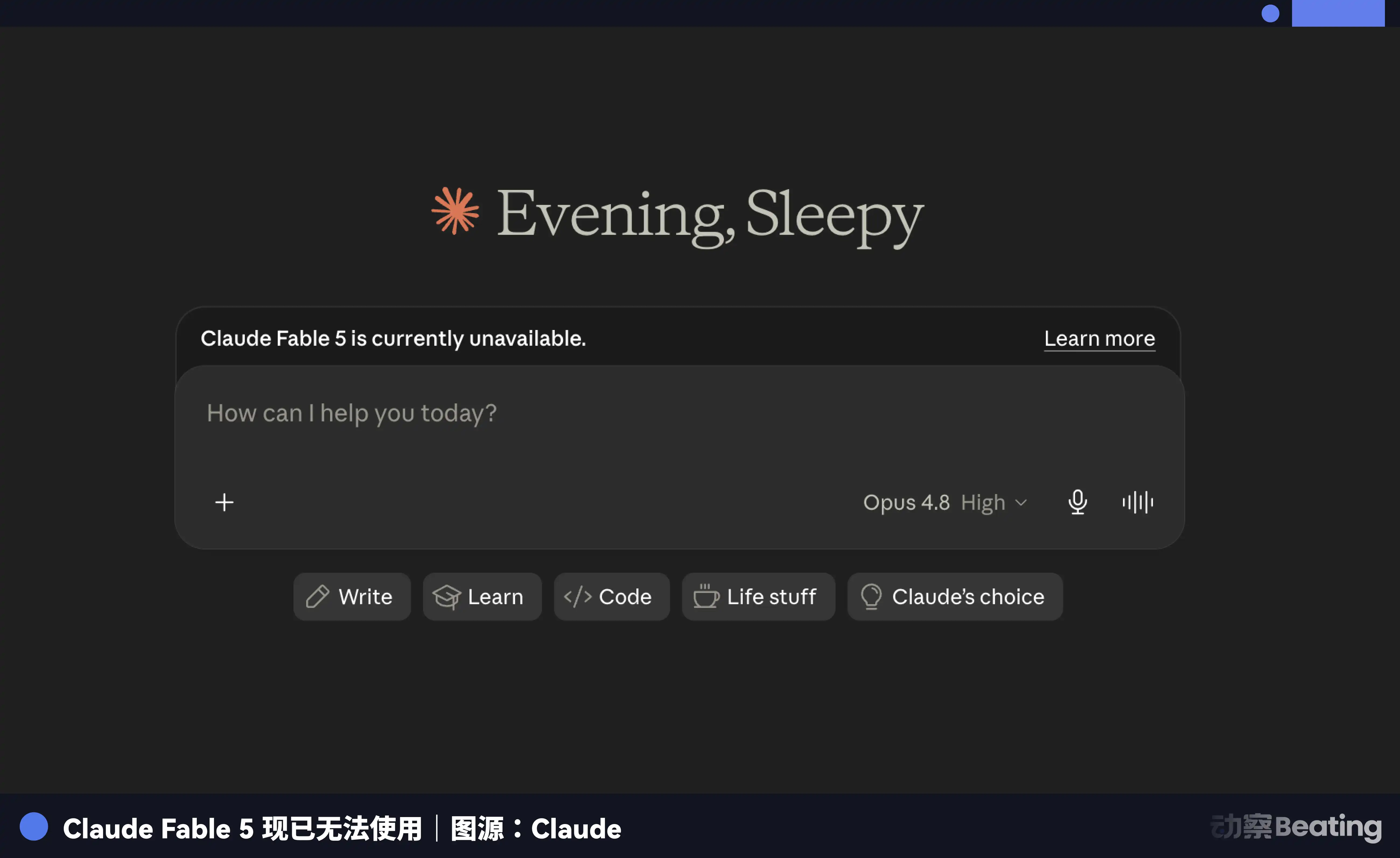
The phrase "national security," applied to a model, sounds weighty. But it was applied because Fable is not simple. This model is the "secure version" of Anthropic's Mythos that has never been released, protected by a security fence to prevent people from using it for activities such as cyberattacks or scientific research that could have serious consequences. However, Amazon submitted a report to the U.S. government, stating that someone could bypass these security measures and directly invoke the Mythos model through Fable. This possibility alarmed the U.S. government, leading to decisive action.
Anthropic is perhaps the world's most serious company when it comes to addressing AI risks. However, over the past two years, model capabilities have grown too quickly, with the entire track only recognizing one direction: forward.
Anthropic began warning everyone earlier than its peers that if things continued this way, there might be a risk of technical runaway, even going as far as to suggest that the government should have the right to stop dangerous models.
Ironically, on the day the U.S. government took action, the first model to be stopped was one of its own.
Amazon warned of the risks, the U.S. government aimed to protect the nation, and Anthropic was doing the security work it deemed necessary. Everyone did their part, but together they did not achieve a satisfactory result.
It may seem like someone has finally put the brakes on the industry, but that's not the case. A model was launched and then halted by a command after just three days, indicating that no one was willing to slow down on their own, so someone from the outside had to intervene. If there were truly a method for companies, security researchers, customers, and the U.S. government to sit down together and collectively decelerate, things would not have reached the point of a blanket national security measure. Moreover, after this measure is imposed, only Anthropic will come to a stop, while others will continue to run. The past three days of Fable are not evidence of the industry starting to slow down, but rather evidence that no one was able to make it slow down properly.
Braking Can Also Become a Competitive Advantage
From the start, Fable 5 was a compromise.
The truly powerful model in Anthropic's hands is Mythos. It has not been publicly released precisely because of its tremendous capabilities. In April 2026, through Project Glasswing, the company provided a preview version of Mythos to a set of security agencies to have them search for vulnerabilities.
The act of searching for vulnerabilities is inherently ambiguous. Whether the same capability is used to discover and patch holes or to exploit them depends on the wielder of that capability.
Nevertheless, Anthropic found itself on this accelerating track every day. By June, it still decided to make such capabilities public. Fable is a secure version of Mythos, where high-risk requests are rolled back to the more restricted Opus 4.8. Before launch, red team testing was conducted, traffic was retained for thirty days to detect any breaches, and it was also treated as a product with pricing, customer reviews, a trial period, and the need to impress investors.
Making security a competitive advantage is inherently conflicting. Competitiveness implies running faster than others, while security means not running too fast. Anthropic wants both of these aspects to be valid at the same time, but how to achieve this balance is something they probably still haven't figured out to this day.
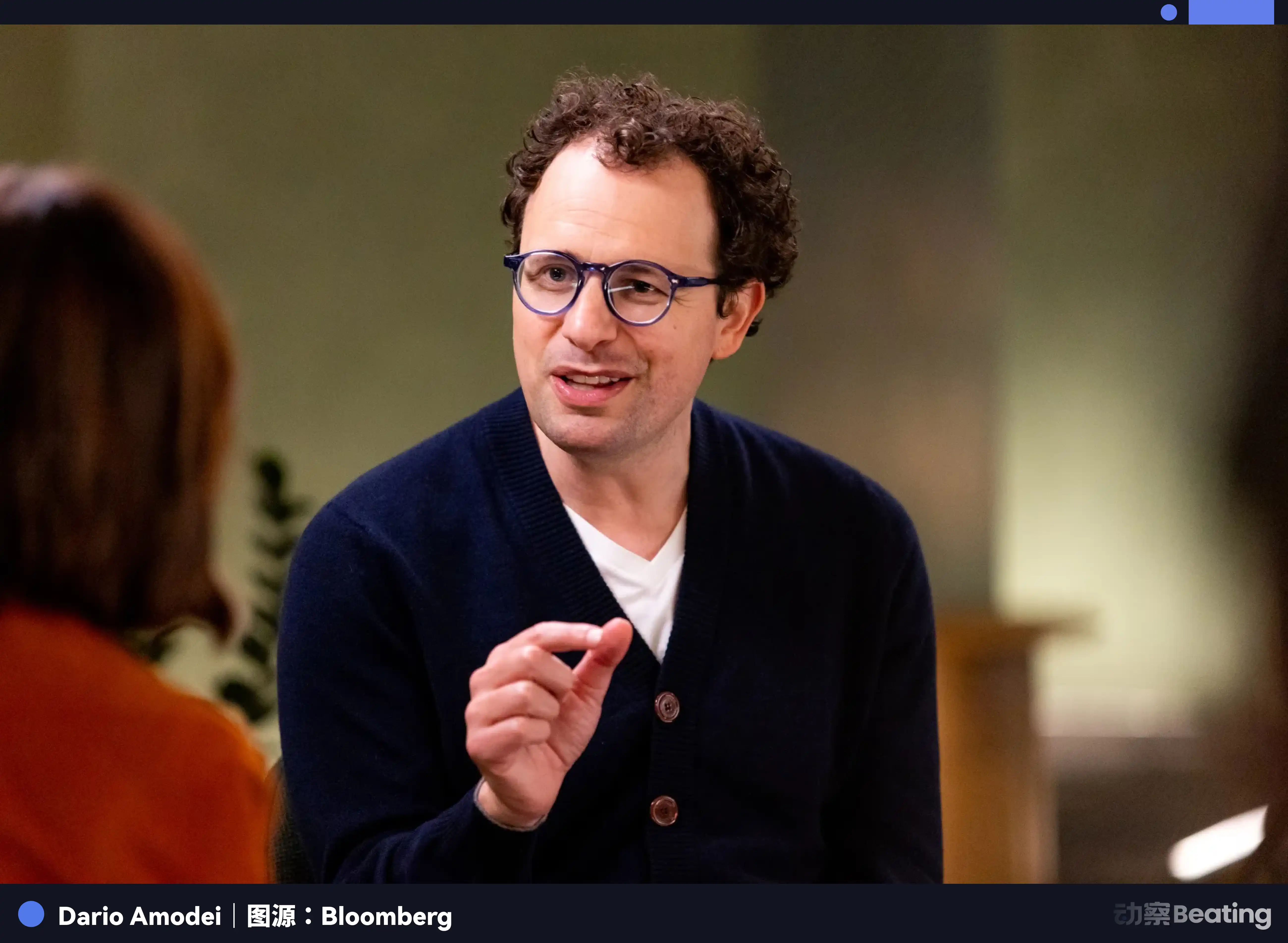
Founder Dario Amodei was formerly the Research VP at OpenAI, and a group of Anthropic's founding members also came from OpenAI. They have witnessed the excitement of seeing models grow increasingly powerful generation after generation, but they also know what lies beneath that excitement.
The later developments of OpenAI can be used as a reference. Altman was fired, then returned five days later, and in turn restructured the board. When the Superalignment team was established, they said they would solve security issues in four years, but disbanded in less than a year.
Anthropic emerged as another response after that storm. It suggests that we should build powerful models too, but with safeguards written into the system. The Responsible Deployment Policy has been updated to 3.0 extending to 2026, categorizing models by security levels. They argue that technology is advancing exponentially, while the regulatory world is lagging behind, so the government should have the right to stop dangerous deployments.
Building models themselves while actively advocating for government authority to halt models indicates a belief that one must trust that the invisible hand will prudently exercise its power and follow procedures. Initially, I respected this position to some extent. However, the Fable of the Three Days demonstrated how unreliable this belief can be.
Earlier this year, Anthropic clashed with the Pentagon over Claude's military application. It created Claude Gov for U.S. government clients but refused large-scale domestic surveillance and unmanned lethal autonomous weapons.
For Anthropic, this is the boundary of responsibility. The national security system, on the other hand, sees boundaries as troublesome because boundaries imply a lack of complete obedience.
When Anthropic talks about security, it means avoiding losing control. The national security system's concept of security is that everything should be controllable.
When even the concept of safeguards is debatable, who can prove they can bear responsibility? Anthropic quickly found out it couldn't prove it because relying solely on itself was insufficient.
Cannot Stop, Dare Not Stop
In early June, Anthropic proposed an idea that perhaps the frontier laboratories might need to coordinate to slow down together or even pause together to allow society and policies time to catch up.
Coordinate.
Why coordinate? Because if one company slows down on its own, the world will not be safer as a result. If Anthropic stops, OpenAI may not stop, Google may not stop, and the capital markets certainly will not stop.
So unilateral restraint in such a situation cannot be considered a virtue. The one who stops first will not be remembered, only replaced.
Anthropic's issue has never been about whether to take responsibility. It is very clear that it is willing to take responsibility. The real question is, in a situation where others may not take responsibility, how far can one person really step up to shoulder that responsibility?
The source of past industrial accidents, no matter how complex, could always be traced back to a relatively clear cause. But the cutting-edge AI is different. The capability of a model comes from computing power, academic papers, the open-source community, investors pushing for growth, and a country's desire for technological superiority. Each piece can absolve itself and say, "It wasn't me making the decision." However, when all these pieces are put together, they have brought the world to where it is today.
Responsibility has been fragmented, yet the acceleration continues.
While Anthropic criticizes in policy papers that AI is progressing too rapidly and governance is lagging behind, it also releases new models.
I'm not trying to say that Anthropic is hypocritical. Anthropic is no longer the small idealistic lab that could survive on ideals alone. It now has to compete with OpenAI, Google, and xAI, deal with funding and IPO expectations. Silicon Valley talks a lot about safety, but when it comes to investing money, it still looks at whose model is stronger.
So, Anthropic can only break things into two halves. It first works on what it can do itself. It then lists out what needs the entire industry to work on together, waiting for others.
Pragmatic, yet helpless.
Fable was born in this dilemma. If the car can't stop, then install a more complex set of brakes on it. What emerges from such a dilemma is destined to satisfy neither end.
Standing in the Middle
After Fable went live, the first group that was dissatisfied was not the U.S. government but those working on security.
Chompie, a researcher at IBM X-Force, said that Fable would reject a bunch of security requests that were only tangentially related, sometimes triggering alerts even by having it read a blog post.

Security barriers aim to discern intent, but the model only sees language and context before it. It cannot distinguish whether you pulling out a tool is to fix a door or to pick a lock, so it might as well block both kinds of people.
Two days later, a report made its way to the U.S. government's desks, and from that moment on, this matter was no longer solely Anthropic's self-assessment of its security design.
Anthropic repeatedly emphasized a timing discrepancy. Before the release, it had notified the U.S. government several times; the U.S. government did not object and even participated in pre-release testing. The company had obtained deployment approval. Three days later, the same system suddenly required it to be taken offline.
Anthropic said that the U.S. government never provided specific details. They had seen the demo themselves and thought it was just a few known and not very serious vulnerabilities, things that could be done with another publicly available model. It was only through the statement that the U.S. government presented verbal claims.
This model, dissatisfying to the developers and to the U.S. government, leaves Anthropic stuck in the middle, pleasing no one.
Behind the Fable incident lies the operation of a whole chain of distrust. With each round, each link is watching out for the previous one. Eventually, society finds it hard to believe anymore that anyone here can truly take responsibility.
e/acc is a Climate
The difficulty of this issue lies in the fact that each party feels responsible and is able to justify their actions. Everyone holds a piece of the puzzle, believing it to be justified.
The terrifying part is here. Each individual only takes responsibility for their own small piece, and when combined, no one takes responsibility for the whole. Responsibility has been fragmented. Internal controls, model evaluations, export controls, customer demands, national competition, return on investment—each fragment reflects a piece of reality, but no single piece reflects the whole.
When even the definition cannot be unified, the only direction everyone can agree on is "fast."
Effective accelerationism, abbreviated as e/acc, has emerged in recent years as a distinct form of technological optimism. By pushing technology to be faster, disregarding regulation, social structure, and ethics, believers trust that progress can solve those major issues.
Not every company claims to be e/acc, and certainly not Anthropic. However, a doctrine that does not require everyone's recognition to change the larger environment.
The competition of capabilities, the insatiable demand for computing power, the timeline of financing, intergovernmental posturing, military needs, developers' thirst for more powerful tools—all these elements combined create a climate. Some may not like this climate, but they have to live in it, just like everyone else.
As strong as Anthropic is, one of the few people repeating calls to hit the brakes in this age of acceleration, in the end, still needs to prove they can run fast enough. Technological acceleration does not need a villain; it just needs every good person to feel they cannot be the first to stop.
The Brakes Have Always Been There
The cost of the Fable incident is handing over the brakes. Hoping for government intervention is a result of inadequate industry self-regulation. However, public authorities may not operate as you expect. The most skillful actions of the national security machinery are not negotiations but rather blocking, permitting, and making exceptions.
AI is no longer a technology that can be clearly defined. When a cutting-edge model is simultaneously embedded in business, research, national defense, and infrastructure, who has the power to decide how it should not be used.
Everyone knows that speed is too fast. But speed itself has become a condition for survival.
Over a hundred years ago, there was also an acceleration that no one dared to stop.
On the evening of August 1, 1914, at five o'clock, German Emperor William II ordered total mobilization of the army. Just a few minutes after the order was issued, a telegram arrived from London, stating that as long as Germany did not attack France, the UK would allow France to stay out of the conflict. The German Emperor was overjoyed. He was originally most afraid of a two-front war, but now, all forces could be sent to the east to deal with Russia. He turned to the Chief of Staff, Moltke the Younger, and said, "Then we will only attack the east."
Moltke said, "That's not possible."
His reason was that a million-strong army, how to mobilize, which railway to take, what time to arrive at which platform, all followed a rigid plan. This timetable had been honed for a whole year, and once finalized, not a single word could be changed.
Later, many historians have recounted this story. Most people treat it as a parable about machines, saying that modern warfare machines are so precise that even the operators cannot control them.
But later on, people discovered another fact. That timetable was actually changeable. The railway department practiced every year how to temporarily change routes and times, and the plan for the eastern front was always ready. Trains could indeed turn around.
In other words, the brakes have always been there.
What really happened that night was not the absence of brakes, but the person standing by the lever, insisting that the brakes could not be touched. He didn't ask if it could be changed; he was too certain that it couldn't.
So the train continued to head westward one after another, turning a conflict that could have been confined to three countries into a war that engulfed the entire Europe. No one wanted this outcome. Everyone at the time felt that they were just doing what they had to do, no matter how inevitable it seemed.
The reason I recalled this train is because AI's acceleration is also a train that has already started. It wasn't created by any one person but was assembled with computing power, capital, and national ambitions, and it keeps moving forward. Everyone is on board the train, each doing what they should be doing, and the train keeps moving forward.
This is what makes me uneasy about the AI era. The danger is not unseen, and the brakes are not truly absent. The person calling for the brakes is sitting on the train, and those who understand the danger still have their feet on the accelerator.
What this industry is most wary of is often the very thing it is frantically creating. The Fable should have been an example for everyone to pause and reflect. But by the time I finish writing this, several new models have been released, each claiming to be the strongest.
There wasn't a single person willing to tap the brakes first.
Welcome to join the official BlockBeats community:
Telegram Subscription Group: https://t.me/theblockbeats
Telegram Discussion Group: https://t.me/BlockBeats_App
Official Twitter Account: https://twitter.com/BlockBeatsAsia
