TL;DR
1. Why is Pre-IPO Perpetual Important? It opens two doors that were previously closed to almost everyone: first, making a directional bet on companies like SpaceX and OpenAI before they go public, and second, getting a real-time price during stock market closures but with news still affecting prices at night, on weekends, and during pre-market hours.
Nowadays, anyone with a wallet can place this bet, continuously and permissionlessly, and it's happening during the largest wave of IPOs in history.
2. Without a public spot price, how does the market price something? This is the core challenge that the entire asset class must solve.
With no external price to reference (sometimes for months), exchanges can only use their own order book, the only thing they have in hand, to come up with a price. This price only moves when there is genuine interest to trade at a deviation from it: it moves slowly and is expensive to manipulate.
trade.xyz uses an internal oracle along with a price range, while Ventuals partly relies on primary market data. Surprisingly, this mechanism actually works: the perpetual accurately predicted Cerebras' opening price within 1.3%, and even priced oil during a weekend when a certain traditional market went completely dark.
3. What worked in this SpaceX case? trade.xyz dominated the on-chain market (about 96.5% of trading volume), not because the oracle is smarter, but because near-zero funding rates allowed for almost zero-cost holding of the trade, leveraging the IPO catalyst for listing and enabling cross-exchange arbitrage based on a per-share valuation.
On IPO day, June 12, the transition from synthetic perpetual to spot-tracking was smooth: no oracle price gaps, no settlement waterfall. On the listing day, the perp price closely tracked the Nasdaq real-time price, with a difference of within 1% (around $152 vs. $150 execution price); its pre-market mark price also aligned perfectly with Nasdaq's own opening indicative price (around $175), and the final execution price settled at a lower $150.
4. What other unresolved risks are there? This asset class excels at handling price but is still primitive in handling events.
Corporate actions, especially post-conversion stock splits, have no channels on-chain: trade.xyz did not disclose any rebase mechanism, while Ventuals outsourced this to a separate data provider, which has had an incident before (an outdated split data caused a 45% flash crash).
The bottleneck is not in price discovery, but in that boring layer of "corporate action" processing: while the traditional markets spent a century standardizing it, no one has rebuilt it on-chain yet. Whoever can reliably deliver it is bridging the final gap between these markets and the ones they seek to replace.
Background: Crypto Just Kicked Down Two Locked Doors
Pre-IPO perpetuals sat at the intersection of two things that until recently were almost locked off to all. Now, the crypto track has pried open both doors.
Door One: Pre-IPO Exposure Finally Available to Retail
Shares of pre-listing companies like SpaceX or OpenAI, previously only accessible to accredited investors, VCs, and a few OTC desks, with opaque valuations that reset only with each financing round. Pre-IPO perpetuals have torn down this barrier.
With just a wallet, one can wager on the valuation of a private company, place bets anytime without permission, without touching any shares, quotas, or voting rights. The timing couldn't be more perfect, as the largest wave of IPOs in history is just unfolding.
SpaceX debuted on Nasdaq with a valuation of around $1.77T on June 12, with OpenAI and Anthropic expected to follow suit. Retail investors can now set the stage before the market opens, rather than chasing highs after listing.
Door Two: After-hours trading, now commandeered by crypto
Traditional trading platforms still follow the "banker's hours." Stocks and futures come to a halt at night, on weekends, and holidays; when news breaks after hours, the real risk exposure remains unhedged. On the crypto side, the door never closes, with most price discovery happening on Hyperliquid.
The key premise of this report is: that after-hours price is not a random guess; it often lands right at the reopening position of the real market. During a Saturday Middle East conflict that drove up oil prices, with only Hyperliquid trading, when CME crude oil futures reopened on Sunday evening, the price they set was exactly where the Hyperliquid perpetuals had already been.
TD Securities estimates that while traditional trading platforms were still closed, this platform had absorbed about 80% of the recent oil price swing. Stocks are no different, with the Cerebras perpetual on trade.xyz differing by only about 1.3% from the Nasdaq opening price. During after-hours, perpetuals themselves become the market.
How Early Is It Now: Accounting for Only About 1% of TradFi Perpetual Contract Volume
CoinDesk data reveals how nascent this market is. In the perpetual contracts of Binance and similar platforms, the spotlight is on commodities and stocks. Pre-IPO is merely a thin layer at the very top of the stack, having been launched around May 21 and now accounting for just over 1% of the total TradFi perpetual contract volume.
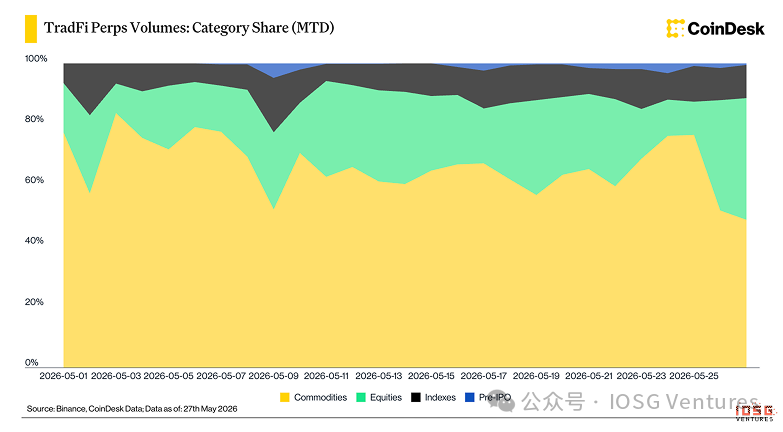
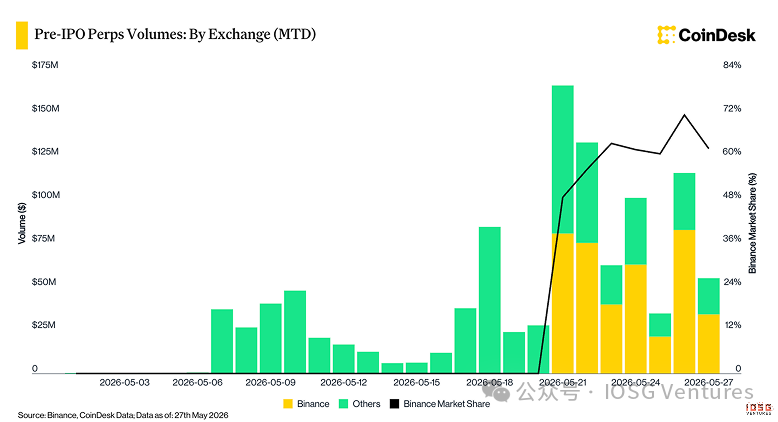
On Binance, Pre-IPO volume is similarly highly concentrated on individual targets: SpaceX accounts for about 79%, OpenAI 11%, and Anthropic 9%. This asset class was launched around May 20, and afterwards Binance quickly captured over 60% of the share.
Pre-IPO on CEX is still in its early stages, with SpaceX as the protagonist. The truly interesting activities are on-chain.
The Landscape of SPCX across Exchanges: Binance Leads, Hyperliquid Holds Firmly in the On-chain Home
Market Snapshot on June 10
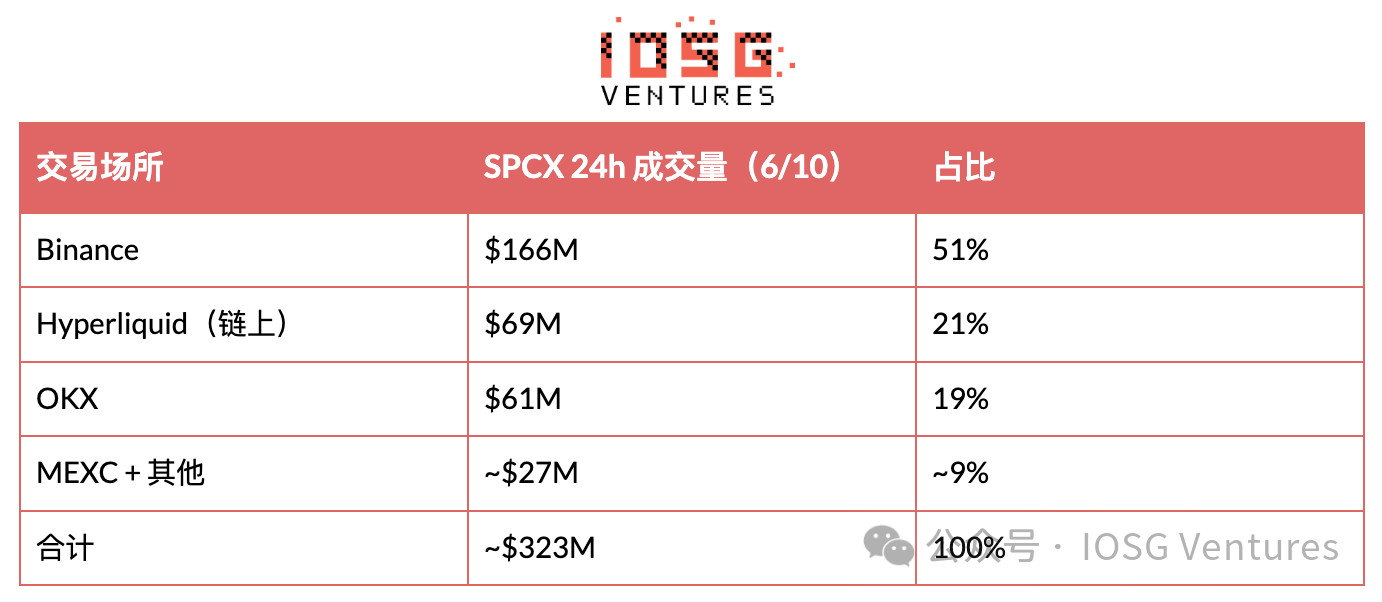
Focusing on SpaceX itself, it is currently the entire Pre-IPO market. In this snapshot on June 10, the 24-hour total trading volume of SPCX perpetual across all venues is about $323 million. Binance leads with $166 million (51%), followed by Hyperliquid with $69 million (21%), OKX with $61 million (19%), and then MEXC and a bunch of smaller venues.
On-chain Landscape: A Market with Only One Builder
Comparing Trade.xyz and Ventuals with Data: 96.5% to 3.5%
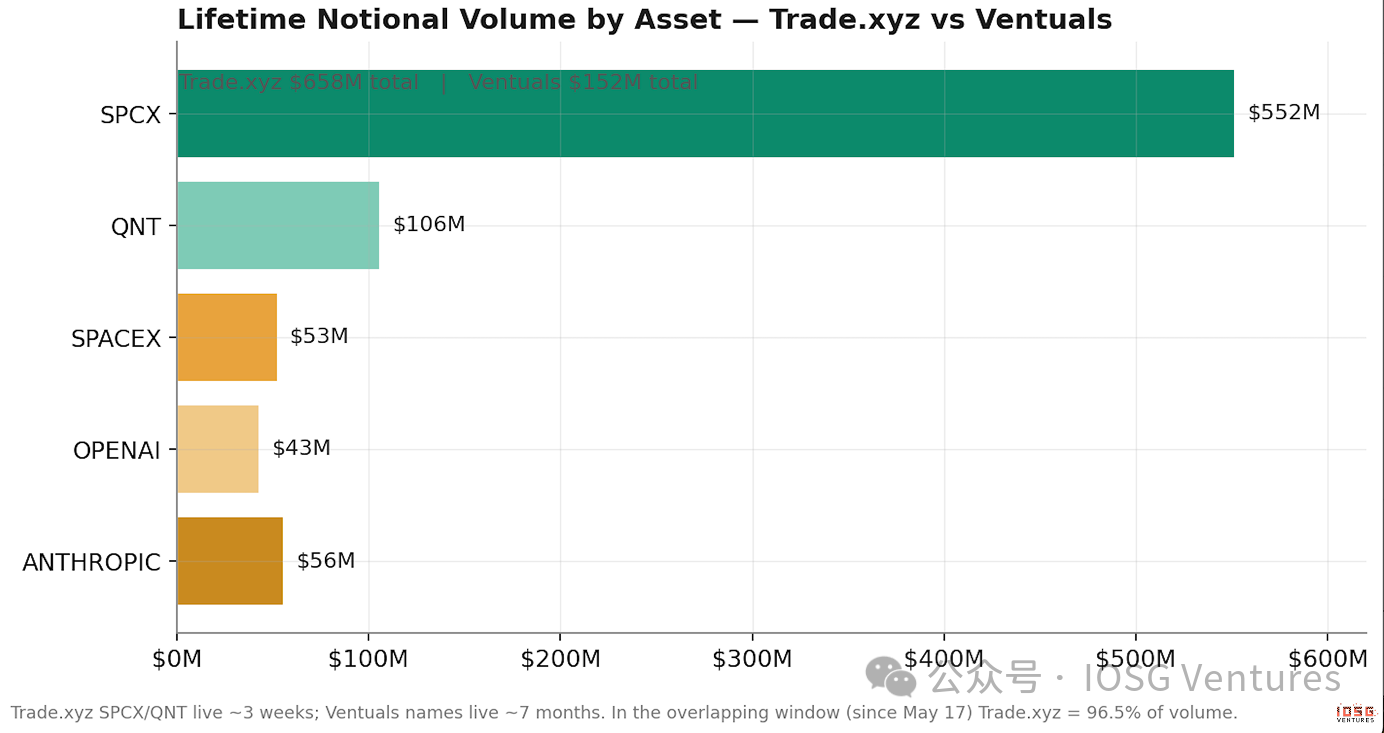
Trade.xyz has a total trading volume of about $658 million, with SPCX accounting for $552 million, and the second asset QNT $106 million, all crammed into about three weeks. Ventuals has accumulated around $152 million, distributed more evenly among SPACEX ($53 million), OPENAI ($43 million), and ANTHROPIC ($56 million), over approximately seven months.
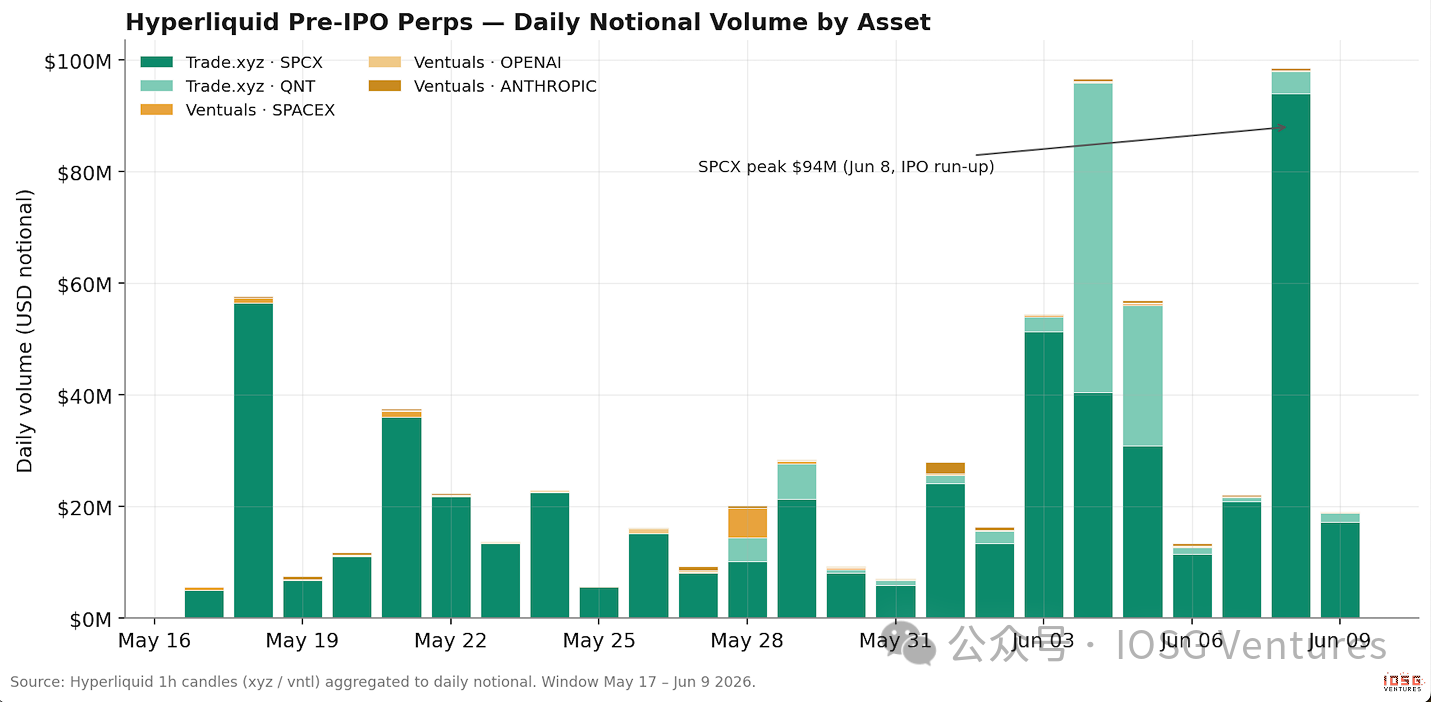
Placing both on the same timeline reveals a stark difference. Within the overlapping window after SPCX went live, trade.xyz accounted for approximately 96.5% of on-chain Pre-IPO trading volume, corroborating the third-party tracker's statement that "Hyperliquid Pre-IPO accounts for about 95% of the basket."
Ventuals listed more assets, including the only active Anthropic and OpenAI contracts, but only received a small portion of the traffic. Listing is not the moat; liquidity is.
HIP-3: The Platform Layer Beneath It All
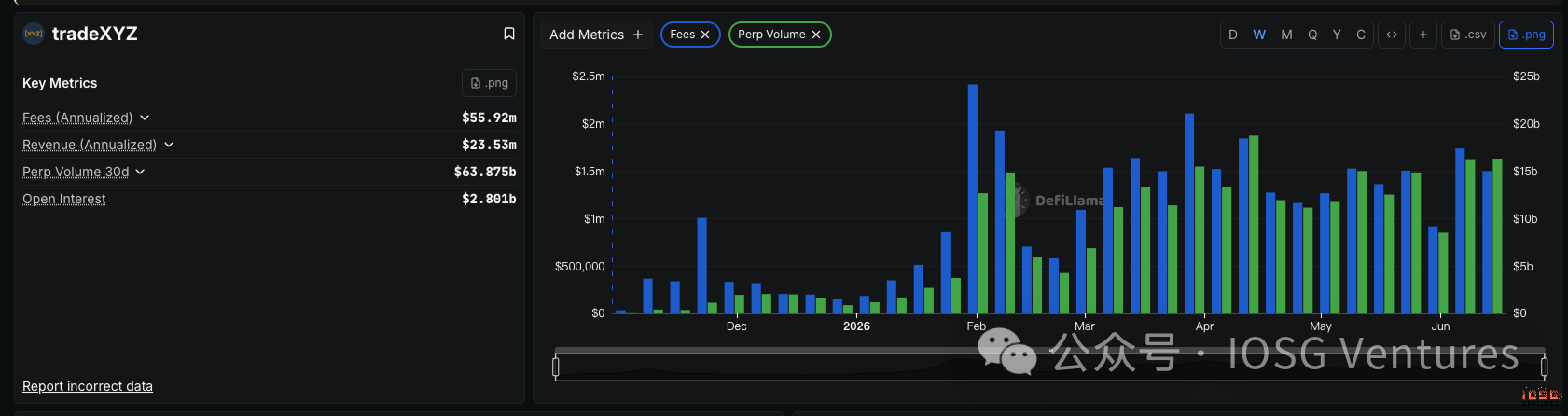
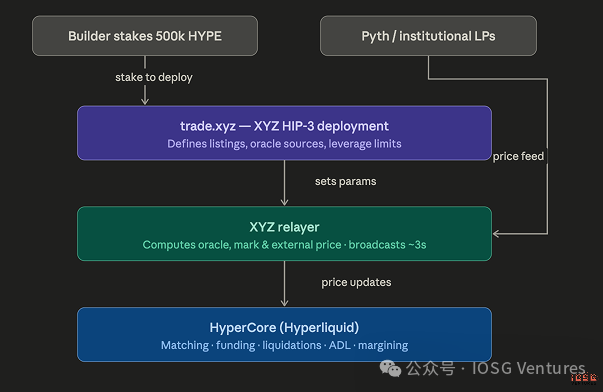
HIP-3 is an upgrade to Hyperliquid that transforms a single perpetual contract venue into a platform for builders to deploy perpetual DEXes. Any team staking 500,000 HYPE can deploy their own perpetual market on Hyperliquid's matchmaking layer, HyperCore.
Builders control listings, oracles, leverage limits, and contract parameters; HyperCore controls execution, funding rates, liquidations, and margins. Trade.xyz is a HIP-3 deployment focused on traditional assets: turning stocks, indices, and commodities into 24/7 perpetual contracts settled and margined in USDC, supporting only isolated margin.
When There Is No External Truth, How Does Trade.xyz Price the Market?
Let's start with the problem because understanding the problem first is the only way this design makes sense. Regular perpetuals copy a real-time spot price from a trading platform; Pre-IPO perpetuals have no spot price to copy and may not have one for several months. Therefore, the trading venue has to use the only thing it has: its own order book, to create a trustworthy price that is resistant to manipulation. This section answers one question: when an asset has no price yet, how do you price it?
Two Oracle Mechanisms for After-Hours Stock Perpetuals
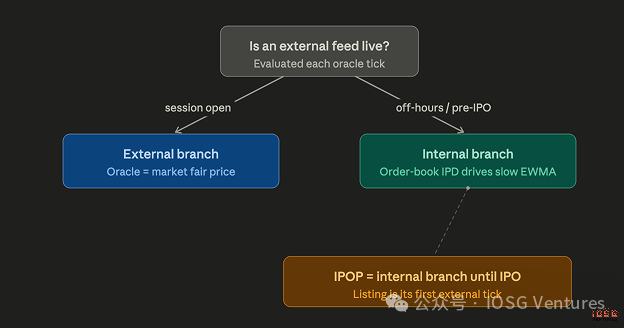
To understand Pre-IPO perpetuals, one must first understand after-hours stock perpetuals. Crypto perpetuals have real-time external prices 24/7, while stocks do not.
AAPL only has a real market price during US stock market hours, so the funding rate and mark price-feeding oracle must prepare two mechanisms: one for when external data is available and another for when it is not. When the external market opens, the relayer directly feeds the institution's fair value price (data sources include Pyth) as an oracle. During off-hours, the oracle can only rely on the perpetual's own order book, which is where the entire design truly excels.
Internal Oracle: Three Core Ideas
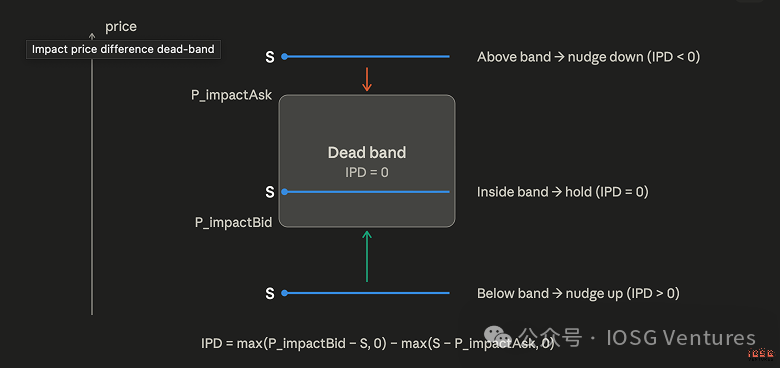
See Where the Tradable Order Book Lies.
The relayer calculates the average trade price for a fixed $1,000 order pushed to each side of the order book, resulting in the tradable buy price and tradable sell price. If the current oracle price falls within this range, nothing happens—the order book aligns with the oracle, and the oracle remains unchanged.
Only when the oracle price falls outside the range, indicating that genuine order book depth is willing to trade at a deviation price, does the oracle get pushed to the order book. Bullish imbalance pushes it up, bearish imbalance pushes it down, and noise within the range is completely ignored. To move this oracle, real liquidity must be provided, instead of just a few trades.
The Oracle Never Jumps.
It slowly converges towards the order book with a thirty-minute time constant, and a hard limit ensures that each update can only converge the remaining distance by about 9.5%, regardless of how long it has been since the last update. Trading halts and irregular updates cannot cause it to gap.
Median of Mark Prices.
The mark price that drives margin and liquidation is the median of three candidate values: the oracle itself, the oracle plus the perpetual contract funding rate's short-term moving average, and a snapshot of the order book (best bid price, best ask price, and last traded price).
The median structure ensures that the fast variable can never pull the mark price too far from the slow-moving oracle. Hourly funding rates further push the market towards the oracle, with a standard multiplier and cap, ensuring that any payment for a single hour is minimal.
Pre-IPO Perpetual: Same Engine, Three Tweaks
PIPC (Pre-IPO Perpetual Contract) is essentially a post-market stock perpetual that can never wait for a "Friday closing price" to rely on. There is no external price before the listing, so the market must operate continuously with an internal pricing mechanism, sometimes lasting for months.
Trade.xyz made three tweaks for this purpose, each revealing the essence of the issue.
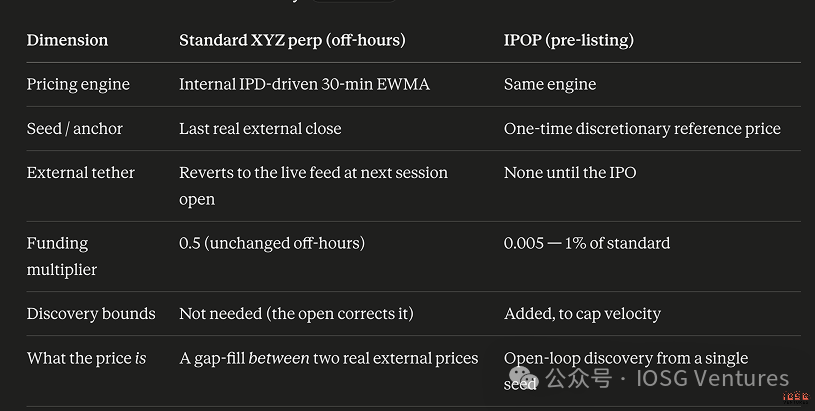
1. The funding rate has been slashed to 1% of the standard rate. Weekend perpetual contracts can drift for up to two days, but by Monday's open, they will correct. Therefore, the normal funding rate is tolerable. PIPC contracts may trade for more than sixty days without any anchor, and the market often remains at a sustained premium or discount reflecting pure sentiment.
Under standard rates, anyone holding a contrarian sentiment position would have been bled dry by funding long before the IPO arrived. It took reducing the leverage almost to zero to make this contract a truly tenable thing. Our view: rather than any cleverness on an oracle, it is this one parameter that has made trade.xyz's product tradable, as evidenced by the funding rate data in the later part of this report.
2. Seed Price Discovery. The weekend markets initialized from the last true external price. With IPOP having no history, trade.xyz set its own initial reference price. It was not a prediction but a mathematical starting point.
Using SPCX as an example (launched late on May 17 UTC), the reference price was set at $150 per share: derived from SpaceX's publicly reported $1.75T–$2T target valuation midpoint, divided by the assumed fully diluted share count of 11.87 billion.
3. Discovery Bound. A price range (collar) around the reference and mark prices that cannot be crossed, accompanied by a rule: positions with a settlement price outside the current range will not be settled during the range's validity.
For 5x leveraged SPCX, the range width is 20% on both sides. A static range either locks a price or is illusory, so this range is tiered: as the slow oracle inches to 90% from the upper bound, the reference price reanchors to that bound, opening a new 20% range around it.
SPCX has seven such tiers in each direction. Compounded, the contract's hard lifetime range starting from the $150 seed price is approximately $25 to $645 per share.
How Much Does It Cost to Manipulate This Market: Expensive, Conspicuous, Slow
This division is critical for anyone looking to manipulate. The mark price is fast but has a hard cap, a single pump can almost instantly slam it to the ceiling, freezing it there.
The oracle is a thirty-minute slow moving average, it is the gatekeeper: only when the oracle hits the 90% trigger line, do the tiers move up. To push the price up a tier, an attacker must prop up the entire order book against arbitrage for nearly an hour, then repeat for the next tier. Expensive, conspicuous, slow—that's the design intent, and so far, it has held steady.
Two Builders: Trade.xyz versus Ventuals
Ventuals: Partial Trust in External Data
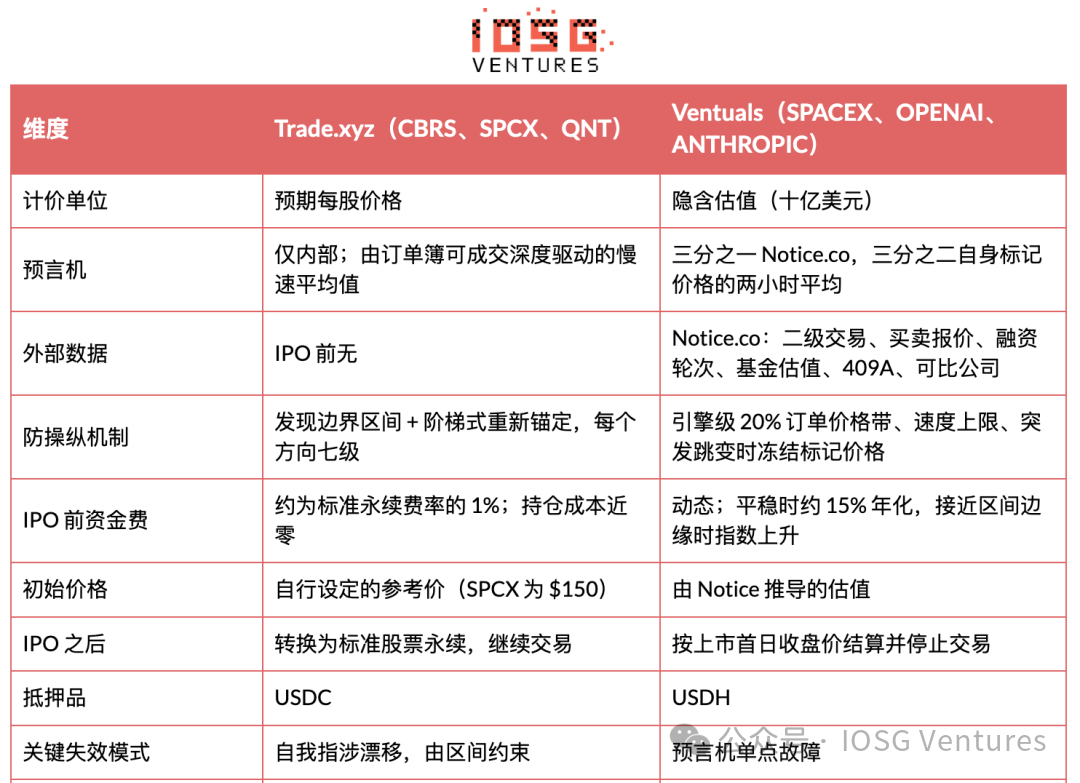
The Pre-IPO perpetual on Hyperliquid comes from two HIP-3 builders, who answered the same question from opposite directions. Trade.xyz trusts its own order book; Ventuals trusts external data partially.
Ventuals prices based on valuation rather than stock price: A SPACEX price of 1,989 implies a $1.989 trillion company valuation. Its oracle is weighted mix: one-third from external valuation estimates by Notice.co, and two-thirds from Ventuals' own marked price two-hour moving average.
Notice aggregates secondary trades, order book bid-ask, funding announcements, mutual fund valuations, 409A valuations, and public comparable company data, polling at least once per minute.
The deliberately set one-third weighting is Ventuals' answer to the "IPO Moonshot problem": anchoring to primary market reality while allowing mathematical space for upward pricing. One more thing not to overlook: this oracle has two-thirds from Ventuals' own market, a design more self-referential than its marketing rhetoric.
Its anti-manipulation mechanism is built on the price path, not interval steps. Orders must not deviate more than 20% from the oracle, enforced by the matching engine. Mark price updates every three seconds, with a maximum 1% change each time.
If a short-term price impact deviates more than 2% from its one-minute mean, the mark price update coefficient immediately resets to zero, so the sudden fluctuation must persist for the mark price to follow. Funding rates are dynamic: around 15% annualized when the market is close to the oracle, rising exponentially as deviation widens, approaching nearly 1% per hour when near the interval edge.
The endgame design is also entirely different. When a company goes public, Ventuals' market settles and halts: funding rates reset to zero, mark price forcibly overwritten to the valuation implied by the first-day closing price, and all positions are forcibly closed. It's more like a predictive market betting on the first-day closing of the IPO rather than a perpetual contract. Trade.xyz's IPOP, on the other hand, converts directly to regular stock perpetuals and continues trading.
Side-by-Side Comparison
Why the Pioneer Lost: Holding Costs, Oracle Failures, and Missed Catalysts
Ventuals launched in November 2025, six months ahead of any target on trade.xyz, and still holds the only live OpenAI and Anthropic contracts. It now accounts for approximately 3.5% of on-chain Pre-IPO trading volume. The explanation mainly lies in the mechanism design, where two parts can be quantified directly.
Entry Cost
The two different funding rate designs mean a world of difference in the cost of holding a Pre-IPO view, and actual funding rate data indicates that the gap is even larger than the document implies. During the identical 538 hours from May 17 to June 9, the long positions on SpaceX on Ventuals paid funding every hour, averaging about 45% annually, with a cumulative cost of 2.79% of the nominal value.
The same long positions on trade.xyz only paid 0.008%. The average funding rate intensity on Ventuals is 33 times higher, with a cumulative cost about 350 times higher.
At a standard 5x leverage, Ventuals' loss is equivalent to wiping out about 14% of the margin in 23 days, and this happens to be on the very trade that both platforms hinge their existence on: longing SpaceX before its IPO.
The holders provided order book liquidity that attracted everyone, with one platform collecting their rent and the other not. We believe this is the single biggest reason for the volume split.
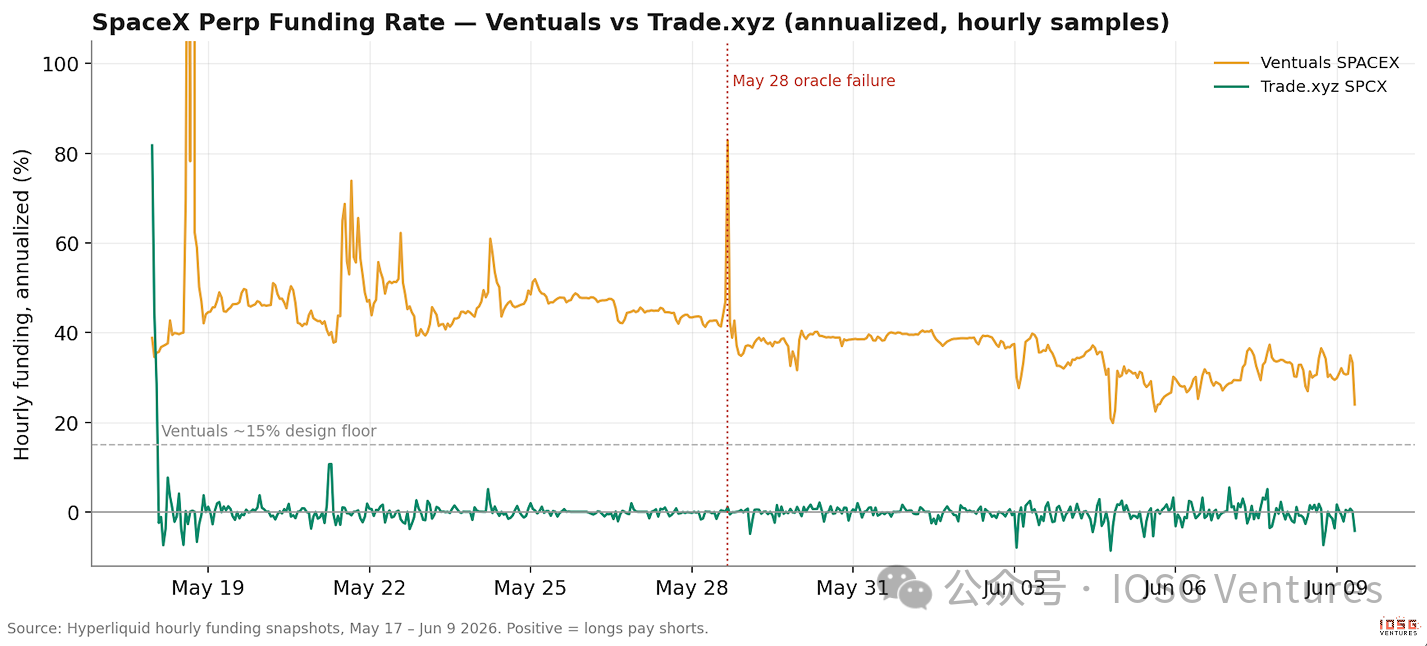
Zooming out to look at the full history, this becomes even more apparent. Longs that have been held since the launch in November have collectively paid about 45% of the nominal value in funding rates, as the market has been trading at a premium above the Notice anchor price for several months, with the dynamic multiplier charging for this throughout. This design allows the price to discover above the anchor, much like a toll road allowing you to drive.
Oracle Failure
Ventuals relies on a single supplier for external data, and this supplier had an issue. During the 5-for-1 stock split executed by SpaceX from May 18 to 22, the data source that was supposed to incorporate this into Notice was incorrect.
Bad data flowed directly into the oracle, which drove the margin calculations, causing SPACEX-USDH to flash crash by about 45% on May 28, resulting in approximately a $1.5 million liquidation before the recovery.
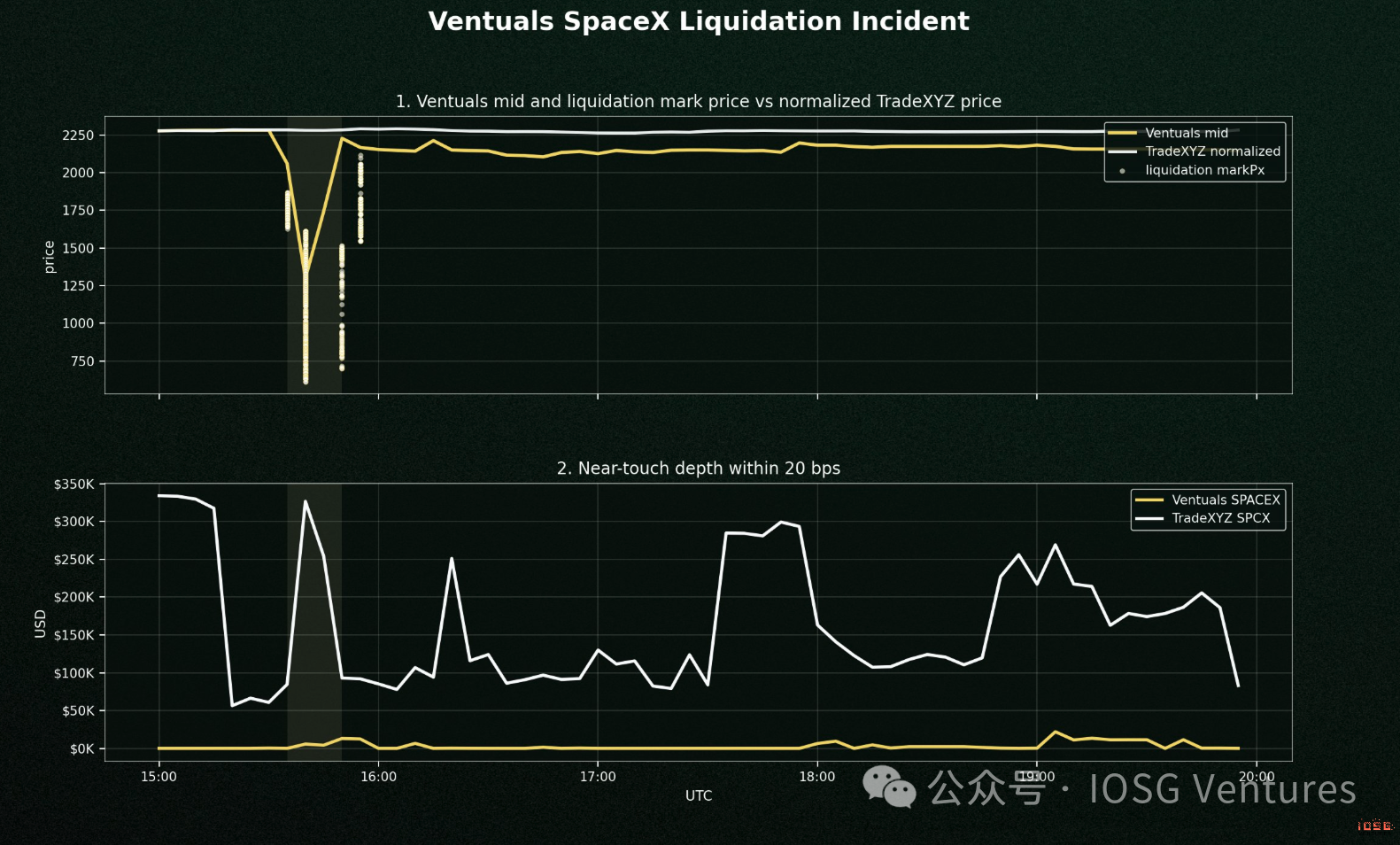
The crucial detail is this: all of Ventuals' safeguards are defined relative to the oracle, so once the oracle itself is the source of the failure, every layer of protection re-anchors to that failure. The speed limit did not prevent the crash but merely scheduled it, compounding at 1% every three seconds, taking about three minutes to complete the full 45%.
Even worse, the 20% Order Price Band kept the rescue at bay: knowing well that the price was wrong, arbitrageurs couldn't quote outside the 20% range above the bad oracle. Trade.xyz wouldn't collapse this way before the IPO, for a simple reason—it didn't have an external data feed that could be manipulated.
Its corresponding weakness is a slow self-referential drift, bound by intervals that cannot be erased, and this weakness has not yet led to its "accident."
And three quieter forces bring up the rear
All major CEXs uniformly priced per share, which is the unit of trade.xyz, allowing its order book to directly arbitrage with every CEX screen, while Ventuals' valuation unit remained outside the arbitrage network.
It turns out that the demand for such products is event-driven rather than normalized. Ventuals didn't benefit much from going live six months early like SpaceX did, whereas trade.xyz happened to go live right on top of a catalyst. On top of that, Ventuals' "settlement equals stop" was essentially telling the market maker in advance: your market will die on the listing day.
And Cerebras' data just happened to show that the trading volume peaked on that day, with about 85% of the lifetime trading volume occurring on IPO day.
Ventuals Still Did Something Right
All this does not mean Ventuals' design was wrong. Its anti-dilutive valuation pricing unit did not require any rebase when S-1/A landed; its funding rate in "anchoring" can be said to be more honest than trade.xyz's near-zero fee rate, as the latter leaves the price untethered apart from the range.
Cheap holding and anchorless drift are indeed two sides of the same design choice. But combining high holding costs, a one-time public oracle failure, an isolated pricing unit, and a market structure with finality equals death explains in full why six months of early launch only yielded a 3.5% share.
CEX Layer: Binance on Trade.xyz
No Oracle, No Index: Binance's Design
Several major CEXs entered the scene relatively late. Binance listed SPCXUSDT on May 21, three days after trade.xyz, and its listing announcement detailed the design. There were no oracles or indices before the IPO.
The Mark Price is the average price of Binance's own recent ten-second trades, calculated every second. During periods of low trading activity, it reverts to a longer window and has a 1% per second price movement limit. As there is no premium index, the funding rate has no corrective function: a fixed 0.005% every 8 hours, approximately 5.5% annualized, acting as a pure funding cost with no anchoring to anything.
From listing to June 9th, long positions on Binance paid about 0.29% of the notional value, which is a fixed cost that remains indifferent to everything that occurred during that period (including dilution re-pricing).
Among these three designs, Binance's is actually the most self-referential. Trade.xyz at least incorporated an oracle into its order book; Binance's price is simply the execution price from its order book, smoothed over a ten-second period.
How does it maintain stability? Through a generous speed limit, an adjustable yet undisclosed upper price limit, and leverage that decreases based on position size: a full 5x leverage only up to a notional value of $50K, above $2M reduced to 1x with a 50% maintenance margin. Binance's whale control plays the role that trade.xyz discovered exists on-chain at its boundary.
Corporate Action: A Watershed of Two Philosophies
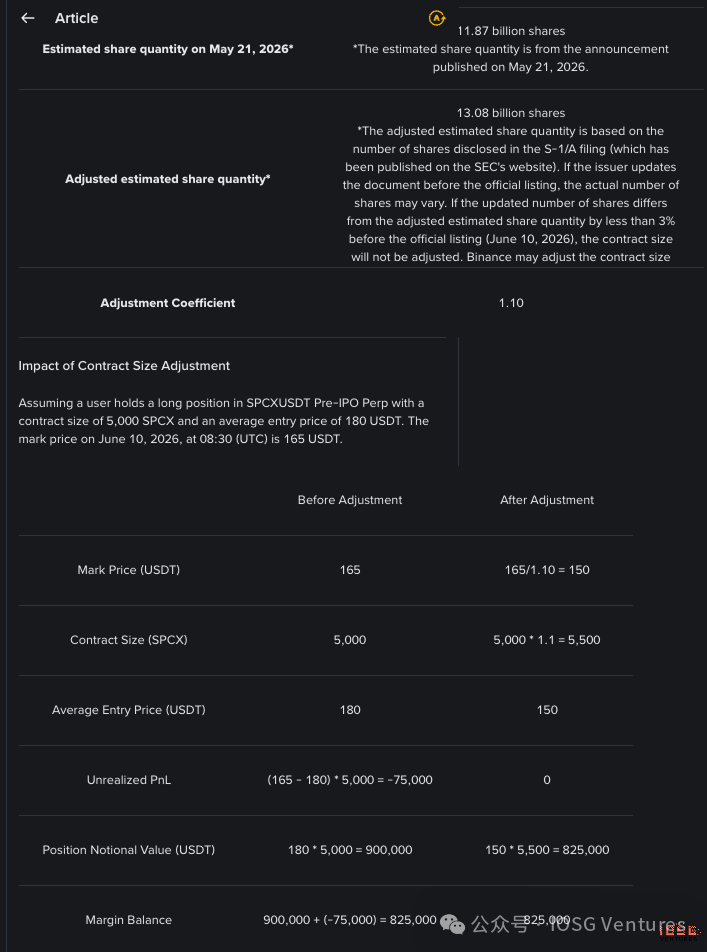
Trade.xyz considers S-1/A stock changes as information and allows the order book to reprice itself, causing long positions to swallow the 10% dilution as PnL.
Binance treats it as an administrative event: a value-neutral rebase with a factor of 1.10, scaling the contract size by 1.1, dividing the opening price by 1.1, announced on June 9th and effective on June 10th, with each account's equity remaining unchanged. Both approaches come at a cost.
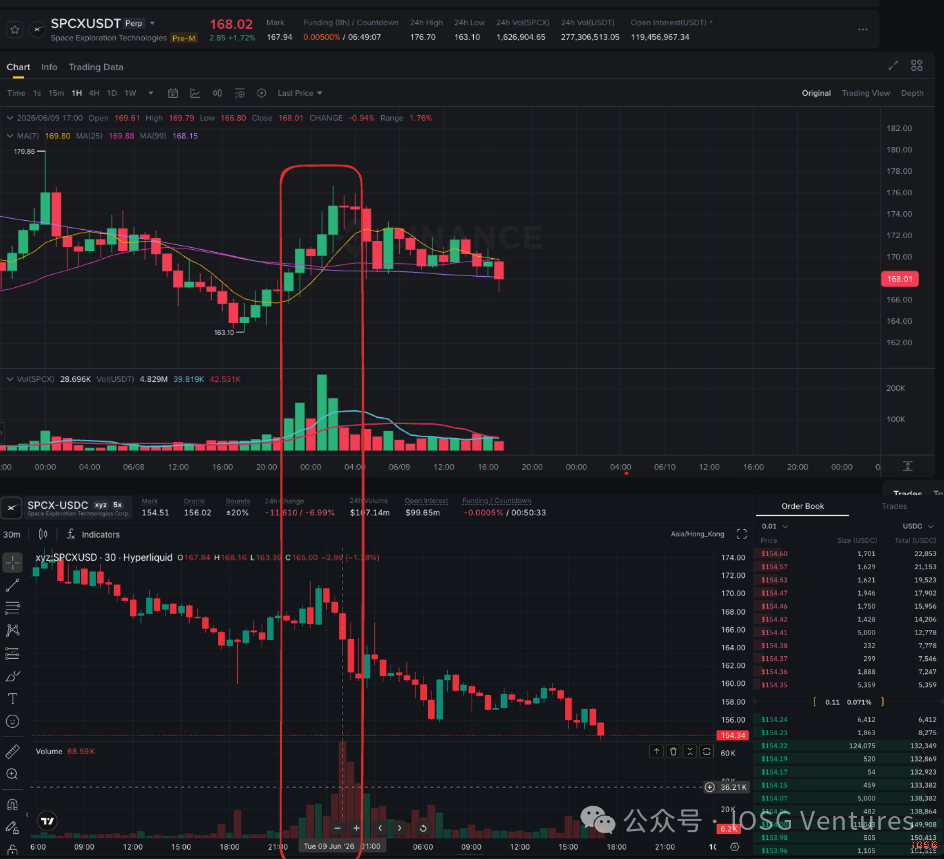
Binance protects position holders from bearing the dilution PnL they never signed up for, but in doing so, it creates a ten-day window where its price mechanism is essentially 1.1 times that of trade.xyz, reflected in the premium seen in the venue snapshot.
The price divergence across venues is essentially a map of rebase time disparities.
Adjusted Outcomes:
The Pricing Gap with No Arbiter: trade.xyz Lacks an Answer to Stock Splits
The recent rebase debate has overshadowed a more challenging issue, which falls on the side of trade.xyz. The pre-IPO cap table restatement can be maneuvered without a rebase: the S-1/A allowed SPCX to reprice down by about 10% in a few days, and the market did its job, with longs taking at least an informational hit.
A post-conversion stock split, on the other hand, is an entirely different beast: a split changes units, not value. A 5-to-1 split would divide the external stock price by five overnight, while the post-converted xyz perpetual is fundamentally a real-time external price feed tracker.
Walking through the announced mechanics, none of the rings can hold it back: as long as the external data feed is live, the internal IPD and EWMA mechanisms are bypassed because the oracle merely passthroughs the external price; the discovery boundary only applies during internal pricing intervals and is not triggered at the open; the mark price is anchored to the oracle's median, causing it to gap up or down.
The result is mechanical: 80% of oracle gaps will clear all longs on the platform (regardless of their entry price), gifting shorts a windfall and passing the residual exposure to ADL. The funding rate can't help; it corrects the basis on a scale of hours, whereas this is a unit change within a tick.
This is not a hypothetical risk profile. SpaceX itself executed a 5-to-1 split during the week of May 18, which coincided with the Ventuals data provider poisoning event; and high-priced public companies are fond of splits: Nvidia, Amazon, Tesla, and Apple have all done so in recent years.
Every other venue in this report has an answer: the options market will adjust contract terms to maintain holders' equivalent economic position post-split; Binance and OKX have announced rebase mechanisms and have practically executed them on this asset in a value-neutral manner; Ventuals doesn't even touch this issue, as its valuation-priced contracts are inherently anti-split and settle out before the company's listing.
Trade.xyz's documentation gets granular about oracles but doesn't mention individual corporate actions. Only its index products can absorb corporate actions, and that's because index futures have dealt with this upstream.
Furthermore, the impact of this event on the "convert and continue" selling point runs deeper.
Continuity is the selling point where trade.xyz outshined Ventuals: your market can outlive an IPO. However, a perpetual that continues to exist post-listing must then handle an entire corporate action calendar — splits, stock dividends, spin-offs, code changes — and trade.xyz happens to be the only one in this comparison set that hasn't disclosed mechanisms for any of these. If something goes wrong, the venue will most likely have to halt trading, manually adjust positions; the deployer's permissions already allow parameter changes, and the HIP-3 market can also pause.
However, this is exactly the kind of operating room-style intervention that the trade.xyz "code is law" philosophy is most opposed to, and it happened at the worst possible moment: user margin pressure was high, with no established convention to refer to.
Our view: This is the most serious pending vulnerability in the entire design. The fix is actually very cheap; it just needs to announce a set of rebase conventions before the first split arrives. Both the documentation and the market have not yet priced it, which just shows how young this category is. The honest conclusion before addressing this is: trade.xyz's perpetual through IPO can be held securely, but not through the split. Almost no one trading it actually knows about this.
Side-by-Side Comparison
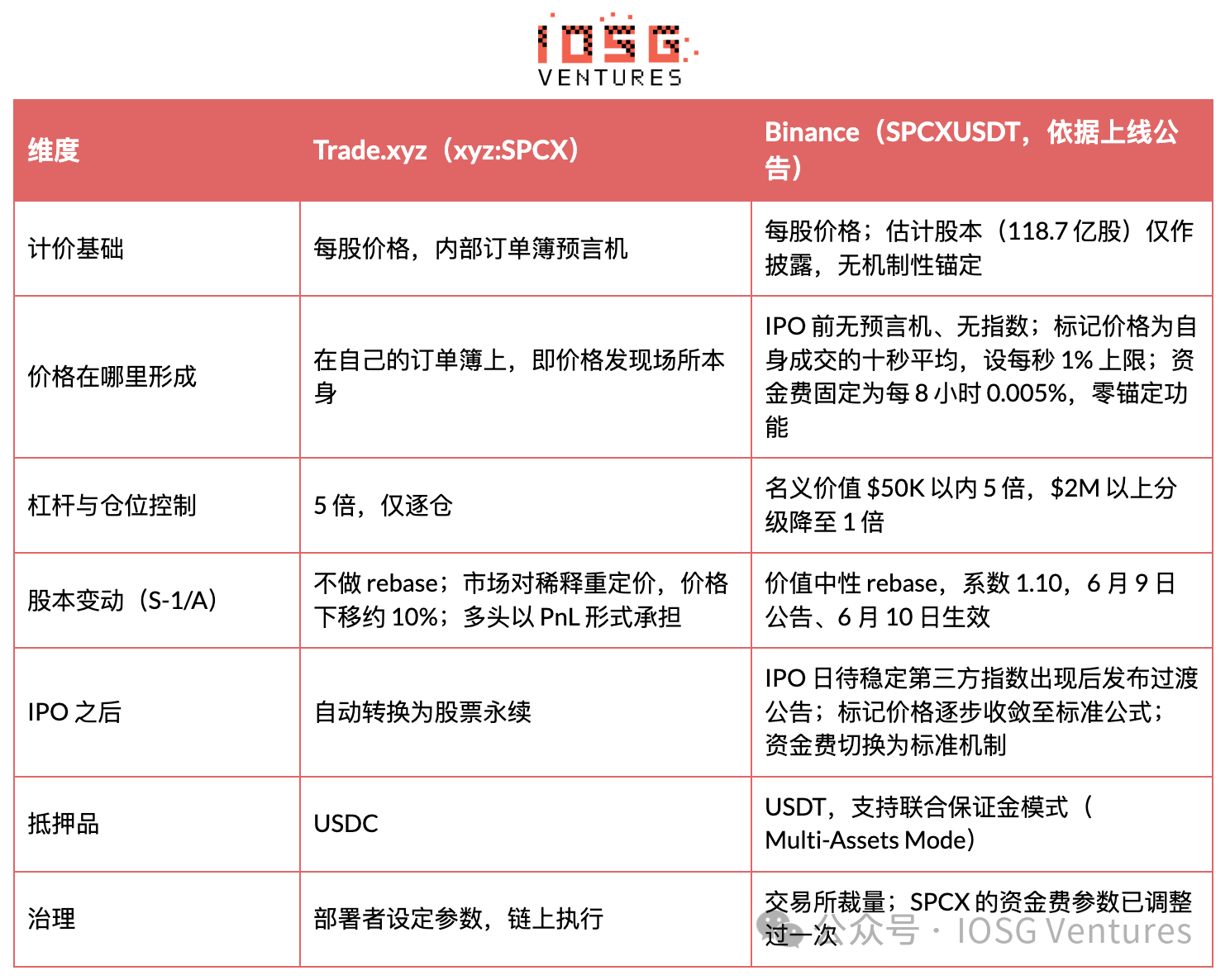
IPO Day: Mechanism's First Live Test (June 12)
SpaceX landed on Nasdaq with the code SPCX on June 12, priced at $135, offering 5.556 billion shares to raise $75 billion, the largest IPO in history, making Musk the world's first trillionaire.
The stock opened at $150, surged to a high of $176.52 during the day, and closed at $161.11, up 19.3% for the day, making it the sixth largest publicly traded company in the US by the close.
For the places focused on in this report, the moment of going public is the moment all mechanisms are prepared for. Here's what actually happened.
Price Steps: Eight Prices, 37% Range
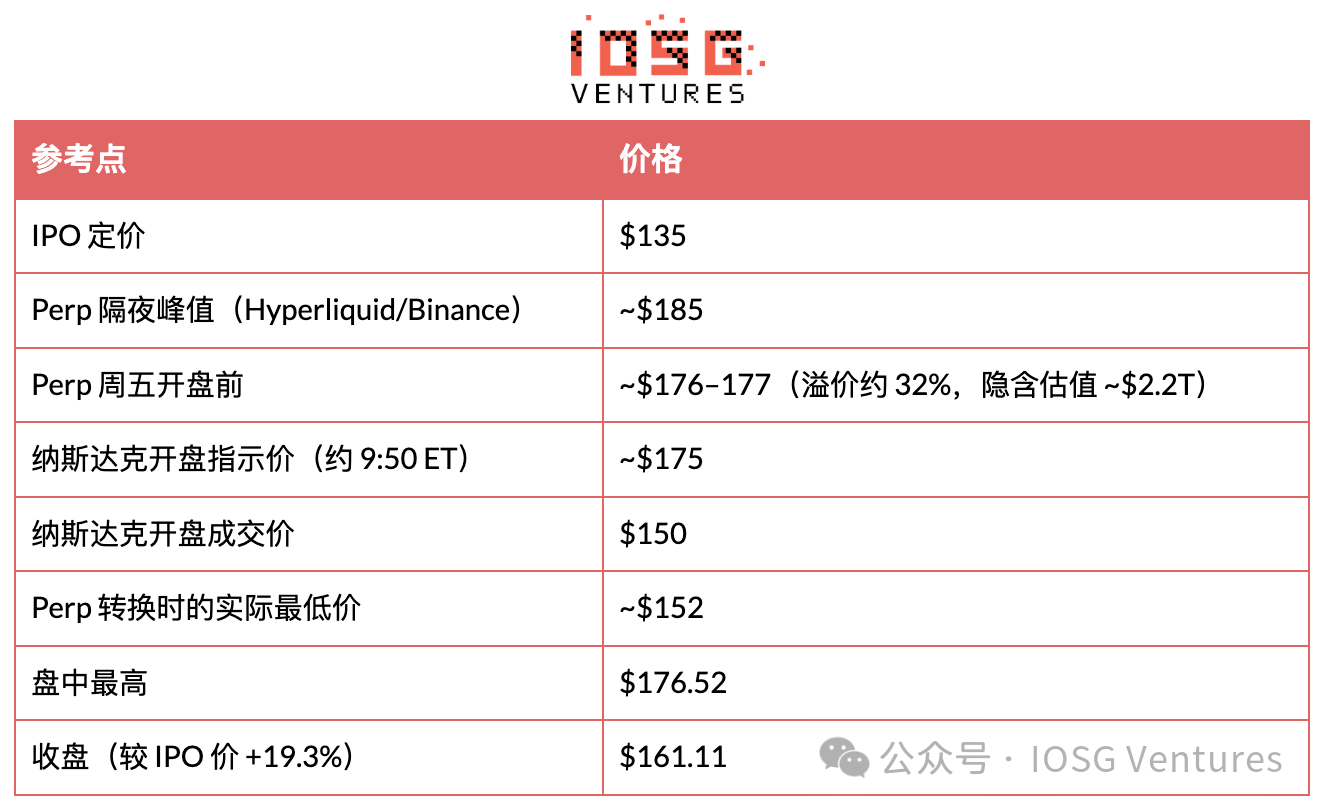
The most important point in this table: eight reference points span a range of 37%, from the $135 IPO price all the way to the peak of $185 in perp; the only cluster within 20% is the one after listing ($150–176.52). Whichever one you call the "answer" determines whether the perp's performance this time is considered a success.
Oracle Switch Successful, and the Window We Marked Indeed Existed
The conversion itself was clean. The SPCX perp on trade.xyz switched at the opening from the internal order book pricing to Nasdaq real-time data source, converting the Pre-IPO contracts to standard stock perpetuals, with no closing or reopening, ensuring a seamless continuation of positions; Coinbase International's USDC-settled SPCX perp also completed the switch in the same manner.
There was no replay of the Ventuals May 28th incident, with no oracle glitch during the transition process and no reports of a large-scale liquidation waterfall. At the most leverage-sensitive moment in this product's life, surviving without a structural failure was a significant outcome, making the day a standout one for the entire asset class: the convert-and-continue process was successful.
However, the gap we marked before the IPO, known as the "listed but not yet priced" window, did exist, and it was quite lengthy.
The opening bell at 9:30 AM ET was merely ceremonial, with SpaceX not yet trading. Nasdaq's opening auction was manually adjusted by underwriters due to the 5.556 billion shares being the largest match pool in IPO history, causing significant delays. Nasdaq President Tal Cohen mentioned the need to "wait a few more hours" for an orderly opening, and there were no trades executed until 10:38 AM ET. The first trade wasn't executed until around 11:30 AM ET to noon, causing a delay of about two hours (similar to the 2012 Meta IPO).
Throughout this window, Nasdaq continuously broadcasted an indicative match price every second, but no shares were able to trade. For approximately two hours, SpaceX was a listed company without a tradable price, and according to trade.xyz's own documentation (as clarified on June 10th), it was never specified how perp would be priced during this transition window. This incident had no issues this time because the opening auction process was not opaque.
Nasdaq continuously broadcasted an updated indicative price every second during the auction, and this indicative price (~$175) consistently matched perp's reference price (~$176) throughout the period. However, there was a nuance: perp's oracle wasn't even reading this indicative price.
Its external data feed (Pyth) only recognizes executed prices, and since there were no trades at that point, perp remained on the internal order book until the moment of the first trade ($150). The alignment between the two was merely a coincidence and not an interlocking mechanism, which was precisely why nothing went wrong during this undefined window.
However, in the event of a disorderly opening, such as trading halts, significant deviations in the indicative price, or auction delays, the impact would fall within the same unrecorded window, which has yet to be addressed in the documentation.
Can the auction price be tracked? How much did perp deviate?
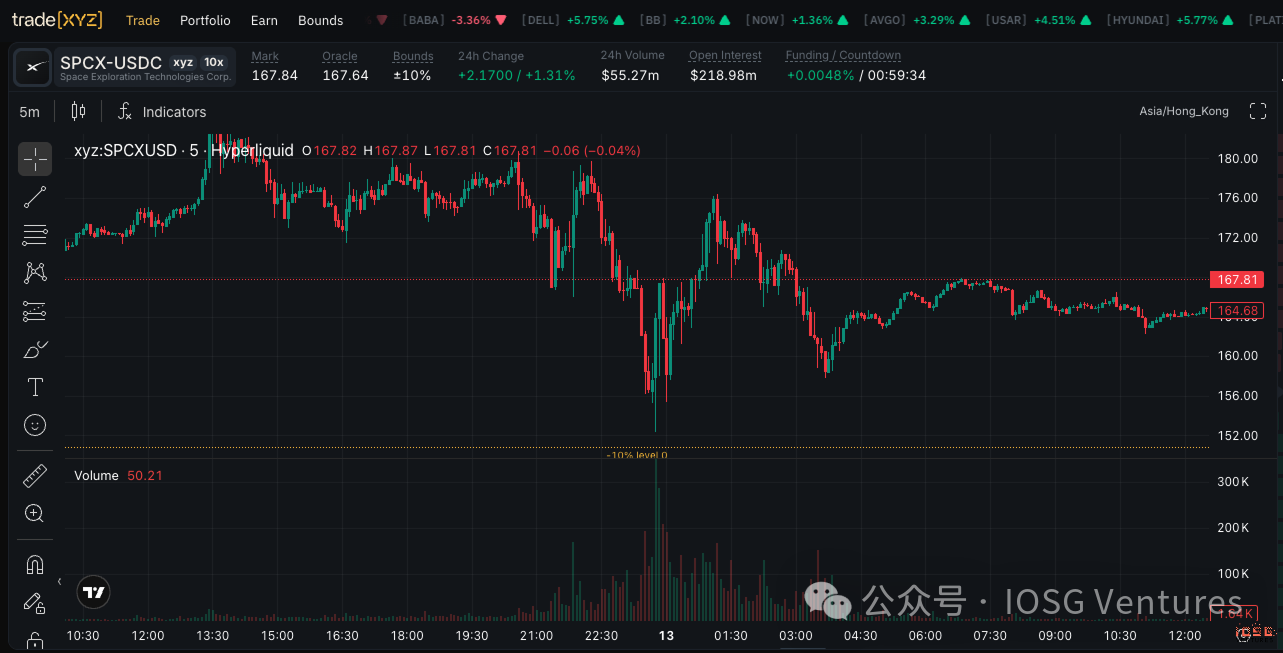
Yes, the auction price can be tracked in real-time because Nasdaq continuously discloses the indicative opening price during the matching process.
A more challenging question, and indeed a key one for the entire report: after weeks of on-chain price discovery, how close are we to the true price? The honest answer entirely depends on which spot price you compare it to, and this difference is the conclusion in itself.
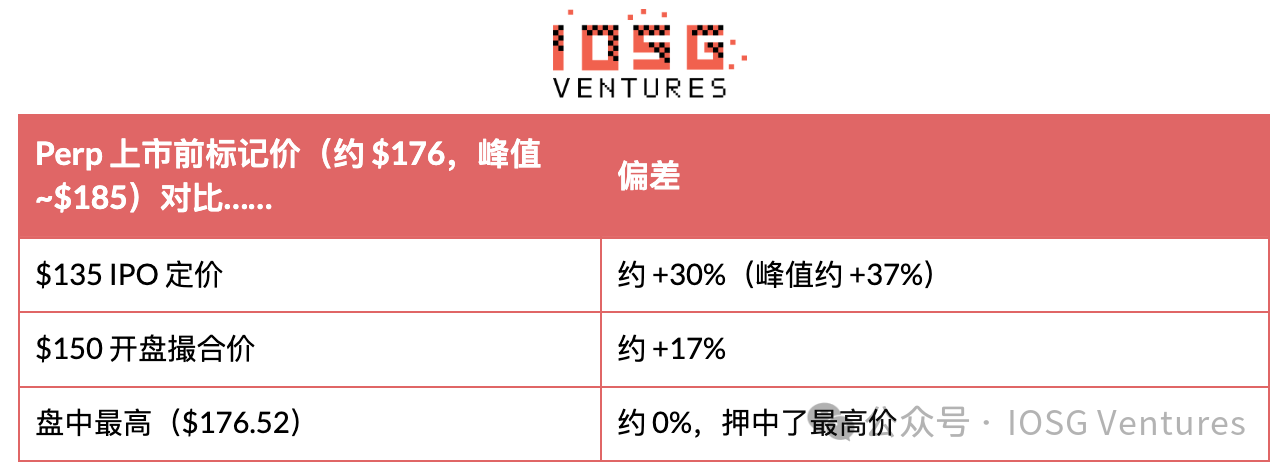
Compared to the truly significant price, namely SpaceX's actual listing price, perp is on the expensive side. It is about 30% higher than the $135 IPO price and about 17% higher than the $150 opening auction price, and it stayed that way for several weeks, not just minutes.
What it actually hit was the intraday high: $176.52, almost its own pre-market mark price. So the fair assessment is precisely the opposite of the Cerebras case: perp hit the highest price but missed the opening price, it read where SpaceX intended to go but couldn't read where the record-breaking new stock supply would settle.
Two points need to be clarified to avoid misattributing credit: the so-called "stick to spot within 1%" only applies after the market opens and half of it is mechanical: the ±10% boundary blocked the conversion crash at around $152, which the naked eye thought was the predicted correct spot but was actually where the boundary was at work.
Furthermore, sticking to the spot after having real-time price is not a skill at all; any perpetual can do that, and that is never what this market is meant to prove.
What needs to be proven is that prediction, and that prediction was about 17–30% too high.
Two Things Loaded Today
Ventuals's SPACEX contract has tested for the first time its "settle-and-halt." With SpaceX's IPO, the contract settled at an implied first-day closing price of $161.11, funding rates reset to zero, all positions were forcibly closed, and this was the first real test of the end-game design described in Section 5.1: a market that dies on the listing day instead of surviving through the listing.
And the stock-split risk marked in Section 6.3 has now shifted from assumption to loaded. trade.xyz's SPCX is now a stock perpetual that hangs a real-time external oracle, with no announced rebase mechanism for corporate actions. The IPO was the safe event; the post-conversion first stock split, special dividend, or spin-off is the one that has no mechanism backing it up. SpaceX itself did a 5-to-1 split in May, which was what took down Ventuals's oracle, so whether the high-priced stock will split again, the precedent is set by SpaceX itself.
What to Watch Now
Three things have become measurable starting today.
First, funding rates finally have significance. With new stock shorting scarce and expensive, perp has become the only cheap tool for shorting; while retail investors who missed out on allocations and can only FOMO into long positions can only enter perp. The net direction of these two forces will be reflected in the funding rates over the next 30 days post-switch.
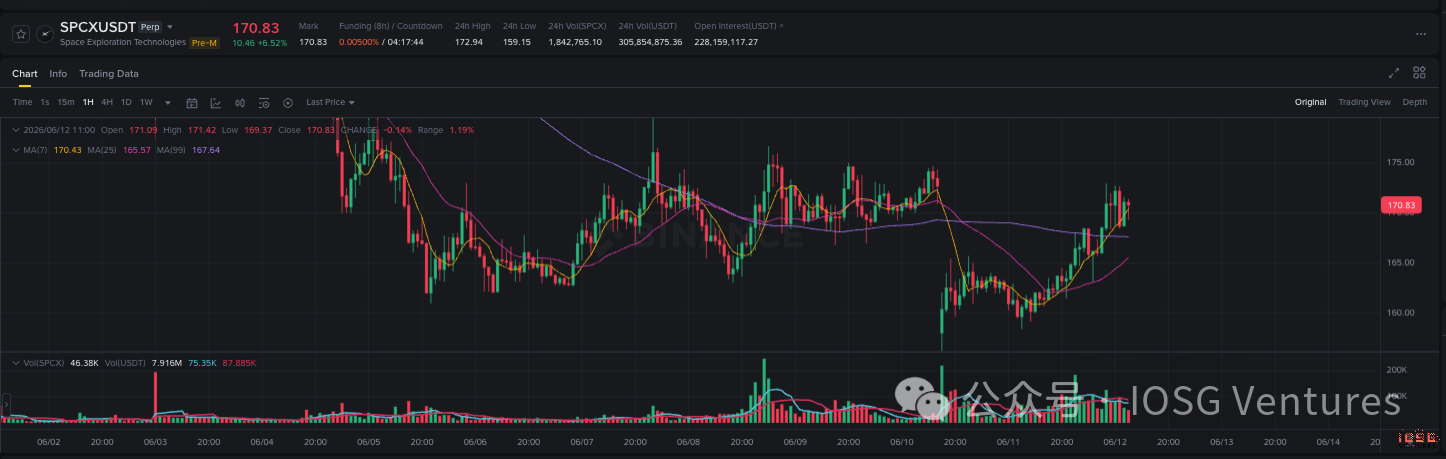
The data for the first three days is already out: perp has converged back to spot, but on its listing day it closed at around $172, representing a 7% premium over the Nasdaq closing price of $161; the post-switch funding rate has consistently been slightly positive, around +0.005% every 8 hours (annualizing to around 5–6%), with longs still paying a small holding fee. This predicted "structural basis risk" scenario has not yet occurred in the first three days. It is worth being made into a permanent internal tracking metric.
Second, corporate action is the unresolved investment question in this space. Whoever can present a credible on-chain rebase convention, coupled with an admin-facing redundant oracle, fills the final gap and is precisely the specific direction worth betting on (as these tools proliferate, perp-spot joint margin will also matter).
Third, the after-hours story truly begins now. SpaceX's big news, whether it be a launch or an accident, broke over the weekend, and on the first weekend when the Starship incident triggered the only real-time price on Hyperliquid globally, that served as both the best event study for this space and its best dissemination moment.
Conclusion: Price Discovered, Market Not Yet Fully Built
First, what this interlude proves. Price discovery can still occur without a spot market.
A meticulously crafted oracle, operating solely on its own order book and a price band perpetual, kept Cerebras within 1.3% of the Nasdaq opening price, causing SPCX to slide from a speculative $216 at listing nearing IPO pricing of $135, and did the same for oil over the weekend at a venue that went completely dark. The direction of the information flow has silently shifted.
Now, onto the more challenging half of the scoreboard. These venues handle price extremely well, but events are still very primitive. Market prices can elegantly digest continuous information, but corporate actions are not continuous information; they are unitary administrative changes that the on-chain tech stack simply has not been equipped to handle.
Trade.xyz has no rebase mechanism, so if a true stock split were to occur post-switch, it would plummet with a full oracle gap down, funding rates can't correct it, and during that discovery border, it might not even be awake, let alone able to stop it.
Ventuals did create this organ, but outsourced it to a separate data provider. On May 28, an expired split adjustment caused its flagship market to flash crash by 45%, liquidating all holders who had everything right except for the pipeline.
Even Binance, with its rebase mechanism in hand, took ten days to execute, allowing the same company to display two prices on two screens. Each operational failure in this report points to the same root cause: it's not that price discovery isn't working, but rather the lack of that mundane corporate action layer.
The traditional markets spent a century standardizing it, yet no one thought it was interesting enough to be worth rebuilding first.
This is also a fair way to score the venue competition. Trade.xyz won not because its oracle was smarter. It won because its funding rate design made this trade almost costless to hold, it won by stepping on the catalyst instead of sprinting to launch, and it won by plugging into a cross-venue arbitrage network with the pricing unit.
And the same set of design choices that made it win is also what exposed it: free holding means an unanchored price, no rebase means no solution to the split, "convert and continue" means inheriting a listed company's entire corporate action calendar without any processing mechanism.
Ventuals made the exact opposite trade-offs, with anchoring, taxation, endgame equals death, losing the volume war but being structurally immune to the kind of fault still unpriced and lying in opponent designs today.
Ultimately, this warning is structural: these things are fundamentally price trackers lacking an "event processing layer," and it is precisely this layer that makes a tracker worth holding securely.
The true stress test of this asset class is not the IPO itself, but the first post-conversion split, special dividend, or spin-off. So the opportunity is quite specific: whoever can present on-chain a trusted, publicly disclosed corporate action mechanism, a set rebase convention, and an administration-facing redundant oracle, will fill in this final gap between these markets and the markets they seek to replace. The price has been discovered, yet the market surrounding that price is still being built.
Welcome to join the official BlockBeats community:
Telegram Subscription Group: https://t.me/theblockbeats
Telegram Discussion Group: https://t.me/BlockBeats_App
Official Twitter Account: https://twitter.com/BlockBeatsAsia
