On June 17th, Polymarket celebrated its sixth anniversary.
In the crypto world, six years is already quite a long time. Sufficient for a narrative to go from bubble to bust, and enough for a product to transition from a fringe experiment to mainstream infrastructure. Six years ago, Polymarket was just a prediction market pieced together by a young founder in a bathroom during the New York lockdown. Six years later, it has made its way onto the balance sheets of Google, WSJ, sports leagues, the CFTC regulatory framework, and ICE, the parent company of the New York Stock Exchange, becoming the world's most watched "information market."
Looking at Polymarket today, it appears to be a typical success story: exploding trade volume, soaring valuation, the founder joining the ranks of the youngest self-made billionaires, and the prediction market moving from the crypto niche into mainstream media and sports broadcasting. However, if we look back along the timeline, this story has not been smooth sailing. It is not a straightforward product history of growth but rather an adventure of being constantly pushed out, yet continually trying to come back in through the front door.
Polymarket's original proposition was simple: when the world is full of uncertainty, can prices get closer to the truth faster than the media, experts, and polls? From COVID, the U.S. election, the Titan submarine, Biden's withdrawal, the Trump Whale, FBI raids, CFTC approvals, to ICE investments, over the course of these six years, it has time and time again turned real-world events into markets, only to be bitten back by the rules of the real world.
Therefore, the significance of Polymarket's sixth anniversary lies in witnessing how a crypto product born in a bathroom has arrived at the intersection of finance, media, sports, and regulation. This article by BlockBeats aims to tell the story of these six years of Polymarket: how it survived, how it was pushed out of the U.S., and how it managed to buy a ticket back home.
The Gambler in the Bathroom
In October 2013, an email landed in the inbox of the U.S. Securities and Exchange Commission.
The sender was Shayne Coplan, a 14-year-old high school student still studying in Manhattan. According to the version he later shared, this email came from a teenager who had read "Flash Boys" and was fascinated by electronic trading networks. The body of the email was very short, but there was a unique blend in its tone: half naive, half confident.
He first introduced himself, stating that he was a sophomore in a Manhattan high school working on an ECN-based stock exchange. His immediate concern was to verify that this idea was "completely legal" and could comply with SEC regulatory requirements.

On December 2, 2024, Coplan posted this old email on X, with a caption that only said, "What people call an 'overnight success' takes a decade." Looking back after more than a decade, this email seemed like an overly neat foreshadowing. At that time, Coplan certainly did not know that what he would eventually create would not be a traditional stock exchange, but a prediction market where the world would bet on the future's price. He also wouldn't know that this market would later be forced out of the United States due to regulatory issues, only to attempt to make a comeback through the front door a few years later.
Polymarket's Prehistoric Story
Coplan grew up in Manhattan, raised by his mother, with his father being an NYU film professor. He attended a public school in Hell's Kitchen, not an elite prep school for Wall Street heirs. The impression he later gave was also not typical of someone trained in the traditional financial system. He was more like a child who had grown up from internet culture, cryptocurrency, entrepreneurial biographies, and New York City streets.

During those years, he began to engage with cryptocurrency. According to reports, the entrance even had a bit of the serendipity of the early internet: while downloading pirated music, he stumbled upon crypto, and then began to research, even attempting to assemble mining rigs himself. For many people of his age, the internet was about games, music, and social platforms; for Coplan, it was more like a staircase that led straight to the basement. Down this staircase, he saw a new financial world without teachers, tickets, or age limits.
In 2014, the Ethereum presale began. Coplan bought ETH for around $0.30 per coin. This early investment later became his startup seed funding.
During the same period, he went to the lyrics website Genius and pitched himself. After sending many emails without a response, he showed up unannounced at the office. NYMag later described Coplan at the time with messy curly hair, possessing an almost encyclopedic knowledge of tech billionaire entrepreneurs. Genius eventually offered him an internship.
This experience is crucial to Polymarket's story because it illustrates that Coplan's early research was not in finance, but in “how people turn an internet idea into reality.” He annotated pages on Genius for individuals like Zuckerberg and Travis Kalanick, essentially sketching a blueprint for his own future. A young man repeatedly reading these people's stories, dissecting them, was essentially learning a path: how a fringe idea enters the mainstream world.
Later, he enrolled at NYU to study computer science, but dropped out after only one semester to focus full-time on crypto entrepreneurship. From 2018 to 2019, he acquired the domain union.market and worked on a product called Union Market, focusing on yield-generating digital assets. This project never really took off.
However, failure did not deter him from the concept of “markets.” During that time, he came across economist Robin Hanson's paper on futarchy. The core idea of futarchy was quite radical: if markets can aggregate information, could prediction markets help society make decisions? In other words, could prices not only reflect asset value but also the probability of future events?
Coplan wrote to Hanson, expressing his desire to create a prediction market. Hanson didn't take it too seriously. The reason was not complex: prediction markets were not a new concept. There had been too many attempts over the decades, with many more failures than successes. This field always sounded correct but has always struggled to truly enter mainstream life.
By the end of 2019, Coplan was once completely disillusioned with crypto. At 21, two and a half years out of school, without achieving anything significant, and running out of money. Looking back at the birth of Polymarket, people easily tell it as a story of a “genius founder seizing an opportunity.” However, in the actual timeline, it was more like a person at a low point continuing to seek a way out within an old idea.
What truly changed everything was 2020.
COVID-19 Breaks the Mold
In March 2020, New York became the epicenter of the COVID-19 pandemic in the United States.
Times Square emptied, Broadway closed, restaurants inverted chairs onto tables, and subway cars were left with only a few masked individuals. The sound of ambulances became the city’s background noise. Every morning, the first thing people did upon waking up was not checking the weather but rather the new cases, hospitalizations, deaths, governor's briefings, and new lockdown regulations.
For the vast majority of New Yorkers, the lockdown meant fear, stagnation, and endless waiting. Some lost their jobs, some left the city, and some were trapped in small apartments constantly refreshing the news.
Everyone was asking the same types of questions: When will the lockdown be lifted? Will the cases continue to rise? When will the vaccine arrive? Will the presidential election be reshaped by the pandemic? But the answers provided by traditional information channels were not stable. Experts, media, government, social platforms—every voice seemed certain, and yet every certainty was quickly overturned by a new reality.
This is exactly the environment that prediction markets thrive in. Not because people suddenly enjoy gambling, but because life presents too many unavoidable and unpredictable realities. The pandemic has turned the "future" from an abstract concept into something everyone must confront every day. Everyone is making predictions; it's just that most predictions don't have a price.
Coplan saw this opportunity.
He developed a product in the bathroom of his Lower East Side apartment in New York. Later, he would jokingly refer to it as his "makeshift bathroom office."
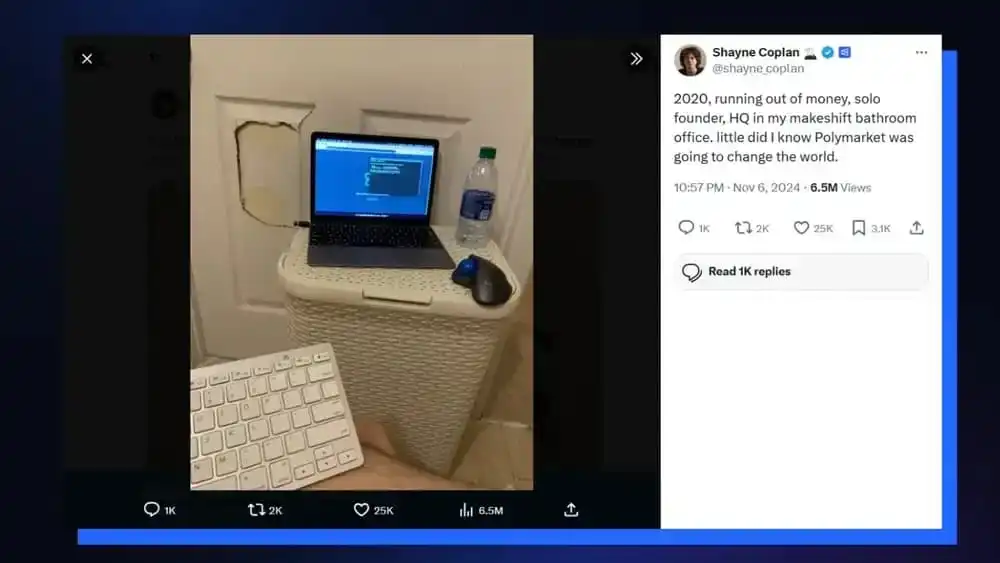
An almost resourceless young man, in the midst of the world's chaos, trying to create a market that would price chaos. The pandemic turned everyone into forecasters, and what Coplan wanted to do was to take those judgments scattered across chat groups, news comment sections, expert interviews, and traders' desks, and condense them into a tradable price.
He had no co-founder, was running out of money, needed to inventory the items in his apartment to figure out what could be sold to pay rent. The product's name was also evolving: Union.market, Union Marketplace, before finally becoming Polymarket. This name later sounded natural, but in the beginning, it was just a new entrance that emerged from the ruins of an old project.

In June 2020, Polymarket officially launched. Technically, it settled using Polygon and USDC, offering lower fees, faster speeds, and a user experience more akin to a regular internet product compared to early Ethereum mainnet prediction markets like Augur.
The early market was straightforward: ETH price, U.S. COVID-19 cases, 2020 election. These markets seemed disparate but actually pointed to the same question: When the world is shrouded in uncertainty, are people willing to put their money where their mouth is about the future?
Four months later, the answer began to emerge.
In October 2020, the U.S. presidential election entered its final stretch. The pandemic was not over, and mail-in voting became a new battleground, the aftermath of racial protests still reverberated in the streets and on TV debates, and the shadow of an economic recession loomed over household bills and market expectations. Trump tried to prove he could lead the U.S. out of the crisis, while Biden framed the election as an opportunity for "building back better."
That fall, every part of American society was being pulled by politics. TV stations aired daily poll results, hosts speculated in front of red and blue maps; social media was filled with conspiracy theories, camp mobilization, and arguments about mail-in voting; Wall Street tried to assess the direction of taxation, regulation, and fiscal policy; ordinary people sought some certainty between the pandemic and the election. Everyone was asking: Does Trump still have a chance? Is Biden's lead secure? If the vote count is delayed, will the market crash first?
When Polymarket launched, it was still a niche crypto tool, but the election gave it its first true public test. In October, Polymarket completed a $4 million seed round, led by Polychain Capital, with participation from Naval Ravikant, Nick Tomaino of 1confirmation, and others.
For a product that had just emerged from the bathroom, this money was not just funding, but more like a signal: At least a group of crypto investors believed that the prediction market might become useful again.
In November, the showdown between Biden and Trump reached its climax. Polymarket's market prices consistently pointed to a Biden victory in the weeks leading up to the election. The "Will Trump win?" market had a trading volume of over $8 million. Looking back today, $8 million is not a large amount compared to the billions during the 2024 election. But at the time, it was enough to prove one thing: Some were willing to trade their political judgments on a blockchain-based market.
This $8 million is not the end of a business success but the beginning of a product proposition. It proved that Polymarket was not just a temporary toy during the pandemic or merely an entertainment experiment in the crypto community. It provided the first visible sample of the question, "Can market prices be a real-time signal of public events?"
Of course, Polymarket in 2020 was still quite small. It was more like a tool within the crypto community rather than a reference source for mainstream political media. Coplan also managed social accounts himself, DMing investors one by one, hoping they would help retweet and like. Vitalik Buterin also tried out Polymarket during the same period, praising its user experience as non-crypto user-friendly on Twitter. This endorsement was significant because one of the biggest past failures of prediction markets was that the concept was attractive, but the product was too difficult to use.
Regulatory Hammer
In 2021, Polymarket evolved from a personal project into a company with over ten employees. Users grew from thousands to tens of thousands of Monthly Active Users. A more comprehensive team started to revolve around it: some focused on the product, some on the market, some on the community, and some on handling the ongoing settlement disputes. It was no longer just a page put together by Coplan alone in the bathroom but a real marketplace producing prices, settling disputes, and generating news material.
The internal team culture was quite "rebel/maverick," carrying the typical essence of a crypto startup: build things first, get the market running, and then deal with the rules and boundaries.
It was the 2021 crypto bull market, where almost everyone believed speed was more critical than order. DeFi, NFTs, DAOs, blockchain games—every day brought a new narrative, each one challenging old rules. Polymarket was also in this atmosphere.
Simultaneously, Coplan continued to accumulate social capital within the crypto culture. He heavily collected NFTs under the identity of ethsquiat, showing early support for crypto artists like FEWOCiOUS. This wasn't Polymarket's mainline product, but it was useful for understanding Coplan. After all, for this generation of entrepreneurs, identity, capital, taste, and product are often intertwined, and sometimes a wallet address can better define who you are than a business card.
However, Polymarket differed from most crypto products. NFTs could be called art, DeFi could be called a financial experiment, DAOs could be called organizational innovation. Once prediction markets began handling real-world events, they directly encountered financial regulation and regulatory boundaries. While Polymarket could claim to be an information market, what regulators saw was different: users staking money on event outcomes, resembling unregistered event contract trades.
Hence, the CFTC's inquiries began to get specific. The question was no longer "Is your product interesting?" but "Are you authorized to offer these contracts?" The more markets on Polymarket, the sharper the issue. ETH price, COVID cases, presidential elections, policy events—while these markets may be viewed as information by users, they could be seen as binary options in regulatory documents.
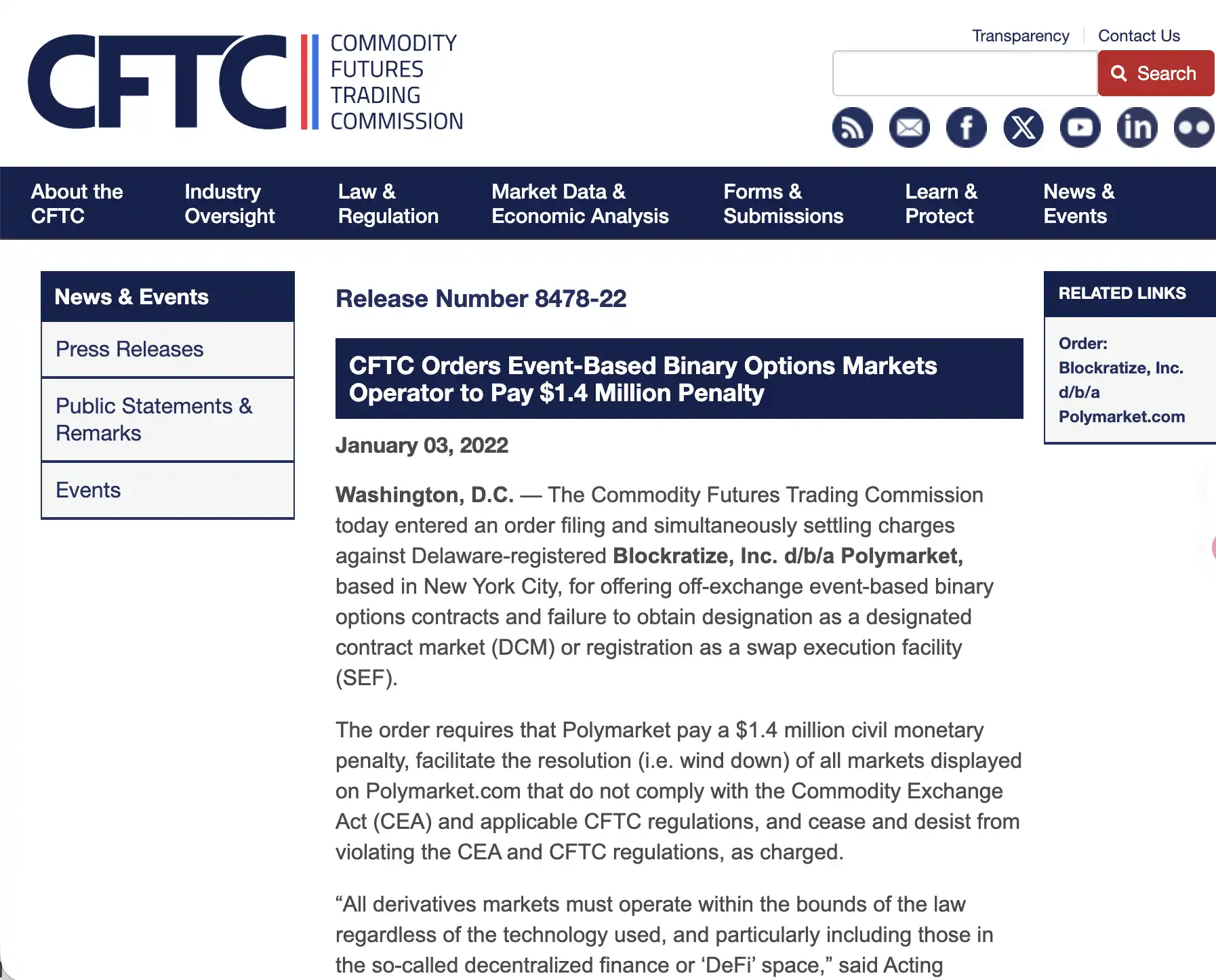
On January 3, 2022, the CFTC issued a cease and desist order against Polymarket, alleging that Polymarket was operating unregistered event-based binary options markets, which are off-exchange binary options contracts not offered on a designated contract market. The penalties include a $1.4 million civil monetary fine, a requirement to wind down the non-compliant markets, and a cease and desist order. The CFTC also mentioned that Polymarket received a reduced penalty due to substantial cooperation. At the time, Polymarket had already offered over 900 event markets.
Following the penalty, Polymarket started geoblocking U.S. users.
As a platform that was still based in New York, still run by American founders, and still serving global political and financial events, Polymarket was forced to shift its core operations outside the U.S., although many of the events discussed on the platform still revolved around the U.S.
Exile and Resurgence
After being penalized by the CFTC, Polymarket entered a peculiar state. It did not die, but it was no longer intact. It continued to operate, serving international users and launching various markets, but it lost its most crucial and symbolic domestic market.
For a New York company, this state of affairs was awkward. It was not a complete failure because the product was still alive; nor was it a resounding success because U.S. users were locked out. It was more like an exile: the company's people were in the U.S., but the product had to pretend the U.S. didn't exist.
In May 2022, former CFTC Chairman J. Christopher Giancarlo joined Polymarket's advisory board and became chairman. Giancarlo is known in the crypto community as "CryptoDad," and his appointment carried significant symbolism: post-regulatory crackdown, Polymarket began a narrative of compliance.
However, a compliance narrative couldn't immediately alter the situation. An advisory board is not a license, and the name of a former regulator does not automatically open the U.S. market. From 2022 to 2023, Polymarket faced a downturn. It operated purely overseas, and its scale shrank. By the end of 2023, the total accumulated trading volume was approximately $73 million. While this figure was respectable at the time, it almost felt like a different era compared to the resurgence during the 2024 election cycle.
The hardest to write and the easiest to overlook, the trough is a time with no photo worthy of reposting, no tweet that can become a headline, and no regulatory raid to dramatize. Yet for a startup, the fate is often sealed during this period: no applause, not enough growth, the external narrative cools off, and the team must still daily improve the product, address the market, explain settlements, and maintain liquidity.
Coplan did not give up. The team continued to iterate on the product, enhance the mobile experience, make the page lighter, the ordering process smoother, and reduce the likelihood of scaring away non-crypto users with terms like wallet, gas fees, and on-chain confirmations. The concept of prediction markets may be grand, but users often leave due to a very small reason: slow loading, unclear settlement, vague market issues, or a non-user-friendly mobile interface. From 2022 to 2023, Polymarket survived in these small details.
It is also waiting for the next public event to bring people back to prediction markets. Not all waiting has a heroic feel. Sometimes, perseverance is simply about maintaining an edge product until the next news cycle arrives, even when no one believes you will succeed.
Titan Submersible Incident
That news cycle did not arrive gracefully.
In June 2023, OceanGate's Titan submersible went missing on its way to the Titanic wreck. Global media began continuous coverage of the rescue efforts. There were rescue ships at sea, experts explaining the remaining oxygen time in news studios, and social media filled with fear, curiosity, anger, and dark humor. With each passing hour, the event felt more like an unignorable public tragedy.

Polymarket quickly launched related markets, with the question "Will the submersible be found by June 23rd" and the betting amount exceeding $2 million. The Polymarket official account even replied to musician Rico Nasty's viral tweet: "Still a 15% chance they find them by Friday."
This statement suddenly put Polymarket in the spotlight, but in an unflattering way. Critics argued that it was gambling on a human tragedy, turning death and rescue into a series of odds. Supporters, on the other hand, would say that the market did not create the tragedy but merely made explicit the judgments people were already discussing. Both sides have some merit.
Subsequently, the U.S. Coast Guard announced the discovery of wreckage, believing the submarine had experienced a catastrophic implosion. The definition of "found" in this context sparked controversy, leading to UMA oracle intervention for arbitration. This process exposed a deeper issue in the prediction market: real-world events are not as clear-cut as contract terms. A single word, a specific time, a press conference could all determine how millions of dollars are settled.
The Titan incident did not bring reputation to Polymarket but instead drew attention to it. The platform saw a record-high Google search volume at the time. It illustrated a somewhat brutal truth: any news can be commodified. Politics, disasters, wars, technology, entertainment—anything the public cares enough about, anything with uncertainty in its outcome, can become a price.
From that moment on, Polymarket was no longer just a political forecasting tool. It transformed into more of a shadow market for the news world. News provides the headlines, the market offers probabilities; media creates attention, prices absorb attention; the more chaotic, controversial, and unanswerable the event, the more suitable it is for Polymarket trading.
This path ultimately leads to the 2024 U.S. election.
Another Election Cycle
In 2024, U.S. politics once again entered a high-pressure state. Trump sought to return to the White House, Biden aimed for a second term, while issues of inflation, immigration, war, cultural conflicts, and anxiety over the democratic system itself intertwined. The screens of news channels were filled daily with red-blue maps, swing states, court cases, campaign rallies, and polling trends.
This was the perfect opportunity for Polymarket.
In May 2024, Polymarket disclosed two funding rounds totaling $70 million. The Series A raised $25 million, led by General Catalyst with participation from Airbnb co-founder Joe Gebbia. The Series B raised $45 million, led by Founders Fund, with personal investment from Vitalik Buterin, and including 1confirmation, ParaFi, Dragonfly, Kevin Hartz, among others. Including the 2020 seed round, Polymarket has raised over $70 million in total.
Founders Fund partner Joey Krug later provided a very accurate explanation: "Internally at Founders Fund we developed a habit of checking Polymarket at times of breaking news." This statement was more useful than a typical investor endorsement. It indicated that Polymarket had evolved from just a trading product to a reflexive response for some when faced with breaking news.
In the summer of 2024, FiveThirtyEight founder Nate Silver joined Polymarket as an advisor. This move further solidified Polymarket's positioning as an "information tool". It was no longer just a claim within the crypto community that it was faster than the media, but it brought one of America's most well-known polling analysis brands into its narrative.
The real turning point came after June 27.
On that day, following the conclusion of a U.S. presidential debate, Biden's performance sparked a massive upheaval within the Democratic Party and the media ecosystem. Television footage was replayed over and over, short video clips were cut into seconds-long segments and shared on social platforms, anonymous internal party messages began to leak, donors panicked, the White House tried to contain the situation, and the campaign team repeatedly emphasized that everything was normal. All this information collided within a few days.
Mainstream political discourse was still trying to maintain the narrative of "he will continue to run". Many knew there was a problem in the room, but no one was willing to be the first to state the conclusion. However, the prices on Polymarket did not bear this kind of dignified burden. The market did not need to wait for a press conference or for party bigwigs to make public statements; it only required traders to continuously adjust their judgments with funds. Thus, while the media and political system were still searching for the right words, Polymarket had already swiftly reflected another possibility: Biden might withdraw from the race.
This was the moment Polymarket transitioned from passive exile to active counterattack. It was no longer just following the news but was providing an early market signal before the news system had reached a consensus. For Coplan, this was more important than mere trading volume growth. Because it proved the story Polymarket wanted to tell: prediction markets are not a casino but a faster information aggregation mechanism.
From July to October of that year, Polymarket became a staple reference source in mainstream political news. It successfully predicted Biden's withdrawal in advance and also forecasted Trump's selection of JD Vance as his running mate early. More and more journalists, investors, and political observers began to treat Polymarket as a real-time barometer of public opinion.
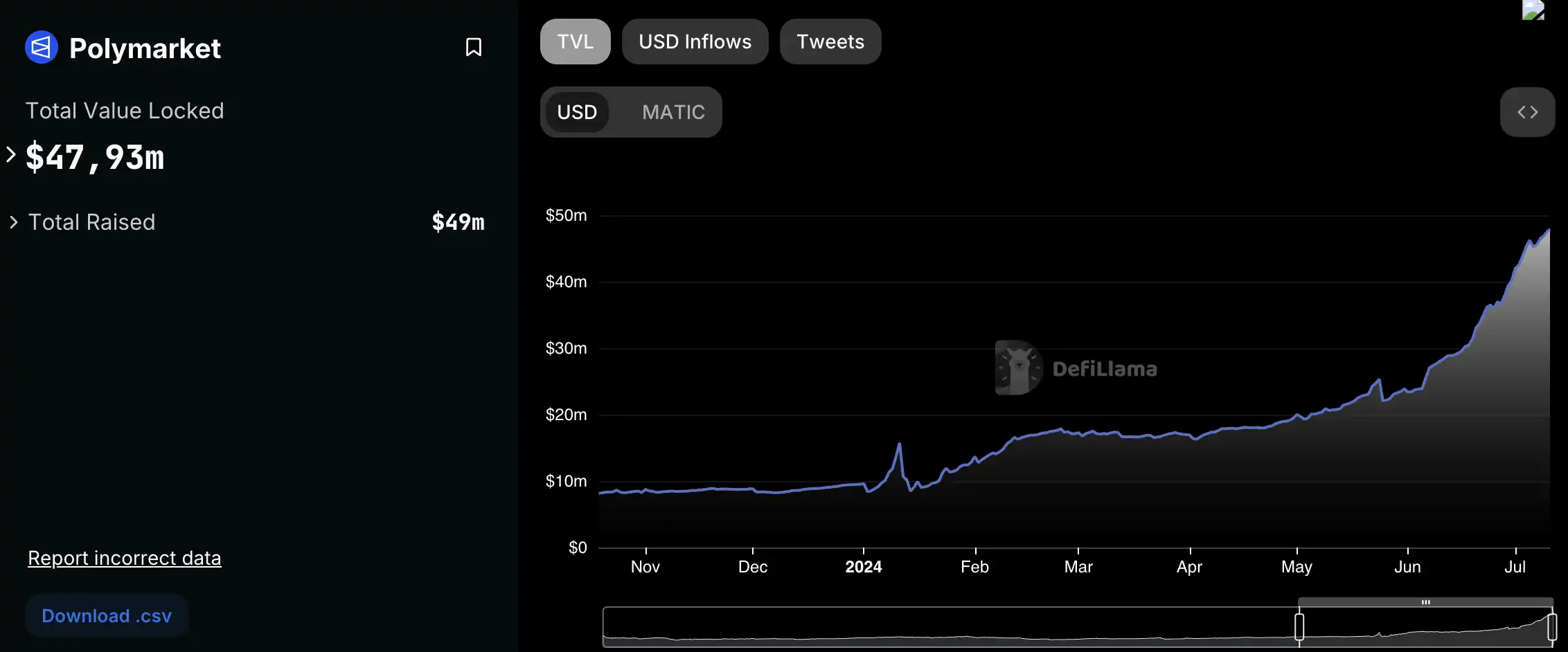
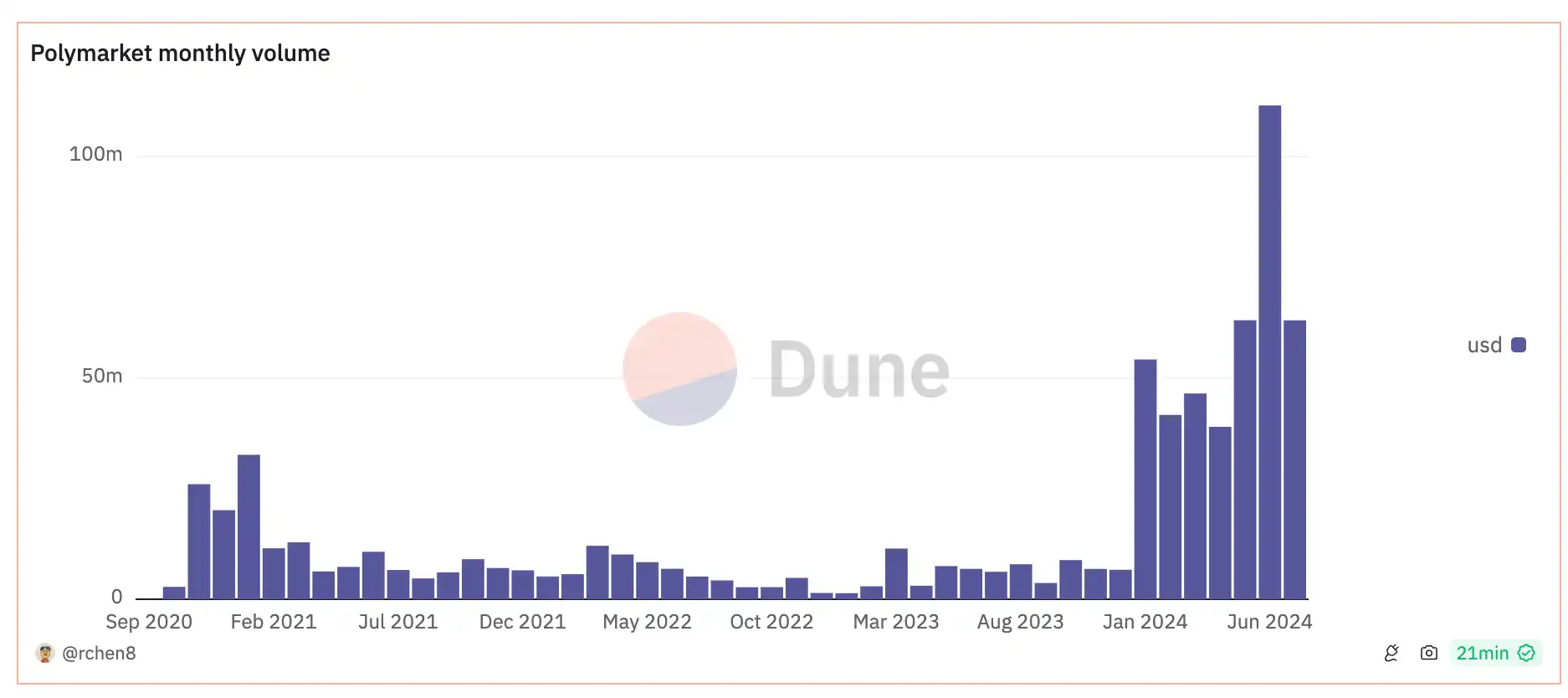
Meanwhile, the Trump Whale controversy erupted. A former French bank trader, reportedly using the alias Théo, bet over $45 million on a Trump victory through accounts such as Fredi9999, Theo4, PrincessCaro, Michie, among others. The Wall Street Journal first reported the whale's moves, sparking manipulation concerns. Following an investigation, Polymarket stated no evidence of manipulation was found.
The core of the controversy lies not only in how much one person wagered but in Polymarket finally encountering the inevitable question after its own success: If a prediction market begins to influence public narratives, is it merely reflecting information or also manufacturing it?
On November 7th, Coplan appeared on CNBC Squawk Box, marking his first-ever television interview. Subsequently, he received a call from a top executive at Mar-a-Lago. In an interview with Fortune, he said, "I've learned that anything is possible. Turning dreams into reality has never felt more tangible, and luckily I'm a dreamer. The world is shaped and changed by optimists."
This statement sounds like a victor's declaration. The issue is that Polymarket's story has never been a simple tale of victory. Every time it proves itself more useful, it also propels itself into a riskier position.
Eight days later, danger came knocking.
FBI Raids
On November 13, 2024, at 6 a.m., New York was barely awake. Coplan, who had recently been explaining prediction markets on TV screens, was jolted awake by a loud noise. According to his later recollection in a CBS 60 Minutes interview, FBI agents used a battering ram. The door was breached, agents entered the apartment, and phones and electronic devices were seized.
There were no arrests, no charges, and no public disclosure of the specific reasons for the investigation.
From the $3.6 billion in transaction volume on election night to the phone call at Mar-a-Lago, and then to the FBI's knock on the door, only eight days had passed. A 26-year-old founder had just stepped into the center of global political narrative, and the next moment, he was standing barefoot in his own home, watching federal agents take away his devices. For Coplan, this was not just a normal legal risk but a deeper uncertainty: he didn't know the specific focus of the investigation, whether he was a target or a person of interest, and whether the mainstream recognition the company had just received would immediately turn into new evidence.
Hours later, he logged into X with his new phone and posted: "new phone, who dis?"
This post has been repeatedly quoted because it almost perfectly embodies Coplan's and Polymarket's attitude: no explanation, no weakness, just a casual internet slang response to the federal government's knock on the door. It was like a joke but also an act of resistance.
Subsequently, he posted a more serious message: "It's discouraging that the current administration would seek a last-ditch effort to go after companies they deem to be associated with political opponents. Polymarket has provided value to tens of millions of people this election cycle, while causing harm to nobody."
A Polymarket spokesperson defined the incident more directly: "This is obvious political retribution by the outgoing administration." Elon Musk commented on X: "This seems messed up."
On the other hand, critics saw a different issue. Despite Polymarket committing to blocking U.S. users as part of a CFTC settlement in 2022, the platform was now handling billions of dollars in transactions during the U.S. election and deeply influencing the American political narrative. Even though the platform claims U.S. users cannot trade, regulators have reason to question: Are these geoblocks truly effective? Are U.S. users still accessing the platform through various means? Has Polymarket violated the terms of the 2022 settlement?
The FBI raid brought all the contradictions to the surface. Polymarket can be said to be an information market, can be said to have not harmed anyone, can be said to have only accelerated the emergence of truth. But in the eyes of regulators, it may still be an event contract market not allowed to operate in the United States. The more successful it becomes, the less it can continue to hide behind the "niche crypto product" shell.
Three weeks later, Coplan appeared on the stage of The New York Times DealBook Summit. The event took place at Jazz at Lincoln Center, Midtown Manhattan, a place far from bath office spaces but close to Wall Street and the media hub. In the audience were Wall Street fund managers, Silicon Valley tech executives, and political commentators. Lights, cameras, name tags, security, media seats—all belonged to the mainstream world.
For a founder who had just been raided by the FBI, had his phone confiscated, and was still under pending federal investigation, this was not an obvious choice. The safer route would be low-key, silence, letting the lawyers handle everything. Coplan chose the opposite direction. He stepped into the spotlight, continuing to discuss the future of prediction markets.
Meanwhile, the walls were getting higher. By the end of 2024, French regulators began investigating whether Polymarket had violated regulations, leading the platform to geoblock France. As we entered early 2025, countries like Singapore, Poland, Belgium, and others successively included Polymarket in their lists of illegal gambling or unauthorized platforms.
Individually, these bans may have a limited impact on trading volume. But combined with the FBI raid and DOJ/CFTC investigations, they all conveyed the same message: the gray area is narrowing. There is no dedicated position in the regulatory frameworks of various countries prepared for "prediction markets."
From late 2024 to early 2025, Coplan and the team's choice had become clear. Continuing to take detours made no sense. The real way out was not to evade regulation but to embrace it. It wasn't about waiting outside the U.S. for approval but about buying a ticket to enter the U.S.
Coming Home
Connecting with the Trump Family
In mid-July 2025, the sword hanging over Polymarket's head finally fell.
The U.S. DOJ and CFTC concluded their investigation into Polymarket, bringing no charges and instantly dispelling the legal shadows of the past three years. Many said it was because Polymarket had connected with the Trump family.
Polymarket is also beginning to have an opportunity to execute a true expansion plan.
In July 2025, Polymarket acquired QCEX for $112 million. What was acquired was not just a name, but a full suite of access within the U.S. regulatory framework: the CFTC-registered derivatives exchange QCX LLC, and its clearinghouse QC Clearing LLC. QCX would later operate under the name "Polymarket US."
This move was crucial because Polymarket did not choose to apply for a license from scratch. That route was too slow, too uncertain, and too easily bogged down in lengthy regulatory processes. It chose a more direct route: acquiring an entity that already held a license.
On August 26, Donald Trump Jr. joined Polymarket's advisory board. Concurrently, 1789 Capital, associated with Trump, invested in Polymarket. This seemed like a simple political relationship exchange, but it also seemed like a real-world echo after the 2024 election.
Polymarket accurately predicted Trump's election victory, which caught the attention of the Trump camp. By 2025, discussions on the regulatory environment, political winds, and the legalization of prediction markets began to intertwine. For supporters, this was an opportunity for an innovative product that had been wrongfully driven out to re-enter the U.S. For critics, this was a gray platform turning over with the political cycle seeking a closer position to power.
Polymarket has never lacked this kind of ambiguity. It is both like an information market and a betting platform; both like financial infrastructure and a political sentiment engine; it can be told as a victory for market freedom, or as a success story of regulatory arbitrage. Trump Jr.'s joining only brought this ambiguity to a more prominent position.
In September, the CFTC issued a no-action letter to QCX, effectively allowing Polymarket to operate event contracts in the U.S. through intermediary channels. Coplan praised the CFTC's "impressive work" and "record timing" on X.
If this sentence were placed next to the email written to the SEC in 2013, there would be a wonderful sense of bookending. A 14-year-old teenager wrote a letter that year to ask the regulatory agency if his exchange idea was legal. Twelve years later, standing behind a platform that has processed billions of dollars in transaction volume, he finally obtained a path into the U.S. regulatory system.
NYSE Parent Company's Big Bet
What truly signaled Polymarket's transformation to the world was a transaction on October 7, 2025.
Intercontinental Exchange announced a strategic investment in Polymarket, providing up to $2 billion in cash. ICE is the parent company of the New York Stock Exchange, one of the world's most important exchange groups. Polymarket was valued at $80 billion, with a post-investment valuation of around $90 billion. ICE will also become the global distributor of Polymarket event data, and the two will collaborate to promote tokenization.
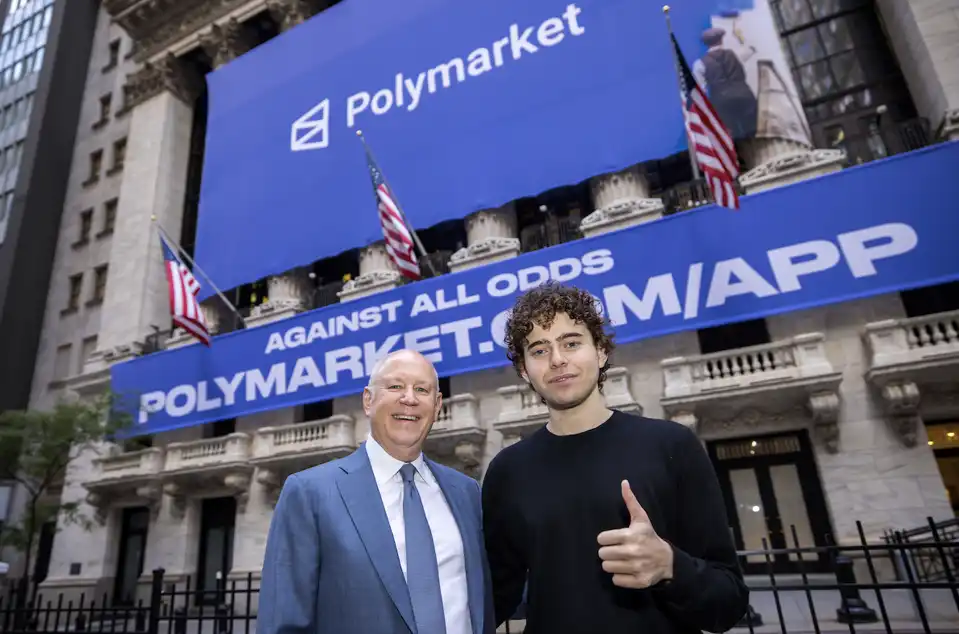
That same month, Coplan was included in the Bloomberg Billionaires Index. Forbes estimated his net worth at around $1 billion based on his approximately 11% stake. At 27, he went from a 26-year-old college dropout raided by the FBI to one of the youngest self-made billionaires in less than a year.
Later, on CBS 60 Minutes, he was asked if he ever imagined Polymarket would be worth so much. His response was quintessentially Coplan: "I mean, I didn't start it to not get here, you know?"
Not humble, not surprised, more like saying: I was meant to get here.
As the narrative of capital and regulation advanced, Polymarket began to enter the sports, media, and financial data systems. From October to November 2025, there was a flurry of partnership announcements. The NHL became the first professional sports league to partner with a prediction market platform. The UFC designated Polymarket as its exclusive official prediction market partner, with Dana White and Coplan appearing together on CNBC. Yahoo Finance positioned Polymarket as the exclusive provider of crypto prediction market data. Google Search and Google Finance started integrating Polymarket prediction data.
These partnerships may seem disparate, but they collectively illustrate one thing: Polymarket is no longer just a destination but is starting to become everyone else's data layer. Users may not necessarily open Polymarket's app every day, but they might see its odds in Google searches, its probabilities on Yahoo Finance, or its market signals on sports event broadcast pages. The prediction market has shifted from an app that requires users to actively visit to a form of data content that can be embedded in other contexts.
On November 13, the first anniversary of the FBI raid, Coplan posted on X: "Cheers to free markets, the American dream, and $3000/hr lawyers."
A year ago on the same day, he was woken up in bed, his phone was taken, and federal agents stood in his apartment. A year later, he is a billionaire, his company just secured a $2 billion strategic investment from ICE, and the path back to the U.S. is about to be officially opened.
"free markets," "American dream," "$3000/hr lawyers." The free market is the ideal Polymarket presents to the world, the American dream is the story it tells itself, and the $3000 hourly lawyer fee is the cost that ideals and stories must pay in American reality.
On November 25, the CFTC issued a revised Order of Designation, officially approving Polymarket to become a regulated Designated Contract Market through QCX. U.S. users can trade through FCMs and traditional brokerage channels. Polymarket enters the same regulatory framework as CME and ICE.
In January 2022, the CFTC fined Polymarket, stating it could not offer event contracts in that manner. In November 2025, the CFTC, through another legal entity and regulatory path, allowed Polymarket to return to the U.S. as a regulated market. The closed door was not knocked down but had its lock replaced. Coplan did not circumvent the rules; he bought the entrance in the rules and then had the regulatory agencies open the door.
In December, Polymarket US launched on a small scale, ending a nearly three-year U.S. market void since 2022. This "return home" was not romantic. No product button can erase the gray area of the past three years, nor can one approval make all controversies disappear. But it completed a very clear action: a platform expelled from the U.S. came back along the regulatory path.
On December 1, Anderson Cooper's 60 Minutes aired a long interview. Coplan sat in America's most traditional TV news format, explaining to the widest audience what Polymarket really is.
He said, "Polymarket is the most accurate thing we have as mankind right now."
He also said, "People rely on Polymarket because we provide clarity where there is confusion and accountability where there is ambiguity."
Clarity in chaos, accountability in ambiguity. For a product long stigmatized as a betting platform, this is a bold redefinition.
On December 11, Coplan was named to CoinDesk's "Most Influential 2025." By this point, Polymarket's transformation was complete: investigations concluded, licenses acquired, CFTC approval granted, ICE investment secured, mainstream media endorsements, and the reopening of the U.S. market.
If the story ended here, it would be a typical tale of victory. But Polymarket's new normal is not tranquility; it's a larger battlefield.
Polymarket's 6th Year
On January 7, 2026, the Dow Jones/WSJ data distribution agreement was finalized, integrating Polymarket's prediction data into The Wall Street Journal's content ecosystem. Less flashy than the ICE investment, this move carried substantial significance: market prices were now entering the news production process.
Where once news reported events and markets traded on events, now market prices themselves became part of the news. When journalists cover an election, a rate cut, or a sports event, Polymarket's probabilities can be cited alongside polls, odds, and futures prices. It shifted from a subject of media coverage to a tool media used to cover the world.
A few days later, this instrumentalization entered a more mainstream setting.
On January 11, the 83rd Golden Globes Awards broadcast showcased Polymarket odds for the first time. The red carpet, gowns, stars, trophies, and prediction market odds all appeared in a single frame. Polymarket correctly predicted 26 out of 28 awards.
Coplan posted on X, "The single most mainstream prediction market integration to date. A surreal moment and a highlight for all our team members' moms."
This statement is not written to regulators, not to investors, but more like a young team suddenly finding that what they have done has appeared on a TV show that parents would watch. But opposition also emerged at the same time. Critics call this "gambling meets dystopia." When everything can be predicted, traded, and put into a live broadcast, does the world become clearer, or colder?
On January 27, Polymarket became the exclusive prediction market partner of the MLS Full Match Series. Sports is starting to become a new battlefield. Compared to politics, sports results are more frequent, clearer, and easier to consume; compared to traditional gambling, prediction markets can package themselves as something closer to trading and information.
In February, Polymarket piloted a taker fee in the sports market, initially covering NCAA and Serie A. Previously, the crypto market fees had achieved a weekly revenue of about $1.08 million. The fee signifies a new stage: no longer just proving transaction volume and information value, but systematically proving the business model.
In the same month, former Fanatics CBO Ari Borod joined as Chief Business Development Officer in sports. Fanatics had sued to prevent him from leaving, later settling out of court. This small episode also illustrates the point: Polymarket entering sports is no longer just a crypto company expanding its product line; it is competing with traditional sports business, betting companies, and media rights holders for people and positions.
On February 4, Blockratize, Inc. applied for the trademarks "POLY" and "$POLY." CMO Matthew Modabber had previously stated clearly: "There will be a token, there will be an airdrop."
This brings Polymarket's storyline back to its crypto origins. On one hand, it is entering the CFTC regulatory framework, collaborating with ICE, and providing data to WSJ and Google; on the other hand, the market is still expecting it to issue a token, conduct an airdrop, and redistribute platform value to crypto users. This is another tension for Polymarket: the more it moves towards Wall Street, the more it cannot completely sever its relationship with the crypto community. Because those who believed in it early, used it early, and brought liquidity in early, are the ones willing to bet on the world on-chain.
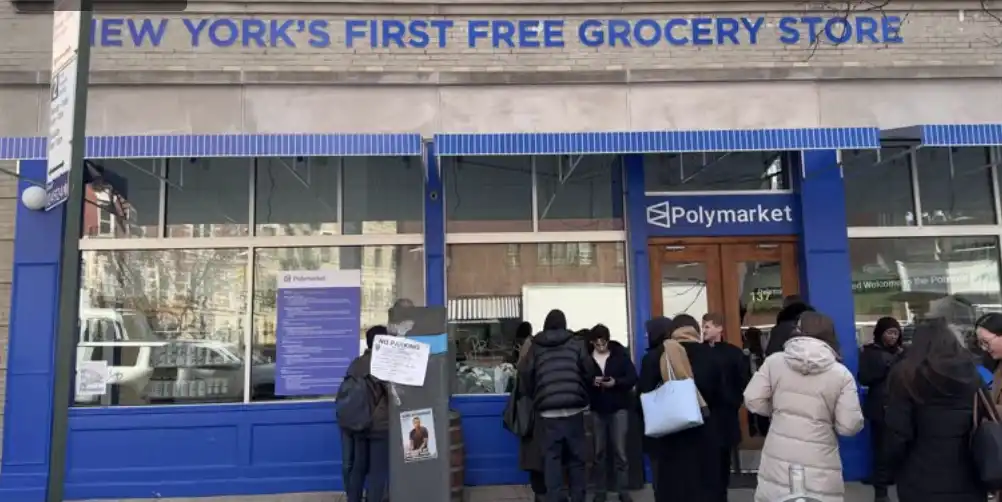
In March, ICE added $6 billion in funding, valuing the company at around $150 billion. In the same month, Polymarket entered into an exclusive multi-year predictive market partnership with MLB, reportedly worth up to $3 billion.
On March 18, Polymarket acquired DeFi infrastructure company Brahma. Founded in 2021, Brahma has processed over $1 billion in transaction volume. Within 30 days post-acquisition, Brahma's standalone products were discontinued, and the team and technology were integrated. The focus is on reducing on-chain barriers to entry: wallet creation, deposits, token swaps—friction points that have deterred mainstream users from on-chain products.
Coplan said, "Building reliable infrastructure across blockchain networks and traditional financial rails is hard—there are no shortcuts."
This statement is particularly apt for Polymarket in 2026. It is now more than just a website, more than just a frontend for prediction markets; it straddles two sets of infrastructure: one side consisting of blockchain networks and the other of traditional financial rails. One side demands openness, speed, and global liquidity, while the other demands licensing, settlements, intermediaries, and compliance. The real challenge for Polymarket is not getting users to click yes or no, but rather getting these two systems to coexist temporarily within the same product.
On March 30, Polymarket introduced a universal category trading fee using a hyperbolic fee rate model: 1.80% for Crypto, 1.00% for Finance and Politics, 0.75% for Sports, and Maker transactions are free with a 25% rebate. Market estimates project annual revenue to exceed $2 billion.
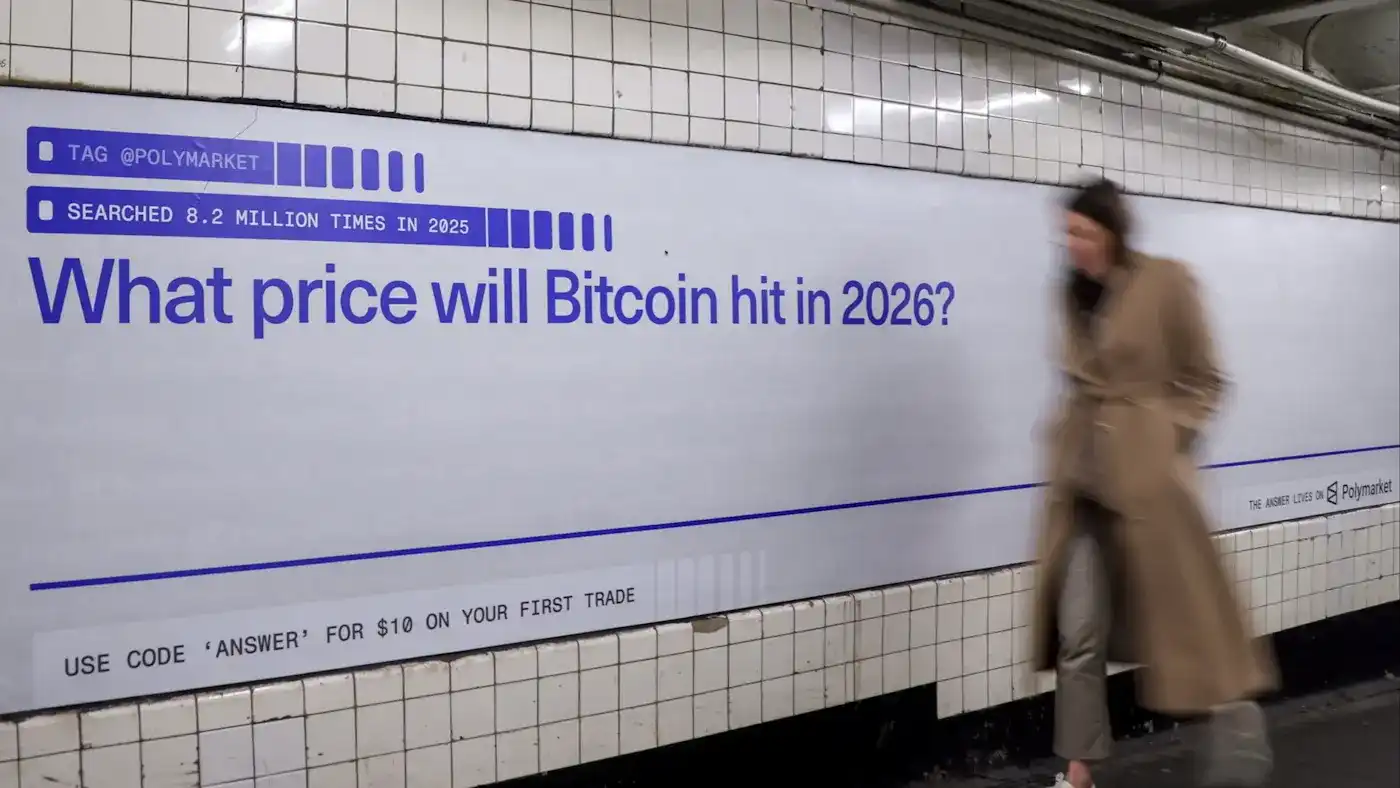
In June 2026, Polymarket celebrates its sixth anniversary.
Six years ago, it was a small product growing in a New York bathroom during the city's lockdown. Six years later, it has entered the regulatory frameworks of Google, WSJ, Sports Leagues, ICE, and CFTC, and mainstream TV broadcasts. Cumulative trading volume, valuation, partners, regulatory recognition—every metric seems to be proving that it has moved from the fringe to the center.
But the sixth anniversary is not a fairy tale ending.
The CFTC has proposed formally allowing sports event contracts while restricting markets on injuries, high school sports, and other sensitive areas. Bipartisan senators have introduced the "Prediction Markets are Gambling Act," attempting to prohibit platforms authorized by the CFTC from offering sports contracts. Wired reports that U.S. users are still heavily using Polymarket's offshore international site. The valuation is reportedly nearing $20 billion. The $POLY token and airdrop are still anticipated, with market predictions maintaining the probability of completing the TGE by 2026 at around 62% to 70%.
Coplan has completed the journey home. But the America he returned to is not the America of 2020.
The America of 2020 was still seeking answers in a pandemic and election, with Polymarket being just a newly launched tool. The America of 2026 already knows that this tool can influence narratives, attract capital, challenge polls, engage in regulation, enter sports leagues, and mainstream media. The front door is open, but the living room is filled with regulators, investors, journalists, league executives, traders, lawyers, and critics.
So "coming home" is not the end of the story, but a shift in identity. On this sixth anniversary, Polymarket has finally reached the position it most wanted to be: a world that is beginning to take information markets seriously.
But this also means that the world is finally going to start judging it seriously.
Welcome to join the official BlockBeats community:
Telegram Subscription Group: https://t.me/theblockbeats
Telegram Discussion Group: https://t.me/BlockBeats_App
Official Twitter Account: https://twitter.com/BlockBeatsAsia
