Today, the editorial team of Synced reported that Alisa Liu, a Ph.D. candidate graduating from the University of Washington, is set to join OpenAI, causing a buzz online.
The main post has already surpassed a million views, with her stating that the job search process was more challenging than she had imagined but also very rewarding.
She wrote a brief blog post sharing the experiences she had along the way, hoping to provide some guidance for the next person going through this process.
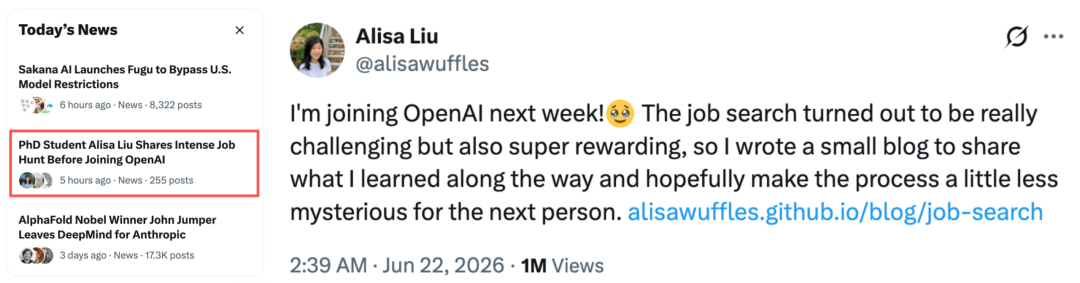
If you are currently pursuing a Ph.D. or about to embark on a job search journey, this article is worth a thorough read. Alisa Liu's research focuses on developing better algorithms for language models, including tokenization, data generation, and adaptive reasoning during inference. Upon graduation, she received Research Scientist / MTS offers from multiple top AI companies.
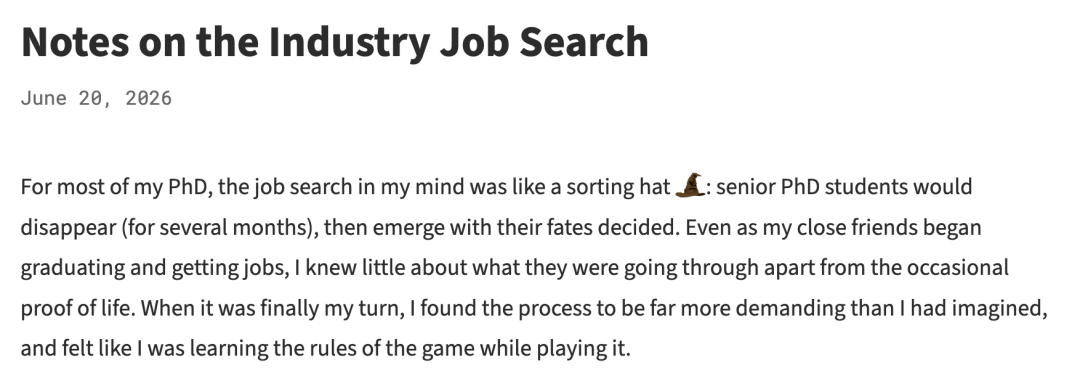
She has therefore turned the entire job search process into a retrospective, holding nothing back—including the moments that made her feel overwhelmed. At the beginning of the blog post, she writes that for most of her Ph.D., the job hunt felt like the Sorting Hat at Hogwarts: senior students disappearing for months and reappearing when destiny had already been decided. She knew where they had gone but had little idea of what had transpired in between.
It wasn't until it was her turn that she realized this process was far more brutal than she had imagined, and she had been "learning the rules while playing the game" all along. This article is her message to those who are yet to start.
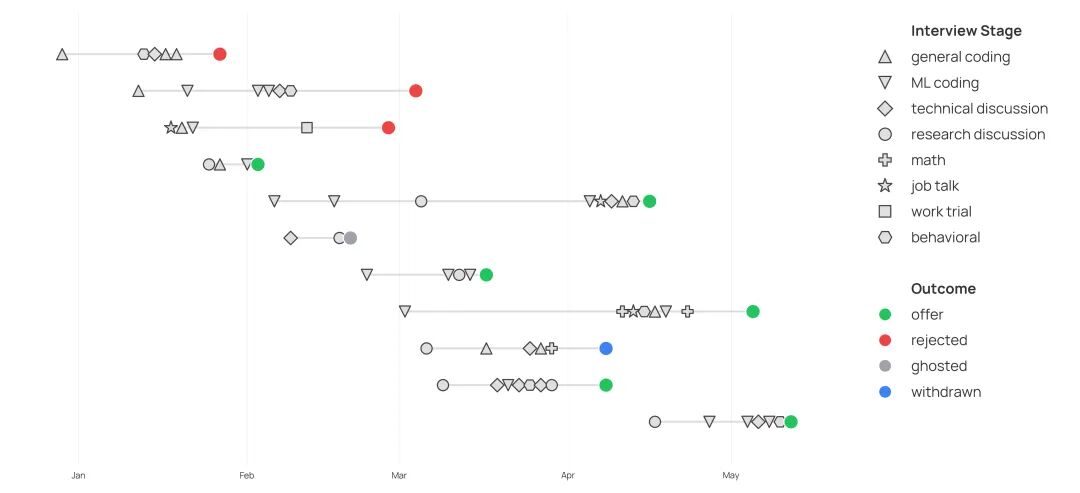
With 6 years of experience as an NLP Ph.D., she applied for roles as a Research Scientist and Member of Technical Staff. Throughout the entire job search process, she participated in the interview stages of 11 companies, completed 57 formal interviews, had 46 recruiting calls, engaged in 16 in-depth discussions post-offer acceptance, and had countless informal networking conversations.
Several companies gave her desirable offers, and she proactively withdrew from other processes; however, there were also companies from which the recruiters never responded.
Whether to "Practice" is a Complex Question
Regarding the interview order, the most widely circulated advice is: first practice with some companies that you are less interested in, then focus on advancing with the companies you truly want to join, aiming to secure multiple offers simultaneously to facilitate salary negotiations later on.
While this logic is generally correct, she found in practice that things are more complicated than that.
Firstly, energy is limited. Practice is helpful, but if the initial companies are treated as cannon fodder and one is exhausted by the time it is the turn of the desired company, one's state may have already deteriorated.
Secondly, the timing of interviews is not entirely under your control. Factors such as whether a company has recruitment quotas, which team is actively hiring, often have a greater impact than your "preparedness," and can be investigated in advance through internal connections or the recruiters.
Thirdly, the deadline for an offer is usually more flexible than you imagine. Recruiters are aware that you are pursuing multiple opportunities concurrently and generally try to accommodate. However, she also cautioned that there are indeed "explosive offers" with extremely short signing windows, so it is essential to inquire about the rules of the game in advance.
The Seven Types of Interviews, None the Same
She categorized all the interviews she had experienced into seven types, emphasizing in particular that overall, the assessment of technical abilities far outweighs the research experience itself. Of course, research experience may be the reason you were granted an interview in the first place.
The most common is ML coding questions. The questions may involve implementing a classic architecture, such as Transformer; implementing a decoding strategy, such as beam search; traditional ML algorithms; or some very creative variants. Proficiency in PyTorch is a must. Occasionally, she also encountered situations where only numpy was allowed, such as hand-writing backpropagation from scratch, but the interviewer would not expect her to be familiar with all numpy syntax in advance.
Next are generic algorithm questions, which are in the style of LeetCode, sometimes with additional context. She mentioned that the underlying logic of this part heavily overlaps with ML coding questions, and a strong foundation benefits both types of questions.
Technical discussions are a brain-teaser category where no coding is required. Sometimes the entire interview revolves around a single issue: you are given a research objective, asked to design an experiment, the interviewer probes your design decisions, presents hypothetical results, and requires you to analyze and design the next steps—assessing your thinking process. Another form is rapid-fire questioning on a wide array of topics, such as "What are the different implementations of positional encoding," "What is 5D parallelization," "What is the difference between PPO and TRPO," aiming to quickly gauge the breadth of your knowledge.
Research Experience Discussion is the type of interview closest to PhD daily training, usually starting with "introduce a project you have worked on," and then delving deeper into this topic. The interviewer may also ask about other papers listed on the resume. When preparing for this type of interview, she deliberately takes a higher-level view of her research—why she chose this topic, what unique insights she gained during the process, and where the most valuable future directions lie. She also adjusts her research introduction approach based on the direction of different companies, stating: "Interviewers are all tired, so let them quickly feel 'your background highly matches our needs,' which is more important than anything else."
Behavioral interviews are the only type where she has experienced a disastrous failure. She said her first behavioral interview was not taken seriously at all. She thought she was "obviously behaving properly," but when asked the most basic questions, her mind went blank, and she could only cobble together a vague memory on the spot.
At the end of the interview, the interviewer said something that made her feel like she was sitting on pins and needles: "You did not answer my question." In the article, she said that the pain was unique—you are simultaneously searching your memory, organizing your thoughts, and trying to express them, but none of the three things were done well. The correct method is to prepare in advance all the stories worth telling from your PhD period, organize them according to the framework of common behavioral questions, and extract them directly when asked.
Math interviews exist in some companies, ranging in difficulty from fun logic puzzles to serious calculation problems that require pen-and-paper derivation. She recommends reviewing probability theory, linear algebra, and calculus.
Finally, there is the Job Talk, which is shorter and more focused compared to its academic counterpart. Her job talk focused on tokenization, mainly delving into a first-authored paper, complemented by a few second-authored papers and ongoing work, aligning perfectly to form a complete narrative.
There Is No Shortcut to Preparation
She stated that nothing is more worthwhile than thorough preparation. She likened this experience to going back to her undergraduate days: taking notes, drawing diagrams, doing exercises, and spending all day deriving ML basics in a coffee shop. She specifically made an LLM (Long-term Memory) note, continuously updated throughout the entire job application process; she also made a set of math notes, hastily put together for a specific interview.
The preparation path was roughly like this: first, watch the entire Stanford course "Language Modeling from Scratch" from start to finish to integrate scattered knowledge points into a complete map. After laying a foundation, delve into specific concepts one by one by reading blogs and papers, engaging in extensive AI discussions, and implementing things from scratch to thoroughly understand them.
She particularly emphasized the implementation of the Transformer, saying, "Being able to implement and debug a Transformer from scratch is so commonly asked in interviews that it's worth making it muscle memory. You definitely cannot afford to lose points on this."
She also warned that during practice, one must completely disable AI assistance to simulate a real interview environment. You will severely underestimate your reliance on AI until you are forced to solve problems independently.
For each specific interview, she would also prepare separately, saying, "It's like a math or CS course you've never taken before, and now you only have about three days left until the midterm exam; you need to cram. She would comprehensively assess the scope of the interview based on the interview description, the company's tech direction, hints from the recruiters, and the company's reputation, and then focus on attacking the most relevant content."
Regarding her pre-interview state, she shared a costly lesson: before her first technical interview, she only slept for two hours, spending the whole night reviewing the details of LLM Inference. As a result, none of that knowledge was tested, and she got stuck for a full ten minutes on a simple off-by-one error because her "brain just couldn't function." The conclusion was: adequate sleep is more important than any last-minute cramming.
She also mentioned an unexpected benefit: intensive preparation significantly boosted her confidence. She was no longer worried about having knowledge blind spots exposed, and she no longer needed to hide anything in academic discussions. She even said that if she had done this preparation earlier in the PhD phase, the problem space she could delve into would be broader, she would have more ideas, and she would engage in more proactive conversations with others.
Getting the Offer is Just the Beginning
Many people think that receiving the offer is the end. She said it's quite the opposite.
What follows is a possibly quite lengthy period where you continue to have in-depth conversations with your future teammates and manager, have meals with the company, answer recruiter calls, and deal with the overwhelming amount of emails—she admitted that she still hasn't had time to reply to some emails at this stage.
Salary negotiation is the most crucial matter at this stage and also the most challenging, she felt. "We, PhDs, have never been prepared for this, and unlike interviews, you can't conquer it by practicing problems. The recruiters have the advantage in market information and negotiation skills, and everyone wants different things."
But not negotiating is not the right approach. The initial offer already has negotiation room, and more than one recruiter directly told her, "I don't expect you to accept our first offer." Investing time and effort during these weeks may actually be worth more than working for several years at the initial offer salary gap.
Her specific approach was this: Before each recruitment call, she would write down what she was willing to disclose, what she was not willing to disclose, and some phrases she could recite directly. She anticipated the questions and arguments the other party might raise, prepared responses in advance, and enabled herself to hold her ground in a comfortable state. This process was time-consuming, but every detail was worth careful consideration.
The Unsaid Parts
Towards the end of the article, she wrote a paragraph that is necessary to fully convey to everyone, "During the job search, she has been constantly managing a lot of emotions. Comparing oneself to peers is a very uncomfortable thing and almost unavoidable. People around you will suddenly be abnormally concerned about your choices, full of various suggestions and expectations, creating social pressure that is very draining. What's even more distressing is that you have to make far-reaching decisions in a situation of severely incomplete information, and many seemingly minor choices—like who to contact first—have no standard answer but may have a disproportionate impact."
During those months, she was constantly on the verge of a breakdown, and other aspects of her life were basically on hold. "I hope you find more joy than I did. If not, at least know that you are not alone."
Final Thoughts
Finally, she said some words about the PhD itself, perhaps the best part of this article.
Running all the way to the end of the doctoral journey, reaching the finish line, she felt a great sense of loss instead. A Ph.D. is a special time, where your only duty is to generate good ideas, execute them, learn and grow, without immediately worrying about making a living.
She hopes this article can make you feel less lost when facing the future, while also reminding you not to overdraft the present due to anxiety too early. Along the way, she increasingly realized that the best work she did often occurred when she truly enjoyed the research and was repeatedly drawn to a particular problem. Being prepared for the future and loving the present can actually coexist.
Welcome to join the official BlockBeats community:
Telegram Subscription Group: https://t.me/theblockbeats
Telegram Discussion Group: https://t.me/BlockBeats_App
Official Twitter Account: https://twitter.com/BlockBeatsAsia
