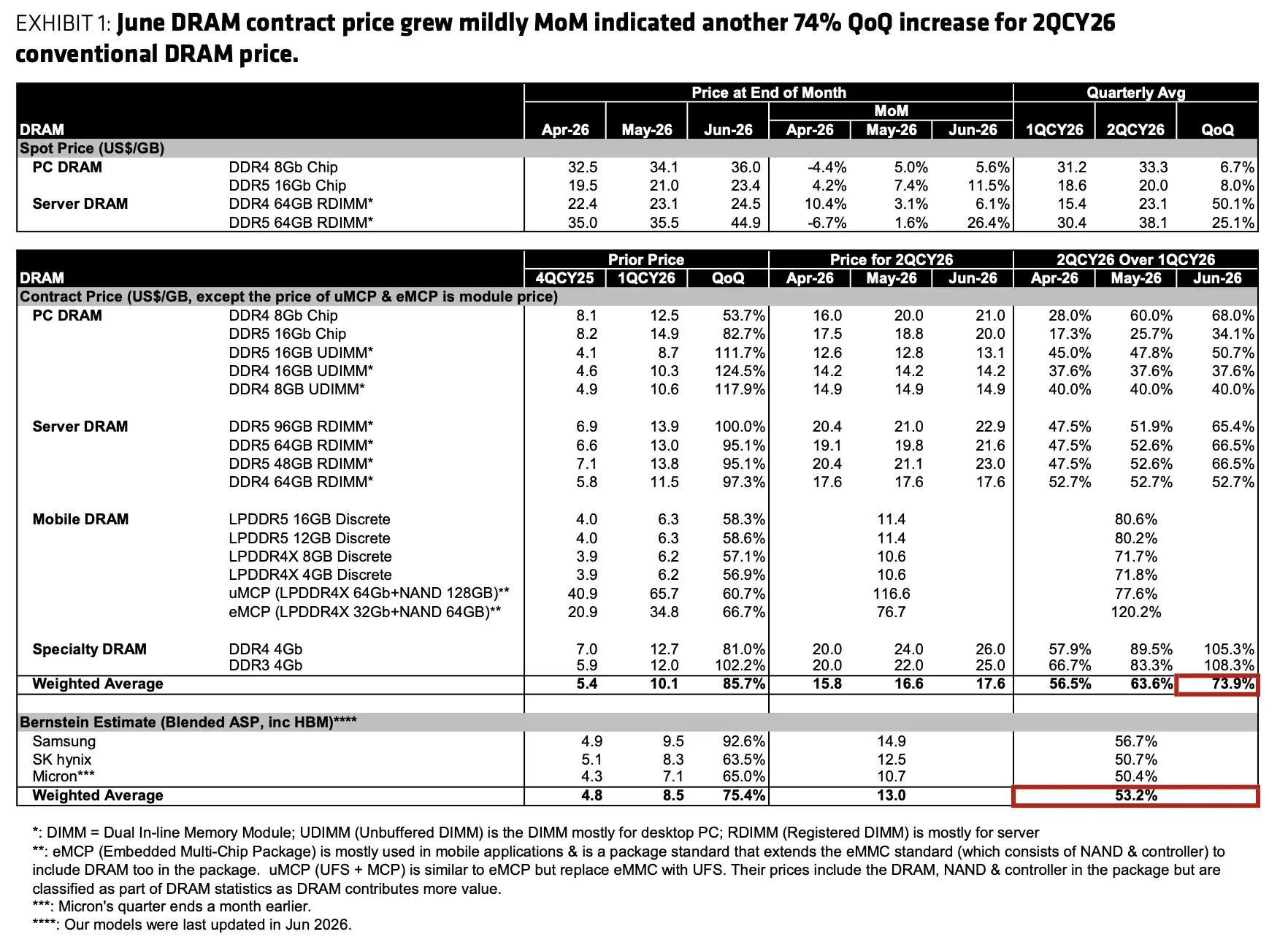
Bernstein's latest June memory tracking has pushed memory price increases to a high level. Its weighted sample shows that the contract price of mainstream DRAM in 2QCY26 increased by about 74% compared to the first quarter, while the overall NAND contract price increased by about 60%.
These numbers are very direct in meaning for investors: Memory price increases will raise revenue and profit expectations for Samsung Electronics, SK Hynix, Micron, SanDisk, and other manufacturers, as well as increase procurement costs for PC, smartphone, and server manufacturers. In recent months, the demand from AI servers and cloud companies has driven memory prices up, but the impact has begun to reverse in consumer electronics, with smartphone manufacturers cutting production and reducing specifications, making it more difficult for PCs and consumer end markets to absorb the ongoing price hikes.
It is important to note that Bernstein's June tracking is based on sample report data and is not the official final value published by TrendForce. TrendForce's public forecast in March had previously indicated a 58%-63% QoQ increase in mainstream DRAM contract prices for 2Q26 and a 70%-75% QoQ increase in NAND Flash. As of July 3rd, TrendForce's public estimate predicts a 13%-18% QoQ increase in mainstream DRAM contract prices for 3Q26 and a 10%-15% QoQ increase in NAND Flash contract prices.
In other words, memory prices are still rising, server shortages have not ended, but the steepest price hike may have passed.
DRAM Sample Price Surged 74% in the Second Quarter, Server DDR5 Still in High Demand
DRAM prices remain strong, supported by server demand.
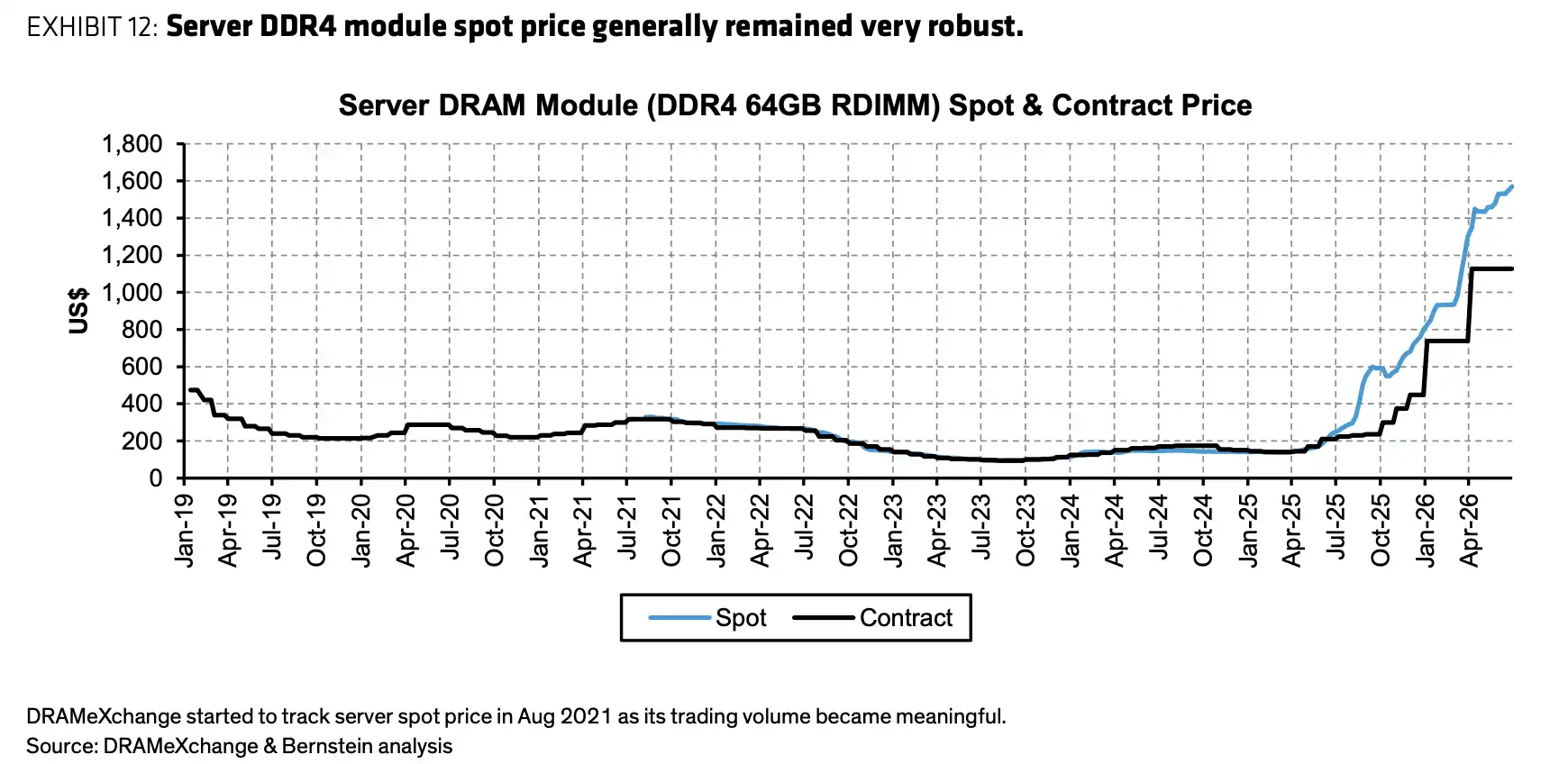
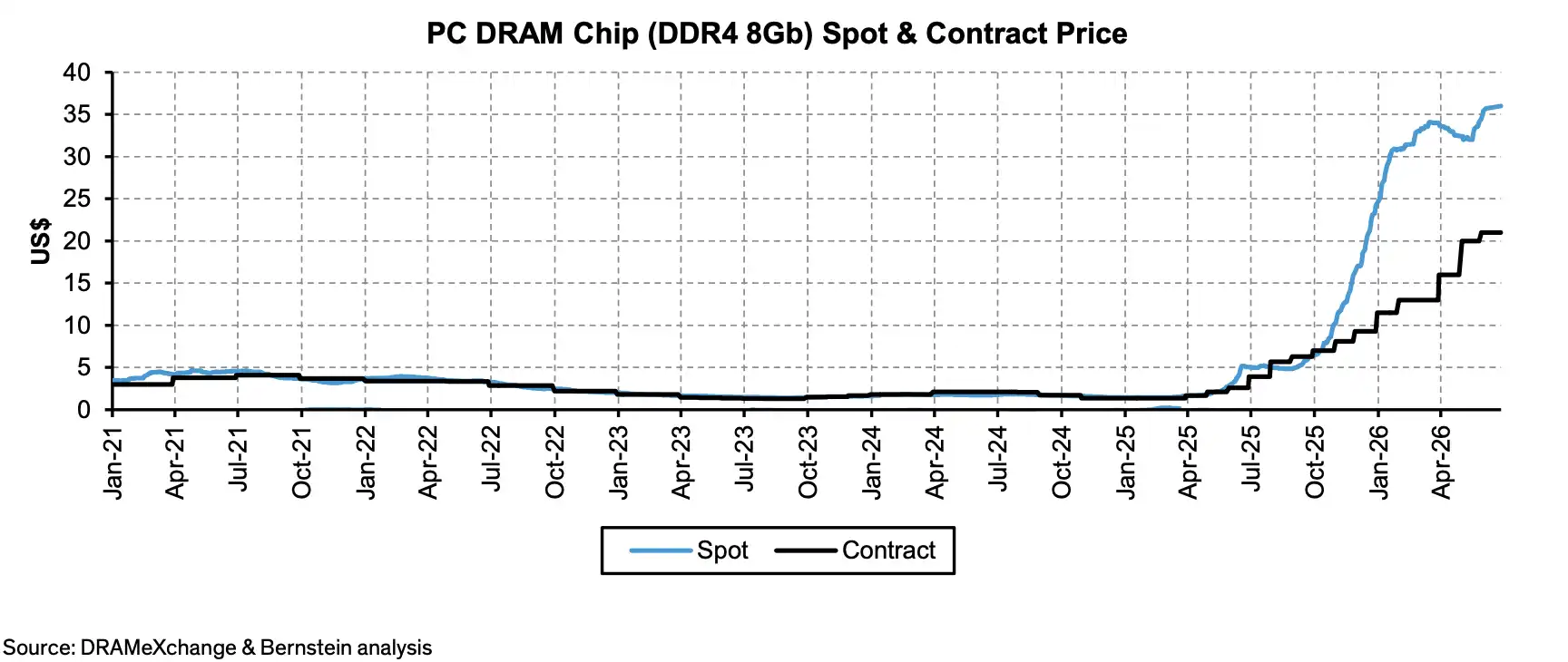
Bernstein's June tracking shows that spot prices continued to rebound in May. PC DRAM DDR4 and DDR5 chip prices increased by 5.6%-11.5% QoQ, and server DRAM module prices increased by 6.1%-26.4% QoQ, with DDR5 performance particularly strong. More importantly, spot prices are still significantly higher than contract prices, and buyers who do not lock in prices through long-term agreements still face higher costs in the spot market.
The sub-item price increases of regular DRAM contracts in the second quarter show that the price hike is not limited to a single category. PC DRAM increased by about 49% QoQ, server DRAM by about 67%, mobile DRAM by about 80%, and consumer DRAM by about 85%. Of these, the significance of server-side is the greatest, as it is directly related to AI data centers, cloud provider capital expenditure, and better supports memory manufacturers' profit expectations.
U.S. cloud service providers are still given priority in the supply chain. The report mentions that SK Hynix and Micron had basically finalized related long-term agreements in April, with Samsung still pushing for higher prices. Micron's long-term agreement price ceiling is close to its second-quarter level, while Samsung's and SK Hynix's ceilings may be higher. Negotiations with Chinese cloud providers are still ongoing into the third quarter, with relatively less favorable terms.
This is also why the contract price increase will slow down, but a short-term slowdown does not necessarily mean a reversal to a decline. Server demand is still absorbing additional supply, especially for DDR5 and high-end server modules, which remain the strongest part of the entire DRAM market.
NAND Prices Are Rising Too, but Wafers Are Weakening
NAND is also undergoing a significant price hike, although its structure is more complex than DRAM.
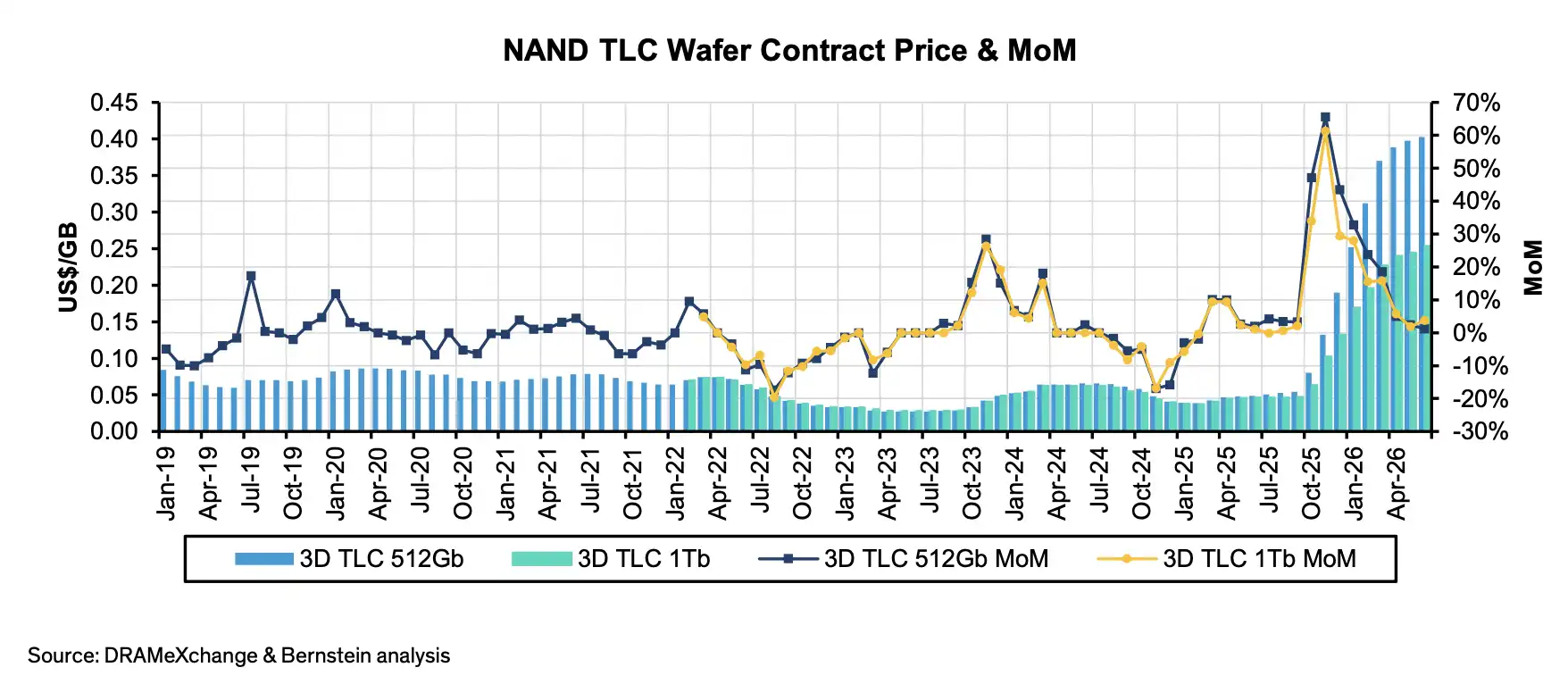
Bernstein's samples show that in June, NAND wafer spot prices declined by 3%-4% QoQ, while wafer contract prices only slightly increased by 0.3%-3.7% QoQ. Looking solely at wafers, prices have noticeably weakened compared to the previous period. However, mobile NAND and SSD contract prices are expected to surge by 70%-80%, driving an overall NAND contract price increase of about 60% in the second quarter.
Not every link in the NAND supply chain is experiencing the same price hike. Wafers have already shown signs of weakness, but end-product and enterprise demand continue to support the overall average price.
This also explains why the third-quarter NAND price increase is struggling to maintain the second-quarter level. The high price hike in the second quarter was mostly driven by the upward adjustment of mobile NAND and SSD prices. Once phone manufacturers reduce purchases and decrease capacity configurations, NAND price pressure will emerge faster than on server DRAM.
For NAND-related companies such as SanDisk and Kioxia, this differentiation is particularly important. Short-term prices are still rising, but if wafer prices weaken first, subsequent profit elasticity will rely more on enterprise SSDs, mobile contract execution, and inventory digestion speed.
Prices Will Continue to Rise in the Third Quarter, Just Slower
The third quarter does not mark the end of price hikes but rather a slowing of the pace of increase.
TrendForce publicly forecasted on July 3 that 3QCY26 mainstream DRAM contract prices will increase by 13%-18% QoQ, and NAND Flash contract prices will increase by 10%-15% QoQ. Compared to the second quarter, the rate of increase has significantly tapered off.
Pressure is coming from both ends.
On one side, AI servers are still placing orders, and U.S. cloud service providers also have priority supply, which will continue to support prices in the short term. On the other side, consumer electronics have begun to adjust. Smartphone OEMs are starting to lower production plans and memory usage. The impact is greater on low- to mid-range models, as they rely more on mature products like LPDDR4, making it harder to pass on cost increases to consumers.
Earlier, TrendForce publicly estimated that global smartphone production in 2026 will decrease by 10% YoY to around 1.135 billion units, with a more pessimistic scenario potentially widening the decline to over 15%. When both smartphone production and memory downsizing occur simultaneously, the price increase space for mobile DRAM and NAND will be capped.
PCs are also facing similar pressures. In June, PC DDR4 and DDR5 chip spot prices continued to rise, but if end demand cannot bear higher costs, the pace of procurement may slow, and channels will be more cautious in restocking.
Another constraint comes from long-term agreements. LTAs can help memory manufacturers lock in orders and reduce the impact of price declines, but they may also limit further price increases. Especially when some agreements set price ceilings, high spot prices may not necessarily be fully reflected in the manufacturers' quarterly average selling prices.
Therefore, the second-quarter contract price sample increase cannot be simply equated to the ASP increase for each company. Factors such as product mix, HBM share, LTA cap, and quarter-end final settlement will affect the revenue recognition of companies like Samsung, SK Hynix, Micron, and others.
Manufacturers Still Benefit, While Handsets and LTAs Will Constrain the Realization Level
Memory manufacturers are still the most direct beneficiaries.
According to a June report from Investing.com, Bernstein raised the target price for Samsung Electronics to 440,000 Korean won, SK Hynix to 3.3 million Korean won, Micron to $1,300, while maintaining an "Outperform" rating. The target price for SanDisk was also raised to $3,000, maintaining an "Outperform" rating, citing reasons related to new long-term memory agreements and price floors. Kioxia maintained an "Underperform" rating.
The ratings themselves are not the focus of this article. What's more important is that in the current price environment, the market is still willing to give top DRAM and some NAND manufacturers higher profit expectations.
However, short-term price increases cannot be directly extrapolated into long-term risk-free gains.
Disruption in consumer demand has already emerged. Smartphone manufacturers are reducing production and specifications, with mid-to-low-end models being more sensitive. The faster memory prices rise, the more likely end manufacturers will respond by reducing capacity, switching to older-generation products, or delaying purchases.
Supply will also continue to ramp up. In Bernstein's model assumptions, memory prices will gradually peak in 2H CY27 and normalize in CY28. The current shortage is more a result of strong AI server demand, supply adjustments lagging, and long-term agreements locking in inventory, rather than a permanent imbalance of supply and demand.
Competition from Chinese manufacturers in the NAND field remains a long-term pressure. Compared to DRAM, NAND is more susceptible to new capacity and price competition. Once demand slows down alongside increased supply, price declines may start with the weaker NAND segment.
The short-term theme of this memory market cycle remains clear: server and AI demand keeping DRAM prices high, while NAND in the second quarter was pulled up by mobile devices and SSD prices. However, starting from the third quarter, pressure from handsets, PCs, and consumer end markets will significantly slow down the pace of price increases. For investors, "prices are still rising" and "the peak of the strongest price increase has passed" are two things that need to be considered separately.
Welcome to join the official BlockBeats community:
Telegram Subscription Group: https://t.me/theblockbeats
Telegram Discussion Group: https://t.me/BlockBeats_App
Official Twitter Account: https://twitter.com/BlockBeatsAsia
