Postscript
The financial reports of Ultra-Large CSPs (Microsoft, Amazon, Google, Meta) were the second watershed in the July market. What were the market's concerns and focal points? Their importance will be discussed later in the text. The performance of Ultra-Large CSPs has already become a key metric in measuring AI commercialization (weight-capacity and large model ARR are consistent). The key is still the speed of AI demand growth, revenue quality, and unit economics. Can they keep up with the rising speed of capital expenditure, depreciation, energy costs, and financing needs? In simple terms, if AI commercialization cannot keep pace with the growth rate of AI capital investment and costs, the free cash flow of Big Tech will also come into play. Let's discuss my thoughts.
1. Market Concerns Can Roughly Be Divided Into Four Layers
1) High Expectations and Crowded Trades
The market has already priced in the continuous Capex, chip demand, and cloud growth for the coming years. Several large tech companies have a combined Capex of approximately $730 billion in 2026. As long as the financial reports are "good but not exceeding expectations," crowded trades in semiconductors, storage, data centers, and utilities may experience a downturn. However, it cannot be simply stated that the entire Big Tech sector has already factored in "many years of perfect expectations." Microsoft, Alphabet, Amazon, Meta still have substantial non-AI cash flows from Office, search ads, e-commerce, social ads, and others. The companies that are most easily priced in for multiple years are usually those with revenue highly tied to AI Capex and have greater cycle elasticity, such as supply chain companies.
Recent deleveraging has alleviated this level of overpricing and crowded trades to a great extent.
2) Capital Expenditure, Depreciation, and Free Cash Flow Mismatch
Revenue can increase immediately, but the depreciation from data centers, GPUs, power supply, and networking will persist for years. The current market is shifting from "who spends the most" to: who can bring new capacity online the quickest and generate enough gross profit to cover depreciation and cost of capital. Amazon saw negative free cash flow in Q1, Microsoft's Cloud gross margin is under pressure from AI investments, Alphabet has explicitly mentioned rising depreciation and energy costs, indicating this concern is not purely emotional.
3) Market Simultaneously Concerned about "Too Much Capex" and "Capex Being Cut"
This is not contradictory because the focus is on different stakeholders: for CSP shareholders, increasing Capex with no return is negative; for the chip, storage, data center, and power supply chain, Capex cuts are revenue negative.
Reducing Capex due to efficiency gains while maintaining revenue and capacity is positive; reducing Capex due to weakened demand is negative for the entire AI industry chain.
So, the market is not really concerned about absolute Capex increase or decrease, but rather: how much sustainable gross profit and free cash flow each additional dollar of Capex can bring.
4) There Is a Time Lag Between the Commercialization of AI and the Revenue and Investment Cycle
There is currently strong demand for cloud-based AI, with some CSPs still constrained by capacity, but large enterprises are transitioning from pilots to production, renewals, and expansions, which takes longer. The market is concerned about whether enterprise AI revenue can catch up fast enough after depreciation and financing costs have already hit the financial statements. In addition, interest rates, energy prices, and macro risks will also affect long-duration tech assets, and not all pullbacks can be attributed to AI. Investors are oscillating between the narratives of "AI infrastructure being undervalued" and "overinvestment happening too soon."
2. What Can Truly Shift Market Sentiment
Simply releasing more models, disclosing more token quantities, or increasing Capex again is not enough to alleviate concerns. The market needs to see a consistent chain of evidence.
First, AI revenue needs to be broad-based, not reliant on a few strategic customers.
We must see growth in enterprise customer count, production workloads, paid seats, renewals, and per-customer spending all in sync, and demand remains strong even after excluding a few mega contracts like OpenAI, Anthropic, etc.
Second, AI Gross Margin Growth Outpacing Depreciation and Operating Costs
Allowing for a temporary decline in gross margin percentage, but the incremental AI gross margin must significantly exceed the incremental investment in depreciation, energy, network, and talent. It is best to see a decrease in unit inference cost while overall gross margin continues to rise.
Third, Backlog Turning into Recent Revenue
Having only three to five-year large contracts is not enough. The market will value more the proportion of revenue recognized in the next 12-24 months, the extent of consumption exceeding the initial commitment, and the immediate utilization rate after new capacity is launched.
Fourth, In-house Chip Design and Model Optimization Yield Verifiable Economic Benefits
What the market needs is not just "Cheaper Trainium, TPU, MAI," but rather: increased share of in-house chips, decreased cost per token or per successful task, price reduction lagging behind cost reduction, improved gross profit per accelerator hour, continued growth in customer total spending and platform attachment revenue.
Fifth, Visibility into Free Cash Flow Bottoming Out
The market wants to see: Capex growth rate becoming manageable, new Capex supported by contractual demand, operating cash flow growth covering an increasing portion of capital expenditure, buybacks and balance sheet not being squeezed long term, a clear explanation of the depreciation peak and investment payback period. Whether free cash flow turns negative is only superficial; what the market truly trades is the reason for the negative turn, the magnitude, duration, and the potential for recovery in the future.
Sixth, Enterprise Customers Demonstrating Real ROI
The most compelling evidence is not model evaluations or token numbers but customer disclosures: revenue and conversion rate improvement, reduction in manual and processing times, moving from pilot to production, renewal and expanded deployment, full AI costs factored in, attractive investment payback period still maintained.
For the most ideal "Goldilocks Combination" in the second-quarter earnings report, the market is most hopeful to see:
Cloud and AI revenue exceeding expectations + roughly stable profit margins + backlog initiation + Capex not unexpectedly out of control, or new Capex clearly tied to signed demand + no further deterioration in free cash flow.
Conversely, the most dangerous combination is:
Sharp increase in tokens and usage, but no improvement in spend per customer, gross margin, and free cash flow; RPO growth relying on a single strategic model company; Capex significantly raised again while profit margins and revenue guidance decline
Foreword
It was on July 6th that I first saw Coinbase's engineering practices in AI, which made me start thinking deeply and researching the trends and changes that enterprises will encounter in the future when deploying AI. Last week, I wrote two articles:
The significance of CSPs (Cloud Service Providers) deploying cost-effective open-source models and reselling Tokens:
The performance of super CSPs will be a more important metric for measuring AI commercialization and value reshaping:
Following this line of thought further and delving deeper, it has led to this lengthy article, discussing my personal logic and thoughts in more detail.
Part One: Multi-Model Scenarios - Changes in Enterprise AI Adoption Process Entering the Engineering Stage
1. Multi-Model Scenarios: Enterprises will no longer ask "Which model is the best," but will ask "Which model should be used for this task?"
The future is not about “specialized high-performance Tokens,” as the Token itself is just a unit of measurement. What is truly specialized includes: the model; inference strategy; context and data; tool invocation path; hardware and service approach; security and manual review mechanism.
The objective function for enterprise model selection will shift from simply pursuing model capability to:
Task Net Value = Task Success Probability × Business Value - Inference and Execution Costs - Error and Risk Loss.
This will give rise to four typical scenarios:

For example, tasks such as email classification, summarization, field extraction, initial customer service routing, code format checking, etc., have relatively low marginal requirements for model capability but have large call volumes and are price-sensitive. These tasks will gradually migrate to small models, open models, or CSP's self-developed cost-effective models.
On the other hand, tasks like complex code generation, critical contract analysis, scientific reasoning, strategic research, complex Agent planning, etc., where a few percentage points increase in model accuracy may correspond to high business value, the enterprises are still willing to pay a premium for cutting-edge models.
2. The deeper enterprises adopt AI, the more they need proprietary AI systems
No matter how many public, licensed, or synthetic data the state-of-the-art closed-source large model has used, it usually does not have access to real-time data, internal rules, organizational permissions, and implicit experience of a particular enterprise. What large enterprises need more is a "private AI boundary," including data not used for training, private network, dedicated tenancy, permission isolation, data residency, and auditability; only a few scenarios must be truly localized or isolated deployments.
What enterprises truly lack is not a model that has "read all enterprise documents," but a system that can access the right data with the correct permissions and take action according to enterprise rules.
Enterprise private data needs to be classified into four categories:

However, "experiential data" is the most challenging asset for enterprise AI, as experience does not naturally exist in data form. It is usually scattered across: the judgment of senior employees, emails and chat records, rejected but undocumented proposals, anomalous event handling processes, human overrides of system suggestions, customer complaints, and post-incident reviews.
To transform this experiential data into an AI asset, enterprises must establish:
Raw Experience → Task Samples → Expert Judgment → Correct and Incorrect Standards → Model Evaluation Set → Feedback and Retraining
Therefore, the moat of a large enterprise is not just "having many documents," but:
The ability to convert tacit knowledge into machine-learnable, retrievable, evaluable, and executable organizational context.
This is also why enterprise AI increasingly requires the participation of FDEs, data engineers, domain experts, and business stakeholders.
And all the above points to one thing:
Enterprise AI adoption is shifting from "purchasing the strongest model" to "engineering deployment around private data, business processes, and multi-model systems."
II. The Rise of "Composite AI Systems" to "Middleware"
1. Multi-Model, Multi-Module: AI products will evolve from "model invocation" to "composite AI systems"
Future enterprise-grade AI systems will typically not just be a model API but will consist of multiple modules working together: user requests, identity and permissions, scenario recognition, data and context retrieval, model routing, model inference, tool/API invocation, result verification, risk control, human review or automated execution, monitoring, and continuous evaluation.
"Multi-module" here is more critical than "multi-model" because what enterprises ultimately purchase is not the model itself but a system that reliably accomplishes business tasks.
Why are enterprises moving towards multi-module systems?
1) A single model cannot be optimal in terms of quality, cost, speed, privacy, and reliability all at the same time.
2) The model itself does not have insight into real-time enterprise data, permission systems, and business context. Context must be established through the data layer, retrieval layer, tooling layer, and system connectors.
3) The production environment requires auditability, rollback capability, and monitoring. The model output cannot directly equate to business execution.
4) Models need to be frequently updated. Enterprises must decouple business logic from specific models to avoid rewriting the entire application with each model change.
The emergence of open protocols like MCP aims to standardize the connection between models, data sources, and enterprise tools, reducing the fragmentation caused by developing connectors for each model separately.
However, having multiple models does not mean an unlimited increase in model quantity.
With each additional model, an organization incurs a set of implicit fixed costs: security audits, legal and intellectual property assessments, data residency reviews, quality benchmarking, regression testing after model updates, operations and incident management, and vendor management. Therefore, the most likely organizational form is not "each team freely choosing dozens of models," but:
Centralizing a limited compliance model pool with a unified data and security control plane; various business units call different models based on scenarios.
This trend brings about the following: Infrastructure at the base level gradually consolidates, while innovation for scenarios is decentralized to business units.
2. The Rise of the Intermediate Layer: Establishment, but a Distinction between "Control" and "Independent Business Value" is Necessary
In the future, the intermediate layer can generally be divided into six categories:

Which intermediate layers are most likely to gain value
What is most likely to capture long-term value is not the thinnest model packaging layer but a platform that controls one or more of the following scarce resources:
1) Enterprise Data and Context: Capable of legally, in real-time, and according to permissions accessing enterprise data.
2) Identity and Security: Determines what AI can access and what it can do on behalf of whom.
3) Business Workflow: Master task entry and execution loop.
4) Cross-Model Evaluation Data: Accumulate quality, cost, and risk data from real production environments.
5) Distribution Capability: Already has a large number of enterprise users or system entry points.
Therefore, data platforms, cloud platforms, security platforms, ERPs, and industry software vendors have a natural advantage.
Microsoft revealed that an increasing number of its AI customers are simultaneously using Foundry, Fabric, Cosmos DB, and security governance services; Google also emphasizes AI usage driving growth in BigQuery and data workflows. This suggests that AI model invocation may become a customer acquisition entry point for services such as databases, analytics, storage, security, and agent runtime.
Which Middle Layers Are Easily Commercialized
Although the following middle layers have utility value, they may not necessarily form an independent profit pool:
· Simple API Aggregation;
· Model routing without proprietary data;
· General Prompt Management;
· Basic Agent Orchestration without a business loop;
· Thin-layer products that only forward requests between multiple models.
The reason is that CSPs like AWS, Microsoft, Google, etc., can provide these functions as cloud services for free or at a low price; large application vendors can also embed them into existing products.
Therefore, a more accurate assessment is:
The strategic importance of middle layers is bound to rise, but the total value of independent middle layer vendors may not necessarily increase proportionally.
Middle layers may become the "operating system" of the AI industry, but the entities most likely to reap economic benefits in the end are: CSPs, data platforms, security and identity platforms, application software companies with system records, and a few independent middleware vendors with cross-cloud neutrality and proprietary production data.
Cross-cloud neutrality will be a key advantage for independent vendors against CSP bundling. Large enterprises are typically unwilling to lock models, data, assessments, and governance entirely into a single cloud platform, so there is still room for independent middle layers, but they must provide capabilities beyond "simple model invocation."
Chapter Three: In the Multi-Model Era, Will Mega CSPs Become a Solid Middle Layer?
1. What Changes Will CSPs' Deployment of Open Model and Self-developed Cost-effective Model Bring?
Change 1: Model Invocation Transitions from Single-vendor Procurement to Model Portfolio Management
Businesses will no longer be deeply tied to a single model vendor but will maintain a model portfolio:
· Cutting-edge closed-source models handle tasks with the highest capability requirements;
· Open models handle tasks that can be standardized and privatized;
· CSP's self-developed models handle high-frequency, cost-sensitive tasks;
· Enterprise-owned models handle highly proprietary, data-sensitive tasks.
CSPs become the gateway and router for model portfolios. Model vendors are no longer just competing for customers but for the task allocation share within the routing system.
Hence, new model competition metrics include: How many enterprise-compliant models have been included in the pool? How many requests have been received in the router? Are they high-value or low-value tasks?
Change 2: Model Prices Decrease, but Total AI Expenditure May Not Necessarily Decrease
Model downsizing, increased caching, and context compression will reduce the price per task token and per token price; however, cost reduction may also stimulate more usage scenarios, leading to a significant increase in task volume.
Change 3: CSPs' Revenue Streams Expand from Model Cuts to Full-stack Affiliation
Even if open-source models do not generate high model licensing revenue, CSPs can still charge for the following: GPU, TPU, and self-developed ASIC computing; hosted inference services; databases and vector retrieval; object storage; networking and data transmission; Agent runtime; security and identity; evaluation, logging, and monitoring; enterprise support services.
Therefore, what CSPs truly care about is not just the revenue share of the models themselves but:
CSP AI Total Gross Margin = Inference Gross Margin + Data Affinity Gross Margin + Storage Network Gross Margin + Security Governance Gross Margin + Agent Runtime Gross Margin
AWS has disclosed that Bedrock customer spending has increased compared to the previous period, with a significant rise in Token transaction volume. AWS has also launched services such as AgentCore Registration, Policy, and Assessment. Microsoft and Google are also advancing a combination of model, data, Agent, and governance services. This indicates that CSPs are attempting to transform model services into full-stack cloud consumption.
Change Four: Model Vendor Value Will Not Disappear, but Will Extend to the Capability and Application Ends
Open source and self-developed cost-effective models will compress the prices of mid-to-low-end models but will not automatically eliminate the value of cutting-edge models. Model vendors may take three paths: 1) continue to raise the capability ceiling to maintain a premium for complex tasks; 2) move towards high-value applications such as Agent, coding, and research; 3) offer customized post-training, security, enterprise governance, and dedicated capacity.
It is more likely to eventually form:
CSPs control the infrastructure and model distribution;
Frontier model vendors control the capability ceiling;
The intermediate layer controls the context, governance, and scheduling;
Application vendors control the workflow and user entry points.
This is not a scenario where a single layer dominates, but rather each layer charges different types of rent.
Change Five: Enterprises' Negotiating Power at the Model Layer Increases, but Platform Lock-in May Deepen
Multi-model and open model approaches have reduced enterprises' reliance on a single model vendor.
However, if a company's data, permissions, Agent status, evaluation system, and workflows are all deployed on the same CSP, while the model layer lock-in may decrease, cloud platform lock-in may actually increase.
In other words:
Increased model interchangeability does not equate to increased overall architecture portability.
2. CSP Controls the Horizontal AI Base, while Vertical SaaS Controls the Business Execution Layer
The value most likely to be captured by CSPs: GPU, TPU, and custom ASIC computing power; open-source model hosting; closed-source model distribution; model fine-tuning and distillation; databases and data lakes; vector retrieval and knowledge graphs; networking and storage; identity and permissions; security and governance; Agent runtimes; evaluation and observability; enterprise tech support.
Vertical SaaS Mastery: Work Entry; Business Object; Business Semantics; User Permissions; Historical Operation Data; System Records; Industry Rules; Final Action Execution; Customer Outcome Feedback.
Therefore, it can package a cost-effective model into high-value business outcomes.
However, this only applies to SaaS that truly owns workflow and core proprietary data. Simply wrapping a generic model in a simple interface, on the other hand, is easily replaceable by model vendors or CSP. This has been discussed here before.
3. Most Likely to Form a "Dual Middle Layer"
Future enterprise AI architecture might be:
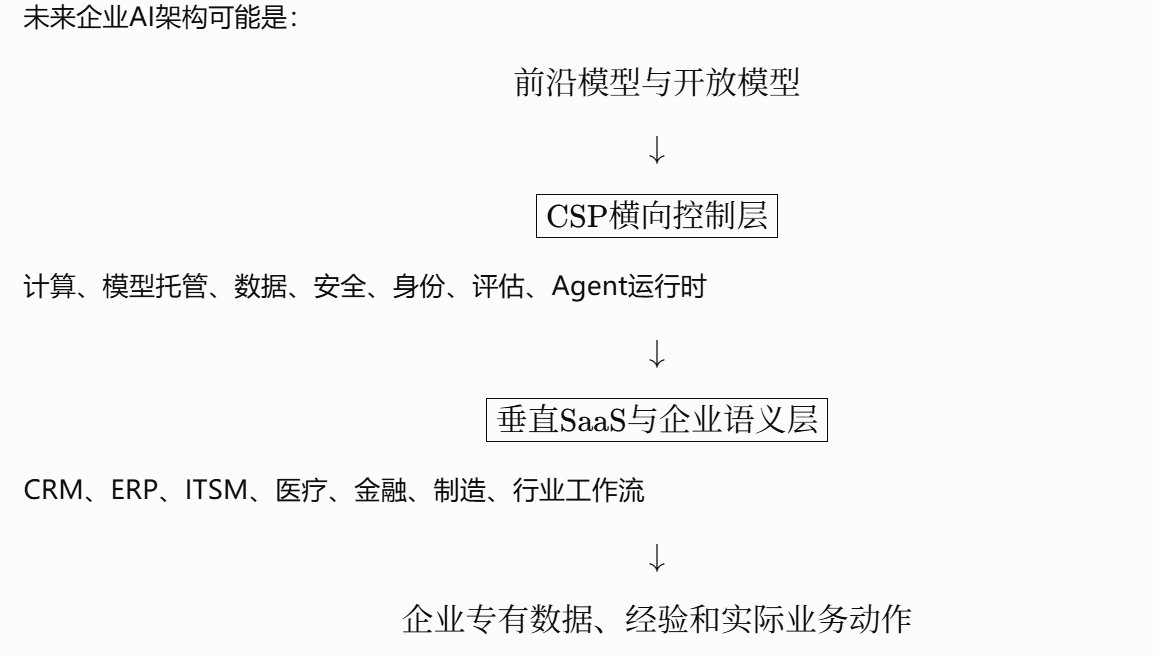
CSP may not be able to directly bypass vertical SaaS's control of all business processes; vertical SaaS is also unlikely to independently take on underlying large-scale computing power and multi-model infrastructure. Who can capture the most value depends on five control points

A truly high-value layer is not necessarily the layer closest to the model but the one that can simultaneously control:
Context, Permissions, Workflow, Actions, and Outcome Feedback.
Traditional SaaS projects typically are:
Fit-gap Analysis → Configuration → Data Migration → UAT → Go-live.
Enterprise AI projects are more like:
Scenario Selection → Data Permissions → Evaluation Set → Model Selection → RAG and Tool Access → Model Routing → Security Boundaries → Human Review → Production Monitoring → Feedback and Retraining.
The biggest difference is:
SaaS is mainly configuring processes within established software; AI is continuously optimizing a probabilistic system in production.
Therefore, AI implementation is more like a combination of software engineering, data engineering, model engineering, process consulting, and organizational change.
Four Value Reshaping of Super-Large CSPs
1. Reshaping the Value of Mega Cloud Service Providers (CSPs)
Previously, it was discussed here that the market used to view CSPs, especially mega CSPs, as intermediaries selling computing power and tokens, while also facing massive capital expenditure without capturing the maximum value. Now, the "efficient midsize model + scaled deployment" has proven its value in a production environment, emphasizing a move away from blindly pursuing a parameter arms race.
This shift in perception now sees mega CSPs as the "AI operating system layer" in the enterprise AI multi-model architecture.
Changes in Cost and Revenue Structure When CSPs Resell Closed-Source Models:
When CSPs resell closed-source models, they receive a limited revenue share (usually ranging from 20% to 50%, depending on the contract) and face pricing pressure from the model provider. Transitioning from self-hosted open-source models to resale, where open-source models have virtually zero licensing costs, CSPs only need to cover their own computing power, electricity, and maintenance costs. CSPs can capture almost the entire markup (after deducting computing costs). Pricing can be based on the actual open-source community costs plus a reasonable premium, providing more flexibility.
As for self-developed models, most of the revenue remains with the CSP.
2. However, New Challenges Arise for Mega CSPs: Time Lag
The entire process can be divided into four stages. The timeframes are for illustration purposes only and vary significantly across industries.
Stage One: Internal R&D and Capacity Investment
In this stage, CSPs train or retrain self-developed models, deploy open models, optimize chips, inference frameworks, and model routing, and establish security, evaluation, and governance platforms.
Financial performance may include: Increased capex; rising R&D expenses and depreciation; cloud revenue constrained by capacity; margin pressure; limited direct commercial revenue.
Stage Two: Customer Trials and Full-Scale Deployment (FDE)
In this stage, customers select scenarios; organize data and permissions; establish RAG, evaluation sets, and tool connections; FDE helps complete the first production system.
Financial performance may include: Increased revenue from professional services and fine-tuning; continued moderate growth in cloud consumption; many proof of concepts (POCs) not yet scaled; increased human resource investment; service profit margins may be lower than software profit margins.
Phase Three: Production Inference at Scale
In this phase: Customer workflows stabilize; Agent starts running continuously; Inference, database, storage, and security consumption increase; Vertical SaaS begins charging based on usage or business outcomes.
Financial performance may include: CSP cloud consumption acceleration; SaaS AI upsell revenue growth; Data and security attachment revenue growth; Improved customer renewals and expansions; Unit inference cost reduction.
Phase Four: Model and Workflow Optimization
In this phase: Low-latency tasks shift to small models, custom models, and open models; High-value tasks continue to use cutting-edge models; Routing, caching, and distillation reduce costs; FDE outcomes gradually productized.
Financial performance may include: Token price decrease; Task volume increase; Model vendor revenue diversification; CSP full-stack attachment revenue increase; Vertical SaaS capturing more value based on workflow and outcomes; Margin and capital return of successful deployments start to improve.
Therefore, the market may first see:
Capex and manpower increase
→ Then see POCs and contracts
→ Then see production workloads
→ Finally see free cash flow and ROIC.
This time lag is indeed at the core of the current AI investment controversy.
Five New AI Commercialization Metrics
1. The future should no longer only ask "How much AI revenue," but also answer five questions.

The most sensible judgment is not to look for a new single indicator but to establish a seven-layer funnel from model to capital return.
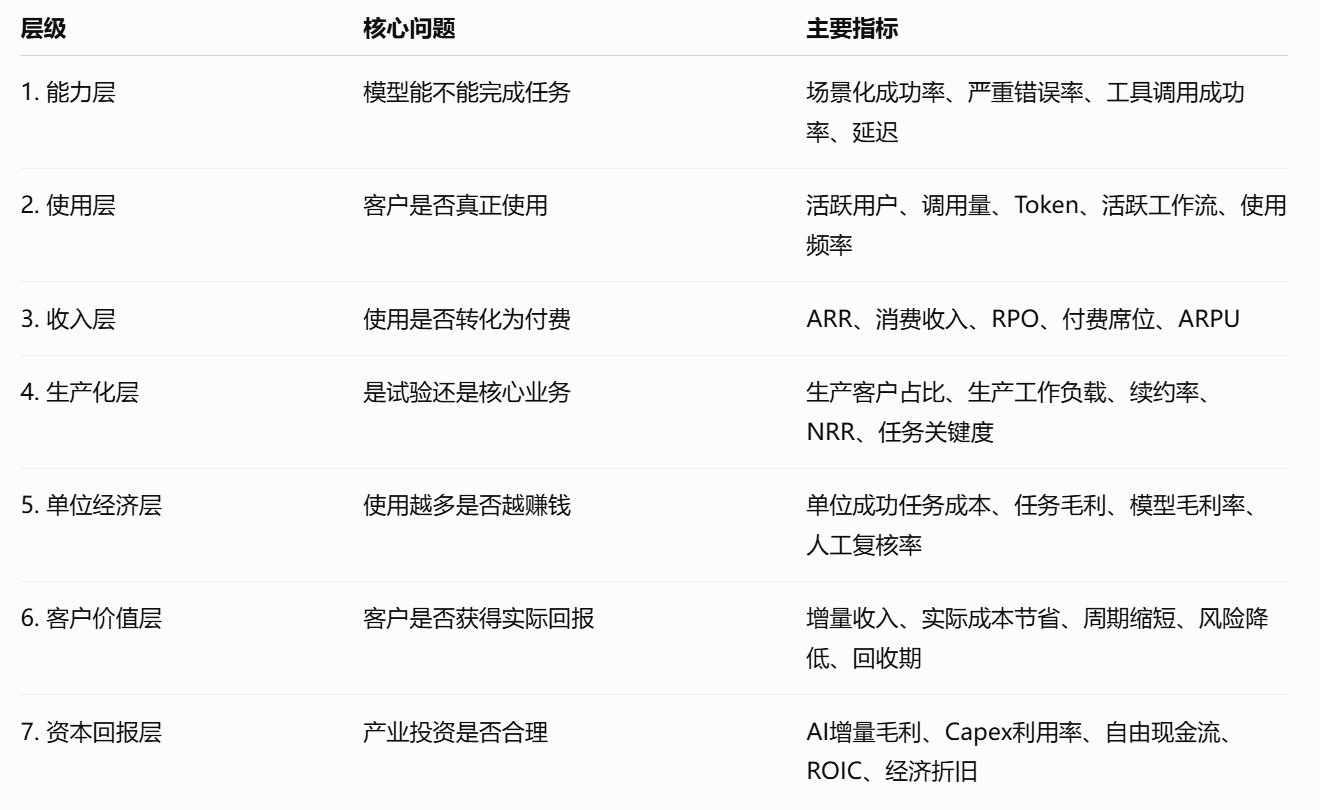
2. Big Model ARR remains critical, but it should shift from an "end-state metric" to a "demand-led capability metric"
The ARR of big model vendors is still very important for four reasons.
1) ARR proves that enterprises are willing to pay for intelligent capabilities, and ARR indicates that at least some customers have entered a paying state and are willing to sign ongoing contracts or establish steady consumption.
2) ARR reflects whether cutting-edge models still carry a premium. If a model's capabilities continue to deliver higher task success rates, customers are willing to pay a premium for high-value tasks. Even as a significant volume of routine tasks shift to small models, cutting-edge models may still command a high price through complex reasoning, encoding, research, and Agent tasks.
3) ARR determines the R&D and compute reinvestment capacity of cutting-edge model vendors. Model training, fine-tuning, inference services, security evaluations, and enterprise sales all require ongoing capital. ARR determines whether model vendors can form a "revenue-R&D-capability enhancement-more revenue" loop.
4) ARR is also a proxy metric for ecosystem impact, with metrics such as developer count, API calls, enterprise contracts, and the depth of model integration into applications typically partially reflected in ARR.
3. Overall View
Large-scale model ARR remains crucial as it demonstrates enterprises are willing to pay for cutting-edge capabilities;
Mega CSP performance will become more comprehensive and carry greater weight in the future, indicating the value of AI adoption in the middle layer of enterprise processes;
Ultimately, evaluation criteria are shifting towards task success economics, enterprise ROI, and capital return.
Commercialization decisions in AI should not be a binary choice between "large-scale model ARR" and "CSP cloud revenue" but should form a complete chain of evidence:
Model ARR proving demand for payment
→ Production workload demonstrating depth of adoption
→ Unit task success margin proving operational quality
→ Enterprise ROI proving demand sustainability
→ Free cash flow and ROIC proving capital expenditure rationality.
What is most worth tracking is not "how many tokens are generated" but
AI Economic Value = Number of productive tasks × Value per task × Vendor value capture rate × Margin rate - Capital cost
This is the overarching framework for measuring AI commercialization in the era of multimodal, multi-module systems.
All of the above actually formed a continuous chain of causation:
Increased Differences in Business Scenarios
→ Enterprises no longer use a single model to solve all tasks
→ Forming composite AI systems with multiple models and modules
→ Intermediate layers such as routing, data, evaluation, governance, and security become the control plane
→ The value of the model layer will not disappear, but the ARR of large models has shifted from being the "sole commercialization metric" to an "important leading indicator"
→ The ultimate evaluation criteria shift to the economic success of tasks, enterprise ROI, and capital return.
This is no longer just a pure architectural concept. Both AWS Bedrock and Microsoft Foundry have already turned model routing based on quality, cost, and task complexity into formal products; Microsoft revealed that more than ten thousand Foundry customers have used more than one model, with around five thousand using open-source models. Google Model Garden also provides hosting or self-deployment methods for proprietary models, third-party closed-source models, and open models.
Of course, this iteration is still in its early stages, but the trend should become increasingly clear.
Welcome to join the official BlockBeats community:
Telegram Subscription Group: https://t.me/theblockbeats
Telegram Discussion Group: https://t.me/BlockBeats_App
Official Twitter Account: https://twitter.com/BlockBeatsAsia
