The Lunar Exploration Physical AI Community, the organizer of the Lunar Exploration Physical AI Hackathon, focuses on entrepreneurial services in the physical AI field. It brings together researchers, developers, the industry chain, and entrepreneurial teams to provide activities, resource matching, and other services for businesses and sci-tech teams. The community aims to build a close relationship between talent and industry resources.
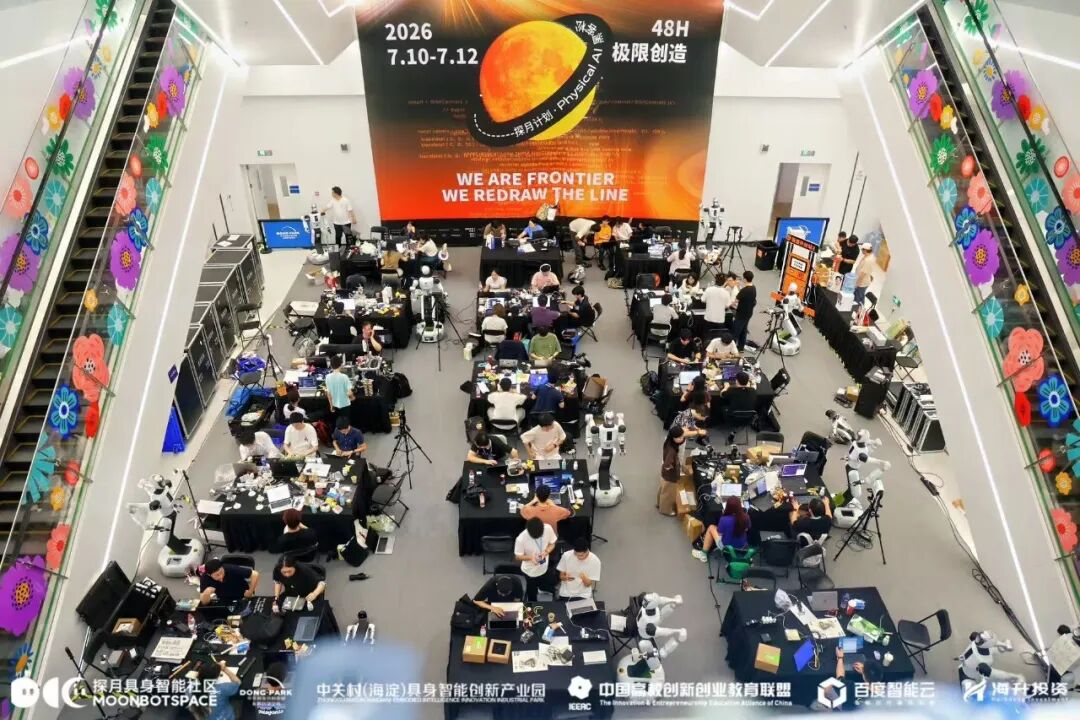
At the Lunar Exploration Physical AI Hackathon, there were teams that had a robotic arm act as a blackjack dealer and others working on air hockey. One team rushed to the basketball court, used data collection to record shooting movements, and tried to teach a robot how humans jump and shoot.
Physical AI currently finds itself in a somewhat peculiar situation. It is envisioned in a trillion-dollar market, with daily increases in valuation, capital, and policy attention, yet stable delivery and scalable implementation are still on the way. While models on screens are adept at answering questions, tasks such as picking up a cup, moving a chair, or navigating around a temporarily shifted table are not as straightforward in the physical world.
While text has been accumulating on the internet for decades, there isn't a readily available database on how the body perceives, judges, and applies force.

Only When the Brain Becomes Smarter Does the Body Have a Chance
Wang Mingyue has worked on product and strategy at Smartisan Technology and Xiaomi, served as the product manager for Xiao Ai smart speakers, and has experience in whole-house intelligence. By the end of 2024, she decided to enter the field of physical AI. Instead of creating a robot, she started from Tsinghua's Physical AI Club and built a community that caters to the entire industry. The Lunar Exploration community has been operational for over a year, with over 50,000 members, including 300+ Ph.D. experts in the physical AI field, organizing dozens of in-depth technical communities and hosting over 50 offline events.
Wang Mingyue's professional experience has always been at the intersection of hardware and software, where products often require integrating invisible software into visible objects. With the release of GPT-3.5, she felt that the "brain" suddenly became smarter. A robot is no longer just a combination of mechanical structure and preset actions; it now has an opportunity to be redefined.
She does not see this as a competition that will end in five or ten years. Physical AI requires a different kind of data that is harder to come by. While language models can read the text left by humans, robots need to collide, make mistakes, and adjust in the real world to understand how heavy a chair is, whether a cup will slip, and where to move their body when obstacles appear.
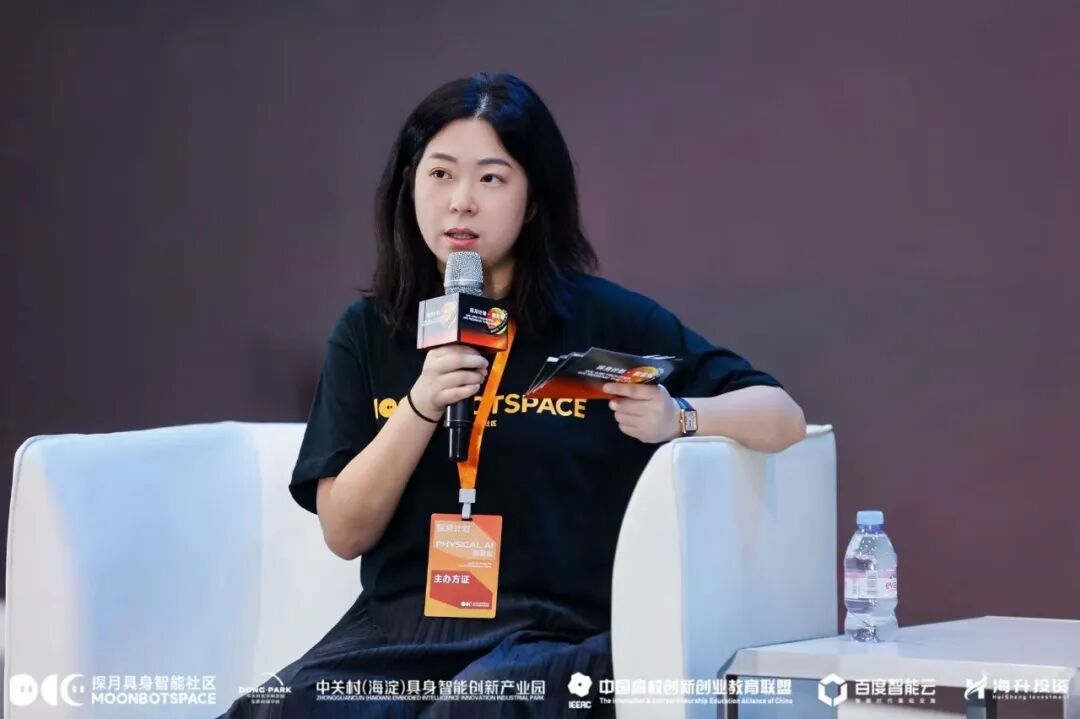
Interview: Can you first introduce yourself and explain why you transitioned from your previous career to Embodied Intelligence?
Wang Mingyue: I am the founder and CEO of the Explore Moon Embodied Intelligence Community, and also the initiator of this lunar exploration hackathon. I was born in the 1980s and have worked for over a decade. I worked at Smartisan Technology before, and later in Xiaomi in product and strategy roles, serving as the product manager for Xiaoai Speaker and working on whole-house intelligence.
I have always been involved in the integration of software and hardware, focusing on intelligent terminals. In 2020, I pursued an MBA at Tsinghua University. By 2024, after GPT-3.5, as the brain became smarter, I believe that the embodiment of robots will become more intelligent. I also pondered about my career transition and how to align my past experiences with new trends. I felt nothing suited me better than robots, as it represents the most complex form of software-hardware integration and will encounter future human division of labor issues. So, by the end of 2024, I firmly decided to enter this industry.
Later, coincidentally, I encountered Tsinghua's club mechanism and applied to the Embodied Intelligence Club. Through this platform, we connect with some top founders and resources. Later, we felt that good resources should not be confined to Tsinghua alone. Therefore, we established the Explore Moon Embodied Intelligence Community independently, open to the entire industry.
Prior to this hackathon, we focused more on internal or customized activities. Over the past year, the community has attracted PhDs in the field of embodiment, industry professionals, and established connections with many top embodiment company founding teams. Explore Moon grew out of the Tsinghua system, and this event also received support from relevant Tsinghua institutions and professors. Tsinghua has spawned many tech startups, with relatively fewer community-oriented organizations. We want to do things differently.
Interview: How large is the Embodied Intelligence industry in China now? Given the rapid gathering of people by Explore Moon, does it resemble a small circle, or is it already a mature industry?
Wang Mingyue: It is an industry with significant contrasts.
Firstly, it has great imaginative potential. If Embodied Intelligence and robots can truly replace some labor, how much GDP can humans generate, then it can, in principle, generate that much GDP, and even do things that humans cannot. It is also related to aerospace and the transition from Earth civilization to interstellar civilization.
This is not something that can be completed in five or ten years. With AI and robots, in the future, humans may transition from Earth civilization to interstellar civilization. The GDP at that time will not be constrained by today's Earth-bound GDP.
Of course, this industry also has a bubble, but it needs to be viewed separately.
In terms of revenue and profit, the industry certainly has a bubble. However, when considering the potential impact on humanity and the future, it cannot simply be called a bubble. The current technology is too complex and too early stage, and there is still no large-scale, stable demand, whether in To C or To B.
In terms of revenue and profit, it is still a small industry. In terms of national strategy, influence, and future potential, it is a large industry.
Dynamic Insight: What is the difference between large models designed for robots and the language models we interact with in our daily lives?
Wang Mingyue: There is currently no unified consensus on embodied large models. Large language models have reached a certain consensus on the technical roadmap after years of development, while embodied models are still each going their own way and are still in the process of debate.
I do not have a technical background, so I will share my understanding after long-term discussions with industry experts.
Language models have a natural data advantage. With the Internet's development over more than 30 years, the text, historical records, and books left by humans can all serve as language model training data. Previous multimodal models have incorporated sound and vision, but there is still a significant gap between these models and truly entering the physical world and forming a world model.
Embodied intelligence involves a physical body to interact with the environment, learn, make judgments, and decisions through interaction. The data used by language models is just the foundation. Robots still lack a large amount of interaction data from the physical world. Actions like picking up a cup, moving a chair, obstacle avoidance, and how the body senses obstacles after encountering them have not been systematically accumulated in the past like textual data.
Autonomous driving can be seen as a very vertical form of embodiment. Cars only operate in the driving scenario, and some data has been accumulated. However, a truly universal embodied model requires multidimensional, multimodal data that is challenging and costly to collect.
In the industry, different approaches have been attempted, such as data collection, simulated data, and recently, first-person perspective data collection has been popular. Once a certain amount of data is accumulated, exponential changes may occur.
About a year ago, I asked many people when we would see an embodied intelligence's GPT moment. Some said ten years, which later turned into three to five years. At this Hacker Forum, entrepreneurs, researchers, and investors gave a more optimistic outlook, with some believing that key progress could be seen in one to three years. This speed is accelerating, and it is not linear.
The large language model is a crucial part of embodied models, and its progress will also drive embodied models. However, embodied models naturally require data in more dimensions. Whether it will end up as VLA, a world model, or something else, there is still no consensus.

The Rarest Asset is Talent
In the bustling world of embodied intelligence, what is most easily mistaken for seriousness is the "end result" — building a body, a brain, a model, a company that can be valued.
However, the lunar exploration initiative was not initially conceived as an organization designed through a business plan. It grew out of the ongoing process of finding co-founders for people, seeking resources.
A community is something that is hard to quantify. The boundaries of a technical project are relatively clear, while the boundaries of a community move with the people. Some come to find engineers, some come to find factories, some come for funding, and some just need to meet someone who understands what they are doing.
For the community, what Wang Mingyue cares most about is not its size but the density of talent.
Dynamic Observation Beating: The lunar exploration project positions itself as the Y Combinator of the Physical AI field, which is quite interesting. Why did you not directly start a business, but instead began with investing in early-stage projects and building a community?
Wang Mingyue: Community in the internet era was not as popular in China. I think one reason is that the internet had relatively few dimensions, and the demand for alignment in backgrounds was not as strong. However, embodied intelligence is much more complex. Taking Tsinghua University as an example, our community consists of people from different backgrounds such as mechanical engineering, automation, materials science, chemistry, interdisciplinary studies, management, and law. It requires multidisciplinary integration, is about composite innovation, and many problems cannot be solved by a single discipline.
Putting people from different backgrounds together is the only way to possibly spark new ideas and solve complex problems. This is the necessity of a community's existence.
When I left the large corporation and started the Tsinghua Club, I never planned to commercialize it into a community or organization. Later on, as we were doing it, we realized that people did indeed need this community. Initially, we were all doing it as a public service, helping people find co-founders and resources, almost never charging any fees. In this process, I discovered that I was good at and passionate about doing this.
Embodied intelligence and AI are leading a new era. This era is worthy of giving birth to new brands; brands should not only consist of technology and product companies but also communities. The lunar exploration project was not planned from the beginning; it grew organically.
Some Ph.D. holders whose projects I invested in have invited me to become a co-founder or partner. If I were to join a company as a partner, I could bring many people and resources directly. However, I already have an emotional attachment to the lunar exploration community, this brand. Also, I am curious about how far I can go with my intuition and drive.
Furthermore, I have been working in product management for over a decade, and later transitioned to a strategic role. If I were to join another company in a product and strategy capacity, it would feel somewhat repetitive for me. At my current stage of life, I prefer to explore a variety of projects, helping them solve resource, personnel, and bottleneck issues. I have the patience to take a moonshot, but I may not have the patience to attend meetings and refine products daily for a single project. My strength lies in identifying what is lacking and then using moonshot resources to fill those gaps.
Dynamic Observation: How Will Moonshot Commercialize?
Wang Mingyue: We should have no problem surpassing a million in revenue this year, including revenue from conferences, consulting, and other services. However, whether it's valuation or revenue, we will not be overly aggressive.
What we care more about is talent density. If a person has the substance, the cognition, and is sufficiently professional, they won't need to prepare too much and will still generate valuable content while sitting at an event. We have been to Silicon Valley and held events during the GTC, attracting domain-specific PhDs from schools like Berkeley, MIT, Stanford, as well as connecting with Chinese professionals working in local companies. We aim to build an international talent network.
Moreover, we believe that excessive commercialization in the early stages will harm the experience. Truly outstanding individuals are not lacking in opportunities. If they feel uncomfortable here, they won't come. Currently, most of Moonshot's exchanges are free, and bar events may charge a small fee to cover costs.
In the future, we can offer more in-depth services for commercialization, such as order linking, financing services, and public relations services. But for now, we need to ensure everyone has a clear sense that at Moonshot, they can meet the best friends, encounter highly knowledgeable individuals, and even find co-founders. When investors come here, they can also discover good projects. Once the brand and reputation are established, commercialization will naturally follow.

Within Forty-Eight Hours, Who Can Get the Machine Moving
Hackathons have become increasingly popular, attracting some skepticism. What can be achieved in forty-eight hours? Are participants showcasing half-finished products? Is it just another lively self-entertainment event?
The embodied AI industry is not as straightforward in hackathons. In software hackathons, creating web pages, calling models, creative individuals can quickly get started. But integrating the model into a system and then coordinating the system with hardware raises the barrier. Wang Mingyue mentioned that in this competition, around 70% of the participants have full-stack development experience. Those who can participate in hardware hackathons are a very small group.
She is unwilling to portray hackathons as a shortcut to entrepreneurial projects. Winning the competition is not crucial; what matters is that through the hackathon, some people have their first contact with hardware, team up with strangers for the first time, and discover for the first time that they might enter this industry.
Dynamic Pulse Beating: The barrier to entry for embodied intelligence startups is very high. Will you encounter difficulties in recruitment and organization when hosting such a hackathon?
Wang Mingyue: Indeed, the barrier to entry for some software-oriented hackathons is relatively low. With AI tools and good ideas, one can easily get started with Vibe coding. But embodied intelligence is different. In this event, at least 70% of participants have full-stack development experience, understand hardware, software, and models, know how to integrate models into systems, and then coordinate systems with hardware.
In China, this is a very small group of people. Without the talent pool accumulated by the community over the long term, it would be very difficult to suddenly find so many people to participate in such a hackathon.
However, the other 30% without full-stack development experience surprised me. We still need to believe in the learning ability of young people. Some participants had never touched hardware before, but through the hackathon, they broke through their own boundaries, became interested in hardware, and even thought about entering this industry in the future. This kind of transformation is sometimes immeasurable in monetary terms. By hosting an event, we may unintentionally change a person's trajectory, opening up a new world for them. Moreover, a team does not need everyone to be full-stack; as long as there is cognitive and collaborative ability, it is enough.
We cannot look at the penetration rate statically. Today, it may be a very small group of people, but events, outreach, and education will make it grow larger. Many post-funded companies come to us and the most common question is whether we can recommend talented individuals. The current bottleneck is talent. A top university only has so many students, and many of them want to start their own businesses.
In the future, Explore Moon also hopes to go deeper and engage in more college-like activities. We will strive for hardware sponsorships, provide a fixed place for everyone to experiment, and build a thick talent pipeline.
Dynamic Pulse Beating: What kind of young talent would make you feel outstanding?
Wang Mingyue: Not only should they understand technology, but they should also have aesthetic sense, interpersonal skills, and know how to build a company more maturely. Beyond technical language, they should have a level of maturity in business, people, and organization that exceeds their age.
If I have a conversation with a young person and I am leading the entire discussion, I would think, why don't I invest in myself and do it. Truly outstanding young people will have their own pace, their own ideas, and know when to persist and when to learn.
I have invested in an early-stage project. After investing, the project's valuation increased by several tens of times. The founder gave me the impression that cognitive iteration is very fast. To exaggerate, if I met him in the morning and saw him again in the evening, his ideas might have already been updated. When I first met him, I thought I could mentor him, but now, it might be him mentoring me.
Young people should also have a forward-looking perspective. Their intelligence is not only in technology, but also in financing, team management, and understanding of human nature.
Dynamic Vision Beating: There has been considerable criticism of hackathons from the outside world. For example, some people feel that it is impossible to create a mature product in a short period of time, some doubt that participants bring unfinished products to the competition, and some even believe that such events have many irregularities. In this situation, can hackathons still discover projects worthy of long-term support, even investment?
Wang Mingyue: I think we need to adjust everyone's expectations of hackathons. It is not a startup competition, and we should not expect a team to receive funding for a product developed in 48 hours. Capital and the outside world should not impose such utilitarian goals on it. It is certainly related to innovation and entrepreneurship, but it is not the kind of relationship that results in immediate transformation.
A hackathon, like its name, is first and foremost a spirit. Everyone enters a state of flow in 48 hours, to create, where rankings are not so important. It is not the Olympics, nor does it have a set of absolutely uniform standards. People have different devices, education levels, and technical skills. Ranking is only needed for the sake of competition, to reward truly creative projects, but it should not be treated as a college entrance examination.
Participants may be a junior high school student preparing for entrance exams, a university student applying for further study, or someone looking for a job. In these 48 hours, they can temporarily forget these identities, focus on a task with the team, unleash their creativity, and push boundaries as much as possible. This in itself is already meaningful, whether there will be funding or transformation later is a surprise and a gift.
Of course, we will continue to look for outstanding teams. Some may not start a business this year, but next year or the year after. Two or three years later, they will start a business and seek funding with teammates they met this time. Can you say it has nothing to do with this hackathon? Some people discover through this event that they like hardware, like embodied intelligence, and want to continue to invest. These seeds may not sprout in a short time.
48 hours is indeed too short. The more innovative the idea, the more complex the technology, the harder the project, the worse the final presentation may be. Because there is not enough time to make the demo look nice, to make the slides look nice. I have seen several projects that I really liked during my rounds, but they didn't even make the top twenty. I was surprised at the time, but later I understood.
This is our first year, and I admit that the competition system is not perfect. We will review it, and next year we may extend the time for the embodied track.
Dynamic Vision Beating: Which projects impressed you the most this time?
Wang Mingyue: The champion team LoopMaster from the Moon Exploration Hackathon, this team from Shanghai Jiao Tong University, their product "Massi Cyber Salesman" is a self-evolving vending robot. This robot can autonomously iterate sales behavior based on sales metrics and a small amount of teaching, and reduce the sales cost for supermarkets and small vendors by 40% through hardware sales + model subscription SaaS mode.
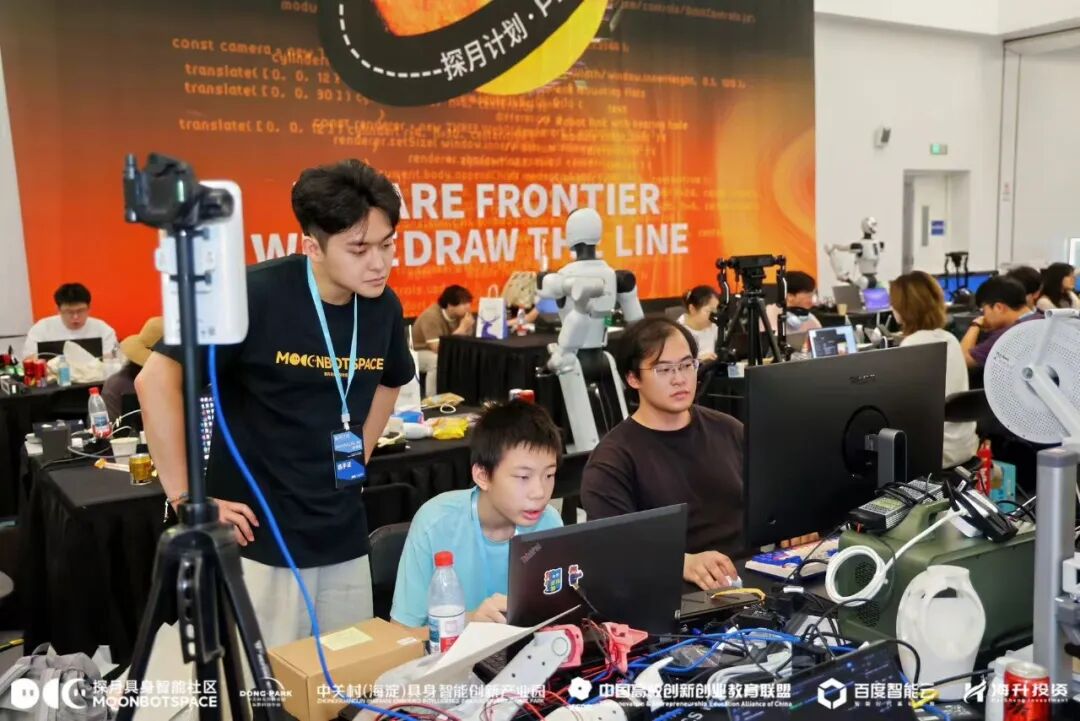
What makes many projects great is not just the idea itself, but the ability of people from different backgrounds to debug and collaborate on complex devices. Some work on robots as poker dealers, while others work on ice hockey.
One team went to a basketball court to use data collection to record shooting actions, then input this data into a large-scale model. They hope that a robot or system can understand how people shoot baskets, enabling them to fine-tune the system.
Another project that left a deep impression on me is the Real to Sim project. Nowadays, when a robot needs to address a specific scenario, engineers often need to go to the site for surveying, which is costly and inefficient. This team used 3D glasses and algorithms to record a real environment, such as a factory in Shenzhen, and fed this information back into the machine system. They first built a simulated environment in the system and then conducted actual operations. People in Beijing might not need to travel to Shenzhen first to collaborate with that factory. Unfortunately, this project did not make it to the top ten, perhaps because the concept was too abstract, but I really liked it.
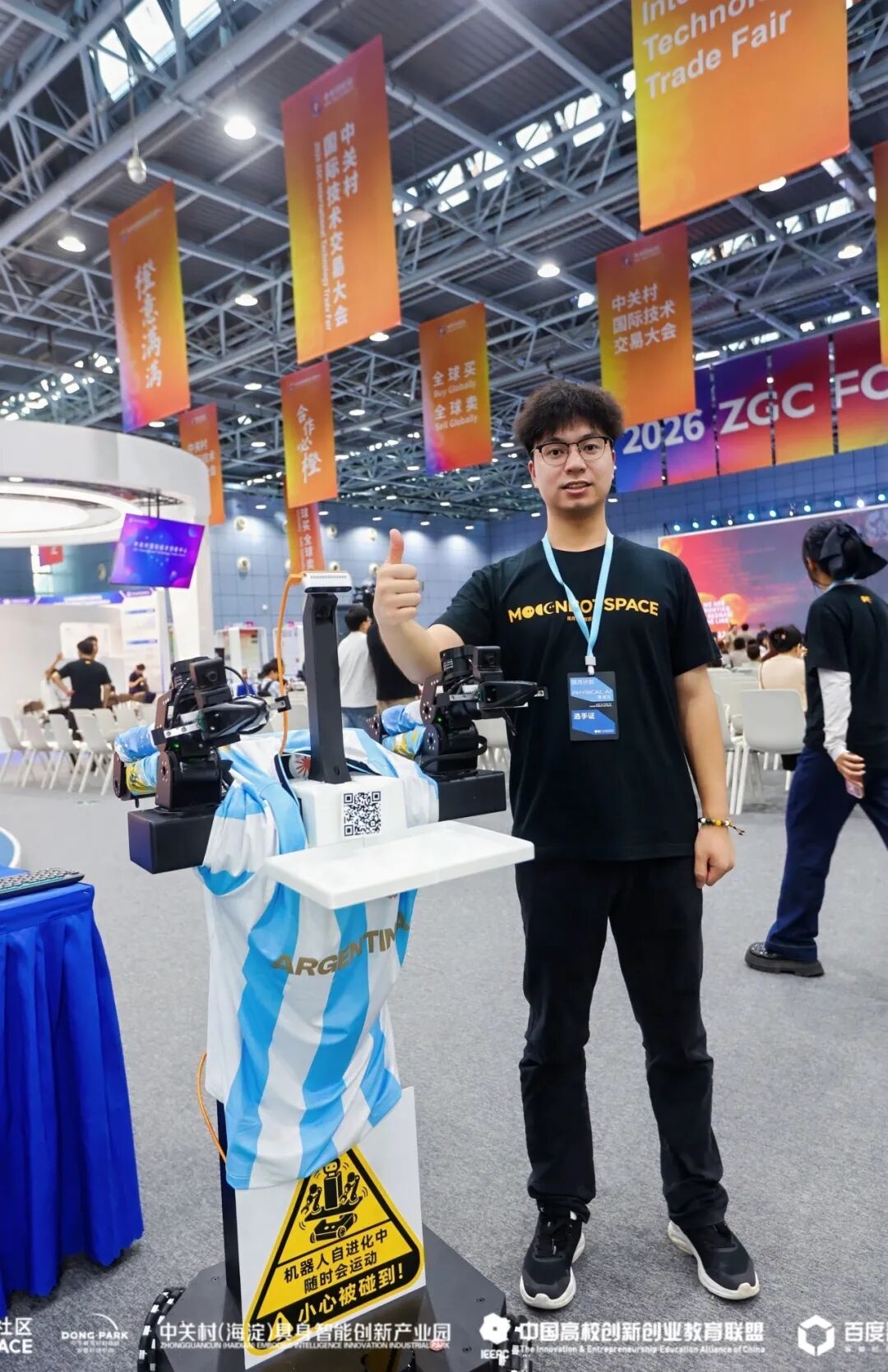
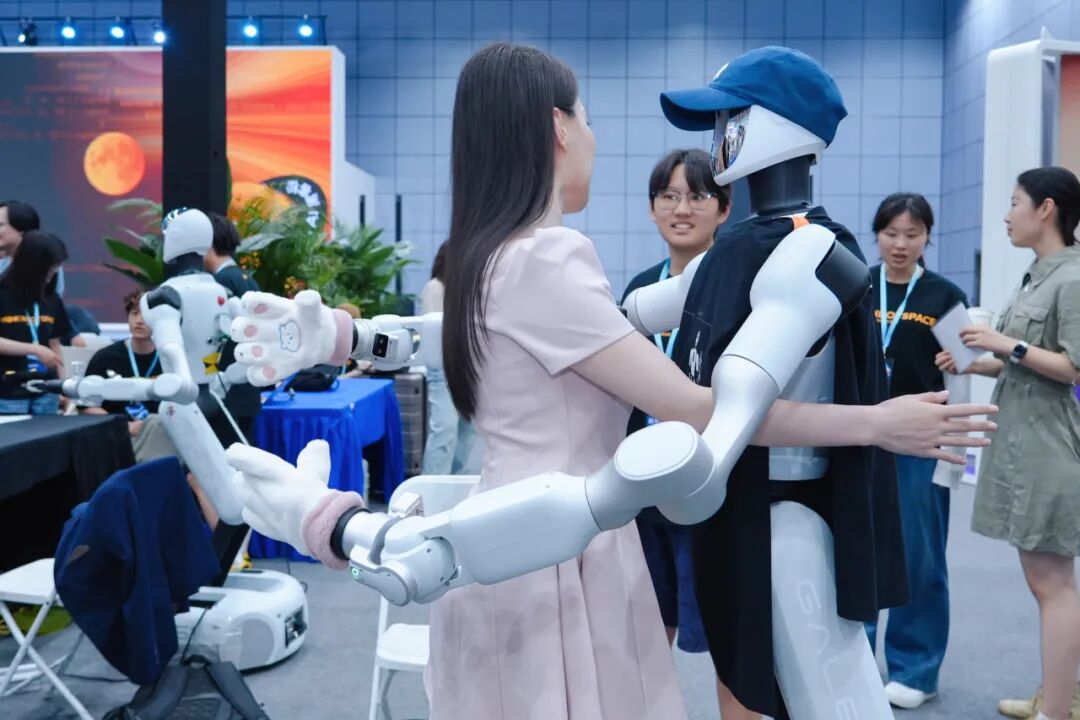
Another project that made it to the top twenty is the "Hug Robot." Students put hats and clothes on a long mechanical arm and hug it. This project may not be technologically difficult, but it involves culture and aesthetics. Students are unwilling to accept a predetermined form of the robot, which is very interesting.

Filtering Out the Foam and People Together
Embodied intelligence always needs a body. The body needs to enter a scene, the scene provides feedback, and this feedback is then fed back into the product and model. Wang Mingyue believes that China's manufacturing capacity, supply chain capabilities, and scene density give this iterative loop its own speed advantage.
At the same time, the embodied intelligence industry will also face many challenges. Geopolitics, regulation, ethics, peer competition, and valuation bubbles will come just like they did in the AI industry before.
Dynamic Observation Beating: What are the advantages of China's embodied intelligence and the problems that have not been fully realized?
Wang Mingyue: Embodied intelligence requires interaction with the physical world, a body, and continuous trial and error iteration. China has a rich and very fast industrial chain. We can quickly create an entity, find a scenario, enter the market, receive positive or negative feedback, and then continue to iterate. This speed is something that many countries, including the United States, find it hard to achieve. Manufacturing capacity, supply chain capabilities, and scene capabilities are strong moats.
As for disadvantages, I am not ready to draw conclusions at this point. Everyone is in infancy, constantly making mistakes. Not understanding things temporarily and having a talent shortage are normal. The key is whether there is confidence and whether there are enough talented people.
This is also the vision of lunar exploration. We hope to bring together people who are willing to do this. It could be "young geniuses," and industry experienced "big geniuses" are also welcome. They can effectively communicate and team up in the community, eventually start a company, and we will be there to accompany and assist. It is precisely because we are still in the development stage that everyone needs each other.
BeatCheck: Beating: Will the geopolitical, policy, and ethical issues in the AI industry gradually extend to embodied intelligence?
Wang Mingyue: Definitely, but I'm not too worried. What should happen will always happen. If an industry has no strange events or risks, it actually means it's not important. The more important the industry, the more likely it is to face geopolitical, competitive, and various complex issues. There is nothing new under the sun; when problems arise, we solve them.
BeatCheck: You mentioned earlier the significant gap between the industry's imagination and current revenue. Applied to specific companies, the industry is still in its infancy, yet some companies have a very high valuation. I previously spoke with an investor focusing on companion robot projects, and he was concerned that some products directly facing users have not yet balanced safety, values, and commercialization speed. How do you view the relationship between such valuations and product maturity?
Wang Mingyue: Any industry will have exceptions. Some companies may seem value-driven and may not perform well in terms of products or other aspects but still achieve commercial success or high valuation. However, exceptions do not represent everyone.
We still hope to convey a more correct entrepreneurial values. In my opinion, prices revolve around value. A person's lifetime is also like this; sometimes overvalued, sometimes undervalued. But if you know your worth, you will eventually return to rationality.
If the technology is not solid, the product is not solid, and there is not enough deep thinking about scenarios and commercialization, even if there is a bubble for a while, even if it is popular for a while, it will eventually be forgotten by the market and people. Those who can survive are still companies with strength and accumulation.
We also hope to provide some positive guidance for newly joined entrepreneurs. Everyone must truly love what they are doing. Entrepreneurship comes with many challenges and pains, which are hard to endure without passion. For example, I am very passionate about what I am doing now. This month, like many post-00s, I often stay up until three or four in the morning. If only economic gains are considered, the accounts don't add up.
At the same time, entrepreneurs should also do things that positively guide society and others to receive positive feedback and persevere. Faced with temporary setbacks or sudden accolades, one must be rational and know their worth.
This hackathon turned out to be much more popular than we expected, but our team remained relatively calm. We did what we needed to do, some as expected, and some not so well, to be improved upon next time. We don't want this to be a one-time event that creates a buzz for a while, gets interviewed a few times, and then fades away. We hope to turn it into a brand, a series. Long-term valuable things need to be done in advance, whether the hype is big or small, just let it be.

Heading to the Moon
In 1970, Apollo 13 was on its way to the moon when an accident occurred, leading to the cancellation of the lunar landing mission. As the oxygen inside the cabin was running low, the ground control center had to devise a way to fit a square CO2 filter into a round receptacle using plastic bags, tape, and cardboard found in the spacecraft.
This historical event was later made into a movie by Ron Howard in 1995, titled "Apollo 13." In the movie, engineers spread out those bits and pieces on a table, trying them out one by one, with no grand vision of landing on the moon in mind.
When Wang Mingyue talked about this hackathon, she mentioned one regret at the end. The booth exhibition segment was lively, with participants presenting their products at booths around the industrial park. However, many judges went to the forum venue and missed this scene.
She mentioned that next year, she may consider eliminating the forum segment and instead bring more judges directly to the industrial park.
Welcome to join the official BlockBeats community:
Telegram Subscription Group: https://t.me/theblockbeats
Telegram Discussion Group: https://t.me/BlockBeats_App
Official Twitter Account: https://twitter.com/BlockBeatsAsia
