According to The Information, NVIDIA's next-generation Vera Rubin server system has been delivered to dozens of customers in small test quantities, with a single cabinet priced at around $7 million to $8 million. The manufacturing partner's ultimate goal is to achieve a maximum daily capacity of up to 1000 cabinets.
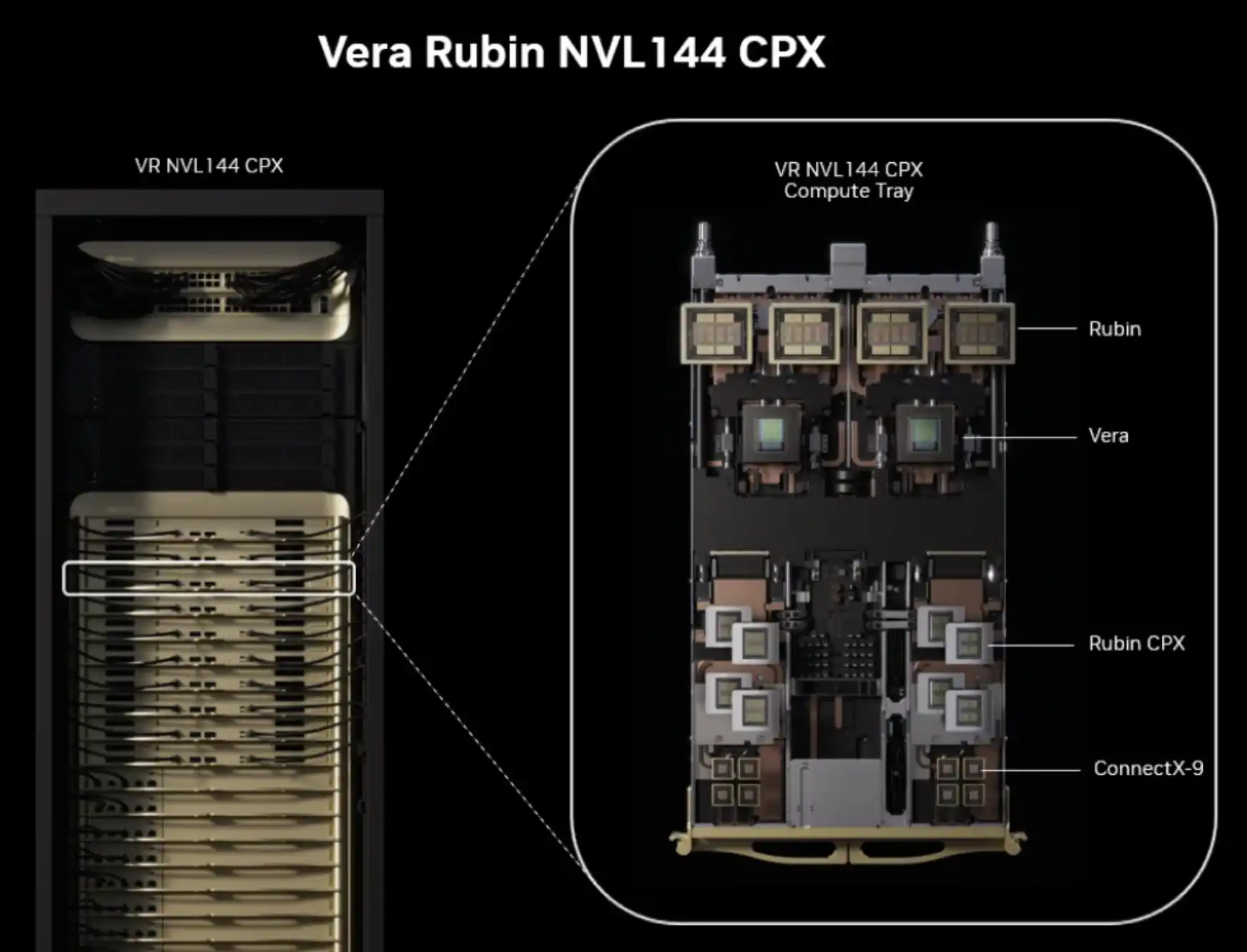
These numbers lay out the focus of NVIDIA's next round of AI hardware upgrades in a straightforward manner: it is not just selling more powerful GPUs but selling more expensive, more complex whole cabinet server systems. According to NVIDIA's official information, the Vera Rubin NVL72 is a rack-level system containing 72 Rubin GPUs and 36 Vera CPUs. Compared to the current flagship Grace Blackwell 300 rack priced at around $5 million, the Rubin single cabinet price is further elevated.
CoreWeave announced in June that the bring-up and validation of Vera Rubin NVL72 had been completed. NVIDIA also recently stated that Vera Rubin has entered full-capacity ramp-up phase, with racks running at partners such as CoreWeave, Google Cloud, Microsoft Azure, OCI, and others. This indicates that Rubin is no longer just a paper product. However, the $7 million to $8 million per cabinet price, dozens of test customers, and the goal of a daily capacity of 1000 cabinets disclosed by The Information are still not NVIDIA's official revenue guidance.
Single Cabinet Priced Up to $8 Million, Buying a Complete Computing Unit
The price of Rubin is not just a chip price increase but a continuation of NVIDIA's whole cabinet system strategy.
After Blackwell, NVIDIA's core product sold to large customers is increasingly not just standalone GPUs but systems that bundle GPUs, CPUs, networking, cooling, power, software, and rack-level interconnectivity together. Customers are purchasing a computing unit that can fit into data center planning, rather than assembling parts from scratch.
This is also why the price per cabinet can reach $7 million to $8 million. According to NVIDIA's technical documentation, the Vera Rubin NVL72 weighs about 4000 pounds, close to the weight of a pickup truck. For cloud providers and AI companies, purchasing a Rubin involves more than just ordering chips; it also requires synchronizing data center floor loading, power supply, liquid cooling, network connectivity, and on-site commissioning.
The Information cited NVIDIA's VP of High-Performance Computing, Ian Buck, as saying that the company wants to sell to all customers, but actual allocation will be tied to whether customers have the physical installation and server onboarding capability. Those who can truly integrate these cabinets into their data centers are more likely to receive more inventory.
1,000 Cabinets Per Day Is Astonishing, But Not Orders
One of the most market-captivating points is the "1,000 cabinets per day."
The Information quoted NVIDIA's Senior VP of Hardware Engineering, Andrew Bell, as saying that over a dozen manufacturing partners working with NVIDIA to produce Rubin racks will eventually be able to produce up to 1,000 racks per day. Based on a price of $7 million to $8 million per cabinet, this corresponds to significant potential revenue.
Based on this production capacity estimate, if 1,000 racks are produced daily, theoretically, this could result in at least $630 billion in revenue for a quarter. For comparison, NVIDIA's revenue for the quarter ending April 26, 2026, was $81.6 billion.
However, this number can only be understood as a theoretical calculation based on "capacity multiplied by unit price." It is not revenue guidance provided by NVIDIA's management, nor is it confirmed orders, and it certainly does not mean that manufacturing partners will operate at full capacity in the long term. Actual shipments will depend on customer orders, the supply chain, data center construction, acceptance pace, and revenue recognition rules.
For investors, 1,000 cabinets per day is more like NVIDIA showcasing the manufacturing upper limit of next-generation systems, rather than a short-term revenue figure that can be directly integrated into the profit model. What will truly impact revenue momentum is whether these high-priced cabinets can be consistently delivered, installed in customer data centers, and put into operation.
Blackwell's Lesson: Let Rubin Solve Manufacturing Challenges First
The first thing Rubin needs to prove is not just performance but whether it can be manufactured, installed, and operationalized more smoothly than Blackwell.
Recalling the issues encountered with the Blackwell racks last year, Bell said, "We almost messed up everything." Hardware, software, diagnostic systems, and manufacturing processes all had problems. After NVIDIA entered a scale of rack production it had never reached before, the system was almost completely rebuilt.
This experience explains why Rubin's manufacturing details are emphasized by executives. The new generation rack is not "cable-free." The NVIDIA tech blog shows that the NVLink spine rear has pre-integrated cable cartridges, containing about 5000 copper cables. The change lies in more cables and components being made into a modular, pre-integrated structure, reducing on-site and assembly line manual wiring work, improving consistency, and assembly speed.
This is crucial for NVIDIA. AI customers buy Rubin not just for computing power on paper, but also for stable delivery and quick deployment. If the new generation rack encounters hardware, software, diagnostic, or manufacturing problems similar to Blackwell's, customer capital expenditure pace will be slowed, NVIDIA's shipments and revenue recognition will be affected.
NVIDIA is also locking customers into a complete data center system
Another layer of meaning to Rubin is that NVIDIA is shifting its position from a GPU supplier to an AI data center system supplier.
In internal discussions, NVIDIA executives emphasize that the company not only sells GPUs but also sells CPUs, network switches, cables, storage, and server cooling technology, among other non-GPU components. This is not just expanding the product line but continuing to hold onto key aspects of the data center as cloud providers and large-scale AI model companies seek alternative AI chips.
Competition is becoming more complex. Google's public information shows that the 8th generation TPU is divided into Training TPU 8t and Inference TPU 8i, indicating a differentiation between inference and training chip routes. Cloud providers and large AI model companies are also looking for cheaper and more controllable computing solutions. If customers partially use non-NVIDIA AI chips in the future, NVIDIA still hopes to sell them networking, interconnects, cooling, and other server components.
This is also why Rubin's single rack price is under scrutiny. It is not a chip's price quote but a new pricing scale formed by NVIDIA by bundling key aspects of the AI data center. The more customers purchase in cabinet-sized systems, the more NVIDIA can gain additional revenue from networking, CPUs, cooling, and system integration.
High-priced racks still face challenges in data center deployment
Rubin has started ramping up capacity, but large-scale commercial deployment may still extend to 2027. Customers need to complete power, liquid cooling, rack installation, network integration, and software adaptation. Any delays in any of these aspects will impact Rubin's actual deployment pace.
Supply chain constraints are not only in advanced chip manufacturing. NVIDIA executives mentioned that the company has a team continually tracking the supply chain and engaging with enterprises involved in aluminum, indium phosphide, and other natural resources. These materials are related to servers and network equipment, indicating that after the cabinet-sized systems are scaled up, bottlenecks may appear in more traditional industrial processes, not just in wafers and packaging.
The target of 1,000 cabinets per day has given the market a huge imagination space, but what Rubin really needs to navigate is a string of real-world constraints: whether manufacturing partners can reliably assemble, whether customers can receive and install, whether data centers can provide sufficient power and cooling, and whether non-GPU components can scale up in sync.
NVIDIA has already pushed the next-generation AI hardware business towards higher unit prices and greater system complexity. What will determine Rubin's success is not just the computational power of 72 GPUs per cabinet, but whether these multi-million-dollar racks can enter data centers as planned and truly get up and running.
Welcome to join the official BlockBeats community:
Telegram Subscription Group: https://t.me/theblockbeats
Telegram Discussion Group: https://t.me/BlockBeats_App
Official Twitter Account: https://twitter.com/BlockBeatsAsia
