On July 24, Intel delivered a financial report that was easily misinterpreted.
According to Intel's official press release, Q2 revenue was $161.28 billion. With a year-over-year growth rate of 25%, this was already a significant number.
What excited the market even more was the guidance for the next quarter. As reported by Reuters via Investing.com, Intel's Q3 revenue midpoint exceeded the analyst expectations aggregated by the London Stock Exchange Group LSEG, causing the stock price to surge in after-hours trading.
If you only look at the headlines, this seems like a story of an old chipmaker hitching a ride on the AI bandwagon. However, the details in the financial report diverged significantly from this narrative. Intel simultaneously presented three tables, one showing growth in data center revenue, another indicating continued substantial losses under GAAP accounting, and a third revealing the drag on the profit sheet from the foundry business.
Who drove the growth?
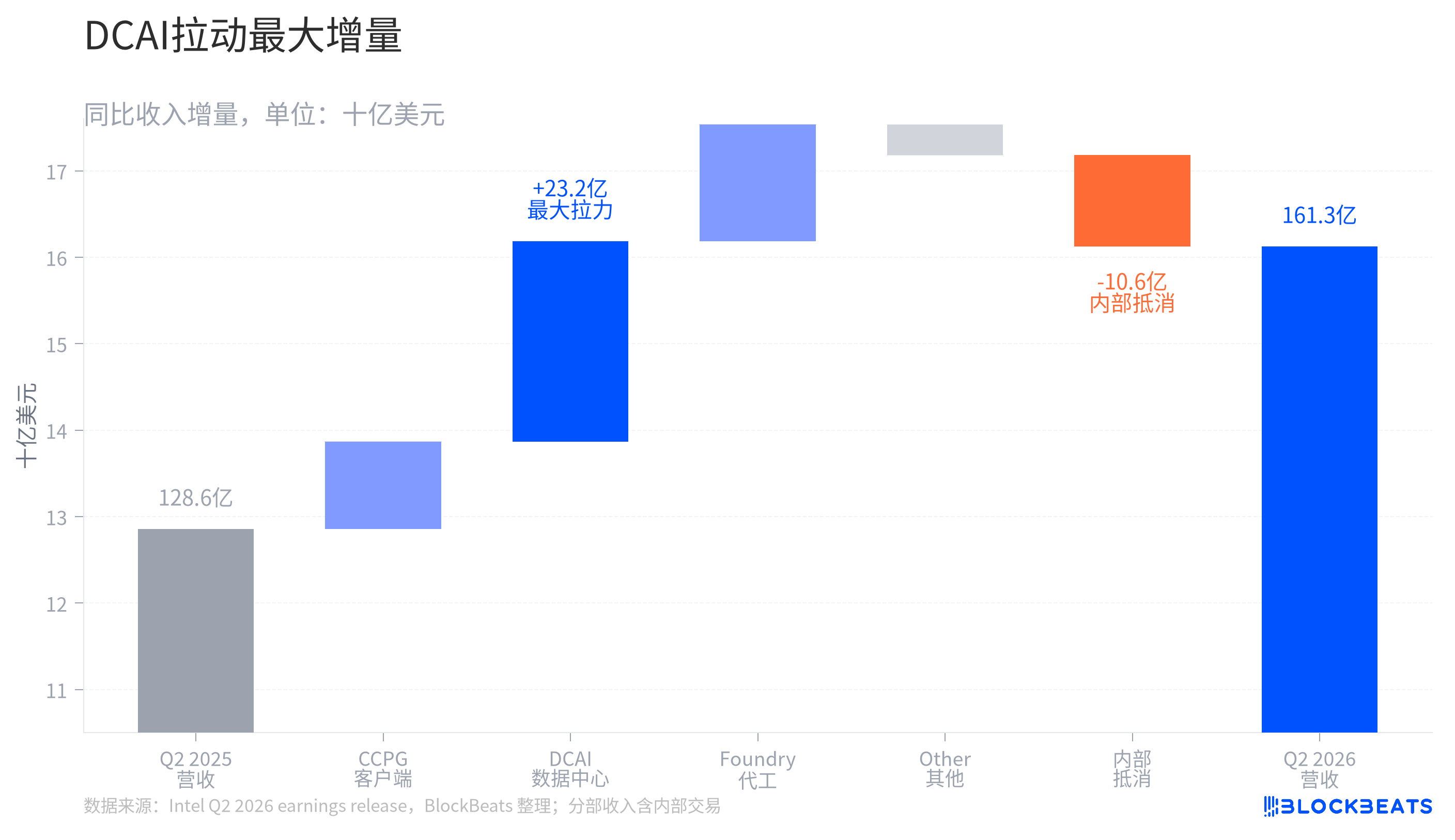
Let's first examine the revenue bridge. This time, the most noteworthy aspect of Intel's report was not the total revenue itself but where the additional revenue came from.
According to Intel's Q2 financials, the consolidated net revenue was $32.69 billion more than the same period last year. The largest incremental blue block in the chart came from DCAI, the Data Center and AI division. If we envision this additional revenue as a rearranged seating plan, DCAI is the one most conspicuously moved to the front in this round.
This explains why the market was willing to react to the stock price first. Intel did not rely solely on the PC refresh cycle to bolster its financials; it genuinely tapped into the CPU, platform, and related demands of the AI server cycle. However, this chart also highlighted another issue in terms of metrics. The Foundry, Intel's manufacturing division, also saw revenue growth, but internal Intel transactions would offset this at the consolidated level. Simply aggregating the divisional revenues and then stating the percentage of a business's share of the company's revenue would misrepresent the data.
This is also why this financial report cannot be simplified as "AI business dominates." DCAI is the primary driver, but it is not the entirety of the company.
Why did revenue surge while incurring a $11 billion loss?
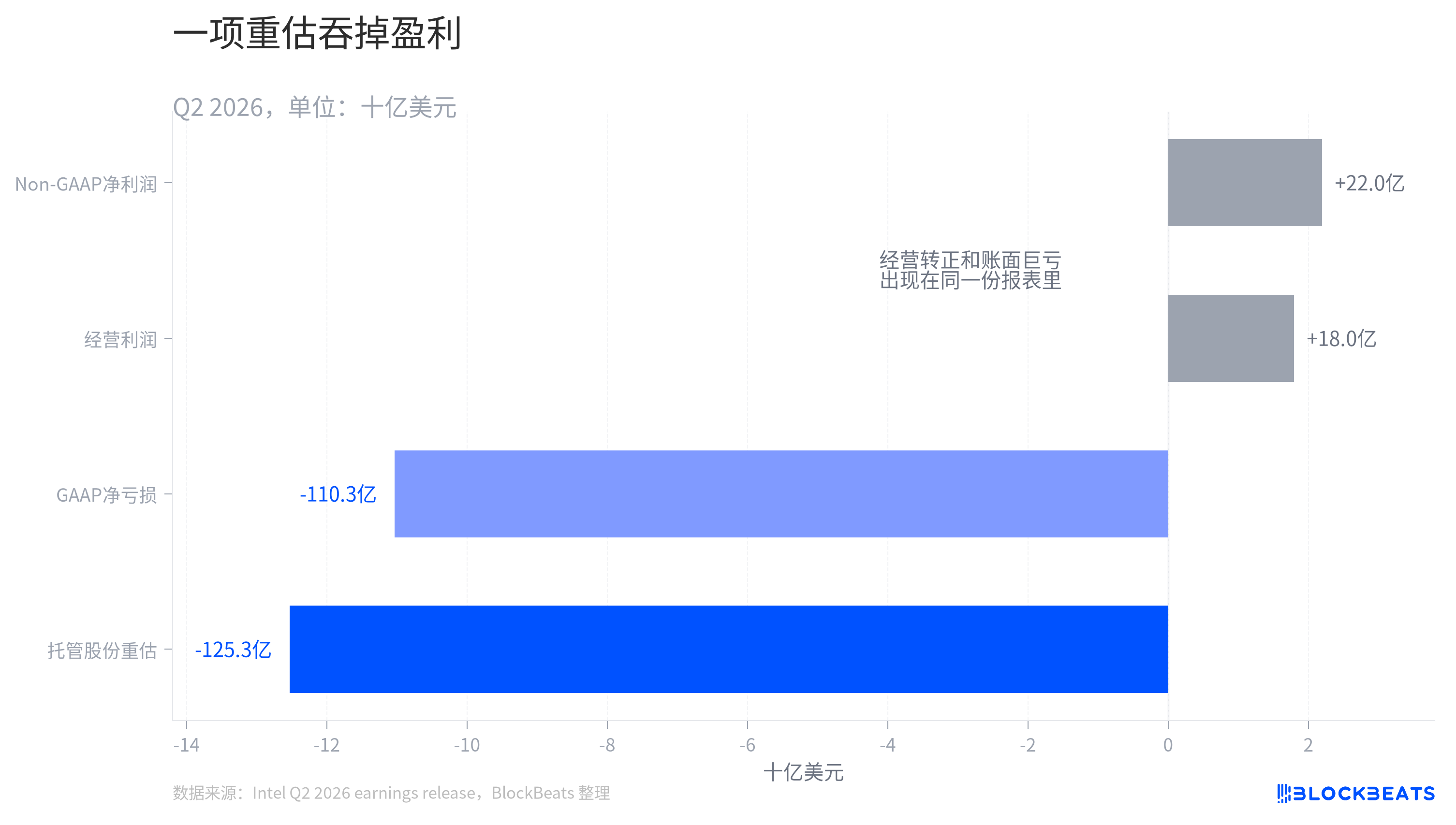
The second contrast lies in the income statement. Many financial report analyses may portray it as "Intel's revenue surges but losses widen," and while this statement is correct, it is not comprehensive.
According to Intel's official press release, Non-GAAP net income was $21.97 billion, while GAAP net loss attributable to Intel was $110.33 billion.
Same company, same quarter, one side shows adjusted earnings, the other side shows a massive loss on the books. What readers really need to ask is, where did that crack in the middle come from.
The answer lies primarily in an accounting revaluation. According to Intel's Non-GAAP reconciliation, the market value loss on government agreement-related trust assets amounted to $12.529 billion. This wasn't money burned in the fab that quarter or a sudden hemorrhage in the data center business. It's more like an asset on the books being revalued, a figure large enough to overshadow the entire operational improvement.
So, the market reaction doesn't seem contradictory. It is buying into the operational turnaround and next-quarter guidance, not the GAAP net loss headline figure. For Intel, the trouble is that the average reader will see the loss first, while professional investors will dissect the adjustments first. Two groups of people reading the same report, yet it's like they are looking at two different statements.
How much does AI really account for at Intel?
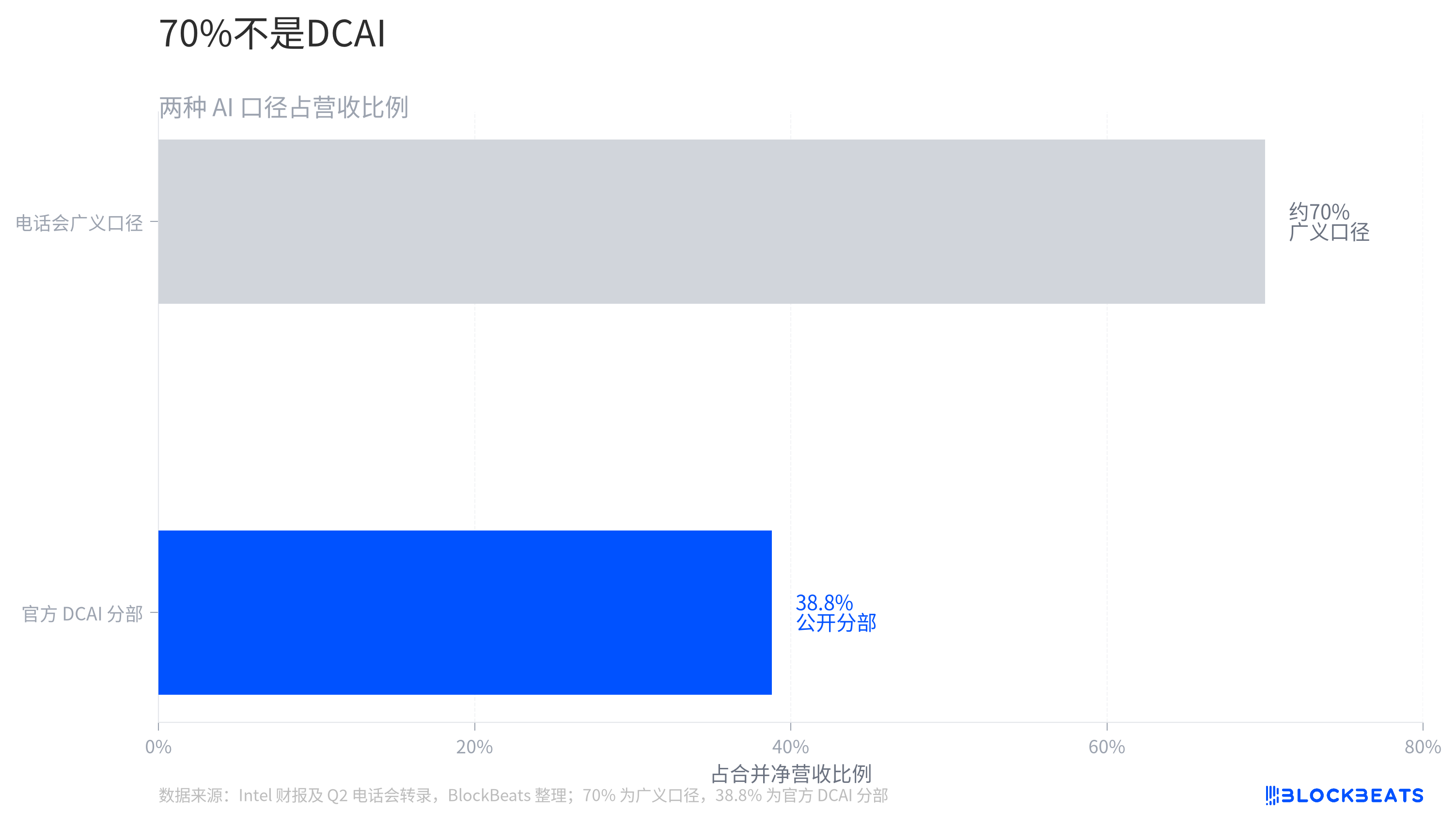
The third misconception comes from the "70%".
Per MarketBeat/Quartr's earnings call transcript, the management mentioned that the "AI-driven business" collectively accounts for approximately 70% of the company's revenue. This statement can easily be transcribed as "Intel's AI business accounts for 70%".
However, in the publicly disclosed segment definition, DCAI revenue is $6.262 billion, representing approximately 38.8% of the total net revenue.
These two numbers are not in the same basket. The former is a broad business definition used by management in the conference call, while the latter is a breakdown available in the financial report. Mixing them up is like considering all revenue related to "dinner" in a restaurant as main course revenue, making the main course suddenly all-encompassing.
This doesn't mean that management is exaggerating. The impact of AI on Intel may indeed extend beyond DCAI to client, packaging, foundry, and platform support. But as long as the company hasn't separated these components in the financial report, the broad statement from the conference call cannot be directly substituted with the segment revenue share in the article.
What needs correction in this picture is not the optimism but the calibre switch. Intel can claim that a larger proportion of its business is being driven by AI demand, but it can't be framed as a company where DCAI accounts for 70% of revenue.
Where's the real unpatched part?
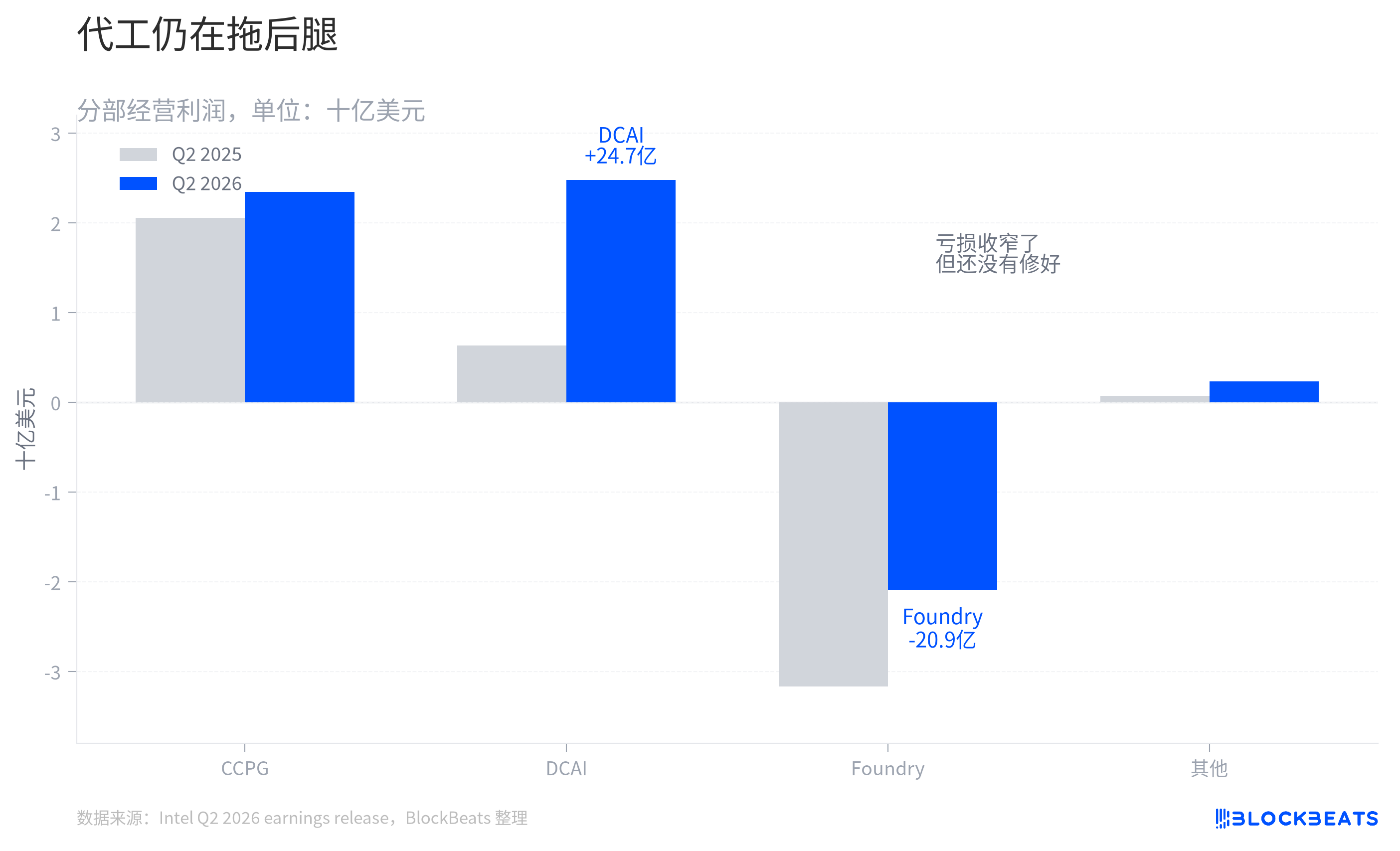
Finally, let's look at Foundry. It is the part of this earnings report most easily overshadowed by the after-hours stock surge.
According to Intel's official breakdown, DCAI recorded a $24.74 billion operating profit, while the Foundry segment incurred a $20.89 billion loss. The former is like the traction pulling the front of the car, while the latter is like the brake that has not been released yet.
Intel's issue is not the lack of AI revenue, but rather that this AI cycle has not yet turned the foundry business into a profit machine.
To be fair, Foundry has shown improvement. It incurred a $31.68 billion loss in the same period last year, and the Q2 2026 loss has already narrowed. For a capital-intensive manufacturing company, this kind of improvement is significant. Depreciation of fabs, capacity ramp-up, and customer mix shifts will not pivot as swiftly on a quarterly cadence as in cloud software.
However, when the market prices AI growth, it often subconsciously uses the Nvidia-like model as a reference. Nvidia benefits from the fact that the AI cycle flows directly into high-margin revenue from GPUs and networking products. Intel's path is more convoluted; it has to sell CPUs, maintain a client base, drive forward with advanced processes, and prove that its foundry business can handle external customers all at once.
This is the true tension of this earnings report. DCAI has allowed Intel to re-enter the list of AI players, while Foundry continues to remind the market that Intel is not a lightweight AI company.
What Intel has received this time is not a certificate of resurrection, but a repriced ticket to the game.
Welcome to join the official BlockBeats community:
Telegram Subscription Group: https://t.me/theblockbeats
Telegram Discussion Group: https://t.me/BlockBeats_App
Official Twitter Account: https://twitter.com/BlockBeatsAsia
