Safe Superintelligence, or SSI for short, is finally no longer just a company rumored to be hidden in Silicon Valley.
On July 27, NVIDIA announced a long-term partnership with this lab founded by former OpenAI Chief Scientist Ilya Sutskever and has made an investment in it. The most eye-catching arrangement is not the amount, but Vera Rubin. NVIDIA will allow SSI to use this as-yet-unscaled platform, with the official statement saying that SSI's computational resources will increase by an order of magnitude.
The company was founded two years ago, with no public models, no products, and no demos. Co-founder and former CEO Daniel Gross left last year. Sutskever, who remains, took over as CEO, continuing to narrow SSI's goal to achieving safe superintelligence.
This time, he gave a sentence that can be seen as a progress bar by outsiders for the first time. According to the joint announcement from NVIDIA and SSI, Sutskever said, "We already have research worth scaling up."
This is not a model report card, nor is it a product release date. It is more like an admission ticket. What SSI has done in two years is to first confirm whether a research path is worthy of large-scale computing power. Now, what NVIDIA is giving it is the machines needed to enter the next round of training.
Why has capital arrived before a product?
Superficially, SSI's financing story is somewhat unusual. A lab that has not yet produced a public product has seen its valuation rise first. According to Reuters, in two rounds of public financing, SSI's valuation has risen from about $5 billion to about $32 billion.
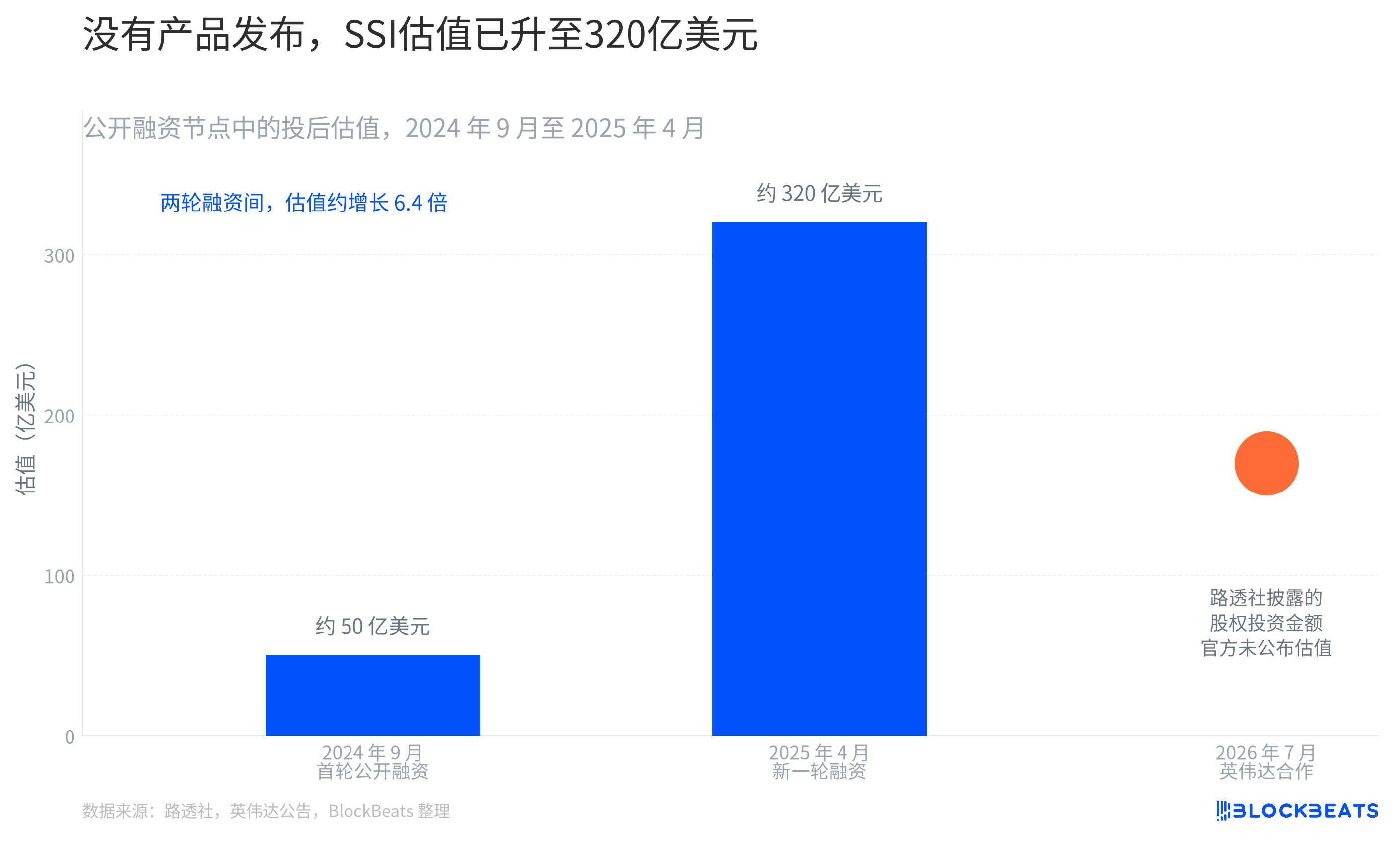
The gap in the picture explains why NVIDIA's appearance is not surprising. Between the two rounds of public financing, SSI's valuation has roughly increased by 6.4 times. The funds are buying not verified commercial revenue, but an option. If Sutskever's found path can continue to be viable on a larger scale, the early capital and computing power providers standing by will secure a seat to the next stage first.
There is a difference in the reported amount of NVIDIA's investment. Reuters states the equity investment as $5 billion, while NVIDIA's official announcement only mentions a "significant investment" without providing a number or disclosing SSI's current valuation. Therefore, the orange dot in the figure represents the investment amount reported by the media and does not represent a new valuation round.
SSI's capital density should not be misread as it already having an organization of equal size. NVIDIA's announcement only states that it has been advancing a new research direction in secret for the past two years. From the publicly available information, SSI has not showcased models, products, or demos. This silence is not a mere decoration of insufficient evidence, but the real subject this collaboration is meant to explain.
Sutskever: What Does "Worth Scaling Up" Really Mean
In the large-scale modeling industry, scaling up is not just about buying more GPUs. It means researchers believe that their current approach is worth testing with more data, longer training times, and larger clusters. This judgment is costly and easily prone to error. If the foundational route is flawed, adding more computing power will only amplify the mistake faster.
According to a joint announcement, SSI has been advancing a new research direction over the past two years. Sutskever's exact words were that the team has "research worth scaling up." Nvidia, on the other hand, stated that it only entered into this collaboration after obtaining rare access to SSI's confidential research. Combining these statements, we can see the sequence of events, where the research direction received internal validation first, followed by the spotlight shifting to the supply of computing power.
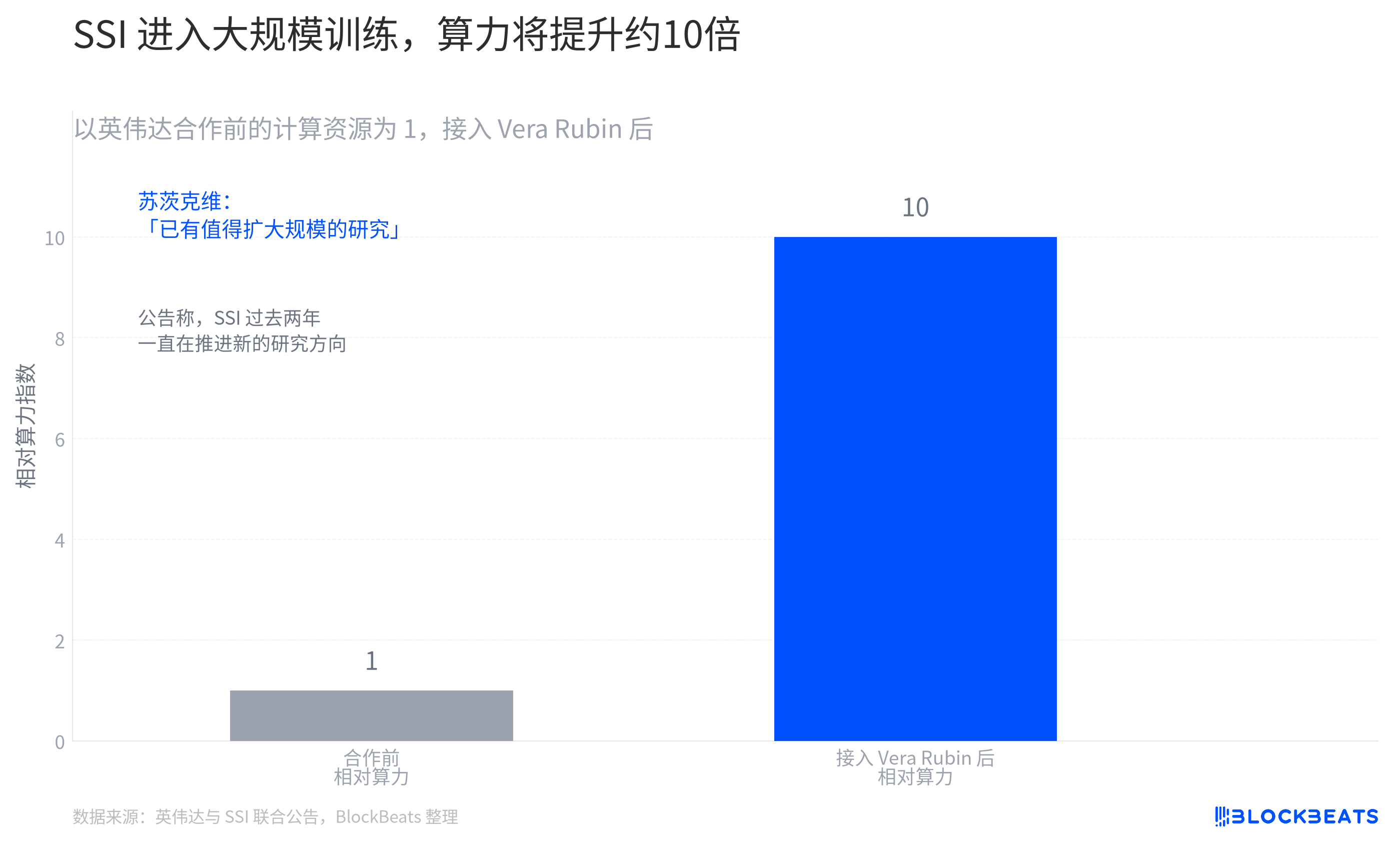
The "10" in the diagram does not represent chip performance scores. It signifies the computing resources that SSI itself has access to, relative to the increase before the collaboration. Think of it as a laboratory moving from a single workbench to a factory. The workbench is enough to determine if a route is viable, while the factory is used to answer if it can be reliably replicated on a larger scale.
This also delineates a critical boundary. SSI can be understood to have completed small-scale route validation and is now poised to enter the truly large-scale training phase. However, "worth scaling up" does not equate to having publicly proven the model's capabilities, nor does it directly translate to an "upcoming product release." In the collaboration announcement, SSI is still showcasing its research direction to the public, not a finished product.
Daniel Gross's departure has brought more focus to this route. Sutskever confirmed in July 2025 that Gross's final day in office was June 29, 2025. The current SSI is led by Sutskever and co-founder Daniel Levy. The company's most recognizable asset, which initially stemmed from a founding team, has now shifted to Sutskever's judgment on the research direction.
Nvidia's Purchase is not an Order Batch, but an Entry into the Next-Gen Platform
If this event is only seen as Nvidia selling GPUs, the most interesting part of the deal would be missed. Nvidia not only provides equity investment but also includes access rights to the Vera Rubin observatory as part of the long-term collaboration. What Nvidia is striving for is to have itself ingrained in SSI's technical roadmap well before the large-scale training truly commences.
This preemptive relationship closely aligns with changes in Nvidia's core business. According to Nvidia's FY2026 earnings, data center business revenue has surged to $193.7 billion. This revenue group has expanded nearly 13 times over four fiscal years, indicating that the computing power business is no longer solely about a purchase order but about securing the default position for the next-gen platform before research projects evolve into large clusters.
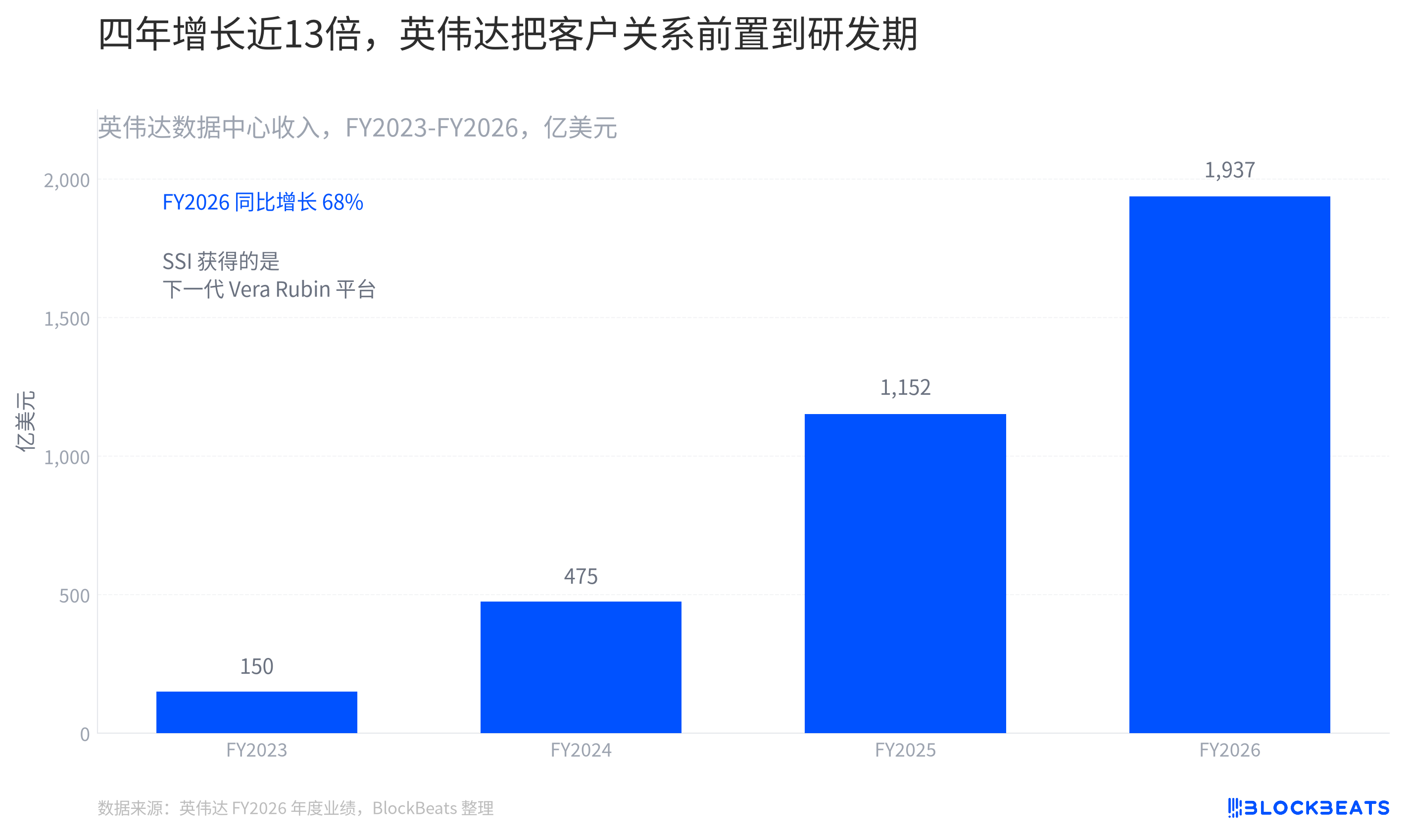
There is an easily overlooked time gap here. The significance of Vera Rubin to SSI is to give about 10 times the computing power to an unpublished study. For NVIDIA, it means adopting a new platform a generation earlier before customers start scaling training. What is exchanged between the two parties is not an immediate income but rather the priority access to future training cycles.
SSI still hasn't handed the answer to the outside world. What NVIDIA is betting on is whether the phrase "worth scaling" from Sutskever can ultimately hold on a larger machine.
Welcome to join the official BlockBeats community:
Telegram Subscription Group: https://t.me/theblockbeats
Telegram Discussion Group: https://t.me/BlockBeats_App
Official Twitter Account: https://twitter.com/BlockBeatsAsia
