Last week, Situational Awareness, the hedge fund under the 'AI Stock God,' was forced to liquidate a $16 billion stock position after a high-leverage bet on AI companies went sour; at the same time, the South Korean KOSPI index plummeted over 20% in 48 hours, only to rebound 25% from its low point and ended the week almost flat.
The market viewed these two events as incidental 'noise' and quickly digested and moved on. After a brief shakeup, the market eventually returned to calm.
However, this forward-looking consensus may be a dangerous misreading. The 'AI Stock God' fund liquidation and the Korean stock plunge, on the surface, did not trigger a systemic market collapse, but according to Deutsche Bank, both are symptoms of leverage buildup in the era of low-interest rates and should not be seen as isolated incidents.
On August 3, Deutsche Bank Research Institute analysts, including Luke Templeman, wrote in a report:
"We believe this interpretation is wrong, at least incomplete. Both are symptoms of the same underlying condition: leverage—leverage present in ETFs, margin accounts, and hedge fund books—a leverage generated by over a decade of low and stable rates."
Even more worrisome is that Fed Chair Powell has withdrawn forward guidance, which may be a deliberate shift—intentionally reintroducing a 'risk premium' to the market to curb excessive leverage. By actively introducing uncertainty, the Fed is set to witness 'small wobbles' with higher frequency, each of which could act as a trigger for a larger crisis.
"Flat is Closed" Is the Most Dangerous Illusion
The KOSPI completed a full 'V-shaped' movement within a week, almost returning to its original level. However, the Deutsche Bank report points out that this number is highly misleading.
A 45% swing in a few days for an index is fundamentally different from staying still in economic terms.
The reason lies in the mechanism of leveraged positions: during a downturn, leverage and margin positions are usually mechanically and irreversibly forced to liquidate, regardless of any subsequent rebound. While the gains and losses at the index level might offset each other, the wealth losses of individual investors—especially retail investors using leverage for the first time—cannot be 'repaired' by a rebound. Those who have been liquidated cannot come back.
Reports suggest that over 3% of South Korean adults have received margin call notices in the past two weeks. The report states, "If true, this number is deeply concerning."
This is not a market fluctuation; this is a real loss of household wealth.
Leveraged ETFs: Korea Today, US and Europe Tomorrow?
The collapse in Korea had a specific trigger: in April of this year, single-stock leveraged ETFs tracking Samsung Electronics and SK Hynix were officially launched.
These two underlying assets were already mega-cap stocks worth over a trillion dollars, with a significant portion held by retail investors. After the leveraged ETFs were introduced, retail investors' leveraged exposure to these two stocks was dramatically amplified almost overnight. As the underlying stocks declined, the leverage products' magnification effect on the downturn immediately triggered a chain liquidation.
Analysts warn that this is not a Korea-specific story. "Similar products in the US and Europe are also experiencing rapid growth."
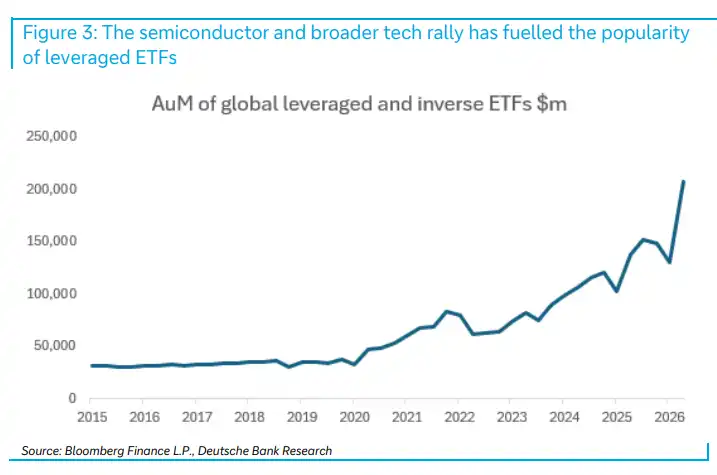
If a similar event were to happen in the US, the transmission pathway would be far more devastating than a hedge fund unwinding – it would penetrate consumer spending (households cutting expenses due to additional margin calls), credit markets (brokerages and lenders reevaluating collateral), and market confidence (retail participation reversing).
Deutsche Bank compared Korea's event to another case: the apparent isolated incident of Silicon Valley Bank (SVB) collapsing, which in reality forced policymakers to nearly guarantee deposits for the entire US banking system – an intervention far exceeding the scale of the initial issue.
The lesson is not that every small issue will evolve into a systemic event, but rather that those that do evolve are almost always not apparent beforehand.
Same Root Cause: A Decade of Leverage Accumulation in a Low-Interest-Rate Environment
The blow-up of the "AI Stock God" fund and the flash crash of the KOSPI seem unrelated. Deutsche Bank believes that both are different symptoms of the same ailment: over a decade of a low and stable rate environment has systematically encouraged the accumulation of leverage in ETFs, margin accounts, and hedge fund books.
It's like the foundation of a building settling slowly over many years – not visible on the surface until a trigger point reveals the cracks.
Analysts also note that while the market and policymakers' attention has long been focused on sovereign debt risks, the risks of household leverage have been systematically underestimated – while the growth rate of household leverage has plateaued, the absolute level remains high.
When we show the chart below, clients' focus will be on the rise of sovereign debt, rather than the plateau of household leverage.
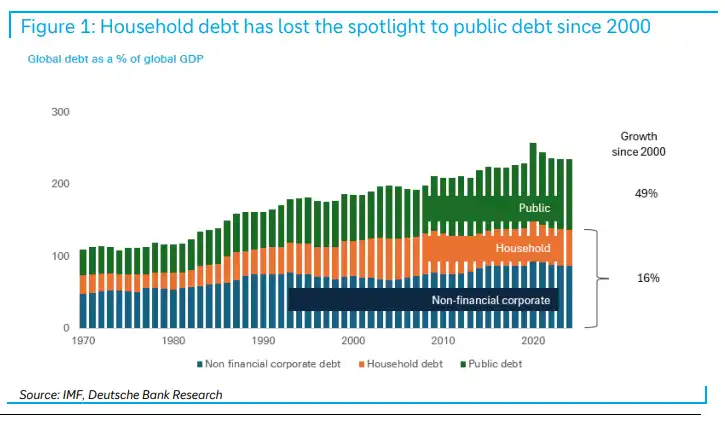
This "focus shift" is the very reason why the current household leverage risk is systematically underestimated.
“Microshock” Events Are Occurring Frequently, Not by Chance
Deutsche Bank's data shows that since 2022, the peak frequency of the VIX has been significantly higher than the average of the past decade.
Analysts have linked this phenomenon directly to the normalization of global central bank monetary policies: in the low-rate era, market volatility was suppressed, leading to leverage accumulation; when rates return to normal, the suppressing force on volatility disappears, and the accumulated leverage starts to seek an outlet.
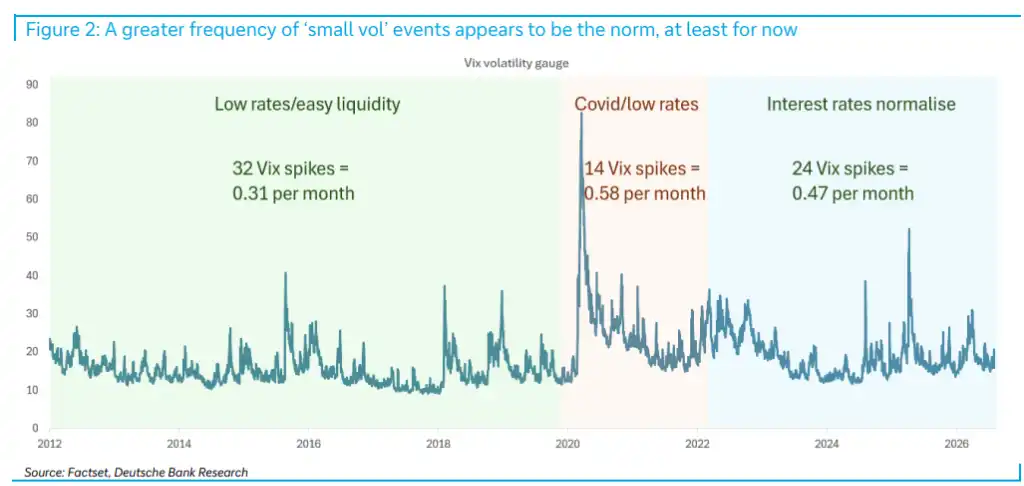
Since the normalization of rates in 2022, the frequency of "microshock" events in the VIX has been significantly higher than the past decade. Meanwhile, traditional safe-haven assets—gold, the US dollar, the Swiss franc, the Japanese yen, US Treasuries, German Bunds—have all failed to effectively hedge risks in multiple shocks since 2020, including the COVID-19 pandemic, rate hikes in 2022, tariff shocks in 2025, and the Iran war in 2026.
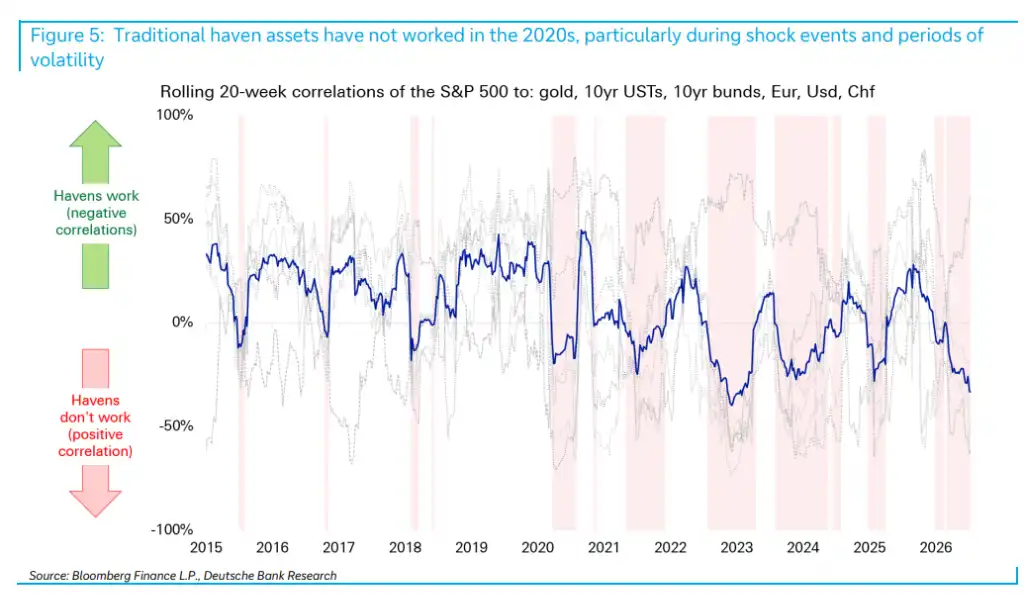
Analysts wrote: “If safe-haven assets continue to fail precisely when most needed, the implicit buffer that investors rely on is much thinner than before. This increases the probability of 'microshock' events evolving into larger issues in the future.”
The Powell Pivot: Is the Fed Actively Manufacturing Volatility?
Deutsche Bank presents a key framework in its report to understand the current market environment—a fundamental shift may have occurred in the Fed's policy logic.
The report cites analyst Rob Armstrong's theory: Fed Chair Powell's withdrawal of forward guidance was not a communication misstep but a deliberate policy choice. The core logic is that forward guidance has long suppressed daily volatility, and low volatility, in turn, encouraged government and market participants to accumulate borrowing and leverage beyond normal levels. In Armstrong's words, “too little daily volatility will eventually lead to a financial crisis.”
Powell's solution is to reintroduce an “uncertainty premium” to the market—letting the market feel risk again, thereby spontaneously restraining excessive leverage behavior. He cannot openly express this logic, as it would directly trigger market panic, so he presents himself in a more ambiguous "referee" style. However, Armstrong sees the policy actions clearly pointing in the same direction.
The profound implication of this logic is that if volatility itself has become a policy tool, then the frequent occurrence of "small-scale" events is no longer just a by-product of the market, but a deliberately intended—even welcomed—outcome by policymakers. Investors should stop treating each "Situational Awareness-style blow-up" or "KOSPI-style flash crash" as an isolated incident—they may very well be the new normal.
Where is the Lingering Risk?
In conclusion, Deutsche Bank listed two areas where hidden residual risks still exist:
Private Equity: A large number of technology, media, and telecom (TMT) targets acquired during the near-zero interest rate era are still held on PE balance sheets, with holding periods far exceeding expectations due to a lack of exit opportunities. "The liquidation moment may still lie ahead."
Publicly Listed Companies: Many publicly listed companies are still burdened with inefficient assets acquired during the previous debt-driven merger frenzy, with low asset turnover rates. This is a legacy of cheap financing that encouraged "revenue-heavy, profit-light" expansion.
The analysts wrote, "The market's instinct is to classify Situational Awareness fund blow-ups and KOSPI volatility as 'noise,' as neither has yet evolved into a systemic event. This instinct could be dangerous, especially in a scenario where policymakers not only tolerate but may even actively guide more daily volatility."
Welcome to join the official BlockBeats community:
Telegram Subscription Group: https://t.me/theblockbeats
Telegram Discussion Group: https://t.me/BlockBeats_App
Official Twitter Account: https://twitter.com/BlockBeatsAsia
