A second-quarter earnings report shifted AMD's two revenue streams in opposite directions. According to AMD's quarterly report, the Data Center business revenue reached $6.718 billion, a 107% year-over-year increase.
In the same report, the Gaming business revenue was $0.779 billion, a 31% year-over-year decrease. Looking at these two figures side by side, it's easy to raise an intuition: Is AMD shifting the business that originally belonged to Gaming over to the Data Center?
A public earnings report can only answer where the revenue is coming from; it cannot directly reveal how R&D, wafer capacity, or customer resources flow internally within the company. But by combining these 12 quarters of segment data, at least that intuition can be dissected further.
First, Look at the Overall Picture to See if Growth is Just Internal Shuffling
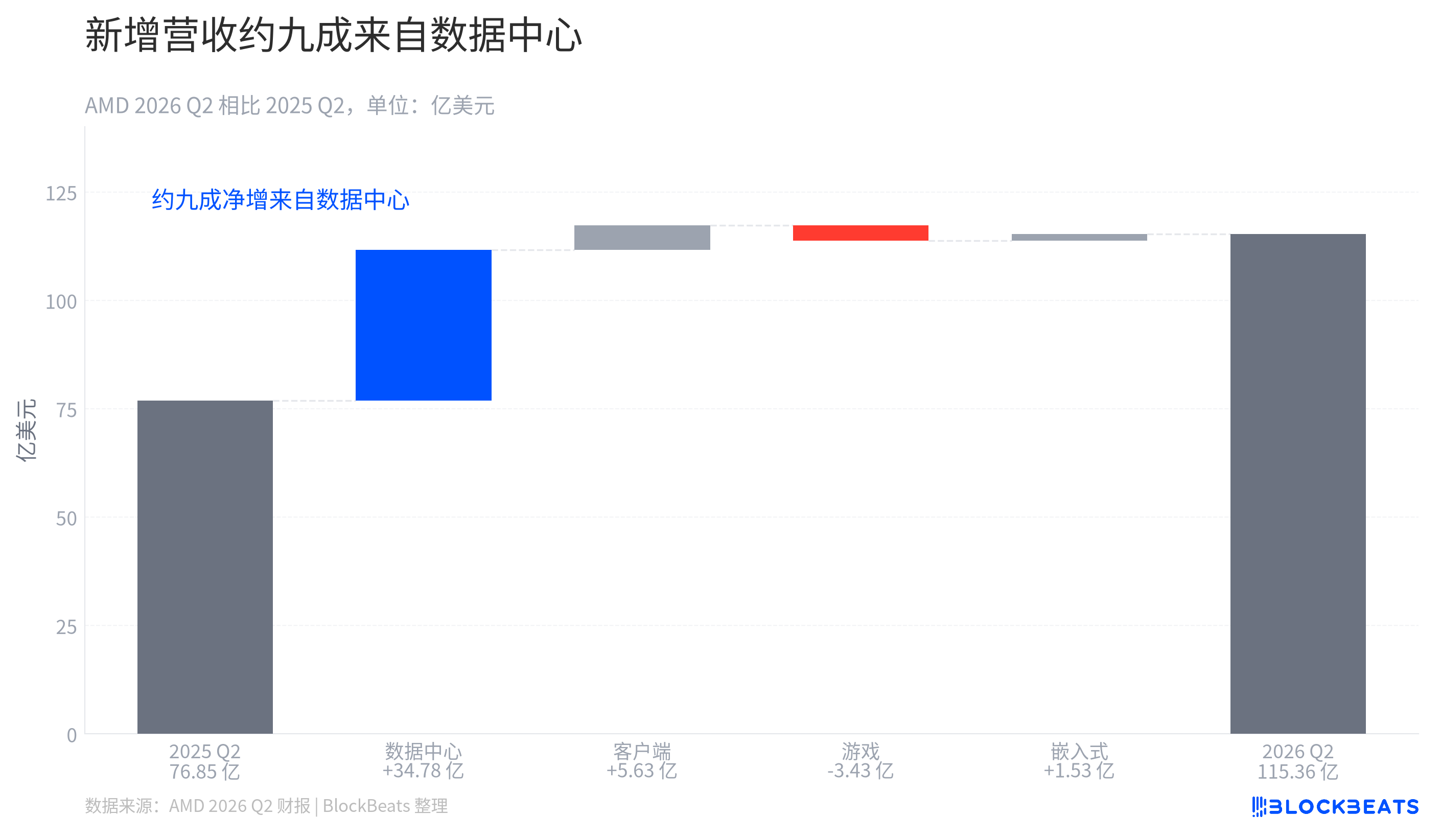
Looking at the year-over-year bridge first provides a more restrained answer than a zero-sum game. According to AMD's quarterly report, the company's total revenue increased from $7.685 billion to $11.536 billion. The endpoint is significantly higher than the starting point, indicating that growth primarily occurred at the overall level rather than through an equal exchange between the two existing businesses.
The tallest blue bar in the chart comes from the Data Center. According to the AMD report, this segment increased by $3.478 billion year-over-year, accounting for about 90% of the company's quarterly net revenue increase. This is a simple revenue calculation and cannot be used to infer that R&D, capacity, or customer resources have been shifted from one business to another.
The Client and Embedded business also saw growth for the quarter. The Gaming business decreased by $0.343 billion compared to the previous period. While this decline does exist, it is not enough to explain the scale of the new revenue brought in by the Data Center. Therefore, this chart supports the idea that the "total revenue base has expanded" and does not prove a one-to-one resource substitution between the two businesses.
There is another often overlooked perspective here. AMD attributes the Gaming business's year-over-year decline in the earnings report mainly to lower semi-custom revenue, which also includes the Console semi-custom business. Reading this line as directly related to Radeon discrete sales or consumer GPU demand would narrow the segment's scope.
When Did the Data Center Become the Revenue Center
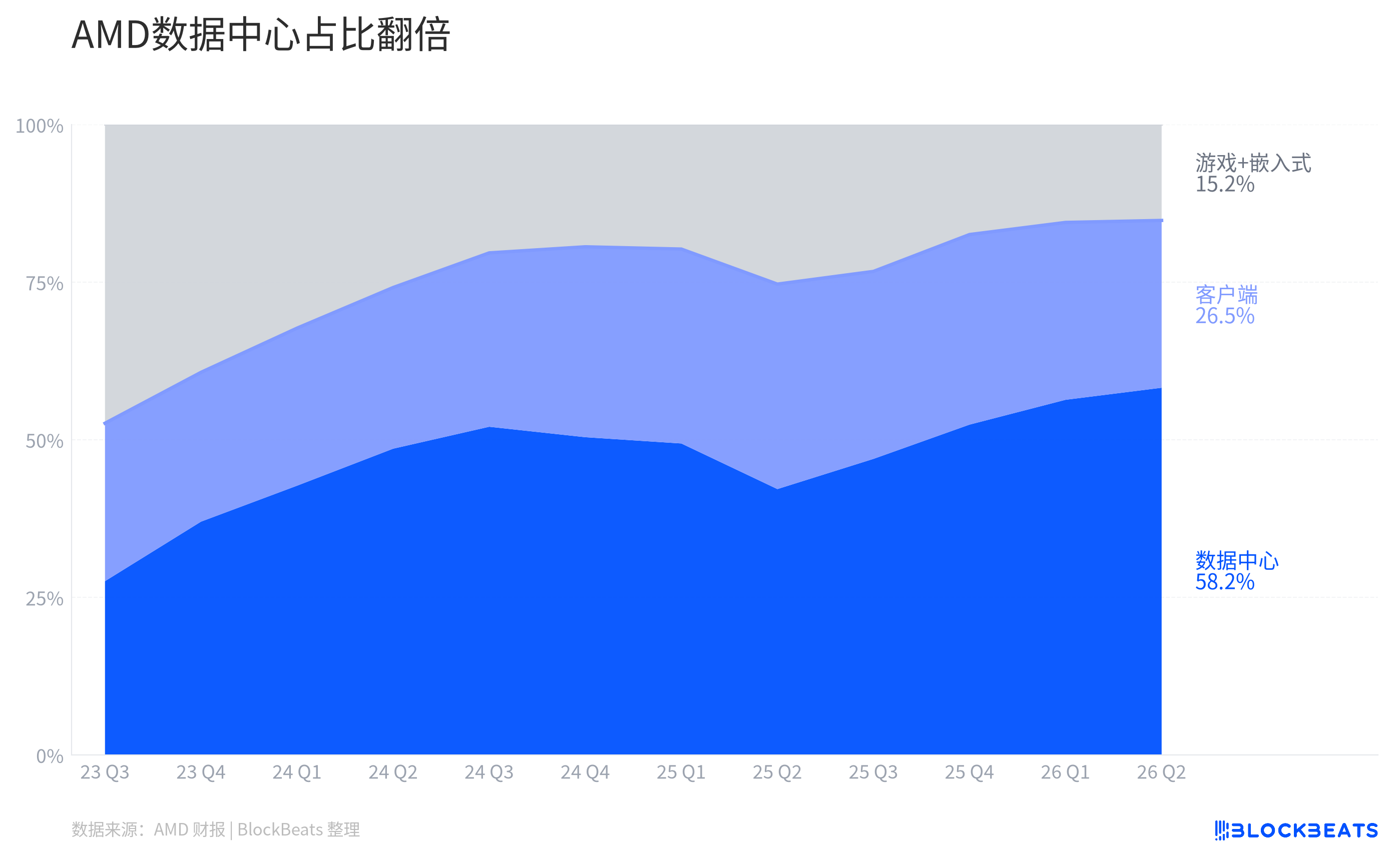
Single-quarter highs and lows are always influenced by product delivery schedules, but structural changes over consecutive quarters better reflect revenue trends. According to AMD's sequential quarterly reports, the Data Center's share of total revenue increased from 27.6% to 58.2%. In the context of every one hundred dollars in revenue, the Data Center has shifted from less than three-tenths to over half of the total.
The crossover point occurred in the fourth quarter of 2025. The deep blue area in the chart never dropped below half afterwards, making the Data Center segment AMD's largest revenue contributor. Client, Gaming, and Embedded remained revenue sources, with Gaming and Embedded combined in the chart to prevent misinterpreting changes in the Gaming segment as fluctuations in a specific graphics card product.
An increase in the Data Center segment's share does not mean that AMD has transformed into a company that only sells AI chips. According to AMD's segment descriptions, this segment includes various businesses such as server processors and accelerators, and the financial report does not break down all increments into individual products. The chart illustrates a shift in revenue structure, indicating which segment contributes a higher percentage of revenue, but it does not replace an internal ledger detailing product configurations or resource allocations.
This area chart also retains an easily overlooked interpretation. The combined three layers of each quarter add up to 100%. The widening of the deep blue area signifies not only an absolute increase in Data Center revenue but also its higher relative position within AMD's overall revenue. It demonstrates how the segment's revenue structure is evolving but does not independently explain product configurations, capacity allocations, or internal resource trade-offs.
Where Does AMD Stand Among Its Peers?
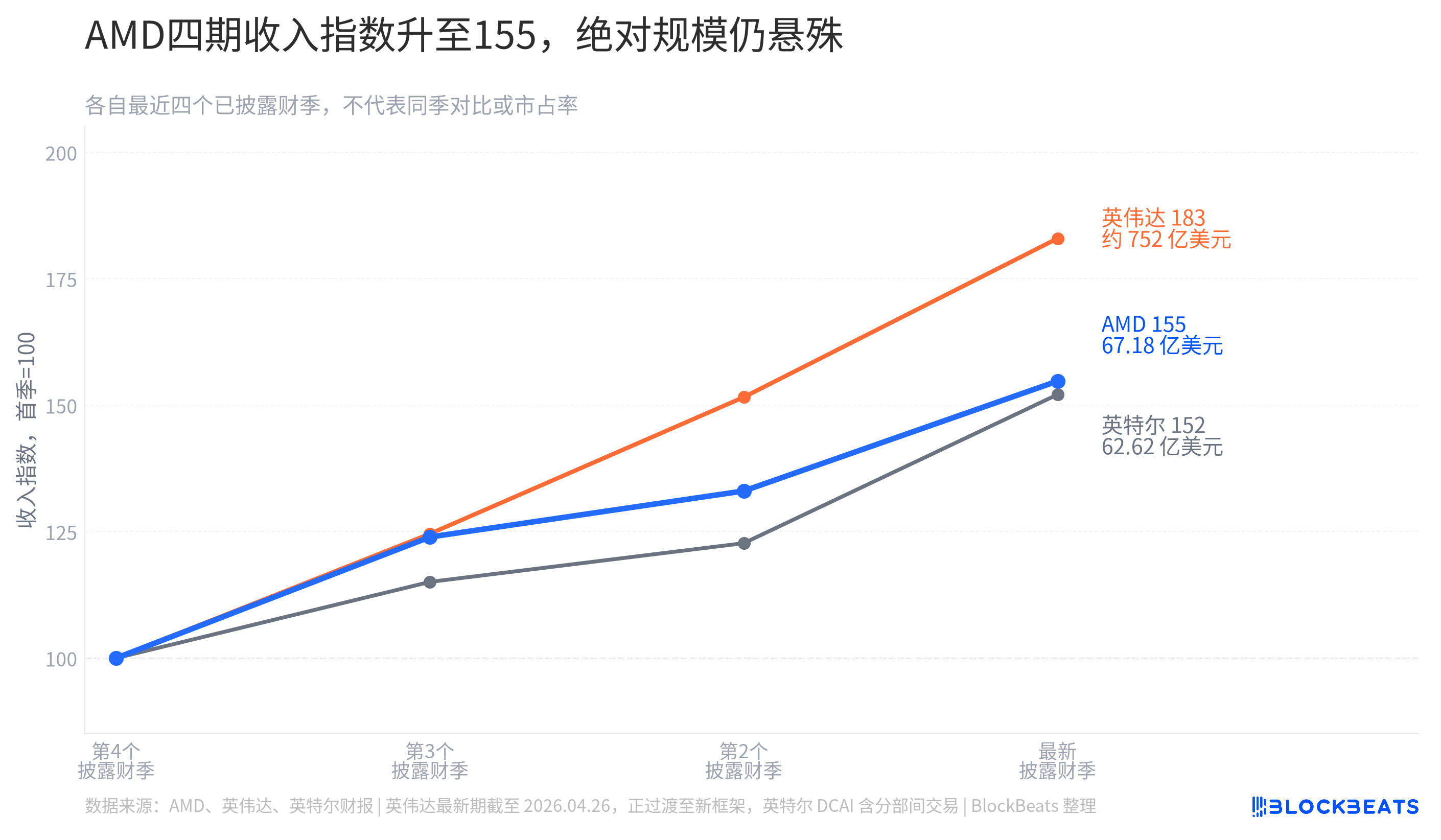
When comparing AMD to its peers, the most common mistake is treating the same index chart as if it represents the same competition. Based on the financial reports of AMD, NVIDIA, and Intel, Chart 2 normalizes the revenue of the three companies over the past four disclosed quarters to 100, with the blue line reaching 155, indicating a rapid growth of AMD's Data Center revenue in this disclosure sequence. NVIDIA's line is steeper, and Intel's line is also trending upwards.
Beyond speed, there is also scale. According to the latest available financial reports of the three companies, AMD's Data Center revenue is $6.718 billion, while NVIDIA's is around $75.2 billion. Viewing the two endpoint labels together prevents misinterpreting an upward-trending blue line as a completed position swap in the competitive landscape.
AMD's latest segment revenue figures are close to Intel's. According to Intel's financial report, Intel's DCG revenue is $6.262 billion. However, this proximity should be noted with caution, as Intel's DCG includes intersegment transactions and is not equivalent to AMD's Data Center business.
Timing is also not perfectly aligned. Based on NVIDIA's FY2027 Q1 report, the latest quarter on the chart ends on April 26, 2026, preceding AMD and Intel's June quarters. NVIDIA noted at that time that they were transitioning to a new reporting framework, categorizing the market platform into Data Center and Edge Computing, and subdividing the Data Center into two submarkets: Hyperscale and ACIE.
Figure 2 only retains the total data center revenue disclosed by three companies, without aggregating NVIDIA's old framework and new framework subcategories together. The three lines can only be used to observe the trajectory of each company's disclosed revenue and cannot be converted into market share, let alone be used as a strict quarterly ranking.
Therefore, what this financial report can confirm is that the data center has become AMD's largest revenue segment. The contraction of the gaming business coincided with this development, but publicly disclosed segment data is insufficient to explain it as a simple internal swap.
Welcome to join the official BlockBeats community:
Telegram Subscription Group: https://t.me/theblockbeats
Telegram Discussion Group: https://t.me/BlockBeats_App
Official Twitter Account: https://twitter.com/BlockBeatsAsia
