Looking around, humans have transformed the Earth's natural environment into a different landscape. Some changes are admirable, some are alarming, but without exception, they all started with one or more evolved primates - that is, humans - and an idea in their minds.
Since the brain needs to process a massive amount of information every day, we constantly create various narratives to make the world coherent and meaningful. It is for this reason that narratives themselves ultimately shape reality.
For investors, in order to predict the future price fluctuations of the market, one must understand which "collective delusions" market participants commonly believe in. The same company, with the future cash flow unchanged, may receive vastly different valuation multiples simply because the market believes in different stories.
The simplest way to achieve a "valuation reset" for a once dull and unexciting company is to give it a new narrative that aligns with the current market trend, causing investors to enthusiastically embrace it regardless of cost.
Is There Really an AI Bubble?
This also raises the central question of whether AI is currently in a bubble.
However, before discussing the AI bubble, it is more important to first answer a more fundamental question, "What exactly are we investing in" - in terms of a romantic relationship, it is like asking, "What are we exactly?"
At least in the view of someone with a somewhat Luddite tendency like me, the key lies in how the market defines AI Capital Expenditure (AI CAPEX) - does it belong to Technology or Real Estate?
Today, the mainstream narrative in the market believes that this multi-trillion-dollar AI infrastructure construction belongs to "Technology," and therefore should enjoy a very high growth valuation.
But my view is quite the opposite. AI CAPEX is essentially just another mundane real estate investment. The only difference is that this time, the data centers are filled not with office buildings, but with computing power. This computing power will eventually give birth to silicon-based lifeforms, driving the advancement of human civilization, the significance of which may even surpass that of the railway revolution.
The reason it is necessary to distinguish between "real estate" and "computing power" is because today those newly matured hedge fund managers, banks, private equity funds, and even governments mistakenly believe they are lending to a tech giant like Apple, rather than providing real estate financing to a Lehman Brothers.
I believe the reason the AI bubble will eventually burst is that financial intermediaries will overbuild data centers, along with all the necessary supporting infrastructure around data center construction, including energy, power, and everything needed for AI chip training and inference.
Therefore, the AI bubble is more like a 2008-style credit bubble rather than a profit bubble like the 2000 dot-com bubble.
During the 2000 dot-com bubble, most public internet companies had almost no revenue, let alone profit, for example, Pets.com, so that bubble was fundamentally a problem of the "earnings story."
But the 2008 financial crisis was different. What really triggered the crisis was the slowdown in U.S. home price appreciation, which raised concerns among banks and financial institutions about the creditworthiness of mortgage assets, making it a credit crisis.
The AI bubble will also follow a similar logic. The real turning point will not be when AI leaders stop making money, but when the growth rate of data center construction begins to slow down, or when cloud computing giants (Hyperscalers) revise down future data center construction guidance.
Even if AI leaders continue to earn massive profits, their forward multiples will still contract as growth expectations decline. The first to fall will be those AI companies with the most fragile credit conditions and the highest leverage.
Subsequently, these risks will quickly spread to financial institutions with large AI debt assets and similarly high leverage on their balance sheets. Eventually, the government will once again intervene in the name of "national security" to ensure that these over-leveraged AI companies and the financial institutions behind them do not collapse.
And this misallocated capital will ultimately flow into the crypto market... sending Bitcoin to da moon once again.
Credit Risk of AI CAPEX
Every time someone brings up the "AI Bubble," AI bulls almost always invoke the "Jevons Paradox" as a rebuttal. Jevons believed that when the price of a commodity falls, its usage will increase significantly, thereby causing the overall market size to continue expanding, even experiencing exponential growth.
If you consider that AI capital expenditure itself represents computational demand, then according to the Jevons Paradox, there is indeed nothing to worry about. As the cost of computation keeps decreasing, the demand for AI Token-consuming applications and AI Agents will exponentially grow. Therefore, lending to AI infrastructure is naturally a foolproof (money good) business.
However, I believe this is actually a misinterpretation of the Jevons Paradox. To understand why the Jevons Paradox does not mean that all credit flowing into AI CAPEX will be rewarded, we might as well examine what a hyperscaler is doing when constructing a data center.
Essentially, it is first and foremost engaging in a real estate development project. It builds a structure to house server racks and then procures the latest generation of semiconductor chips for AI model training and inference. And as industrial technologies—especially semiconductor manufacturing—continue to advance, the floating-point operations per kilowatt-hour of electricity will continue to exponentially grow.
In a few years, whether it's Nvidia, AMD, Intel, Huawei, or SMIC, all will introduce a new generation of AI chips that are far more efficient than today. By then, the same data center, while consuming less power, will be able to deliver over 1000 times more intelligence.
This means that two things can coexist: on the one hand, there could be complete saturation in the construction of physical infrastructure like AI data centers; on the other hand, the consumption of AI Tokens can still experience exponential growth.
So, the real question to consider is, whether you want to hold onto a real estate business—that is, what today's cloud computing giants are doing; or the AI Application Layer?
The common counterargument from AI bulls is that hyperscalers are both landlords and tenants. They rely on the massive cash flow generated from the "attention economy" of the Web 2.0 era to support debt issuance for data center construction; at the same time, they leverage their AI capabilities to sell the "Apple of Wisdom" from the garden of Eden to the whole world.
If you truly believe in this story, then I hope you hold their stocks, not their bonds. There is a reason why bonds are called Fixed Income—no matter how successful the company becomes, the best outcome for bondholders is to receive back their principal with a little interest.
If Google, due to a successful bet on AI, creates a revolutionary product significant enough to alter the course of human civilization, and the stock price soars, then shareholders certainly have reason to celebrate; however, bondholders would still only receive their principal.
Conversely, if Google ends up as a "data center landlord" renting out a large quantity of depreciated NVIDIA GPUs but fails to generate sufficient income to service its debt and interest, then bondholders will suffer heavy losses. The value of a data center filled with outdated chips is also highly questionable.
Cloud computing giants' CFOs and Wall Street financiers are not foolish. They are aware that they are essentially in the real estate business. As such, they must find some "greater fools" to make these individuals believe they are investing in high tech, not real estate.
These greater fools include insurance companies under alternative asset management giants like Apollo, as well as taxpayers of various nations who will ultimately foot the bill for government-backed AI credit.
If you carefully peruse those intentionally cryptic financial statements, you will discover that the substantial debt issued for AI CAPEX financing is almost entirely kept off the balance sheet, with little clear connection to the core profit-making business underpinning stock valuation.
How we define AI CAPEX determines how we perceive the entire AI investment cycle. It is this narrative that explains why a severe capital misallocation is occurring and why the scale of this bubble may exceed that of the railroad bubble from yesteryears.
More importantly, since the AI bubble is a credit bubble, not a profit bubble, when the crisis hits, the government will inevitably intervene to rescue those final greater fools who mistakenly treated traditional real estate debt as new tech equity assets.
Do not assume the AI bull market has ended just because of the recent corrections in the AI sector, especially in leveraged markets like South Korea. On the contrary, the truly manic "blow-off top" phase may have only just begun.
Just last week, the Federal Reserve had the opportunity to address persistently high inflation across various metrics above trend levels through a rate hike, but it chose not to do so, opting to stay put, with even former Chair Powell casting a vote in favor of keeping rates unchanged.
So, for those crypto players who have been forgotten by the market and can only struggle in a sideways bear market, is AI credit allocation a good thing or a bad thing, and what does it have to do with anything? The key is that it determines how future governments will go about filling the financial hole created by out-of-control AI CAPEX investments—why, and how much money they will print.
The following discussion will revolve around this theory and explain why governments will ultimately have no choice but to resort to printing money to save the economy.
With AI CAPEX growth slowing down while credit continues to expand, Bitcoin will establish a bottom and begin a long-term uptrend. When policymakers finally realize that the highly anticipated AI GDP growth is fundamentally just another ordinary real estate bubble, they will have to kickstart monetary easing on a scale even larger than the 2008 Global Financial Crisis (GFC).
Eventually, this will drive Bitcoin to surpass $1 million, or even higher.
The Second Derivative Determines Everything
I always have to remind myself: "What we are truly trading in investing is not growth itself, but the acceleration of growth."
In other words, what we are focusing on is actually the Second Derivative—whether growth is accelerating or decelerating.
This actually makes intuitive sense. When an asset is still in an accelerating growth phase, people will constantly weave stories of its unlimited future potential. Hence, the market will see grand statements like "I would rather see a major cloud computing player go bankrupt than miss out on the opportunity to build AGI (Artificial General Intelligence)."
However, all growth eventually enters a deceleration phase. The issue is that the operating rule for most asset prices is often:
· Growth acceleration phase: Prices keep hitting new highs;
· Growth deceleration phase: Prices move sideways in volatility;
· Only when growth itself (i.e., the first derivative) turns negative do prices truly begin to fall.
No one can accurately predict how long it will take from growth deceleration to entering true negative growth, but many investors, including myself, tend to subconsciously believe—even as growth is decelerating, asset prices can still rise indefinitely.
If the AI bubble is fundamentally a credit bubble, then the importance of the second derivative becomes even more pronounced. Because the entire society's willingness to continue financing AI CAPEX is built on an assumption—the scale of AI investment will continue to accelerate indefinitely.
Once this acceleration disappears, continuing to increase debt becomes increasingly risky, but the reality is, no one knows when to stop until they really get punched.
Either wait for a financial crisis to erupt; or wait for "Kenny G" (Odaily Planet Daily Note: here implying Ken Griffin, who recently took over the AI stock god position at a low price)
to take away all your assets at the market bottom.
Therefore, even though investment growth has started to slow, credit expansion often continues. Only when the AI CAPEX budget truly begins to decline will the market usher in that classic "Wile E. Coyote" moment—where the character has already run off the cliff, only realizing there's no ground beneath when looking down, and then instantly falls.
At that point, the market will begin to identify who has become overleveraged due to holding a large amount of junk AI CAPEX debt.
Let's apply this logic to the U.S. subprime crisis. My favorite course during college was studying U.S. housing policy and the mortgage market. The instructor had served as Deputy Secretary of Housing during the Clinton administration. Coincidentally, I took this course in the spring of 2008—right when Bear Stearns collapsed, a truly perfect timing.
The core point conveyed in this course was that, in order to achieve the social equity goal of "homeownership," the government continuously encouraged more people to buy homes, leading to ongoing credit expansion. However, by 2006, many first-time homebuyers were actually unable to afford the monthly payments after the loan interest rate reset. Their only condition to continue making payments was for house prices to keep rising at an increasingly faster pace.
Of course, I am still waiting for the government to deliver on my "forty acres and a mule" (a historic land compensation promise in American history). In that case, why not just print money to build houses.
The following quad chart illustrates:
· S&P 500 Index;
· U.S. Mortgage Credit and Construction Activity;
· Case-Shiller U.S. Home Price Index.
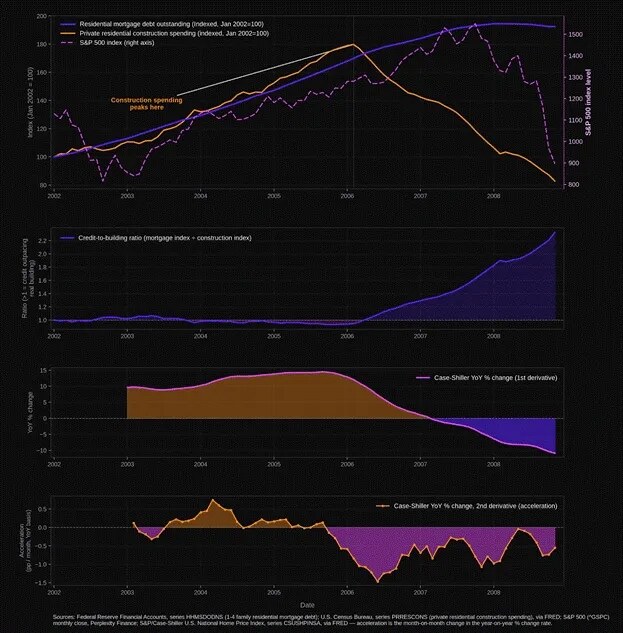
By the end of 2005, the U.S. housing price appreciation had started to slow down, coinciding with the peak in actual construction spending (orange line in the first chart). However, real estate credit (purple line) continued to flow into the market until the stock market peaked and began a slight pullback.
The period from 2006 to 2007 can be seen as the "no man's land" before the full-blown crisis, where home prices were still rising but at a decreasing rate. Subsequently, the stock market peaked in mid-2007 (pink dashed line in the chart). The true "Big Short" moment occurred in August 2007 when three credit hedge funds under BNP Paribas collapsed. The crisis then spread continuously, eventually toppling Bear Stearns and Lehman Brothers in September 2008... all while the S&P 500 index had already dropped about 50% from its peak.
What truly triggered the financial meltdown was investors finally realizing who was holding those toxic "Frankensteinian" financial derivatives. In the end, the government had to take over both the debt and equity of these institutions simultaneously to avert a new Great Depression.
This point is crucial because when discussing how the government rescued the AI industry later in this piece, we will come back to this logic.
The second chart is equally worth noting. It depicts the beginning of capital misallocation, precisely when housing price appreciation started to slow. If new credit had still been used to construct more homes, the issue would not have been as severe. However, if the entire system began relying on borrowing fresh debt to pay off old debt, risks began to accumulate. The increasing ratio of construction loans to construction spending exemplifies this process.
Now, apply the same analytical framework to AI. The key variable here is each company's CAPEX expenditure plan.
The current market belief is that real estate (here referring to AI) is technology; the more tech investment, the higher the future profits. Thus, the market rewards cloud giants announcing increased capital expenditure budgets by boosting their stock prices.
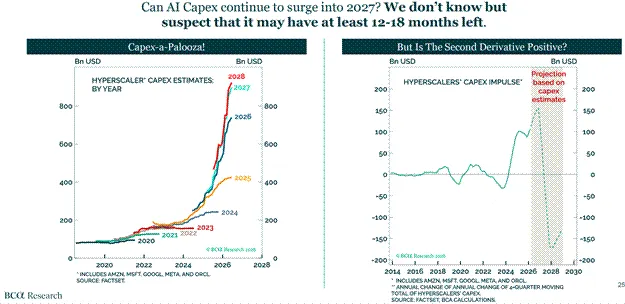
I anticipate that the growth rate of AI CAPEX announcements will start to slow down in mid-2027, and by 2028, the market will notably enter a "slowdown phase."
Meanwhile, a seemingly contradictory phenomenon will occur. Although the CAPEX growth rate is starting to decline, the scale of credit flowing into AI will continue to expand. The reason is that lenders believe they are investing in technology rather than real estate. Additionally, governments worldwide keep emphasizing the need to take a leading position in global AI competition. Therefore, continuing to finance any projects related to AI CAPEX seems to be the most reasonable choice.
As a result, 2027 will become a similar "no man's land" to the 2006 to 2007 period. The current significant correction of AI stocks is just a normal adjustment in a bull market. The true AI bubble peak will occur next year.
After that, the market will begin to reward the cloud computing giants who "first exits the arms race" and actively reduce their CAPEX budgets. Unlike the early stages of the bubble from 2022 to 2026, future cloud computing giants will find it increasingly challenging to rely on their own free cash flow to support AI investment. They will have to rely more on issuing bonds and new shares to raise funds.
The pressure on the balance sheet will also force management to seriously consider: "Is it really worth continue borrowing money to build more data centers just to accommodate more chips that will continuously depreciate?"
At least for the American cloud computing giants, the price-sensitive Chinese leading AI models, with almost comparable performance at a lower price, will completely extinguish their "silicon-based deity" fantasy. After all, if two products have the same quality, or are only slightly inferior, most people will choose the cheaper one.
With the exponential growth of AI chips' intelligence production per kilowatt-hour and under the competitive pressure in China, while the cost per Token keeps decreasing, a rational CFO of a cloud computing giant will not further deteriorate their balance sheet just to construct more data centers.
Even if, following the Jevons Paradox, the demand for AI Tokens will eventually experience explosive growth, this growth will not be fast enough to offset the negative impact of the substantial debt issued several years ago. In the end, the market will first punish the lowest-credit participants. It is only then that people will truly realize how much capital has been wasted in this AI investment frenzy.
I cannot predict which cloud computing giant will be the first to overextend, causing bond investors to collectively exclaim, "Oh shit!"
However, before discussing why banks, knowing full well the massive AI investment risks, still have to continue lending, let's take a look at the following chart. It shows the comparison between the committed CAPEX investment scale of major cloud computing giants and their cash on hand.
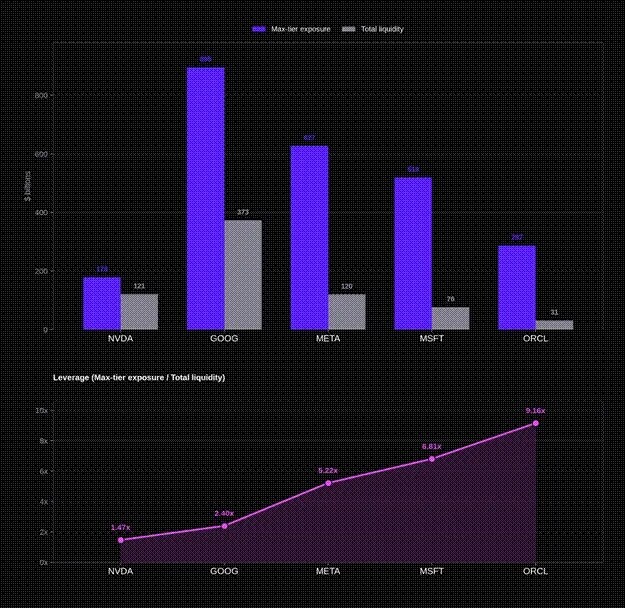
What actually underpins the entire AI bull market narrative is leverage on the scale of trillions of dollars. Among these companies, eventually, one will fall from grace like the once market-darling AI genius Leopold Aschenbrenner. The difference is that when the time comes, the ones to bail them out will not be the greedy and neurotic East Coast hedge fund managers of Wall Street but the money printers in the hands of Warsh and US Treasury Secretary Bessent.
The Dilemma of Bank Credit
Many believe that the AI CAPEX growth rate is about to slow down, indicating that the AI bubble is nearing its end. If that's the case, why would banks still keep lending?
The reasons are actually quite simple: first, because it is profitable; second, because the government wants them to do so; third, because they know that even if the loans ultimately default, the government will step in to help.
Louis-Vincent Gave of Gavekal Research published an interesting article last week. He believes that Warsh's interest rate policy actually follows a very simple logic—actively steepen the yield curve.
Doing so has two benefits. First, it can make bank lending more profitable; second, it can gradually dilute America's massive debt burden through inflation.
In the end, banks will continue to create new loans, effectively creating new money. This new infusion of funds will provide financing for the re-industrialization of the US manufacturing sector and will continue to support AI development. This approach is highly consistent with the "Hamiltonian Economics" that Treasury Secretary Bessent has been emphasizing recently.
If we look at all objective economic indicators, the Federal Reserve should have actually raised interest rates at its most recent meeting, but the fact is it didn't. Instead, long-term bond yields subsequently soared.
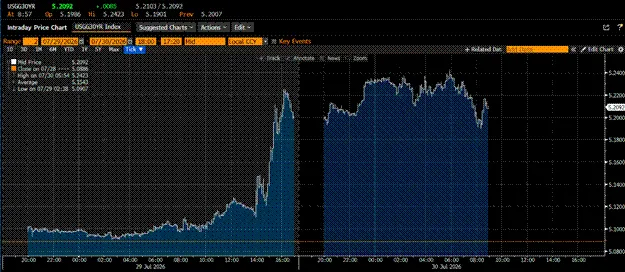
· Odaily Note: The 30-year US Treasury bond yield surged rapidly after the Federal Reserve held its ground.
Many believe that this was a policy mistake by the Fed, but from a bank's perspective, it was a true godsend.
The reason is simple. Banks can fund almost at the cost of the Federal Funds Rate, and the Fed has deliberately maintained this rate below the nominal economic growth rate, even below the actual inflation rate.
Subsequently, banks lend out the funds in the form of long-term loans to AI data center developers, rare earth mining companies, defense contractors, and so on. The steeper the yield curve, the higher the Net Interest Margin that banks can earn.
And as shown by the scale of commercial and industrial loans in the chart below, banks are more incentivized to continue creating new currency through lending.
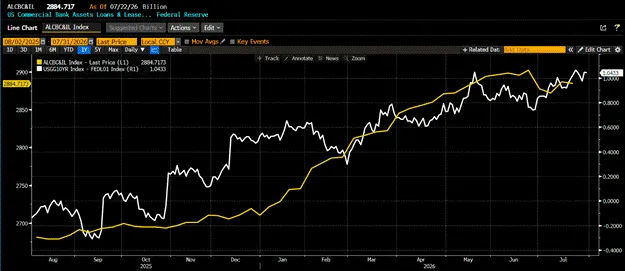
· Odaily Note: The white line represents the 10-year US bond yield minus the effective Federal Funds Rate (reflecting the steepness of the yield curve); the yellow line represents the balance of US commercial banks' commercial and industrial loans.
From a political perspective, this is a sustainable Fed policy. Even though the Justice Department of the Trump administration has investigated and even prosecuted some Fed governors (such as Lisa Cook and Powell), these voting members still support keeping short-term rates in negative real terms.
In other words, Warsh has actually formed a "volunteer alliance" that includes not only Trump allies but also those who were deeply affected by "Trump Derangement Syndrome" (TDS) and are still within the system.
From a monetary policy perspective, the Fed's recent actions have also allowed Treasury Secretary Benson to issue short-term bonds (T-Bills) at a yield below the nominal economic growth rate. If the market cannot absorb the massive weekly issuance of treasuries, the RMP (Reserve Management Program) will bridge the demand gap by printing money.
To suppress the "disobedient" and continuously rising long-term bond yields, Benson can also implement bond buybacks—first issue short-term bonds monetized by the Fed, then use these funds to repurchase 10-year or 30-year bonds to lower long-term rates.
It is worth noting that Warsh, who has always been known for advocating for reducing the Fed's balance sheet, has no intention whatsoever of limiting or even halting the expansion of the RMP project. All of this is nothing but a theatrical UFC performance staged on the White House lawn.
If you are a credit officer at a “Too Big to Fail” (TBTF) bank and are looking to advance in your career with a raise, then you are almost certain to approve loan applications that belong to “key industries,” such as AI, defense, and so on.
The reason is simple. This not only increases the bank's profits but also aligns with the Federal Reserve and Treasury's policy directives. Even if the loan eventually defaults—which, statistically speaking, is quite likely—the government will definitely quickly deploy a “bazooka-sized” rescue plan.
There is virtually no downside risk here. This is the true operation of “Window Guidance” in the United States.
I believe that the 2026 version of the “Treasury-Fed Accord” has actually already quietly taken place, just without a formal announcement. Otherwise, how else could you define the current situation?
· The Fed maintains a negative real interest rate;
· The Fed prints money to buy Treasury bonds issued by the Treasury;
· The Treasury encourages banks to lend to key industries;
· Once the loans go sour, the ruling government will implicitly guarantee to backstop.
If this is not considered fiscal and monetary policy coordination, I don't know what is. So, I am now extremely bullish on the market, believing that the true large-scale money printing is far from over.
U.S. Sovereign Wealth Fund
Now, let's indulge our imagination further. What if the U.S. government not only bails out banks after a crisis but proactively steps in to buy shares of AI companies at the first sign of trouble? After all, out-of-the-box thought experiments are always interesting.
In fact, the Trump era has already begun the rescue of AI. Under the guise of “national security” and “U.S.-China competition,” the U.S. government has started borrowing money and directly purchasing equity stakes in so-called “key industry” companies involved in rare earths, semiconductors, and more.
This is fundamentally a form of increasing dollar liquidity operation, which can also be understood as Equity QE (Quantitative Easing). Because these dollars that were originally sitting in government accounts have been injected directly into the financial markets.
Below are some examples where the U.S. government, using funds borrowed from the CARES Act, CHIPS Act, and the Defense budget, directly holds equity in relevant companies.
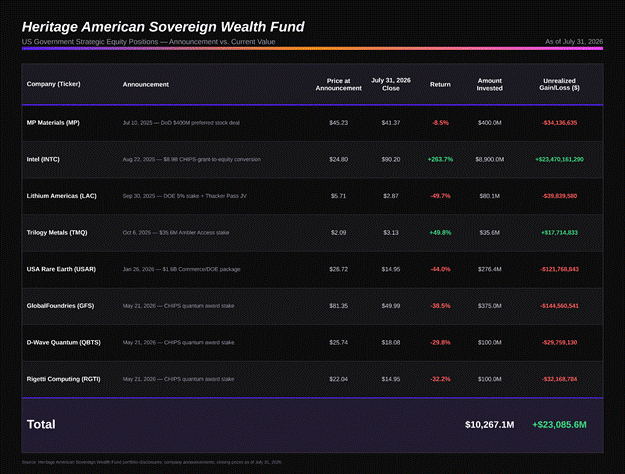
Unfortunately, for those of us crypto investors whose wealth is entirely dependent on money printing, there is very little room left under the current legal framework for the government to continue engaging in equity-like investments.
However, the Trump administration and Treasury Secretary Benson have clearly shown an attitude that as long as the law allows, they will not hesitate to use borrowed money to buy the dip in AI stocks.
So, a new question arises: Is there a way to front-run the crisis, print money in advance to buy AI stocks, and do so without needing approval from Congress?
The answer is yes! And this is precisely where it gets interesting.
According to the Federal Reserve Act, under so-called "Emergency and Exigent Circumstances," the Fed can print money directly and provide unlimited liquidity loans to a special purpose vehicle (SPV) established by the U.S. Treasury.
During the 2008 financial crisis and the 2020 pandemic, the Treasury used the Exchange Stabilization Fund (ESF) to support first-loss equity, which was then financed by the Fed to purchase various financial assets to stabilize the market.
Currently, there is still approximately $28 billion in the ESF account. Benson could use this fund as the initial capital for a new SPV, with the rationale still being to safeguard the country's AI security.
As per past practice, the Fed is usually willing to provide up to a 10x leverage for the SPV. In other words, Benson could theoretically leverage around $2.8 trillion to invest in those AI companies that have not yet become profitable. Of course, compared to today's AI giants with market caps in the trillions, $280 billion is not actually that much of a "big gun."
So, could the scale be further increased? For instance, could the Treasury simply establish an SPV with no first-loss capital buffer and have the Fed provide unlimited loans directly? Technically, this is feasible, but doing so would mean that the Fed must withstand significant political pressure—because the outside world would view it as secretly conducting an unlimited-scale Equity QE.
So, does the Fed really care about political pressure?
The answer is both yes and no. New Chair Wash has always emphasized that AI will soon become the miracle that boosts U.S. productivity. In other words, in principle, he himself believes in the grand narrative painted by AI entrepreneurs.
If Trump were to tell him that, in order to save Sam Altman and OpenAI, the government must step in directly to buy stocks. The reason is that there are not enough retail investors willing to shell out real money to buy shares of a still unprofitable cutting-edge AI company; meanwhile, Dario Amodei's Anthropic, which is already profitable, has even stronger model performance.
So, Wash would most likely act without hesitation. Of course, according to the procedure, approval of the SPV loan still requires three other Federal Reserve Board members to vote in favor. But considering that in the most recent interest rate meeting, including Cook, Powell, and others, have already sided with Wash (supporting the rate hold), if Wash really pushes the Fed down this path, I can hardly see any substantive resistance.
After all, compared to theoretical concerns about whether money should be printed, the investment returns in personal stock accounts always carry more weight.
If the Treasury uses printed money to support the IPO of those upcoming AI star companies, it is actually cashing out the unrealized profits on the books of early investors and employees. This is the purest form of "Liquidity Creation."
Because before the government steps in to support, this part of the capital simply does not exist. It is precisely the government's willingness to provide a bid for these artificially inflated primary market valuations that truly allows these paper fortunes to be realized.
From an accounting perspective, the government can reap two benefits.
1. First, as long as an AI company has government backing, investors will flock. After all, following the money printer in buying stocks, at least initially, almost always leads to profit. So, this SPV's books will quickly accumulate massive unrealized gains. Trump can easily package these paper gains as government "profits," and even claim that they could theoretically offset the fiscal deficit. If AI is indeed the most important technological revolution in human history, then solely based on paper gains in the stock market, in accounting terms, they could even "eliminate" the entire U.S. fiscal deficit.
2. Second, the millionaires, billionaires, and trillionaires born out of this will have to pay federal and state capital gains taxes when selling their stocks. These additional tax revenues can also reduce the fiscal deficit, allowing the government to reduce borrowing and further claim that the U.S. debt-to-GDP ratio has decreased. At least initially, the bond market will believe this story, so bond yields will decline, and the market will reward the government for this "accounting magic."
However, I must emphasize that Trump did not invent the Philosopher's Stone. He simply continued to postpone the issue, hoping that it would eventually be taken over by the next administration—preferably a Republican one.
Why will this pattern inevitably lead to a disaster? We can do a simple thought experiment. Suppose you want to become a billionaire overnight without doing any work. So, you spend a few thousand dollars to register a company and issue a total of 1 billion plus 1 shares of stock.
Then, you sell 1 share to your mother for $1. Since the latest transaction price is $1, the remaining 1 billion shares in your hand are now valued at $1 billion. Next, you take this "wealth" to the bank, hoping to borrow $100 million to buy a mansion, a Lamborghini, and all kinds of luxury goods. The bank will tell you straight away, "No way."
You will be puzzled because in your view, the loan-to-value (LTV) ratio of this loan is only 10%, so the risk is obviously low. But the bank's response is simple:
"If you need to sell these shares in the future to repay the loan, there is simply no market liquidity."
Applying this logic to the AI SPV, it's the same story. If the SPV has become the largest single shareholder of an AI company, and other investors bought shares only because the government is involved, then once the government is ready to exit, there will be no real buyers in the market. Moreover, when those politicians—like Ro Khanna, Nancy Pelosi, and others—start selling shares, all investors will rush to sell before the government, causing the paper profits originally intended to "offset the national debt" to vanish in an instant. Not only will they turn into actual losses, but they will also further increase the government's debt.
What's worse, the Treasury Department will still have to repay the money it originally borrowed from the Fed. Therefore, for this SPV, it is actually an investment that can only be bought and not sold. The Fed can only keep rolling over the SPV's loan, ensuring that a Margin Call will never be triggered.
Ultimately, to sustain the entire system, the expansion of the Fed's balance sheet will become permanent.
However, this is not a concern for Trump. Because politically, he has benefited from both ends—on the one hand, the yet-to-be-profitable U.S. AI companies have received funding to continue competing with China; on the other hand, the paper "wealth" created by AI has boosted tax revenue growth and stimulated current economic activity.
Meanwhile, unrealized gains combined with additional tax revenue create an illusion that the "US debt-to-GDP ratio is declining." As a result, the market is willing to continue lending to the US government at lower rates.
The US government could do this now to prevent the AI bubble from bursting. Of course, it could also wait until AI CAPEX growth slows down and the market starts a widespread sell-off of AI stocks before intervening to support the market.
Since the US government has already begun directly purchasing corporate equities, why not buy more? By combining "bank-guided lending windows" with "government direct purchases of AI stocks," it could theoretically ensure that an AI credit crisis never occurs. At least not until after the 2028 US presidential election.
Some may ask, after printing so much money from 2022 to now, why hasn't Bitcoin broken through $126,000? Don't worry, the next section will give you the answer.
When Will Bitcoin Bottom Out?
The bottom of the previous cycle occurred when the market discovered that white boy Sam Bankman-Fried had stolen FTX customer funds, a discovery facilitated and promoted by CZ.
Meanwhile, ChatGPT was commercially launched, marking the beginning of the AI wave.
Starting in October 2023, the US liquidity environment changed. Due to continuous outflows from overnight reverse repurchase agreements (RRP), US dollar liquidity began to increase. Subsequently, bank credit and government borrowing also started to grow. Bitcoin consequently rose and peaked in October 2025; however, Bitcoin did not continue to rise. It only increased by about 2x compared to its previous all-time high, as AI credit and AI stocks absorbed the newly added fiat liquidity.
As AI capital expenditure (CAPEX) expansion accelerated, consuming all available fiat liquidity, the subsequent 50% drop in Bitcoin—looking obvious in retrospect—occurred.
By mid-2026, the liquidity environment reversed. The announced AI capital expenditure growth rates for the next 18 months will begin to slow, but banks and the government are just starting to create dollars and funnel them to the AI sector.
If banks are unable to fulfill their "patriotic duty" to continue providing credit, the government will strongly encourage them to lend to AI. If that effort fails, the government will reduce the risk of banks lending to the AI sector by providing equity support to specific AI companies and making procurement commitments similar to Intel and IBM (offtake agreements).
Bitcoin will bottom out in the early stages of this credit mismatch cycle, and the financialization of AI—where the dollar and yuan amounts chasing quality AI projects in the market exceed the actual size of truly quality projects—will ultimately lead to capital misallocation.
As of late July 2026 when authoring this article, I do not know at what price Bitcoin will ultimately bottom out; perhaps the bottom has already occurred.
The market needs time to digest the concerns arising from Strategy's sale of Bitcoin. Additionally, the market needs to find a new narrative: If Strategy is unable to continue issuing stock or find investors to purchase its preferred shares and use those funds to continue buying Bitcoin, then why would Bitcoin continue to rise?
Bitcoin may oscillate between $60,000 and $70,000 for a period and could potentially dip to $50,000. However, throughout all this, AI capital waste will continue to accelerate, laying the groundwork for Bitcoin to bottom out and slowly rise thereafter.
If my view is correct—that the scale of truly valuable AI capital expenditure projects is smaller than the flow of credit into "AI"—then the Bitcoin price will eventually reflect this excess liquidity. This will help Bitcoin bottom out, even if digital asset treasury companies like Strategy can no longer buy Bitcoin in a Bitcoin-per-share accretive manner through stock and corporate debt markets.
I will continue to watch several indicators to validate this logic:
· Whether AI capital expenditure growth is slowing down;
· If AI loan volumes are increasing;
· Whether hyperscalers are increasing their off-balance sheet commitments.
If we are entering the capital waste phase of this AI credit boom, the next question is: What will regulators and governments do? Will they preemptively print money? Or will they wait for the ultimate crisis to unfold due to a lack of political space and then intervene through rescue measures?
Fortunately, as long as we hold Bitcoin in a non-leveraged manner, we are not concerned about when the bailout will arrive. Because we know that due to the distortions of government incentive mechanisms, they will eventually choose to print money to save the system. The AI capital expenditure credit frenzy currently amounts to a proportion of GDP equivalent to the railroad construction era. This means that the scale of capital misallocation has already exceeded that of the U.S. subprime crisis.
Therefore, the scale of future bailouts will exceed the tens of trillions of dollars printed by the Federal Reserve and major central banks globally between 2009 and 2013. Bitcoin was born as a response to the "irresponsible banker bailout" during the subprime crisis. If you think about it carefully, this is a very amazing thing. And this time, Bitcoin already exists, and it may fulfill the dreams of many people—rising to $1 million or even higher.
Given the current bleak state of the crypto capital markets, it is not easy to imagine such a future. But in my view, this creates an interesting asymmetric opportunity. Maelstrom has held a large amount of Bitcoin for a long time.
Aside from Bitcoin, what new narrative could drive a significant market cap token's rise in the next six months? Ethereum is currently the most hated and forgotten large-cap "shitcoin" in the market. It has not even surpassed its 2021 high of $5000 yet, while most of the top-ten shitcoins have already done so.
In my opinion, the next narrative is around enterprises like Robinhood building Real-World Asset (RWA) chains that will use a customizable Ethereum Layer 2 like Arbitrum. Ethereum will become the settlement layer for these chains. Therefore, even though the actual Gas revenue flowing into Ethereum is a small part of the system, ETH is still the shitcoin driving the "tokenization of everything."
I am a critic of RWAs. Maelstrom often receives a large number of shitcoin project funding pitches, with teams claiming to ride the wave of asset tokenization, but on the other hand, traditional finance (TradFi) loves to discuss: "All assets will be tokenized in the future and will operate on a private or public chain."
I strongly believe that if this future truly arrives, then these TradFi RWA projects must operate on public blockchains. And Robinhood launching its own chain using Arbitrum will reduce the professional risk for TradFi practitioners—they can replicate the same pattern, ultimately building Ethereum-based solutions.
This narrative is very strong. And ETH, as a shitcoin, is the second-largest crypto asset by market cap, has been around since 2015, and therefore has the second-best Lindy effect after Bitcoin (i.e., the longer it has been around, the higher the probability of continuing to exist in the future). Additionally, Bitmine's Tom Lee endorsing ETH allocation for institutional investors has provided fund managers with the opportunity to bet on the capital market tokenization trend.
My rough price target for ETH by the end of 2026 is $5,000, representing roughly a 2.6x increase from the current price. I like this trade because I can size into a fairly substantial notional position while still being able to stomach the risk of ETH plunging 75% one day due to some sort of technical vulnerability, a risk that is quite low.
Furthermore, ETH is highly liquid. Therefore, even though it makes up a sizable portion of the Maelstrom portfolio, I can exit within minutes. Lastly, I will also sell out-of-the-money puts to earn additional yield while accepting the risk of buying ETH at a discounted price if it falls below the strike.
The AI bubble once sucked liquidity out of the crypto market, but that situation has ended. As the market narrative shifts from "invest in AI at any cost" to "what is my ROI" and eventually to "when do I get my money back"... governments that bet their entire economic policy on AI will start to worry—perhaps, that bubble really could pop.
To avoid admitting their mistake and prevent this outcome, they will engage in massive capital misallocation, a scale of misallocation that will ultimately create a cryptocurrency bull run unlike any we've seen since 2021.
Welcome to join the official BlockBeats community:
Telegram Subscription Group: https://t.me/theblockbeats
Telegram Discussion Group: https://t.me/BlockBeats_App
Official Twitter Account: https://twitter.com/BlockBeatsAsia
