Last week, Bitcoin rose by 13%, reaching above $70,000 over five trading days for the first time since June. By this Monday, the price was above $78,000.
The world's largest corporate Bitcoin buyer, Strategy, did not buy a single coin during this week.
Instead, it did something else. It sold off 18.26 million shares of its common stock, raising around $2 billion, which it then converted to dollars. As of August 23, the company's total dollar liquidity stood at $6.69 billion.
Where did this $2 billion go?
$300 million went into the "USD Reserve" — a dedicated pool created by the company in June that can only be used to pay preferred stock dividends and debt interest, requiring board approval for any other purpose. This pool now holds $5.1 billion.
$1.364 billion was used to repurchase 1.43 million shares of STRC preferred stock.
The remaining funds went into a newly established pool with a straightforward name: "USD Cash," currently holding $1.59 billion. In contrast to the previous pool, this one has unrestricted use — it can be used to buy Bitcoin, repurchase common or preferred stock, redeem convertible bonds, replenish the USD Reserve, or for other corporate purposes.
The company stated that the additional flexibility would allow the management to respond more quickly to market changes, "including price dislocations in Bitcoin or the company's own securities."
In the same filing, as of the week ending on August 23, Strategy neither bought nor sold any Bitcoin, maintaining its position at 840,447 coins for the second consecutive week. In fact, it has not made any purchases since the week of June 22.
Why is a Bitcoin-buying company hoarding cash?
To understand how unusual this is, you first need to know how many times Michael Saylor has repeated that analogy over the past few years: holding cash is like holding a melting ice cube. Strategy's entire narrative is built on this statement — converting every penny on its balance sheet into Bitcoin as quickly as possible.
Now it has two labeled dollar pools totaling $6.69 billion.
The reason lies in the cost basis.
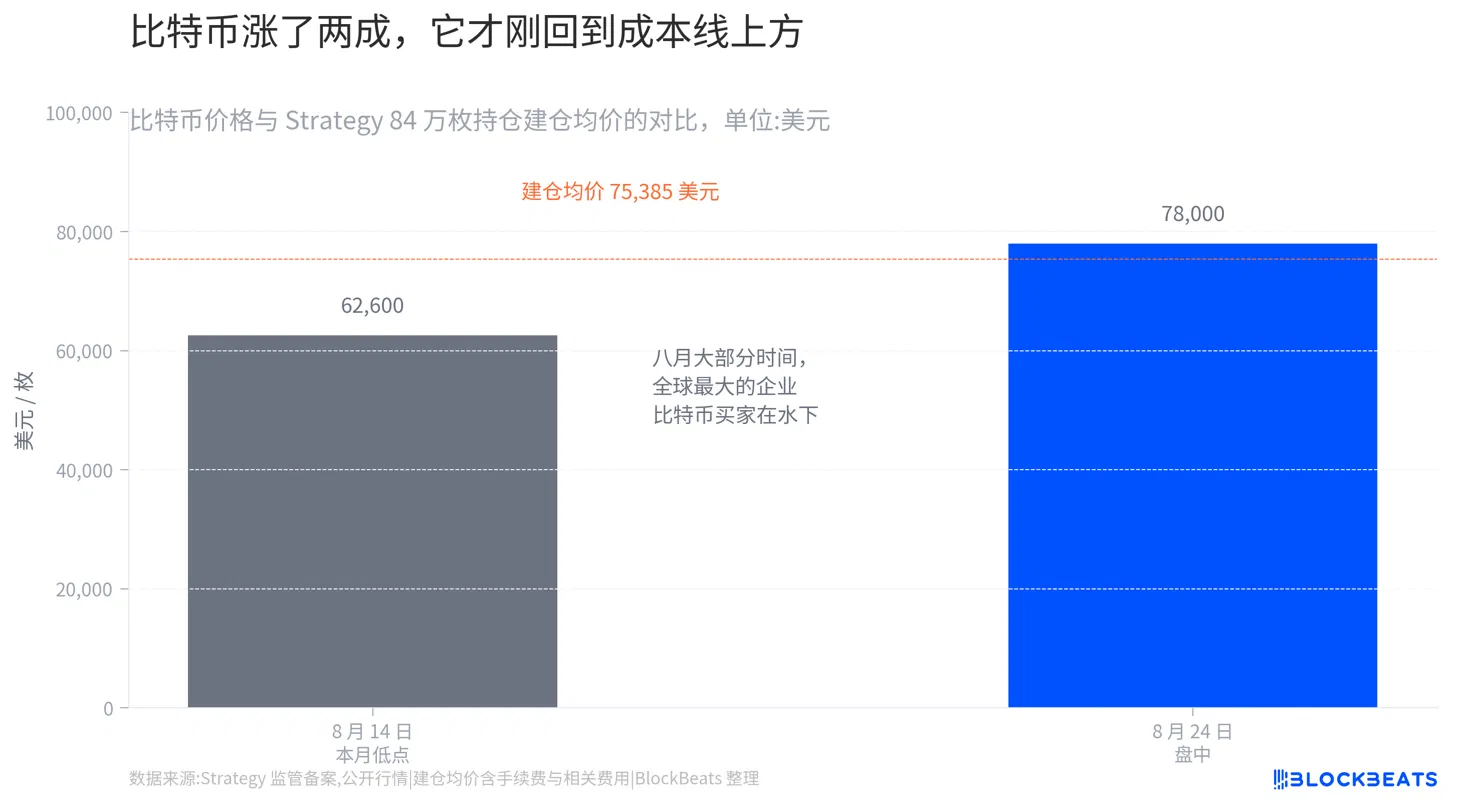
Strategy held 840,447 bitcoins, spending a total of $63.36 billion, at an average of $75,385 per bitcoin (including fees and related expenses). This line is key to the whole thing: On August 14, when bitcoin dropped to $62,600, the company reported an unrealized loss on bitcoin of up to $8.2 billion.
It wasn't until last week, when the price rebounded to $78,000, that it just stepped back above its cost line, with a $1.4 billion paper profit.
The issue is that paper losses don't need to be repaid, but dividends and interest must be paid on time.
Strategy's issued STRC preferred stock promises a 12% annual interest, with a face value of $100. It can be understood as a high-interest IOU issued by the company—the market's confidence in this IOU is directly reflected in its price.
All summer, STRC has been trading below face value; CEO Phong Le publicly stated in early August that the 12% dividend would be maintained unchanged, and that the goal was to keep STRC trading in the range of $99 to $100 in the long term.
To support this price, they have to buy back. And when bitcoin is in a deep retracement and the stock price is not rising, where does the money come from?
The answer lies in the new capital management framework set in June—it allows Strategy to sell bitcoin for the first time to buy back those preferred shares trading below face value.
On August 3, the company sold 1,638 bitcoins, cashing out $104.73 million; by August 5, a total of 5,226 bitcoins had been sold, raising $321 million, and $106 million of STRC had been repurchased. On August 17, it issued shares again, raising $334 million, also used to repurchase preferred shares.
This round of $2 billion in share issuance is an amplified version of the same action. So far, the $1 billion preferred stock buyback program has used approximately $483.4 million, leaving $516.6 million; the other $1 billion common stock repurchase authorization has not been touched.
What went wrong with the Flywheel?
In recent years, Strategy's pattern has been called the "Flywheel" by the market: Issue new shares for financing → Buy bitcoin → Bitcoin rises → Stock price rises faster than bitcoin → The higher the premium, the more money can be raised by issuing the same amount of shares → Buy more bitcoin.
The premium is gone; the market is willing to pay how much more Bitcoin for each dollar of it.
Now that the premium is gone, MSTR has dropped by about 66% over the past year. According to Bloomberg, this financing flywheel "remains impaired, with the valuation premium far below prior cycles." Once the premium is gone, stock issuance shifts from "lever up for free with other people's money" to pure dilution.
Nansen's Senior Research Analyst, Nicolai Sondergaard, has calculated this trade-off quite clearly: "For MSTR shareholders, this trade-off is about exchanging dilution for flexibility. The recent equity offering strengthened the balance sheet but did not immediately increase the Bitcoin exposure per share."
His assessment of the new pool is equally sobering: "The new USD cash pool gives Strategy more time and optionality but does not eliminate those underlying obligations."
In other words, dividends still have to be paid, interest still has to be paid, and convertible bonds have to be repaid upon maturity. The cash bought is time, not liberation.
So, how should we understand the actions this week?
In mid-August, index provider MSCI initiated a consultation proposing to remove "non-operating companies" from its Global Investable Market Indexes. The judgment is made through a two-step screening process based on the percentage of operating assets and five financial metrics. Under this proposal, Strategy, Japan's Metaplanet, and uranium holder Yellow Cake could all be affected.
For a company with a significant passive fund holding, being kicked out of an index means a wave of sell orders regardless of price. On the day the news broke, MSTR dropped by 4.3%.
Strategy's rebuttal came with indignation: The index provider's role is to measure the market, not to decide what assets a company can hold.
There was a clear driver behind this Bitcoin rally: Trump urged Congress to pass a bill to regulate digital assets, while the US Treasury doubled the size of long-term bond buybacks, pushing down yields—when yields fall, risk assets thrive.
As prices have recovered, paper losses have turned into gains. In early Monday trading, MSTR briefly rose by 3% to $122.79, and STRC reported $96.49, still about three dollars away from Phong Le's mentioned range.
And what the company has done this week is to convert $2 billion into dollars and place them in two pools.
That piece of ice, once thought to be melting, is now the most flexible thing in its hands.
Welcome to join the official BlockBeats community:
Telegram Subscription Group: https://t.me/theblockbeats
Telegram Discussion Group: https://t.me/BlockBeats_App
Official Twitter Account: https://twitter.com/BlockBeatsAsia
