On August 20, the legal AI company Harvey, backed by OpenAI, released Tenet. This company, founded in 2022, is now valued at $11 billion, making it the world's highest-valued legal AI company, serving thousands of institutions. Its shareholders include Sequoia Capital, a16z, and GIC.
Tenet is its first proprietary model, based on the Kimi K3 open weights released in July after the Dark Side of the Moon. Tenet is currently in the research preview phase, and Harvey plans to gradually incorporate the validated capabilities into the product.
Harvey's founders, Winston Weinberg, originally a litigator at O'Melveny & Myers, and Gabe Pereyra, who worked on large-scale models at Google Brain and Meta, received early investment from OpenAI. The two parties also trained a case law model together, incorporating about 10 billion U.S. case law data tokens into the training. In a customer case study released by OpenAI at the time, Pereyra mentioned that Harvey evaluated various options but ultimately trusted OpenAI to complete this custom training.
For several years, Harvey has almost always used closed-source models in the professional services industry, and has continuously been able to access a group of the world's most powerful closed-source models. However, when it decided for the first time to truly encode its legal tasks, lawyers' scoring standards, and two months of computing power into a set of weights, the selected foundation was an open weight model from China.
After a model is released, the industry quickly learns two things: how smart it is and how much these capabilities are worth. Within a few hours, benchmark tests are updated, Arena rankings change, and various intelligence and price coordinate graphs begin to circulate. A model that has been trained for months and has consumed a large amount of computing power is ultimately compressed into a point on the graph.
For most developers, this approach is still effective. The premise behind it is that when the model is handed to the user, its capabilities are already well-established. When closed-source APIs dominated, this premise held true. Model companies completed pre-training and fine-tuning, then packaged the capabilities into an interface. Downstream companies could modify prompts, perform retrievals, and build intelligent agents, but it was difficult to further alter the model itself.
Open weights have shattered this premise. After receiving the weights, companies can continue to input their own data and expert feedback, bringing real-world tasks and evaluation criteria into the training. Two models that both scored 90 points when released, when further trained on the same data and computing power, one may reach a final score of 91 while the other could achieve 97. For companies willing to invest months of time, computing power, and expert resources, the initial 90-point score upon release represents a world of difference.
However, there is a prerequisite for this. For a company willing to stake a few months of time and a batch of computing power to continue training, there must first be a set of weights worth training. Over the past few years, there has always been a gap between open-source models and cutting-edge proprietary models. The difference is not significant in general Q&A and everyday code writing. However, once it enters a high-stakes professional scenario, this gap is magnified. The legal field represents the highest requirement in this category, and in the past, those who truly entered the core business of companies like Harvey were basically the strongest group of proprietary models at that time. Open weights are certainly easier to control and modify, but if even the most basic professional tasks cannot be completed, there is no room to talk about further training.
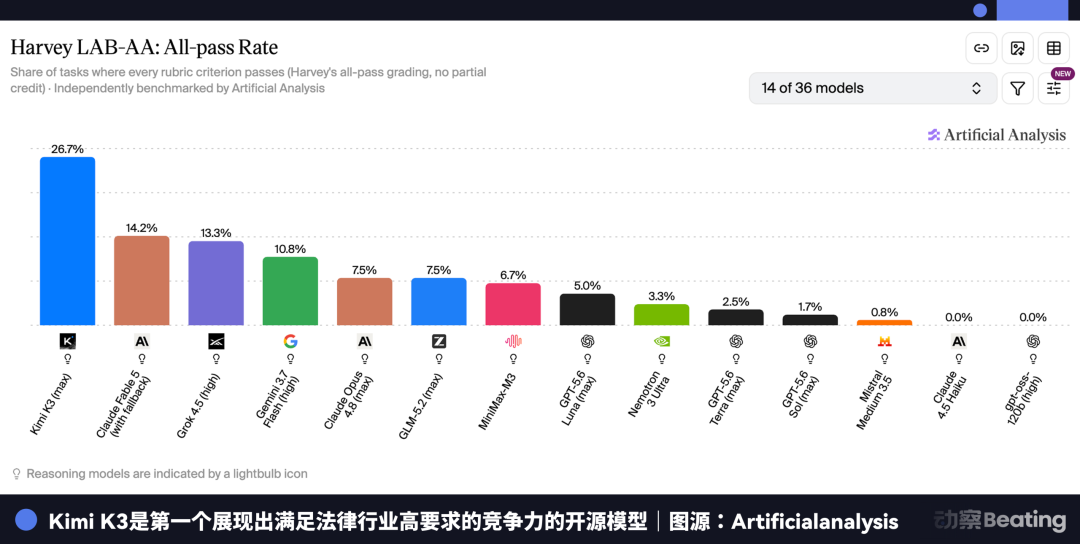
Kimi K3 has crossed this long-standing threshold for the first time. Its total parameters have reached 28 trillion, supporting a context of 1 million tokens. It already has a good basic ability in long-term tasks, tool usage, and complex reasoning. For Harvey, the open weights model is no longer just a lower-cost, more controllable alternative, but has begun to enter the range that can be seriously evaluated alongside cutting-edge models.
So they started to care about an issue that has rarely been discussed separately in the past: how easy it is to continue training with this set of weights.
When training Composer 2, Cursor did not choose a model based on common programming AI rankings. Its judgment is that the intelligence and long-term task capabilities of an agent will undergo significant changes during the reinforcement learning process, and the pre-training rankings may not necessarily predict the final results. Compared to ranking scores, Cursor values the model's programming knowledge, state tracking ability, confusion in internal codebases, and its operational efficiency in their own infrastructure. The base selected in the end was the Kimi K2.5 model.
Behind Devin, Cognition made a similar judgment. After K3 opened its weights, it quickly integrated the model into Devin Desktop and CLI. On their own FrontierCode 1.1 Extended, K3 achieved a score of 58.2% and a pass rate of 63.6%. This test assesses whether the code can finally be merged into the main branch and whether the quality is sufficient. Cognition also mentioned that K3 excelled in reproducing bugs and managing its own operating environment, which happen to be the most error-prone linkages in long-term programming tasks. It then conducted further training on this set of weights.
The Truly Scarce Resource Is Not Legal Data
Harvey grew rapidly. In March of this year, it served approximately 1,300 institutions and over 100,000 lawyers. Five months later, the number of customers almost doubled, covering 70 countries, with over three-quarters of the AmLaw 100 law firms using Harvey.
The project amount for legal services is high, with a low tolerance for mistakes. A due diligence report for a merger and acquisition may require searching through hundreds or thousands of documents to find change of control provisions, determine if the transaction is triggered, identify risks, and provide the original text as a reference. In between, there are often dozens of consecutive judgments that need to be made. If a single issue that truly impacts the transaction is missed, most of the work done correctly up to that point becomes largely meaningless.
As the law firm's services grow, Harvey has also accumulated a type of foundational data that is hard for a typical model company to obtain. It knows how a lawyer will organize a task and where the supervising partner will pick up on mistakes in the end.
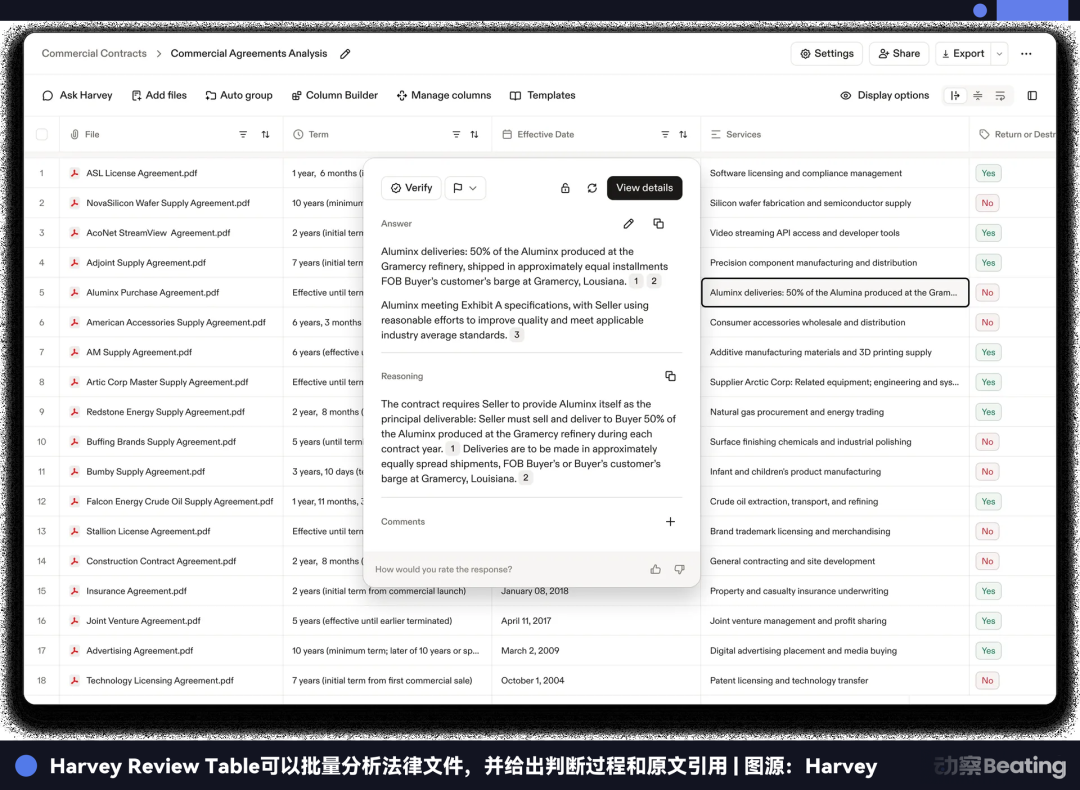
These experiences were later turned into a Legal Agent Benchmark. There are now over 1200 long-range legal tasks covering 24 practice areas. Each task description averages about 50 words, and the model then enters a closed client matter environment. Relevant documents and a large amount of irrelevant material are mixed together, requiring self-searching, reading, judgment, and finally producing work results that can be checked item by item.
Each task has an average of about 50 scoring criteria, with complex tasks reaching several hundred criteria. Whether the facts are fully found, conclusions can be drawn, citations correspond to the original text, the risk level and recommendations are reasonable, all are broken down into independently assessable scoring items. A task can last for more than 1000 rounds, consuming hundreds of thousands of tokens.
After working for a few years, young lawyers gradually learn what clients are truly concerned about and remember which seemingly insignificant clauses cannot be overlooked. These experiences were previously difficult to fully incorporate into textbooks and mostly remained in partners' revisions, team internal work habits, and in the delivered documents.
Harvey divides some of these into tasks, materials, and scoring criteria. Each time the model completes a task, it has feedback that can be calculated and compared.
Cue words and search capabilities tell the model where to look, while scoring criteria begin to answer another question: to what extent a legal task is considered complete. Over the past few years, in addition to clients and legal data, Harvey has truly accumulated a professional evaluation system that can be directly used for model training.
Embedding Legal Experience into Weightings
Those tasks and scoring criteria are now truly entering training. Data comes from public legal materials, synthetic data, and human expert data, with practicing lawyers participating in task construction, scoring, and synthetic data validation. Harvey has prepared a total of approximately 1750 legal AI task environments.
Once the model enters the workspace with materials and tools, it needs to read the files, use the tools, and submit the results on its own. The system then checks the entire work trajectory against the standards set by lawyers, evaluating how well the specific requirements have been met and the extent to which legal issues have been resolved. If all key requirements are met, additional rewards are granted.
Each training cycle generates over ten thousand task trajectories. Harvey employs Group Sequential Policy Optimization (GSPO) to allow the model to generate multiple approaches to the same task and then updates the weights based on the quality differences between the results. When two trajectories have scores that are too close, the system recalculates to reduce the impact of evaluation noise on the training.
The entire process lasts about two months and utilizes around 150 NVIDIA B300 GPUs. Pretraining a cutting-edge model typically requires the use of tens of thousands of cards, marking a significant increase in computational power for Harvey. Harvey employs a rank-64 LoRA, covering Kimi K3's attention layers, feed-forward networks, and routing expert weights, involving approximately 500,000 expert tensors.
Long trajectory training also faces an engineering challenge. A legal task may last several hundred rounds, and while the model is still generating task trajectories, the weights on the training end have already been updated. When the trainer recalculates this trajectory, if both sides of the model state do not match, the probabilities corresponding to each action at the time may change, making it difficult to accurately apply rewards to the original decisions.
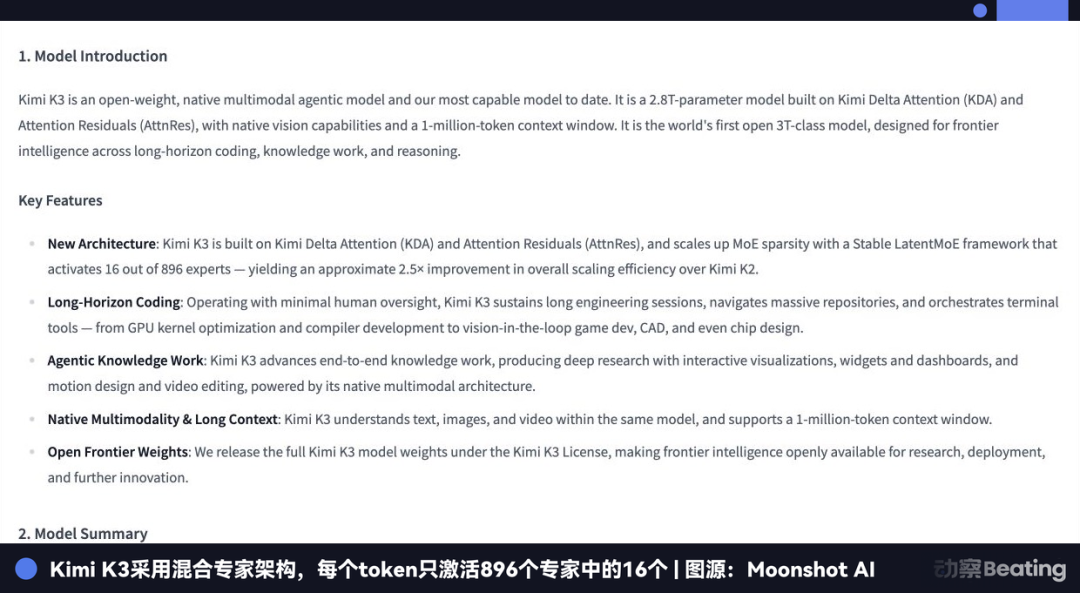
The hybrid expert structure of Kimi K3 complicates this issue further. After each token enters the model, the router selects 16 out of 896 experts to participate in the calculation. If there are minor differences in numerical precision or batching between the training and execution ends, the same token may be assigned to different experts, making it challenging to fully reproduce the original trajectory.
Therefore, Harvey and its suppliers have performed numerical alignment at the kernel level between the trainer and the execution environment. Once the weights are updated, they are directly hot-loaded into the execution environment without the need for repeated pauses for task generation. The system also records the expert routing results for each token, allowing the trainer to recalculate while trying to follow the path the model took when generating that trajectory.
At this point, Tenet no longer resembles a typical fine-tuning process of adding legal text to the model. Harvey has set up a repeatable training process. Legal tasks continuously enter the environment, the model completes the work, the trajectory is evaluated against the standards set by lawyers, the weights are then updated, and the new model goes back into the environment for the next round of tasks.
Whether Kimi K3 can be stably trained further is also practically proven in this iterative cycle.
After Training, It Behaves More Like a Legal Agent
Harvey's primary goal was to enhance the model's ability to perform complex legal tasks. It adopted a rigorous all-pass criteria, where all key performance indicators in a task must be met. According to Harvey's disclosed internal results, on the unseen LAB validation set, Tenet completed nearly double the number of tasks compared to the original Kimi K3, with the all-pass rate increasing from about 11% to 19.7%, a gain of around 9 percentage points.
In specialized testing for contract drafting, reviewing, and negotiation within LAB Contracts, the number of tasks completed increased by approximately 20%, with an all-pass rate of 11.3%, a gain of about 2 percentage points. According to Harvey's own ranking, Tenet secured the top spot in LAB Contracts and the second spot overall in LAB.
Subsequently, Tenet was subjected to two external evaluations, Mercor's APEX Agents Corporate Law and Crosby's Redline Bench. The former test simulated long-range professional tasks in a work environment, while the latter required the model to iteratively revise contracts and then be scored against standards set by attorneys.
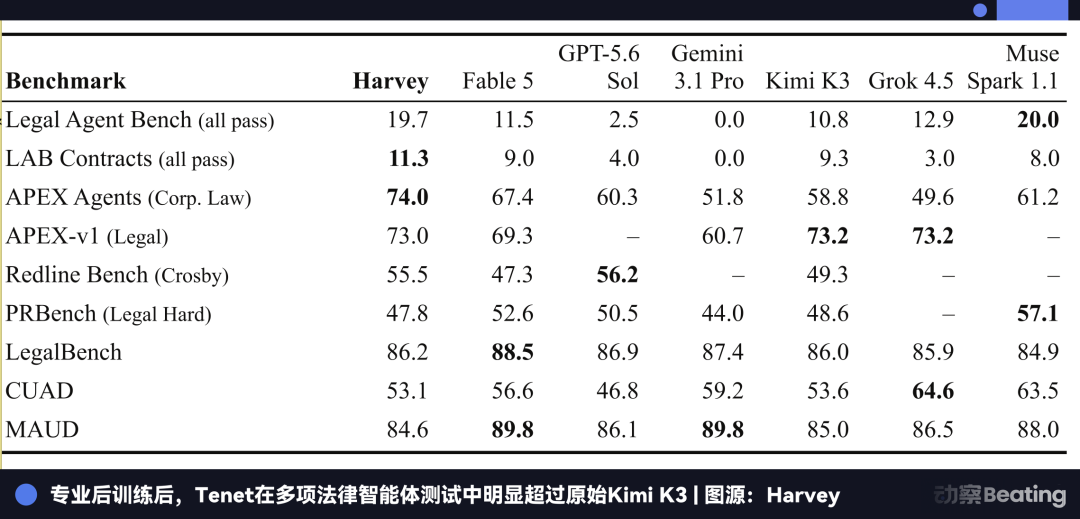
Tenet had no exposure to the training data for these two evaluations, yet it still outperformed the original Kimi K3 significantly, demonstrating that the skills honed in Harvey's task environment could be transferred to new legal tasks.
However, a common issue is that post-training, a model often specializes more in certain types of tasks, potentially losing some of its original knowledge and reasoning capacities.
On benchmarks such as LegalBench, CUAD, and MAUD, Tenet did not exhibit any noticeable regressions. In the challenging subset of the Scale Professional Reasoning Benchmark, its score even marginally increased from 36.0% to 36.8%. At least from this set of results, it can be inferred that after enhancing its legal capabilities, Kimi K3 did not experience significant forgetfulness issues.
Harvey's reward design tends to favor shorter trajectories as the quality of results converges, as each additional document read and tool invocation by the legal agent leads to increased token consumption and wait times. Post-training, Tenet reduced some unnecessary steps. As the task quality improved, the cost of completion remained relatively stable.
What changed the most in this round of training is how Kimi K3 approaches complex legal work. It now follows more defined steps, leverages tools, and misses fewer key requirements in tasks.
Harvey has been adopting a multi-model strategy since as early as 2025 and is still integrating new models from OpenAI and Anthropic this year. Tenet finally introduced a set of open-weight models into this system for the first time, all trained and controlled by Harvey.
What it requires is a set of base models that have already been validated. Harvey's legal tasks may involve handling a large number of documents, executing hundreds or even thousands of operations in succession, and the model needs to maintain its state throughout the lengthy process. Fine-tuning can continue to shape how it approaches legal work, but it is challenging to retroactively imbue a set of base models with abilities they did not originally possess.
Another requirement is control. While Harvey can make API calls to GPT and Claude, it cannot continue to embed 1750 legal task environments and lawyers' evaluation criteria into these closed-source models. Open weights allow it to decide how to train, how to design rewards, and to retain the trained expertise within its own controlled weights.
However, after obtaining the weights, the suitability of continuing training with this model must be evaluated. It is only through a real test that one can determine if long-trajectory reinforcement learning can run stably, if the routing of hybrid experts can be accurately reproduced, if newly acquired expertise will lead to forgetting previous knowledge, and if the inferential cost can remain within a production-usable range.
Two months after the completion of Tenet, Kimi K3 provided the answers for this round. The training process ran smoothly, there was a noticeable increase in legal task capabilities, no significant ability loss was observed, and costs did not spiral out of control along with the effectiveness.
For Harvey, these results are more crucial than the "open weights" themselves. The weights can be downloaded, indicating the company is eligible to continue training. However, the true value of this model lies in how much capability remains after training – determining whether it is worth further investment in computing power, data, and expert time.
Another Business of Model Companies
Harvey stated that its goal is to enable law firms to train their proprietary models on open weights and possess the capabilities that have been developed post-training. What Tenet provided was more of a methodology rather than just a model.
In the past, the core business of model companies mostly revolved around the deployment of models post-release. Open weights have introduced a different dynamic where a company can continue to train off-the-shelf base models, incorporate their industry knowledge into the weights, and ultimately obtain a model that is more tailored to their specific business.
This type of demand used to be difficult to form a true market for. When the general model's capability was not strong enough, even vertical companies found it challenging to solely rely on fine-tuning to cover long-range reasoning, tool invocation, and complex task handling. Self-pretraining from scratch was too expensive, and most companies simply didn't need to do it.
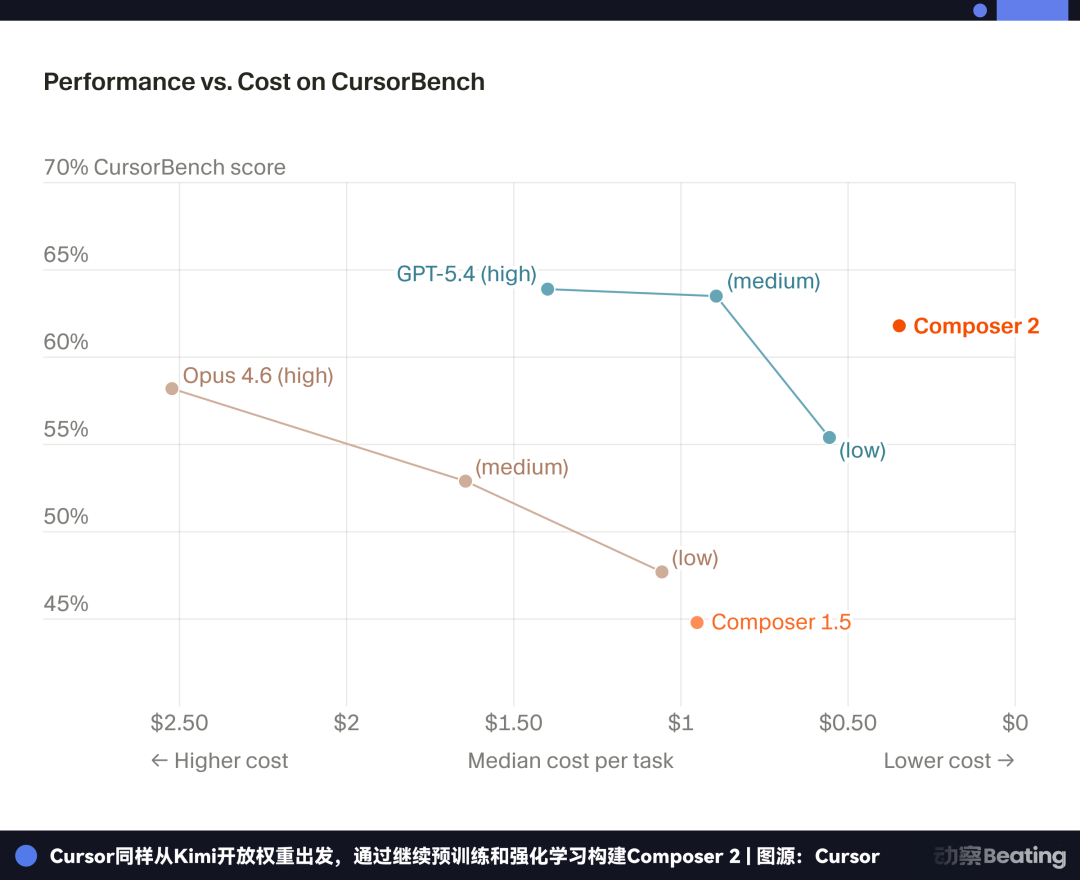
In programming, Cursor trained Composer 2, Cognition continued to train the model used by Devin on the same set of weights, and Harvey developed Tenet in the legal field. Programming and law are very different, but both chose to start from the general ability already trained in Kimi, and then incorporate their own familiar professional work.
Tenet also made the threshold of this matter more specific. In two months, about 150 cards, plus a set of evaluation criteria defined by practicing lawyers, a company can push a set of general weights to the forefront of its industry. The computing power threshold has dropped by an order of magnitude, and the more difficult-to-replicate part has shifted to the other end. It is unclear if anyone can explain to what extent a professional job is considered complete.
Software development and law are just two cases that have emerged. Industries such as finance, consulting, pharmaceuticals, accounting, and a large number of professional service industries all have their own data, workflows, and expert judgments. These industries themselves are knowledge work markets measured in the trillions of dollars. The top companies in these industries may not necessarily pretrain their basic models themselves, but are increasingly able to continue training their own models on a mature set of weights.
If this path continues to hold, Kimi's market will no longer be just about how many people are using it. What is more worth paying attention to next is how many companies, after Harvey, Cursor, and Devin, will choose to train their own models on Kimi.
Welcome to join the official BlockBeats community:
Telegram Subscription Group: https://t.me/theblockbeats
Telegram Discussion Group: https://t.me/BlockBeats_App
Official Twitter Account: https://twitter.com/BlockBeatsAsia
