On August 26, Hyperliquid's Aligned Quote Assets v2 (AQAv2) mechanism will officially start accruing revenue.
This means that in addition to trading fees, Hyperliquid will add a new income stream related to stablecoin reserve earnings, ultimately used for buying back HYPE.
According to the mechanism design, AQAv2's earnings will be settled on a 30-day cycle, and on the 8th day after the end of the cycle, they will automatically enter the Assistance Fund (the first revenue is expected to be credited on October 3), and then fully used for HYPE buybacks — in other words, while AQAv2 will not generate a large buyback fund immediately today, starting now, the relevant stablecoin reserves on Hyperliquid will officially begin accumulating buyback "water" for HYPE — the market currently estimates that AQAv2 may bring in $150 million to $200 million in additional buyback funds annually for Hyperliquid.
For Hyperliquid, which already has strong revenue and buyback capabilities, the value of AQAv2 lies not only in the growth of revenue scale but more importantly in the expansion of the revenue structure — it allows Hyperliquid for the first time to have an income and buyback source that is weakly related to trading activity and can expand with stablecoin scale.
If summarized in one sentence, AQAv2 is the second buyback engine for HYPE.
What Exactly Is AQAv2?
In simple terms, AQAv2 is a "revenue-sharing" mechanism that Hyperliquid has introduced for stablecoins.
The core logic of this mechanism is not complex — the stablecoin issuer can share reserve earnings with Hyperliquid in exchange for the stablecoin's liquidity and distribution channels in the Hyperliquid ecosystem.
To understand AQAv2, we first need to look back at its predecessor, AQA (or also known as the v1 version).
Previously, Hyperliquid had introduced the Aligned Quote Assets (AQA) mechanism, allowing eligible stablecoins to become the pricing asset for Hyperliquid's spot and perpetual contract markets, enjoying lower transaction fees, higher market maker rebates, and increased trading volume contribution. However, AQAv1 had a significant limitation where only stablecoins that were "exclusive" to Hyperliquid could be an Aligned Quote Asset. This meant that stablecoins like USDC, which were distributed across ecosystems such as Ethereum and Solana, were not eligible for the AQA conditions.
Hyperliquid's initial idea was to exchange trading-level incentives for a deep integration of stablecoin issuers into its ecosystem. However, with the implementation of AQAv1, Hyperliquid gradually realized that the "exclusive" condition actually constrained the protocol's development. This restriction prevented the protocol from leveraging the global liquidity and brand effects already established by mature stablecoins like USDC, making it challenging for its native stablecoin (USDH) to compete directly with these established giants.
This led to the creation of AQAv2 aimed at breaking these limitations. According to Hyperliquid's official definition, AQAv2 extends the "Aligned" qualification to stablecoins that are not exclusively on Hyperliquid, with the condition that the stablecoin issuer must share about 90% of the adjusted reserve yield generated by the stablecoin circulating on Hyperliquid with Hyperliquid.
If AQAv1 was "You give me exclusive access to your stablecoin, and I give you trading incentives," AQAv2 has transformed into "You can continue to serve other ecosystems, but if you wish to deeply engage with Hyperliquid, you must share the reserve yield with me."
In May of this year, aiming to seize the immense potential of Hyperliquid as an on-chain distribution channel, Circle and Coinbase announced a partnership agreement with Hyperliquid, making USDC the official "Aligned" stablecoin of Hyperliquid, with the native stablecoin USDH gradually phasing out.
Under the partnership terms, Circle, as the technical deployer, must ensure the stablecoin's minting, redemption, and cross-chain transfer infrastructure operate smoothly; Coinbase, as the Treasury deployer, is responsible for treasury management and revenue distribution. To ensure the long-term commitment and performance capability of the participants, both parties must stake 500,000 HYPE each and provide a 6-month advance notice to exit. If a lack of funds in the treasury address results in failed revenue deductions, the staked amount will be penalized at a daily rate of 2%.
Let's take a simple look at this three-way partnership. Hyperliquid provides users, liquidity, and the financial market; Circle provides the USDC stablecoin product; and Coinbase provides reserve asset management services—ultimately, the three parties will collectively share the additional value brought by the expansion of USDC's scale.
This is also the most interesting aspect of AQAv2. Hyperliquid does not need to issue USDC itself or personally manage tens of billions of dollars in government bonds and cash reserves, yet it can participate in sharing the revenue generated by these US dollar assets based on its users and financial infrastructure.
From this perspective, AQAv2 is not just a stablecoin mechanism update; it signifies that Hyperliquid is transforming its liquidity and distribution capabilities into a new business model.
AQAv2, How Much Money Can It Really Bring to HYPE in a Year?
Having understood the logic of AQAv2, the next question naturally is, how much horsepower can this new buyback engine really deliver? The answer actually depends mainly on two variables—the stablecoin scale on Hyperliquid and the actual yield of the reserve assets.
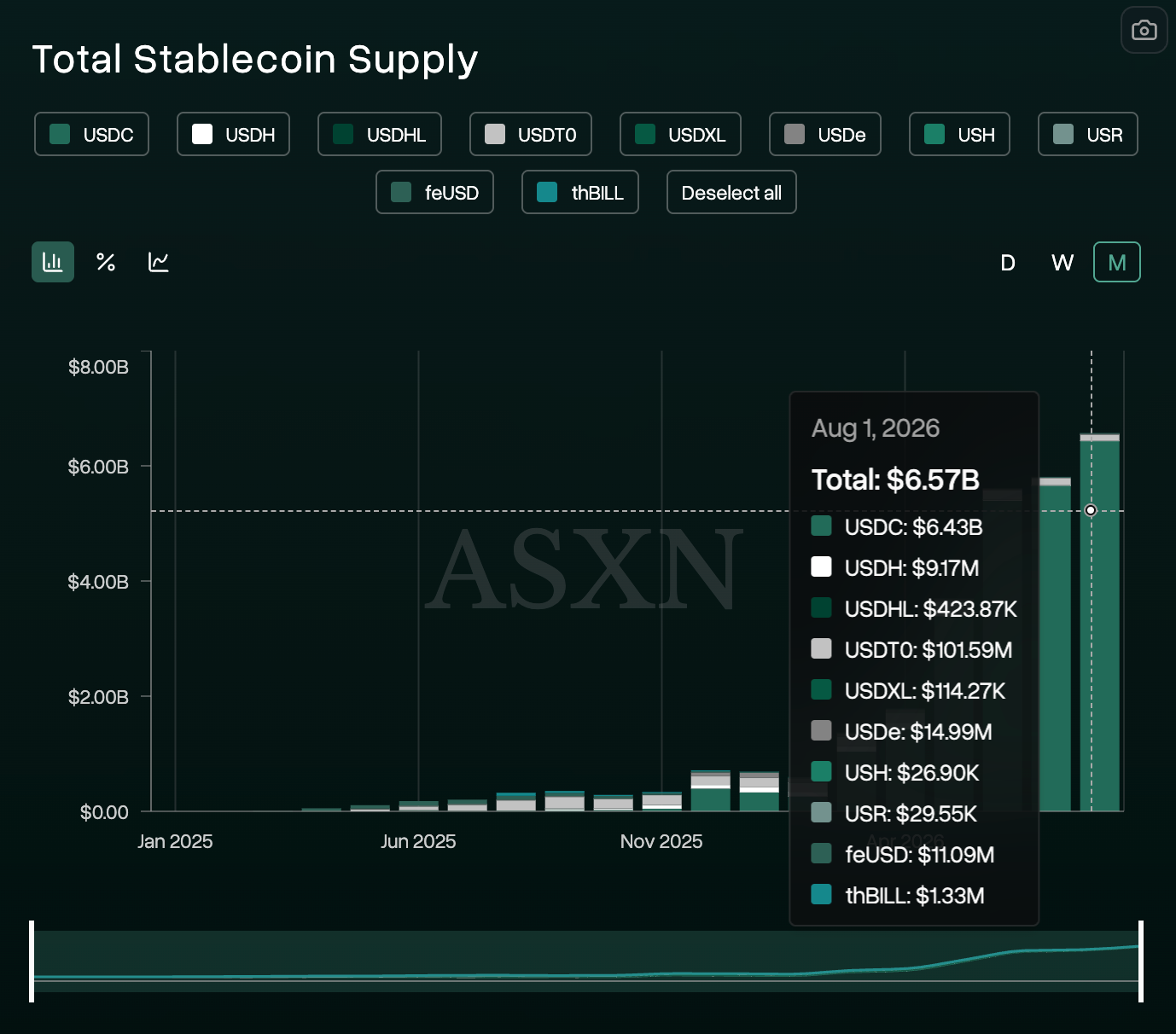
Recent data from Hyper Screener shows that the total stablecoin circulation on Hyperliquid has reached approximately $6.57 billion, with USDC holding absolute dominance at a circulation scale of around $6.43 billion.
Since the revenue-sharing ratio of AQAv2 is approximately 90%, a very simple formula can be used for estimation:
· AQAv2 Annual Revenue ≈ USDC Scale on Hyperliquid × Reserve Yield × 90%
If we use the current USDC circulation scale of around $6.43 billion as a baseline, the estimated income contribution of AQAv2 under different yield rates is roughly as follows:
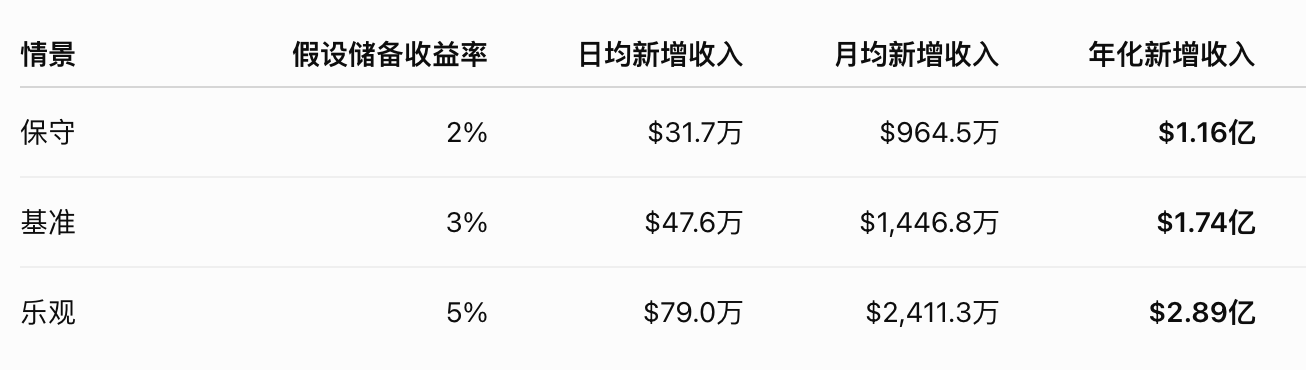
Even using a 3% yield rate, based on the approximately $6.43 billion USDC circulation scale, it is estimated that AQAv2 can increase Hyperliquid's income by around $476,000 per day, amounting to approximately $174 million annually.

What is this number? The latest data from Hyper Screener shows that Hyperliquid's total revenue in August is $50.27 million. Roughly calculated for 26 days, the daily average is about $1.933 million. In other words, if AQAv2 operates with a 3% yield, the additional revenue is equivalent to approximately 24.6% of the current daily revenue.
Even using this static data for evaluation, AQAv2 is already a significant revenue source in marginal terms. More importantly, the circulating USDC on Hyperliquid is still rapidly growing—the more USDC, the more reserve revenue generated; the more reserve revenue, the more funds entering the Assistance Fund; and ultimately, the more funds available for HYPE buybacks.
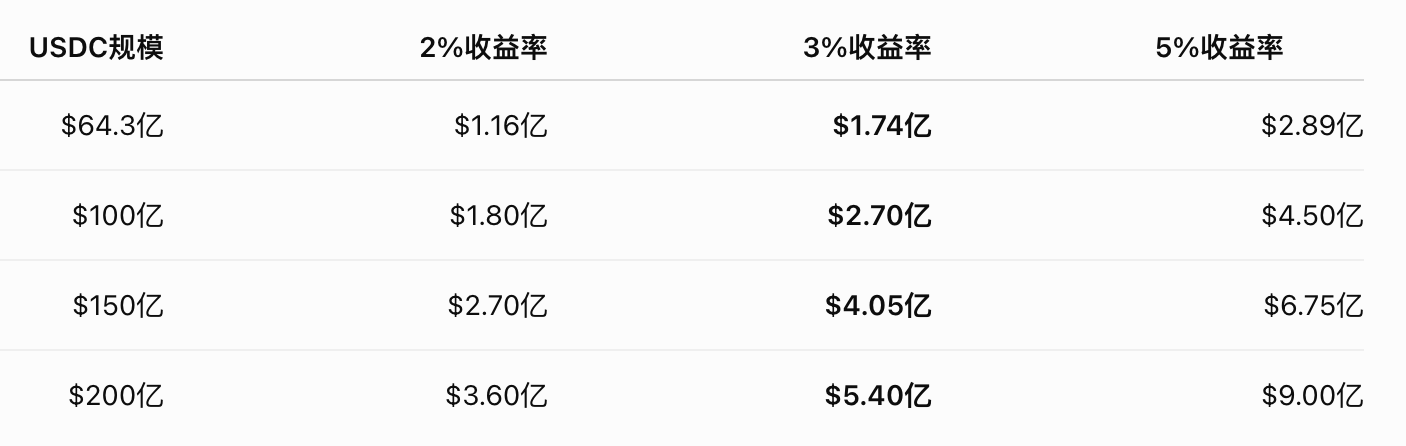
Therefore, an income of $150-200 million is by no means the upper limit for AQAv2, but rather resembles a starting point for benchmark revenue.
The Bulls Are Coming, and the Good News Keeps Coming
If the market's previous core pricing logic for HYPE was highly dependent on Hyperliquid's trading volume and fee revenue, then the launch of AQAv2 means that this logic is further expanding—HYPE's buyback capability is no longer only tied to trading activity but is also starting to be linked to stablecoin volume.
Just as HYPE has recently experienced a strong uptrend. With improving macro liquidity and overall market sentiment rising, HYPE has surpassed $80 and hit a new all-time high. The market is using price to reflect expectations of Hyperliquid's growth, and AQAv2 is further providing a new fundamental support for HYPE—the larger the USDC volume, the higher the reserve revenue, and the more funds available for HYPE buybacks.
Of course, after the short-term uptrend, HYPE's valuation is already high. Whether it can continue to rise in the future ultimately depends on whether revenue, stablecoin volume, and buyback size can continue to grow. But at least for now, Hyperliquid is transitioning from a "fee-earning" on-chain trading platform to a protocol that can continuously capture value from transactions, stablecoins, and the entire on-chain financial ecosystem.
Audit Quality Version 2 may not be the sole reason for the next price pump, but it is likely a key part of its long-term value capture thesis.
Welcome to join the official BlockBeats community:
Telegram Subscription Group: https://t.me/theblockbeats
Telegram Discussion Group: https://t.me/BlockBeats_App
Official Twitter Account: https://twitter.com/BlockBeatsAsia
