After more than two months, Strategy finally resumed buying Bitcoin.
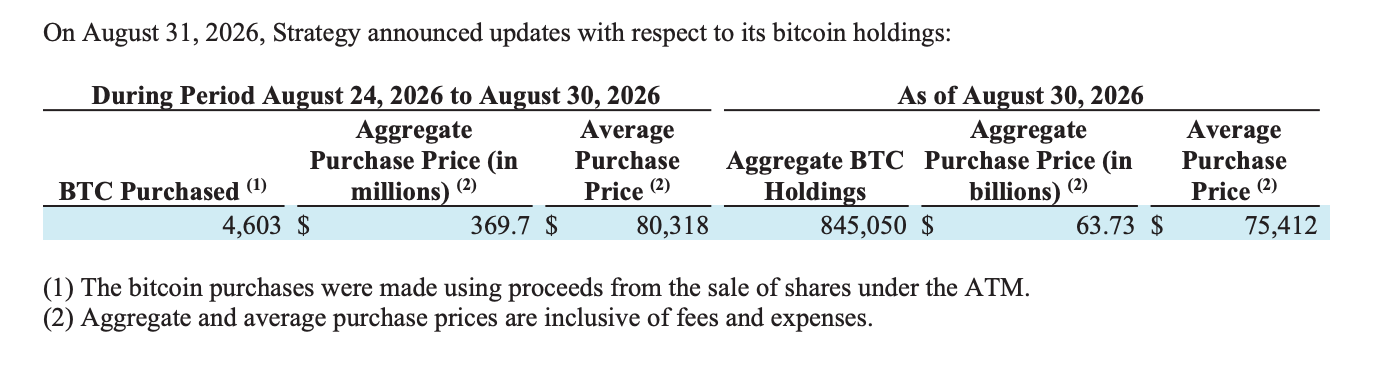
On the evening of August 31, Beijing time, Strategy announced that it had purchased a total of 4603 BTC between August 24 and August 30, spending approximately $369.7 million, with an average purchase price of $80,318 per BTC. As of August 30, Strategy holds a total of 845,050 BTC, with a cumulative investment cost of approximately $63.73 billion and an average holding cost of $75,412 per BTC.
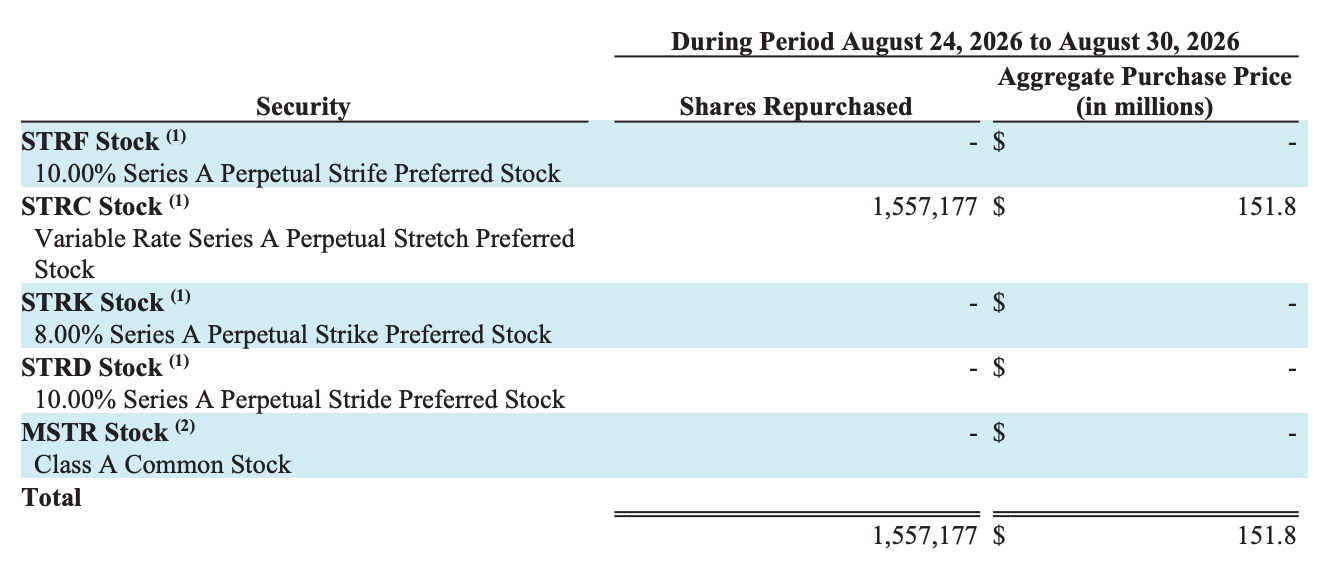
Meanwhile, during the same week, Strategy did two more things—it injected about $30 million into the "USD Cash" liquidity account and spent around $1.518 billion to repurchase 1.557 million shares of STRC. As of August 30, Strategy's "USD Reserve" is $5.1 billion, USD Cash is $1.61 billion, totaling $6.71 billion.
· Odaily Note: The difference between USD Reserve and USD Cash is that the former can only be used to pay dividends on Strategy's preferred shares and interest on outstanding debt, while the latter can be used for broader treasury purposes, including buying Bitcoin, expanding USD Reserve, broader capital management purposes, and similar objectives.
Purely from a price perspective, Strategy's trading around BTC in the past two months may seem a bit awkward—Lookonchain statistics show that Strategy sold a total of 6,916 BTC over the past two months, with an average selling price of around $62,081 per BTC. Now, when repurchasing, the average price has risen to $80,318 per BTC ... Strategy seems to have made a not-so-smart "sell low, buy high" move.
However, if we take a broader perspective, we will find that this series of transactions is by no means a failure for Strategy as a whole, and can even be considered quite successful. After all, the main purpose of Strategy's coin selling over the past two months was not to time the market top, let alone predict a BTC price drop, what it really wanted to address was a crisis that was once more complicated than the BTC price—an STRC depegging issue and the cash reserve problem it exposed.
Today, after a series of BTC sell-offs, replenishing USD reserves, adjusting the STRC mechanism, and initiating a large-scale buyback, Strategy has finally resumed accumulating BTC. To some extent, this also means that the looming cloud over Strategy for the past two months has received at least interim handling.
STRC Derailing and Cash Reserve Crisis
For investors who have long been following Michael Saylor and Strategy, everything that happened this summer was somewhat unexpected.
Over the past few years, Strategy has almost established an extremely simple yet firm business narrative—fundraising, then buying BTC. Whether issuing common stock, convertible bonds, or later introducing a series of preferred stock products such as STRK, STRF, STRD, and STRC, Strategy's capital operation ultimately mostly pointed to the same goal: continuously raise funds from the capital market and then steadily expand its BTC holdings.
In this system, what is most important is not how much cash flow Strategy's software business can generate, but whether the capital market is still willing to provide continuous fuel for this "funding machine."
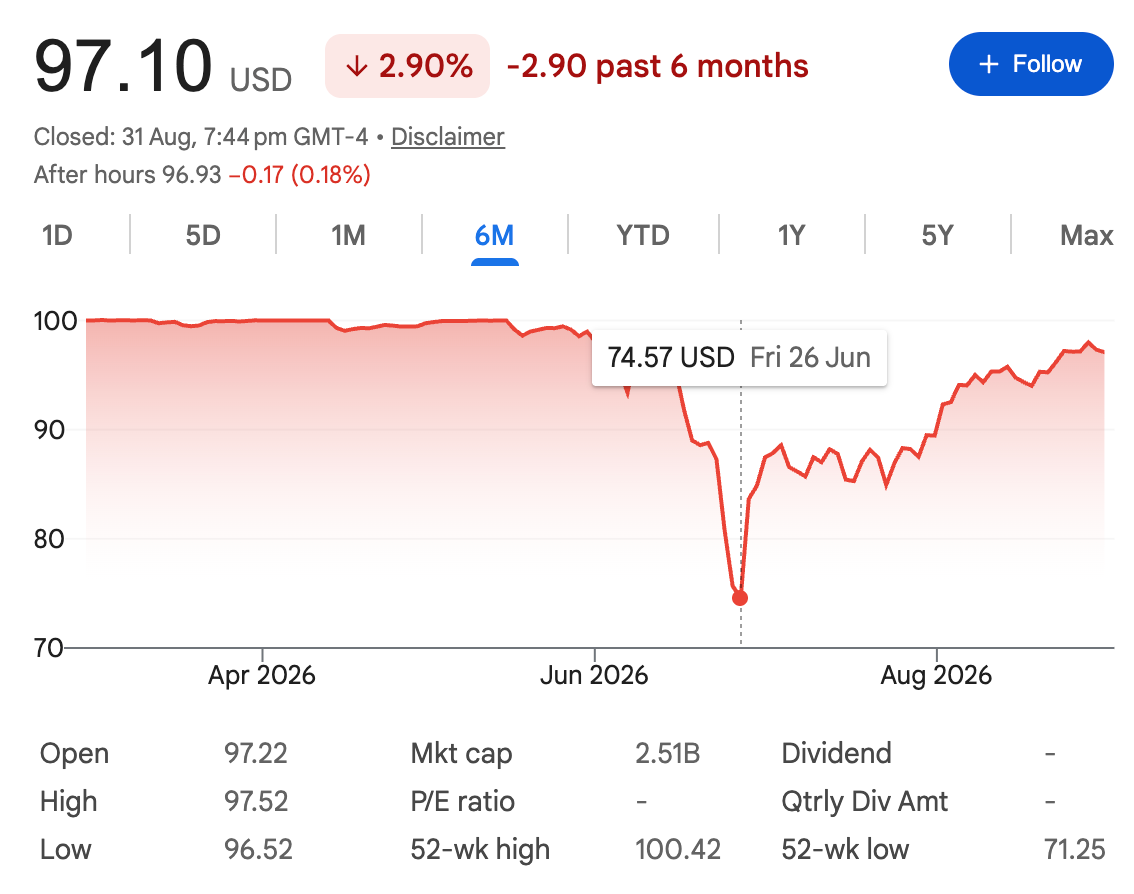
However, in June this year, the issue first arose with STRC. As Strategy's most important floating rate preferred stock product, one of STRC's initial core goals was to trade as stably as possible around $100. Around this goal, Strategy would maintain its attractiveness through adjusting dividends and other means so that STRC could function as a relatively stable financing tool, continuously absorbing funds from the market. But as STRC began to derail and the situation worsened, this mechanism also began to face challenges.
· Odaily Note: Refer to "STRC Derails by 11%, Can Strategy's Perpetual Motion Machine Still Operate?" and "Without STRC's Anchor, There Will Be No Bull Market for BTC."
For Strategy, the biggest issue with STRC derailing is—once the market price remains below the issuance price for a long period, the company's ability to continue financing through issuing STRC will be significantly affected. And this precisely touches the most core part of Strategy's capital model.
The reason Strategy has been able to continuously expand its BTC holdings over the past few years fundamentally relies on ongoing financing. When financing channels such as common stock, preferred stock, etc., operate smoothly, the company can continuously receive new funds and invest these funds in BTC; but once a key financing channel malfunctions, and at the same time, the company faces ongoing cash outflows such as preferred stock dividends, debt interest, etc., liquidity pressures will quickly emerge.
Therefore, on June 29, Strategy launched a self-rescue plan called the "Digital Credit Capital Framework." One of the key changes in this plan was that Strategy officially opened the door to "selling BTC" for the first time.
· Odaily Note: See "Flash Loan Quintuplet! Strategy Self-Rescue Plan Officially Released" for reference.
According to the arrangement, the company can, when management believes that selling BTC is more advantageous than issuing common stock or conducting other capital market financing, use the proceeds from selling some BTC to fund preferred stock dividends, debt interest payments, or supplement dollar reserves.
In other words, the previous "hodl-only" BTC treasury was given another function for the first time—when there is pressure in the capital markets, BTC itself can also become a source of liquidity for Strategy.
Subsequently, Strategy officially began large-scale BTC selling operations—prior to this, there was actually a test sale for "de-sensitization," but it was on a smaller scale, with only 32 BTC sold.
Crisis Resolution Status
In retrospect, since the announcement of the "Digital Credit Capital Framework" on June 29, the main theme of Strategy's operations in the past two months has been very clear—selling some BTC for liquidity, continuously replenishing cash reserves through MSTR ATM, and massive STRC buybacks to restore the peg, until the current reserve pressure is relieved.
Regarding BTC sales, Strategy sold 3588 BTC in the week of July 6, with an average price of about $58,603, totaling approximately $210 million sold; 1638 BTC in the week of August 3, with an average price of about $61,660, totaling approximately $101 million sold; and 1690 BTC in the week of August 10, with an average price of about $64,260, totaling approximately $108.6 million sold. In total, across the three sales, Strategy sold 6916 BTC, realizing approximately $430 million.
However, selling coins is only part of the entire self-rescue plan. In the past two months, Strategy's main source of funds has still been MSTR's ATM sales. By continuously selling common stock, the company has increased its dollar reserves from $2.55 billion on June 29 to $5.1 billion; meanwhile, a dollar cash account was established in late August, reaching $1.61 billion as of August 30. The total of the two dollar assets reached $6.71 billion, an increase of approximately $4.16 billion from the end of June, a growth of over 160%.
Meanwhile, Strategy continues to buy back STRC. In the latest week, Strategy once again spent $151.8 million to repurchase 1.557 million shares of STRC. Since initiating the buyback at the end of July, the company has now used approximately $635 million in total to buy back STRC.
Under the triple strategy, this adjustment seems to have begun to show its effect.
In addition to the previously mentioned cash reserve situation, the most obvious sign of recovery is the anchoring of STRC. As of the U.S. stock market closing on the morning of September 1st Beijing time, STRC had risen to around $97, with only about a 3% gap to the $100 target. The Strategy management had clearly stated in the Q2 earnings call earlier that the goal was to push STRC back to near $100 by September 8, and at the moment, the hope seems quite strong.
The Market's Most Feared Landmine, Temporarily Mitigated
Of course, at this stage, it is still premature to conclude that Strategy has completely "survived."
Whether STRC can smoothly re-anchor by September 8 and stabilize long-term near $100 thereafter remains to be seen; the vast preferred stock system of Strategy still implies ongoing cash outflows, and whether its "finance-to-buy" capital machine can return to normal operation in the future also depends on whether the market is willing to continue to provide funding.
However, at least compared to over two months ago, Strategy has regained some initiative—cash reserves have increased significantly, the anchoring of STRC has visibly narrowed, and the company has finally shifted from continuous selling to buying once again.
Overall, Strategy's operations over the past two months can be described as a very wise "sell low, buy high." Although it may seem like a loss on the surface, it has brought more than $4 billion in additional dollar assets, a buyback of hundreds of millions of dollars worth of STRC, and when concerns arose about STRC anchoring and cash reserve issues, it secured adjustment space for the entire capital system.
The massive looming threat hanging over the market may not have completely disappeared, but at least it is no longer as dangerous as before.
Welcome to join the official BlockBeats community:
Telegram Subscription Group: https://t.me/theblockbeats
Telegram Discussion Group: https://t.me/BlockBeats_App
Official Twitter Account: https://twitter.com/BlockBeatsAsia
