Author: 0xLonglife
Robinhood Chain Trench Warfare Continues. Data shows that in the two months since launch, Robinhood Chain has accumulated a total of 463 million transactions, 12.08 million active wallets, a DEX total trading volume of $52 billion, and nearly 594,000 on-chain meme coin trading pairs.
Transaction fees are the most honest sentiment indicator for a chain: Robinhood's total on-chain gas has reached 4274 ETH; According to DeFiLlama data, Robinhood Chain's daily gas fee has increased from around $56,000 on August 23 to around $3.75 million on September 1. The increase in fees is due to the surge in transaction volume and the fact that this chain is not cheap. The community has started to complain about the "increasingly expensive transaction fees," with some even lamenting that the fees exceed those of the Ethereum mainnet.
High transaction fees are certainly not good for users, but looking back, isn't this a good thing for the LP farmers during the DeFi Summer 6 years ago?
So, we want to explore whether, in this fee environment, it is more cost-effective to continue engaging in trench warfare PvP or to choose high-quality pools to provide liquidity.
Why Are Fees High?
Robinhood Chain is an Arbitrum-based L2, and fees consist of two parts:
L2 execution fee: On-chain execution fee;
L1 data fee: The cost of posting transaction data to Ethereum for data availability.
The official documentation states that the L1 data fee will vary with Ethereum congestion and calldata size. Therefore, regular transfers and complex swap/launchpad transactions are not at the same cost level. Platforms like Pons and long.xyz will bring more calldata and contract calls, with gas being only the first layer of cost. It can be said that issuance platforms act as amplifiers of user fee expenditure.
For example, taking Pons: Pons charges a 0.0005 ETH issuance fee, V1 swap incurs a 1% fee; V2 default curve fee is 1%, creator tax can go up to 10%, and even after token graduation, Uniswap v4 hooks can continue to charge 1%. Fee allocations include protocol, creator, PONS buyback and burn, meme token buyback and burn, Uniswap/LP, etc. Even the Pons team themselves admitted in a post yesterday that Pons was the platform with the highest user fee payment among on-chain launchpads in the last 24 hours.
Therefore, the "expensive" aspect of the Robinhood Chain lies in three layers: on-chain gas fees, token transaction taxes, miscellaneous fees, and the cost of repeated failed payments in high-frequency PvP.
Take microduck as an example. Suppose a user buys this token with $1000 worth of ETH. The aggregator's transaction path should be: WETH → USDG → NVDA → microduck. In this path, each step is calculated using the most liquid pool, and during the buy phase, the user will incur over a 20u transaction cost, mainly consisting of Pons V2 hook fee and creator tax (each 1%).
Similarly, if microduck is sold after a 50% increase, the cost during the transaction exceeds $30. In the end, for a trade with a theoretical profit of 50%, where the gain should be $500, the actual profit is $437.3, with a transaction cost of around $62.7.
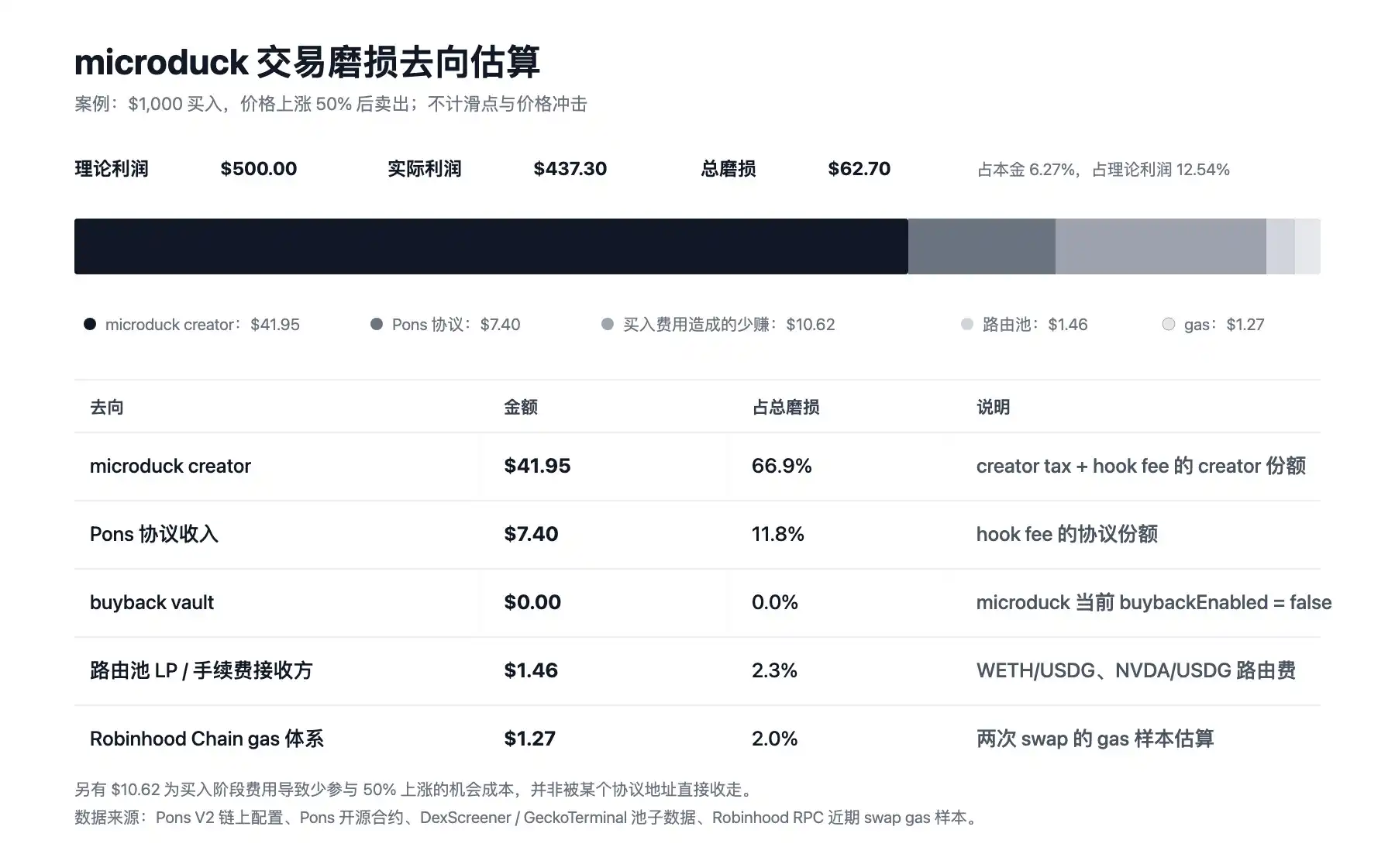
In this way, an investor finally managed to capture a golden dog, only for 12.54% of the profit to be taken by intermediaries in the trade.
Trench PvP Actual Win Rate
Many people think trench is an information asymmetry game. But after the rise in fees, it has become more like a cost-control game.
Dune data shows that in the past 30 days, among those who have sold memecoins on the Robinhood Chain:
Profitable addresses: 479,514;
Loss-making addresses: 716,383;
Loss ratio: approximately 59.9%;
Frankly, the above profit-loss ratio is already considered challenging in a market environment where crypto has not completely turned bullish. However, the current data includes the profit-loss situation in the first 50 days of the simple mode on the Robinhood Chain. With the current influx of funds into the rh chain, feedback from the community indicates that the trench difficulty has entered hell mode, with foreign Twitter handles complaining of being hacked every day. The subsequent profit-loss address ratio is likely to deteriorate further.
Additionally, due to the persistently high on-chain fees, it has exacerbated a PvP paradox: the higher the fee, the higher the win rate threshold for small accounts; the heavier the tax, the larger the price swing needed for short-term trades. Ultimately, the trench does not lack opportunities, but it demands that you be earlier, faster, and more accurate than most, all while paying increasing friction costs. Over time, as fees become more expensive, low win-rate speculative strategies become increasingly challenging to outperform in the long run.
Alternative Pools for LP
As a result, the cost-effectiveness of choosing an alternative LP pool has gradually become apparent. This is because PvP earns money from the opponent, while LP earns money from the transaction order itself.
Combining this round of RH chain hype with the main meme coin of the chain, referring to Robinhood Chain pool data, the author has selected several pools worth observing:
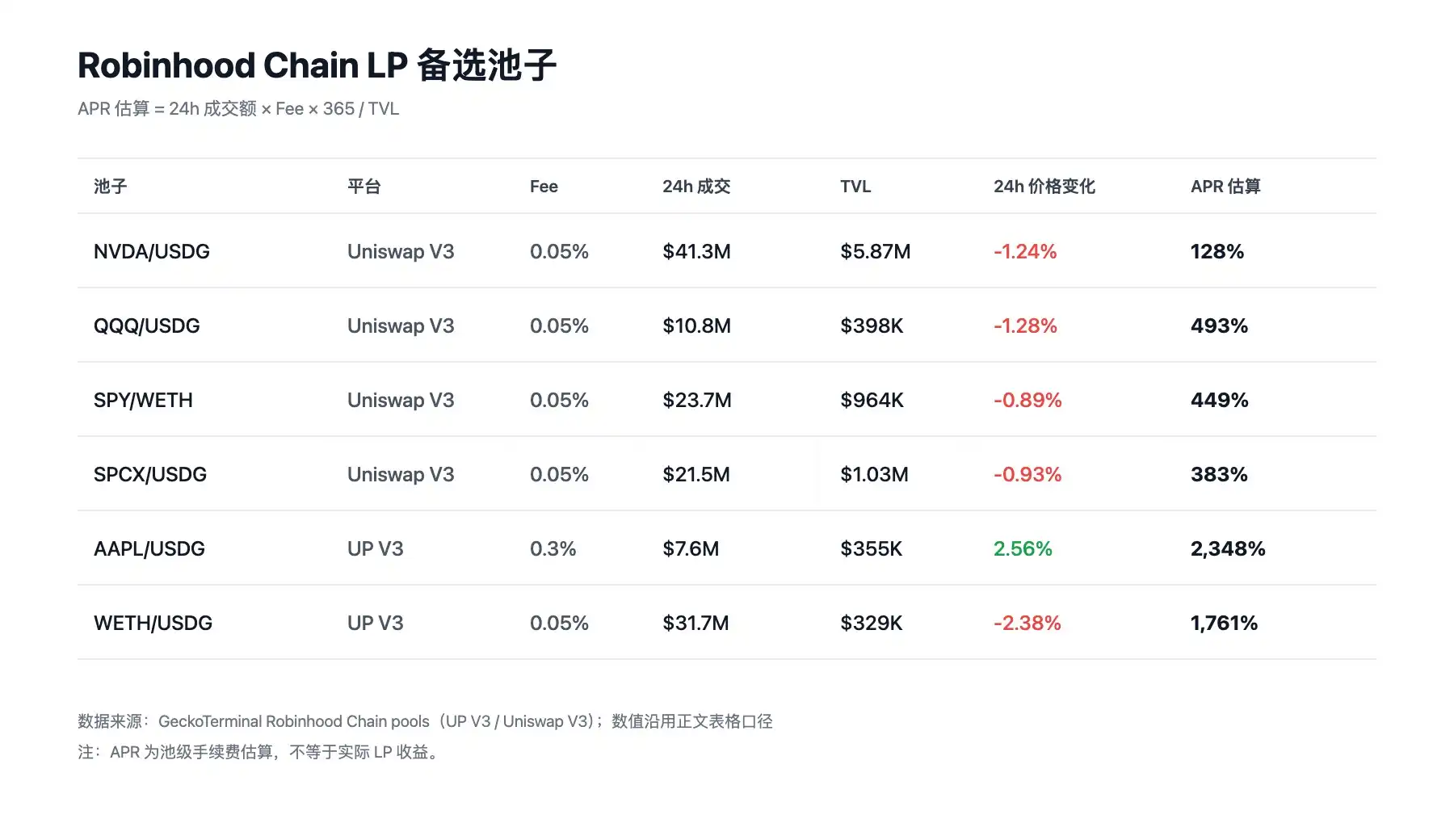
It is necessary to explain the data here: Most of the tokens issued by platforms like Pons are stock tokens, and most users will not hold these tokens in large quantities. Therefore, during the transaction process, the route will take an extra step, and the extra step taken is the excess income we earn.
It should be pointed out that as a native ve (3,3) protocol on the rh chain, the AAPL/USDG and WETH/USDG APRs on UP look very high, but the TVL is relatively small, so the sustainability of earnings needs to be further observed.
Of course, another approach is to choose promising infrastructure projects on the rh chain for long-term holding and LP pairing. It is recommended that investors pay attention to existing product deliveries and rh chain native protocol projects. For example, the ve (3,3) protocol Up mentioned earlier, benefiting from the recent rapid appreciation of the token, the protocol's token is currently paired with WETH on the platform, with an APR as high as 21,950%.
In addition, projects such as the NET protocol similar to OHM (OlympusDAO), the officially recognized stock dividend protocol Index, and the rh chain native order book DEX Mancer, if there are no surprises, are expected to perform well in the long run, with the APRs of their largest mainstream pools currently standing at 2,341%, 1,261%, and 1,059%, respectively.
Finally, there are savvy on-chain degens taking the "dark path," utilizing the high volatility of popular meme coins and LP scarcity by creating custom high-fee LPs on Uniswap V4, riding the on-chain FOMO sentiment wave, and also achieving good returns. For example, the token Rabbit, which surged briefly yesterday, someone created a USDG pool with an 8% fee, with a pool TVL of $328,000, experienced $239,000 in volume within 24 hours, ultimately earning $19,000, and achieving an APR of 2,124%. However, this is also a bit like another form of meme farming, betting that it will not return to zero quickly.
In conclusion, the operational strategy of Robinhood Chain in the new situation seems to need a rethink. In a low-fee era, the trenches can tolerate high-frequency trial and error; in a high-fee era, every click is turning into a chip. For the average user, the win rate of PvP is only about forty percent, and they are further eroded by gas fees, platform fees, slippage, and failed transactions. In contrast, selecting high-quality stock tokens or index token pairs to provide liquidity is essentially placing oneself on the fee side of the trading flow.
The author believes that in the current environment of rapidly rising fees on Robinhood Chain, the higher cost-effective solution is not indiscriminate trench warfare but rather participating with a small position in high-certainty narratives, and using the main position to filter for high-volume, more price-stable LP pairs with substantial TVL.
The trenches profit from directional judgment amid chaos. LPs profit from the chaos itself.
Welcome to join the official BlockBeats community:
Telegram Subscription Group: https://t.me/theblockbeats
Telegram Discussion Group: https://t.me/BlockBeats_App
Official Twitter Account: https://twitter.com/BlockBeatsAsia
