$8.15 million in fees in a single day, $54.3 million in a week.
That's the profit data delivered today by Pons, the launchpad on the Robinhood Chain.
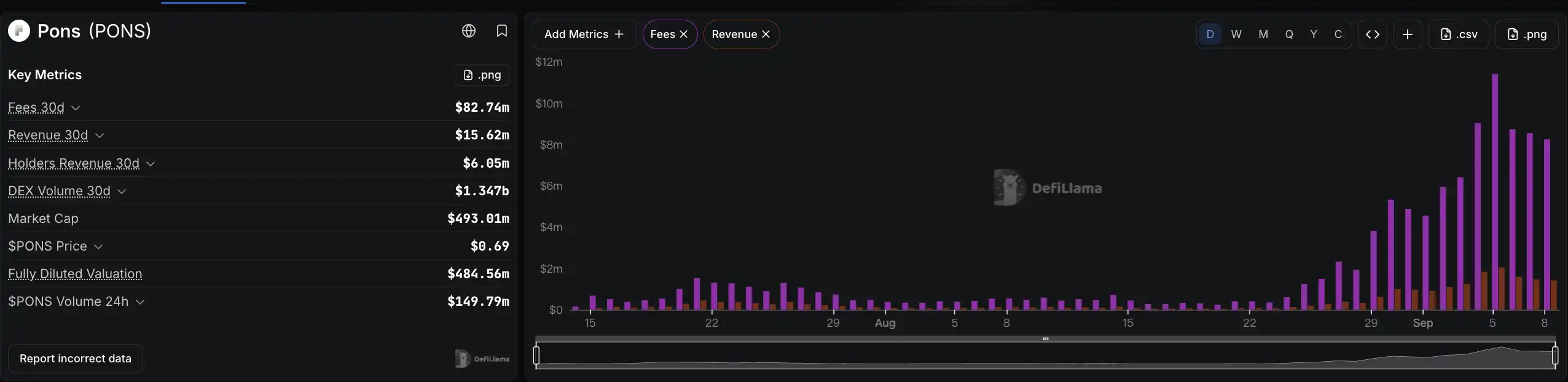
Leading the narrative of "stock-paired tokens" and "holder-based distributions," the platform token has skyrocketed, "golden dogs" keep emerging, and Robinhood is drawing on-chain traders to reallocate their capital and time.
For established ecosystems, the threat is already at their doorstep—what countermeasures have they deployed?
Solana Officially Joins the Fray
On the launchpad front, Solana's key bet is StonkFun.
StonkFun allows memes to pair with stock tokens and other crypto assets. SPY stock tokens, ZEC, and other assets can also serve as trading pairs. Meme trading volume thereby drives these assets to circulate on Solana, providing a concrete use case for stock-paired tokens and on-chain asset trading.
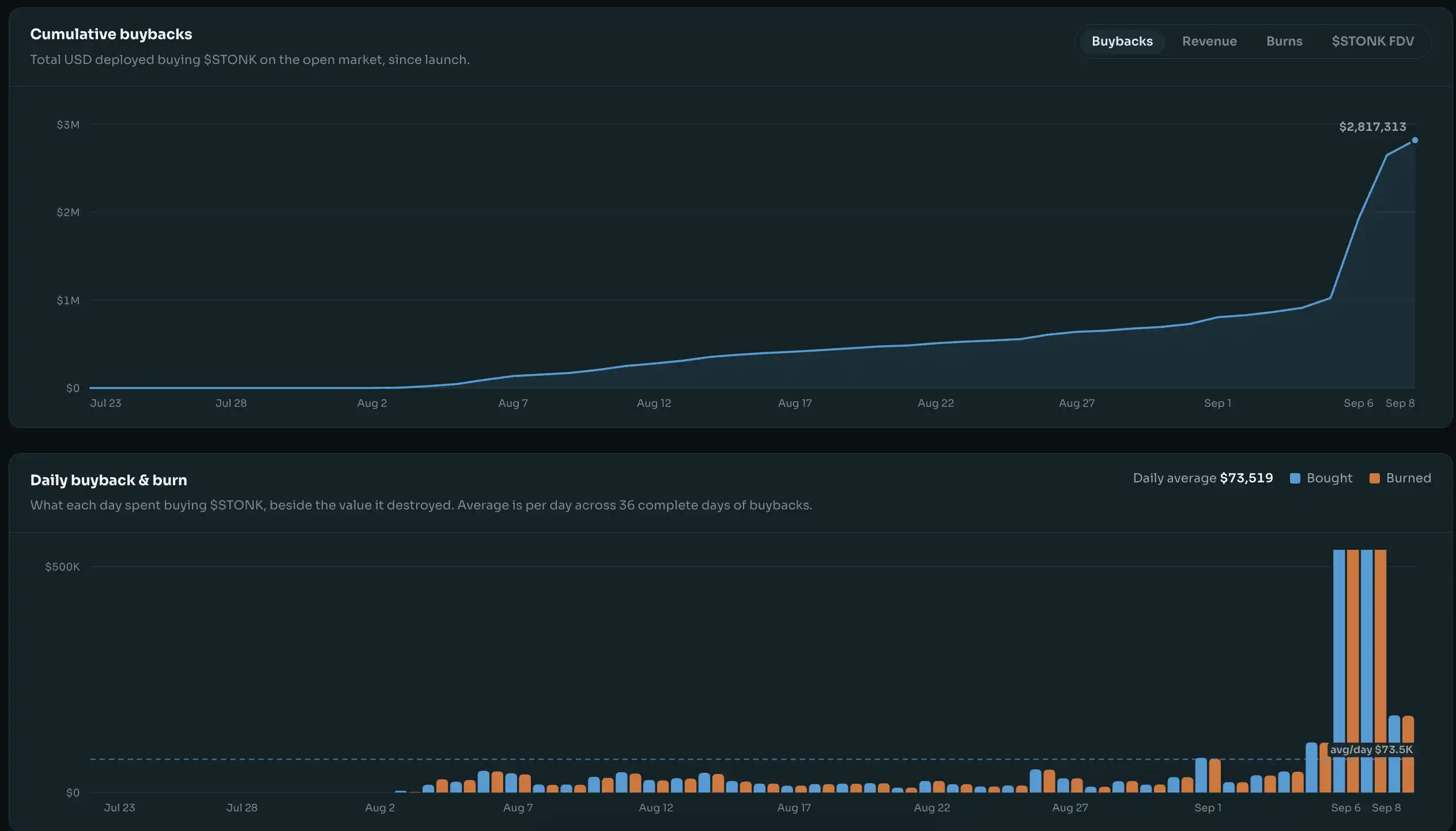
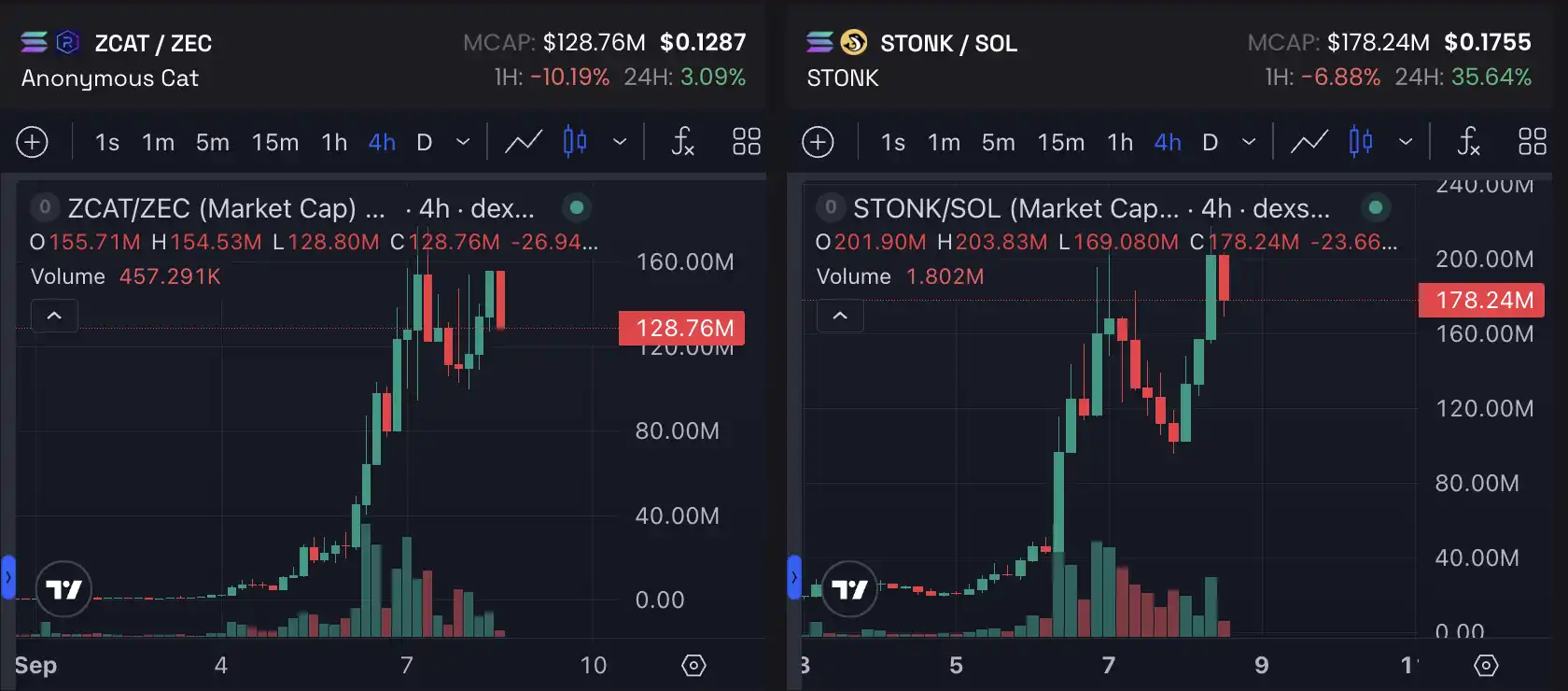
STONK is StonkFun's platform token, and a portion of StonkFun's revenue is used to buy back and burn STONK. The buyback dashboard shows that StonkFun has cumulatively invested approximately $2.82 million to repurchase STONK, with the buyback curve visibly accelerating in early September. This converts ecosystem trading activity into buying pressure for the platform token, while STONK's rise brings more attention to the launchpad.
The platform also allocates a portion of trading fees to buy back and burn the top ten ecosystem tokens by market cap, weighting distribution accordingly. This ensures leading projects receive ongoing platform support, while trading heat can also transmit to ecosystem tokens.
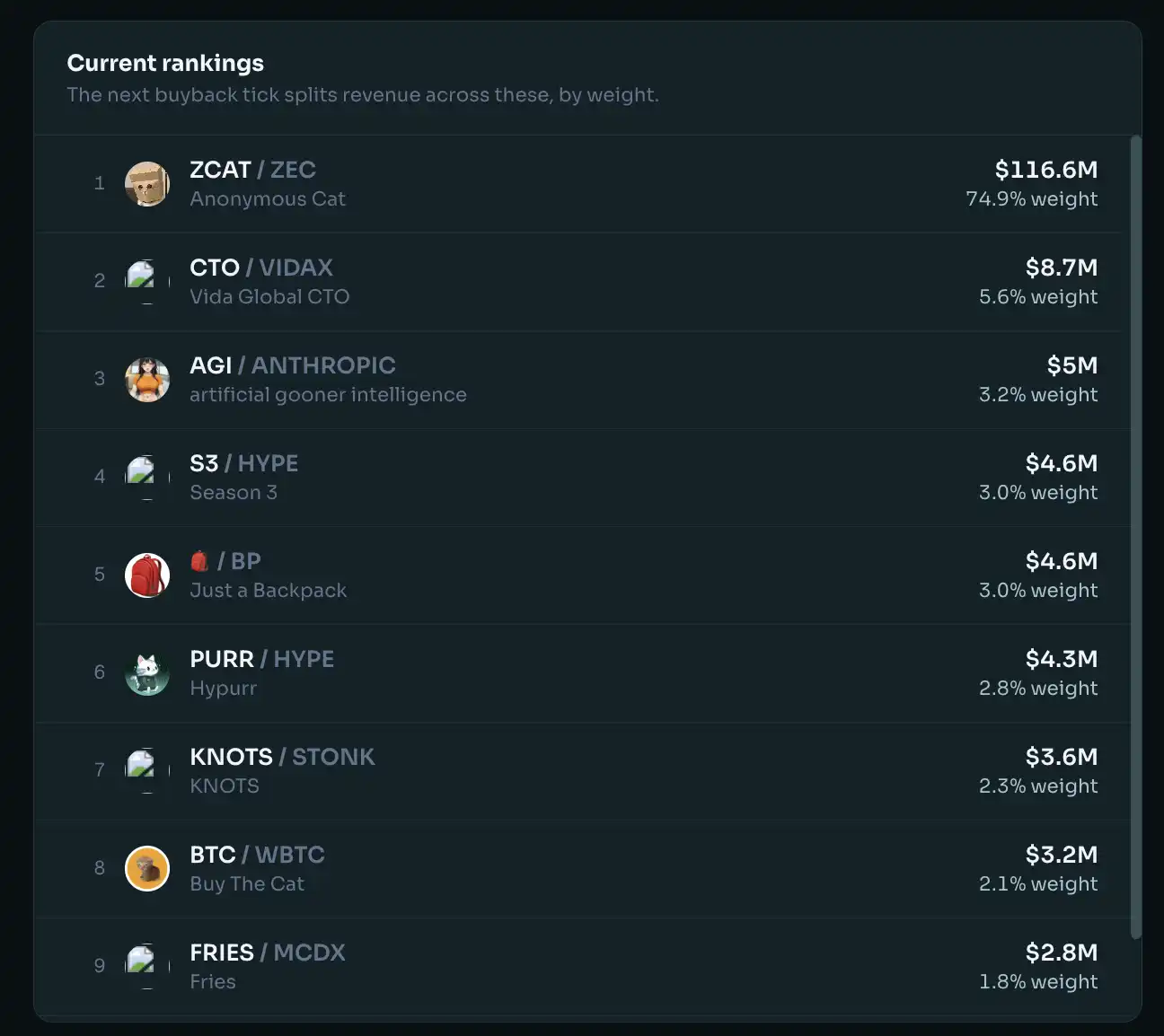
ZCAT is the most closely watched among them.
An anonymous cat wearing a paper bag over its head packs Zcash's privacy culture into a meme. It pairs with ZEC on Solana while accumulating reward funds through a 3% transfer fee, converting them into ZEC distributed proportionally to eligible holders. Players holding ZCAT have the chance to receive ZEC.
This is also the logic Ansem emphasized most when shilling ZCAT. On September 7, he publicly stated he had bought ZCAT the day before and already received ZEC distributions. In his view, those bullish on Zcash continuing to rise and capturing this cycle's market attention will also seek out related memes with higher volatility; and placing this meme on Solana, where traders are already congregated, makes perfect sense.
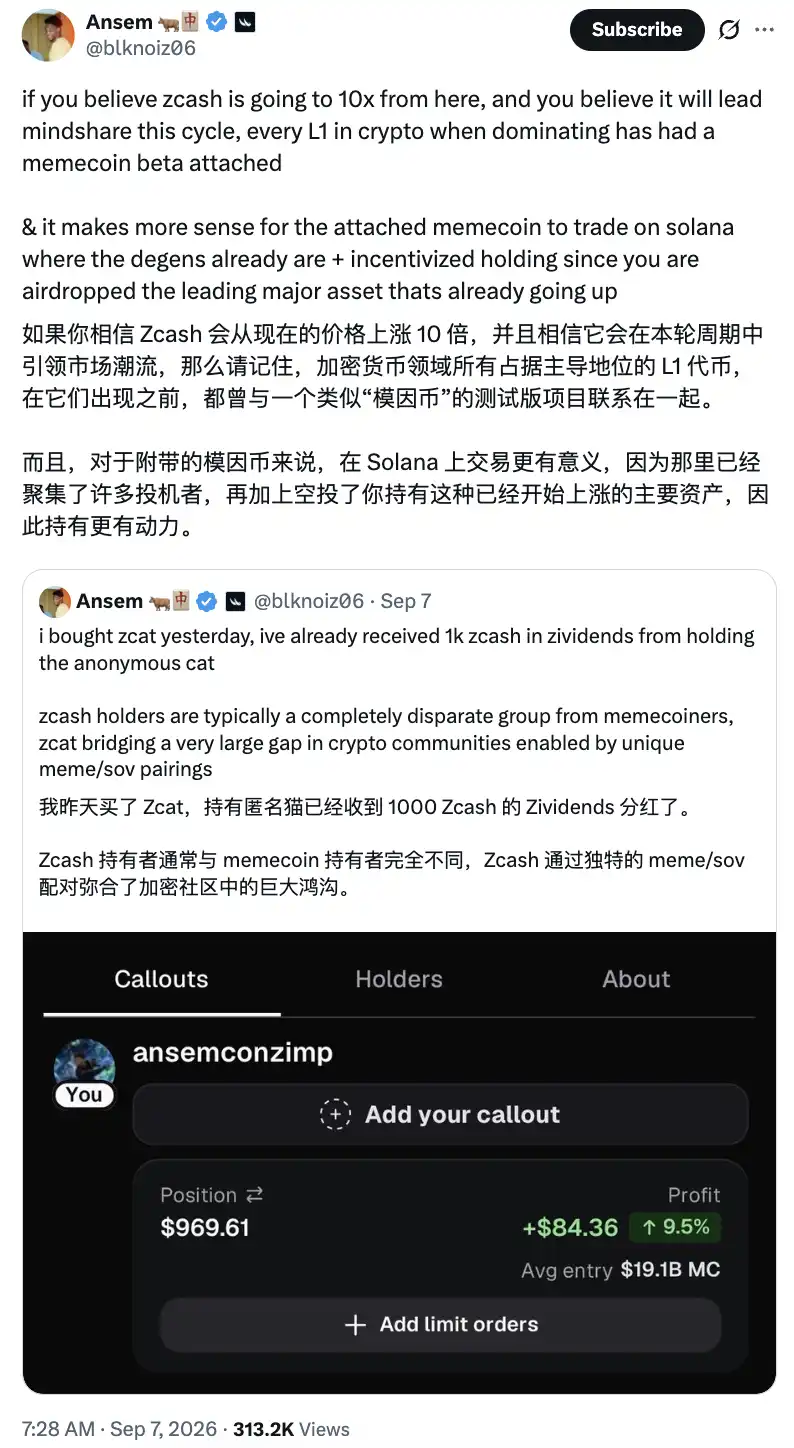
Zcash holders and meme players were not necessarily the same crowd to begin with. ZCAT provides an intersection for both sides: the former can see their familiar assets and privacy symbols, while the latter get a highly shareable trading vehicle that also accrues ZEC while held. Ansem's role was to deliver this logic to a broader trader audience.
What stands out even more than KOL shilling is Solana's official stance.
On the evening of September 7, Solana's official account unusually posted a meme-heavy image: a suited figure with a paper bag over their head standing at a NYSE podium, with the Solana logo behind them. The caption read only "The bag stays on." The paper bag points to ZCAT, while the stock trading scene echoes STONK.
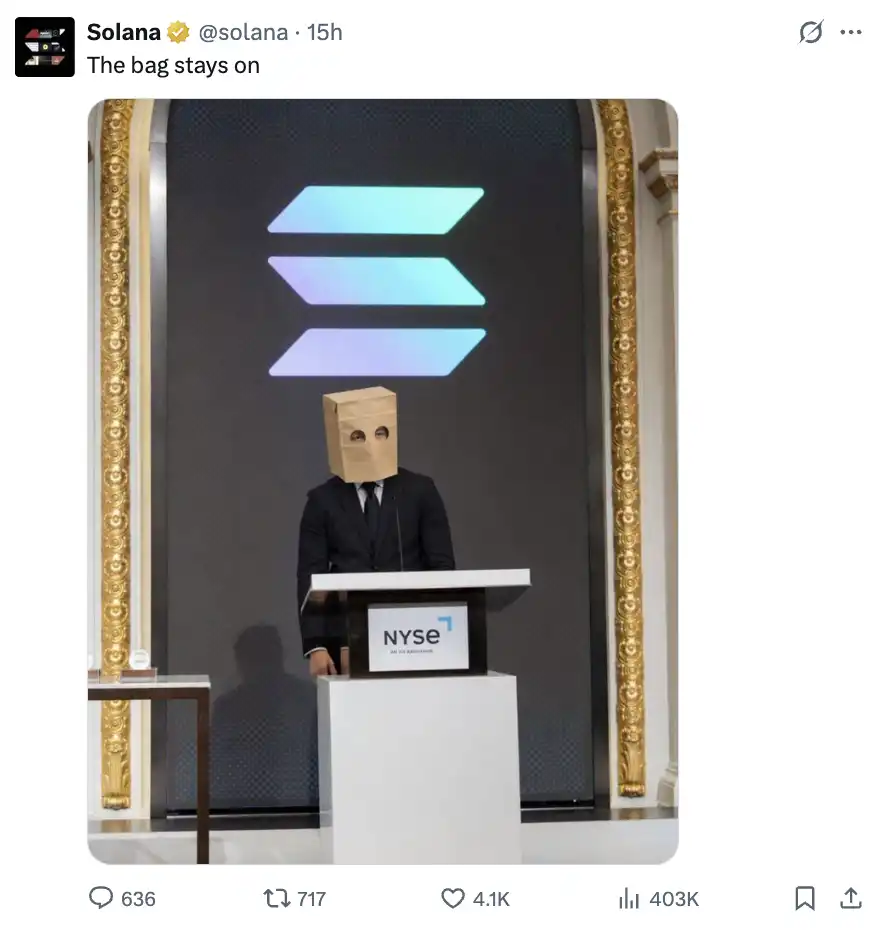
Behind this image lies a series of moves. Earlier, Solana's official account and co-founder Toly had already interacted with StonkFun; Raydium integrated its launch business and also put out a cat-themed tweet saying "I love cats," which the ZCAT community saw as a nod. The launch platform, trading protocol, and ecosystem accounts all joined in, amplifying ZCAT's momentum.
Following this relay, both STONK and ZCAT surged to new highs.
However, the official enthusiasm also drew backlash from Solana's OG meme community. KOL JW100X questioned that NEET had been building for a year without seeing such treatment, yet the new hype took only two days to get everyone putting paper bags on their heads.
The official side now needs to prove that this support for ecosystem memes can benefit more seriously run projects. The visible shift for now is that Solana has at least begun to proactively step up and provide help to the ecosystem.
Incompetent Base
Over on Base, the tone took a sharp turn as Hunter Biden announced he would launch LAPTOP on Base on September 9.
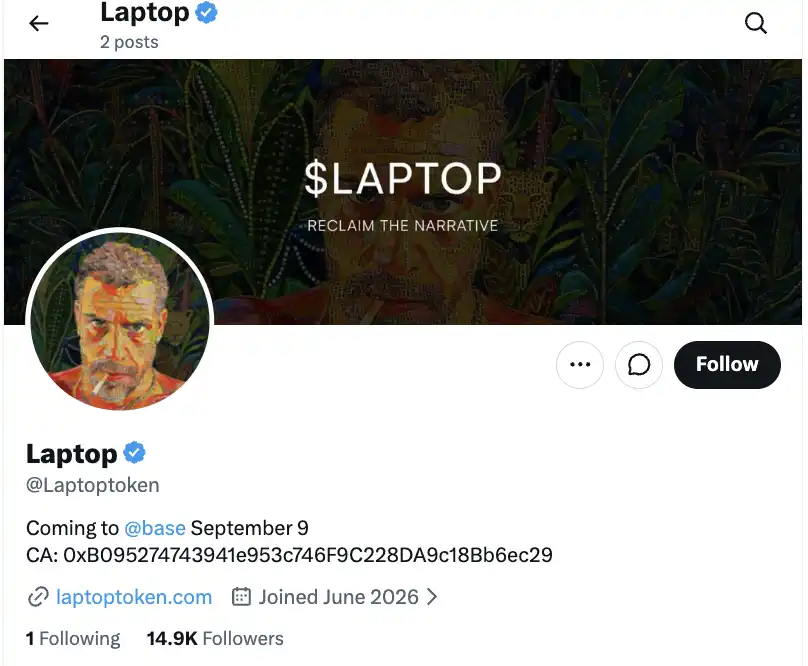
According to The Wall Street Journal's report, the team received 30% of the supply, locked for six months and then released over two years; the airdrop targets include wallets that lost money on TRUMP.
For retail investors who have developed "PTSD" from celebrity token launches, it's hard to rebuild trust based on just a new name and a bit of airdrop—especially when Hunter Biden is drowning in debt.
Solana has already lived through the post-traumatic aftermath of the celebrity coin mania. The pump-and-dump cycles of political and celebrity tokens dragged down the ecosystem's reputation, disputes over meme issuance and trading ended up in court, and the "Pump.fun case" even named Solana Labs, the Foundation, and related executives as defendants. Although the claims against these Solana entities were dismissed on August 31, the reputational damage and legal costs Solana paid stand as a cautionary tale for Base.
What's more, Base's own market performance is a mess.
Among the recent hot memes on Base, Basecat and BLUECHIP are two representative high-market-cap plays. After the LAPTOP news broke, both saw noticeable pullbacks, with 24-hour declines of 26.46% and 8.99%, respectively.
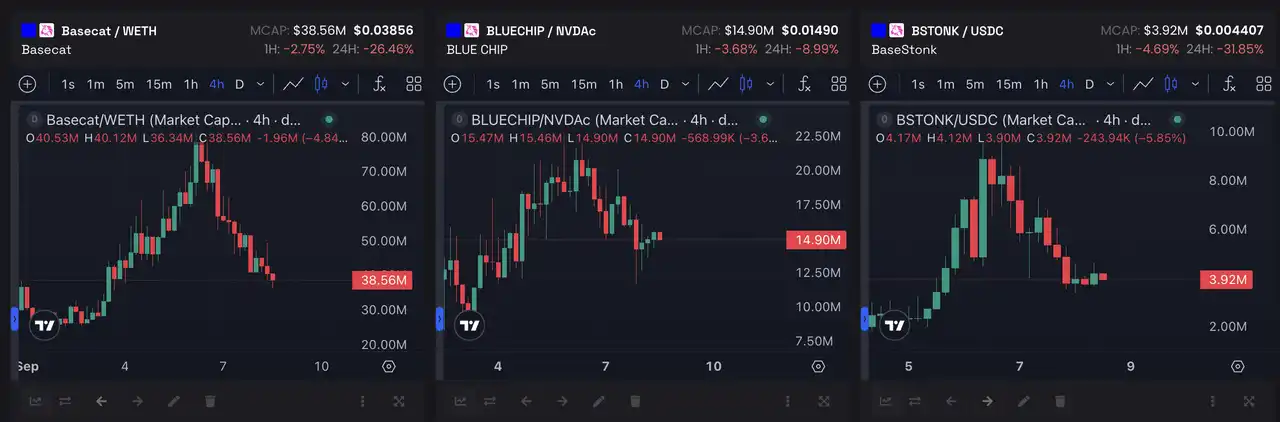
Before incremental buyers have even shown up, the celebrity token teaser is already siphoning away the attention of existing players. Those looking to enter the new launch need to free up capital, while existing memes still have to fight for buy-side support and maintain community confidence. For already-weakening tokens like Basecat and BLUECHIP, this competition feels more like cannibalizing the existing liquidity pool—hardly something to celebrate as an ecosystem win.
Cobie went into overdrive defending Base, stating: "Launching a token on Base requires no permission from Coinbase. LAPTOP is not a joint issuance by Hunter Biden with Jesse, Coinbase, or Base. A token appearing on a permissionless chain doesn't itself imply official endorsement."
But that still doesn't answer why Base is so passive in this round of competition. The official side can't dictate who launches tokens, but it can decide where its marketing resources and product capabilities go. What traders want is an ecosystem worth sticking around for: room for existing projects to sustain operations, new apps that can absorb new demand, and fresh hotspots that give participants a view of more opportunities.
In this specific meme cycle, Base has yet to deliver a response commensurate with the Robinhood threat—instead, it's let an unlaunched celebrity token dominate the conversation. The community's frustration stems precisely from that gap.
BSC, on the other hand, marches to its own beat, relying on a relatively fixed token listing path for expectation management and a stable base of Chinese retail investors. Combined with the rise of FOMO, which has provided fertile ground for the continuous spread of Chinese token narratives, topics once confined to Chinese circles are now visible to a wider audience. BSC's overall momentum is steady and improving.
Only Base is starting to fall behind, watching helplessly as Robinhood becomes what it once dreamed of being.
Welcome to join the official BlockBeats community:
Telegram Subscription Group: https://t.me/theblockbeats
Telegram Discussion Group: https://t.me/BlockBeats_App
Official Twitter Account: https://twitter.com/BlockBeatsAsia
