From Retail Broker to 24/7 Exchange
Robinhood is attempting a new identity transformation.
In the past, Robinhood primarily monetized through payment for order flow, stock and options trading, crypto business, and interest income; after launching Robinhood Chain, the company began extending its business into asset issuance, trading, settlement, and on-chain fee sharing—deeper layers of financial infrastructure.
Robinhood Chain launched on July 1, 2026. It is an Ethereum-compatible Layer 2 network built on Arbitrum technology, primarily used for tokenized trading of stocks, ETFs, commodities, stablecoins, and other real-world assets. Users can trade related assets 24/7 through the Robinhood wallet and also use them for on-chain lending, liquidity pools, and collateral.
Just over two months after launch, the chain has already accumulated approximately $1.5 billion in total value locked (TVL), over $50 billion in cumulative spot DEX trading volume, approximately $7 billion in perpetual contract trading volume, and more than 550 million on-chain transactions. Based on August data, its transaction count ranks third among all blockchains, behind only Solana and BNB Chain.
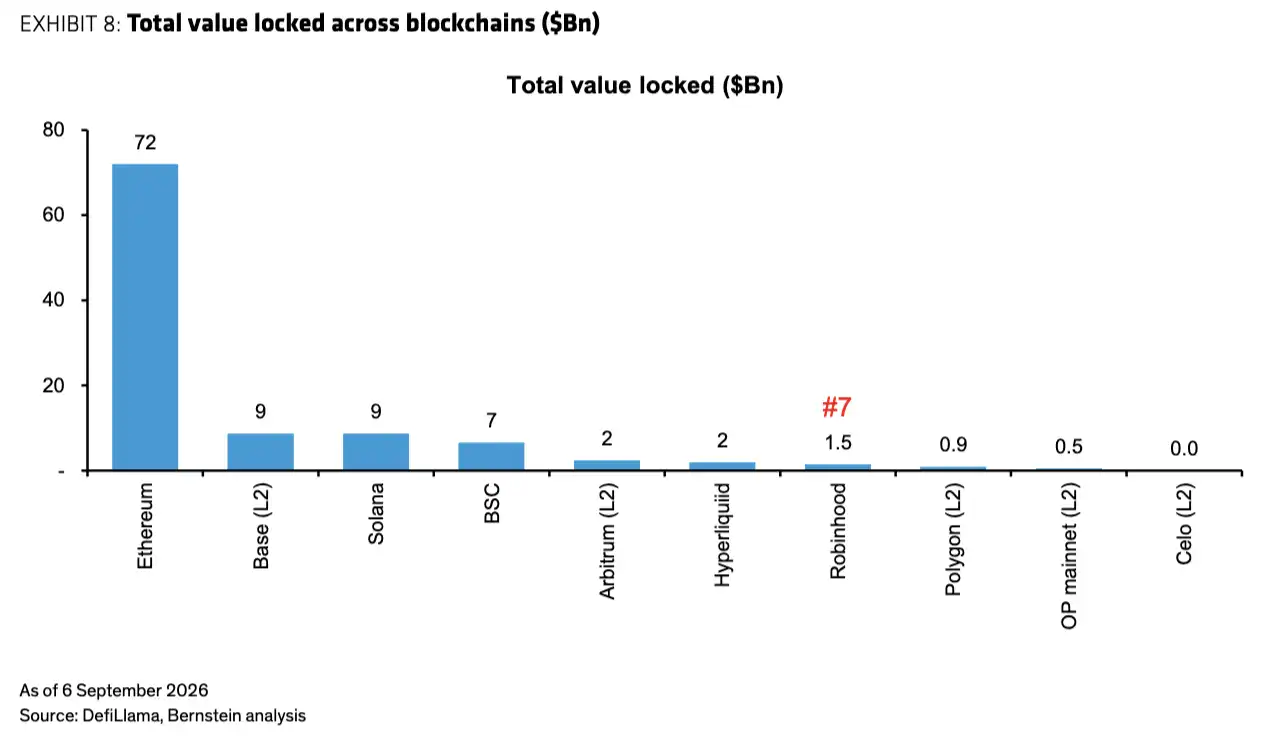
Bernstein believes this data set indicates that the Robinhood chain has initially established an on-chain financial system encompassing stablecoins, spot trading, perpetual contracts, lending, and asset management. For Robinhood, the more critical shift is that these activities have already begun to translate into actual revenue.
Ranked First in Fees Over the Past 15 Days, HOOD Retains About 90% of Revenue
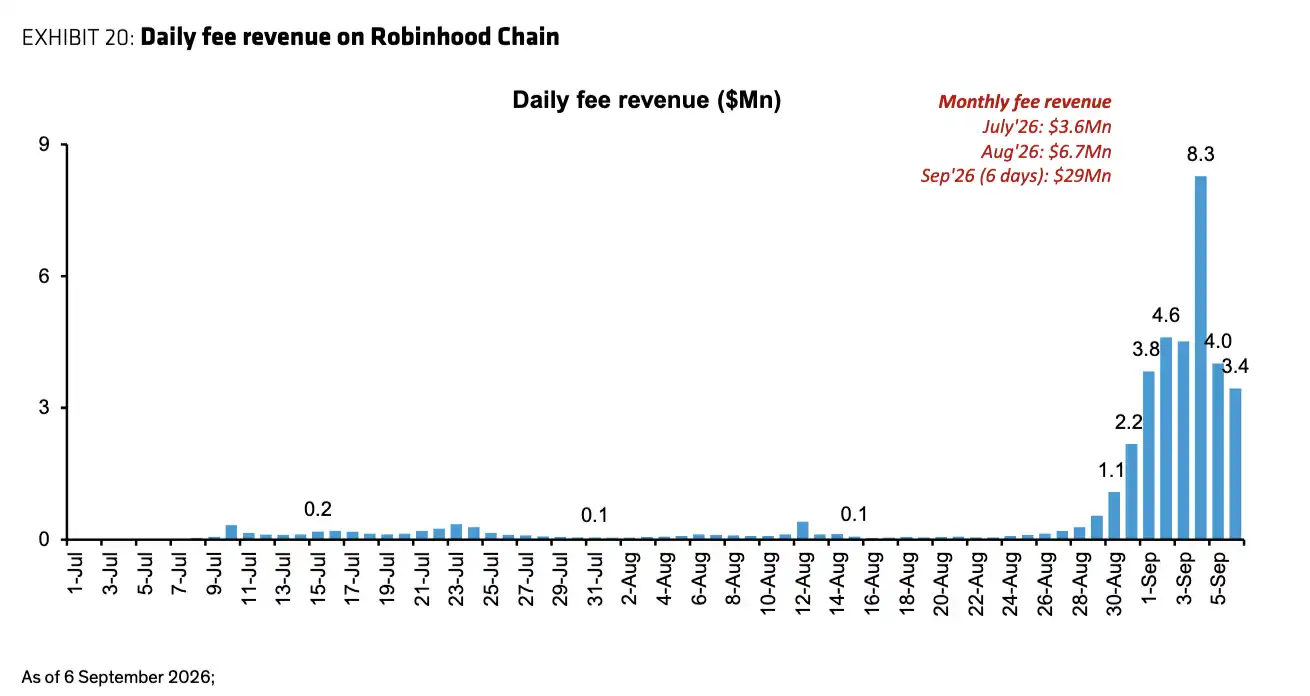
As of the reporting period, the Robinhood chain has generated approximately $39 million in cumulative net fees. Fee revenue was about $3.6 million in July, rising to about $6.7 million in August, and reaching about $29 million in just the first six days of September, with a clear inflection point in growth appearing at the end of August.
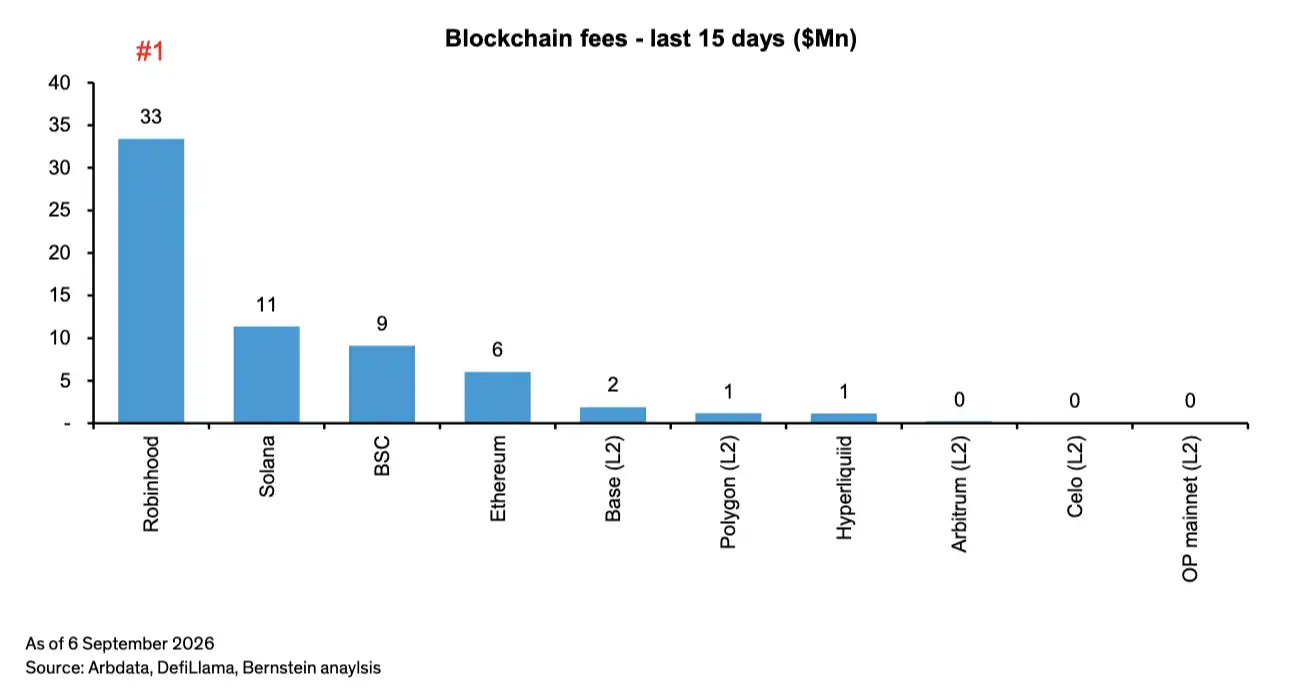
Over the past 15 days, the Robinhood chain generated approximately $33 million in fees, surpassing Solana's $11 million, BNB Chain's $9 million, and Ethereum's $6 million, temporarily ranking first among all blockchains.
Under the revenue-sharing arrangement between Robinhood and its infrastructure providers, HOOD retains about 90% of on-chain fees, Arbitrum receives about 10%, and data publication costs paid to the Ethereum mainnet amount to less than 1%. Since blockchain operations do not require significant increases in manpower and operational investment in tandem with transaction volume, new revenue can in theory be converted into profit relatively directly.
This also explains why Bernstein summarized its report title as: "The exchange has now become a chain that operates around the clock, and this chain is becoming a source of profit."
Bernstein had previously projected that the Robinhood chain would contribute approximately $160 million in fee revenue by 2028. By comparison, the $33 million in fees over the past 15 days, if simply annualized, is already far above that forecast. However, the recent fee growth is related to the rapid rise in market trading activity, and it is still not appropriate to directly extrapolate short-term revenue into future years.
Stock Tokens Grow 14-Fold in Two Months
Another growth driver on the Robinhood chain comes from stock tokens.
Over the past two months, the value of tokenized stocks and ETFs on the chain grew from about $10 million to about $140 million, a roughly 14-fold increase. Including ETFs, commodities, and U.S. Treasuries, the total value of tokenized assets on the chain is about $150 million, of which stocks account for about 76%, ETFs about 17%, and commodities about 6%.
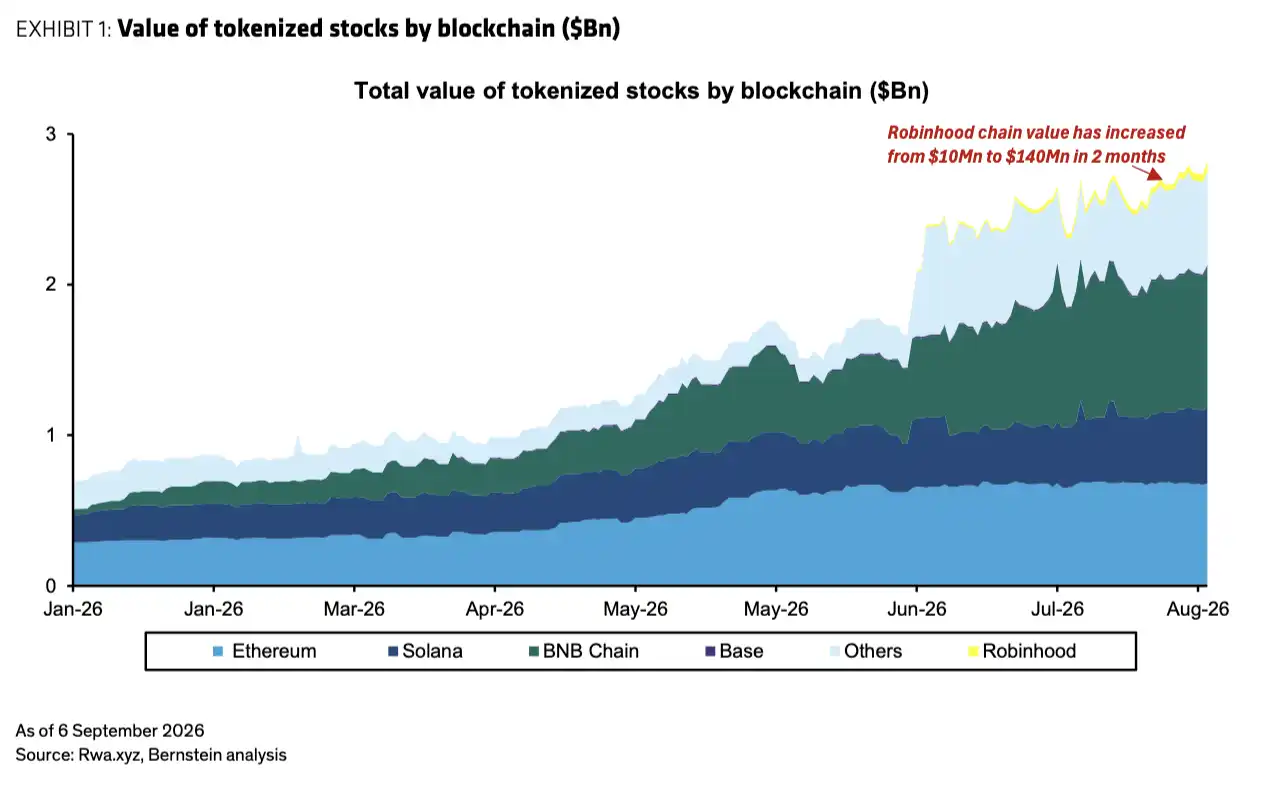
The number of addresses holding more than $1 worth of stock tokens also rose from about 35,000 at the end of August to 107,000. More notably, the Robinhood chain holds only about 5% of the total market value of tokenized stocks, yet its share of weekly transfer value has already reached about 32%, second only to BNB Chain's 53%.
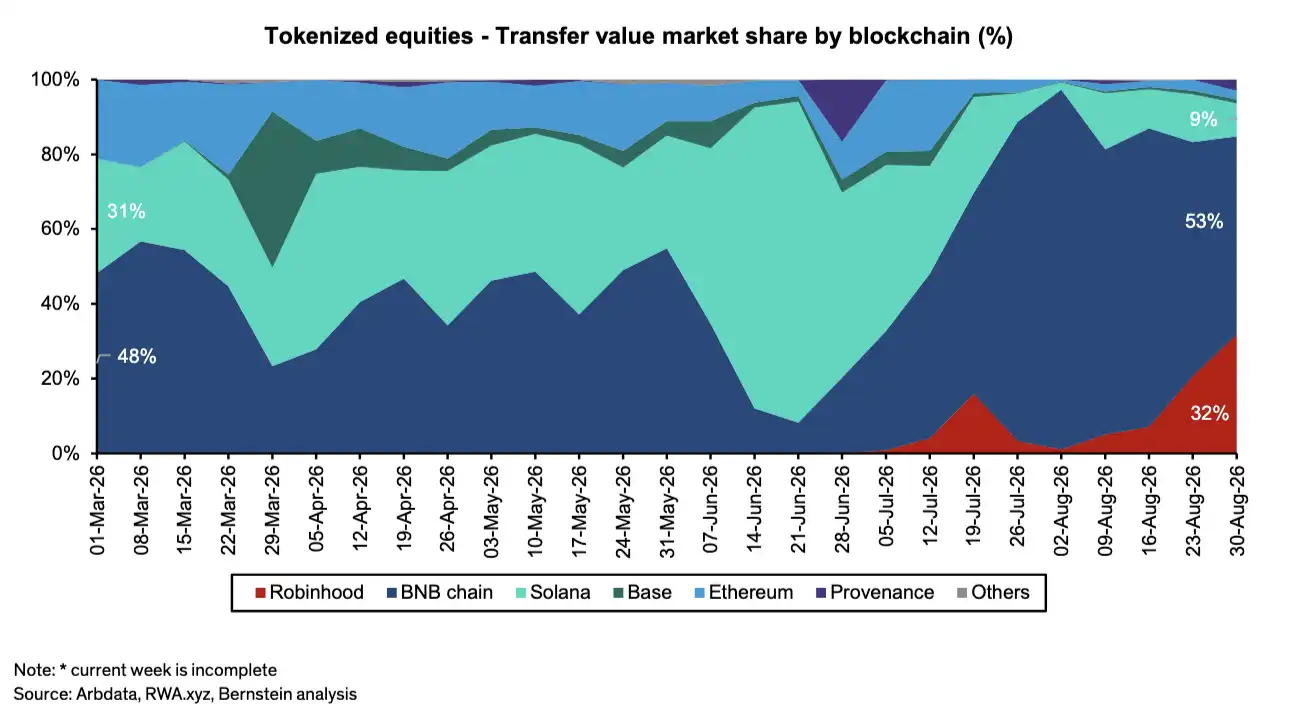
The gap between value share and transfer share indicates that stock tokens on the Robinhood chain have a significantly higher turnover rate than on other networks. These assets are not merely held passively by users; they are also frequently used in DEX trading, liquidity pools, lending, and collateral.
Robinhood adopts a third-party tokenization model: the company purchases and custodies the underlying stocks, then issues on-chain tokens linked to the economic performance of those stocks. The related products are issued by Robinhood Assets Jersey Limited and offered in more than 120 countries and regions, but are not yet available to U.S. investors.
Stock token holders receive economic exposure to the underlying stocks, not traditional equity ownership. They are not registered shareholders of the underlying companies and do not directly possess voting rights, participation in corporate actions, or traditional shareholder protections. Robinhood passes dividends through to token holders, but the dividends are automatically used to purchase more of the underlying stock rather than being paid directly in cash.
This structure allows stocks to enter the DeFi ecosystem, while also meaning that their regulatory status and investor rights differ significantly from directly holding stocks.
Meme Coins Bring the First Batch of Liquidity to Stock Tokens
In the early days of the Robinhood Chain's launch, native meme coin trading pairs once accounted for nearly 100% of total trading volume. However, as stock token, ETH, and stablecoin trading grew, the on-chain trading structure is gradually diversifying.
By early September, meme coins and ETH-USD trading pairs each accounted for more than about 30% of total trading volume, while stock token trading had also risen to nearly 20% to almost 30%. According to the data in the main report, meme coin, ETH-USD, and stock token trading pairs accounted for approximately 36%, 36%, and 27%, respectively.
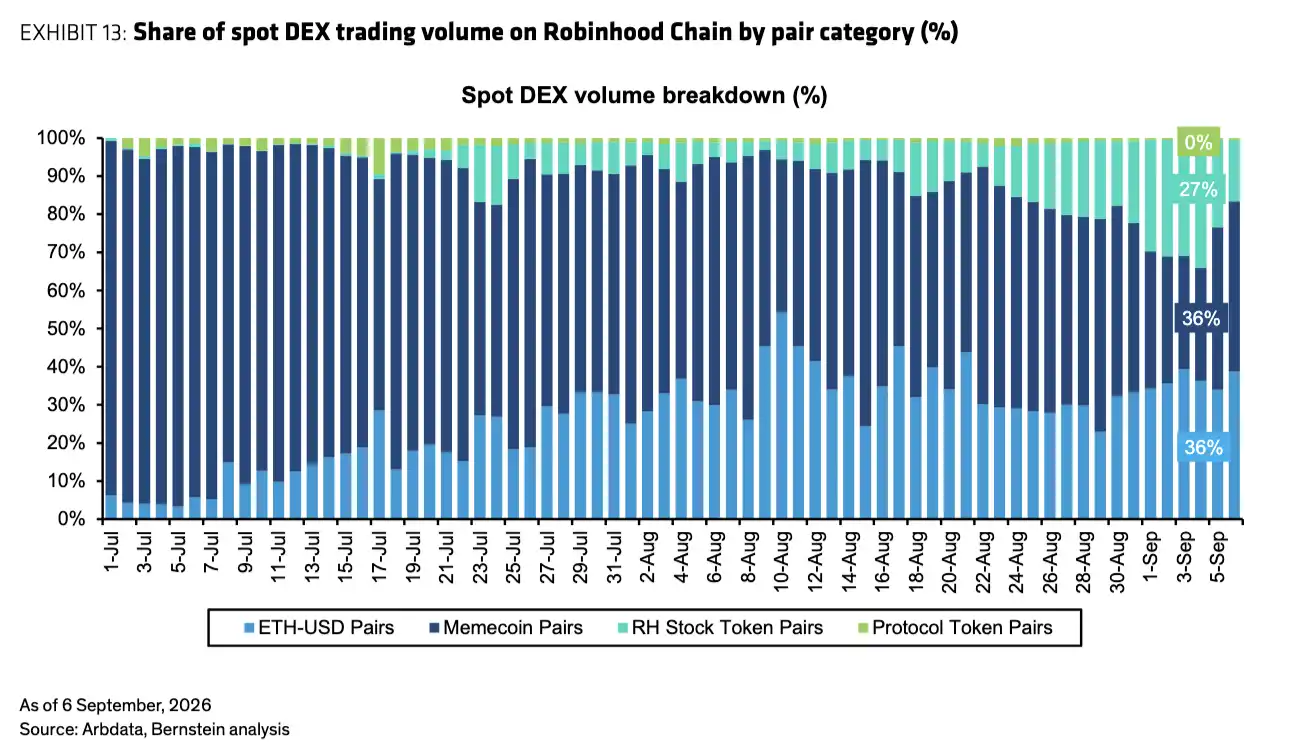
Bernstein noted that meme coin trading and stock tokens are not two completely separate markets.
Uniswap is the primary automated market maker on the Robinhood Chain, contributing about 92% of DEX trading volume in August. Liquidity providers can create trading pools between meme coins and stock tokens on Uniswap. When trading demand for one asset rises, liquidity, arbitrage, and trading demand for the other side may also increase accordingly.
This forms the Robinhood Chain's currently distinctive growth mechanism: meme coins attract traders and speculative capital, while stock tokens channel some on-chain liquidity toward real-world assets. Stocks, commodities, real estate, stablecoins, foreign exchange, and even private equity could all potentially be included in this round-the-clock trading system in the future.
However, this mechanism also means that recent growth still carries strong market-cycle characteristics. If meme coin enthusiasm declines, whether stock tokens can sustain trading scale through long-term allocation, collateral, and lending demand remains to be further observed.
On-chain capital mainly flows to lending and yield products
The Robinhood Chain's TVL has increased from about $51 million in early July to $1.5 billion, ranking seventh among major blockchains. In terms of capital structure, the chain does not rely entirely on spot trading; lending and asset management together account for more than 60% of TVL, spot DEX accounts for about 20%, and the remaining capital is distributed across real-world assets and perpetual contract protocols.
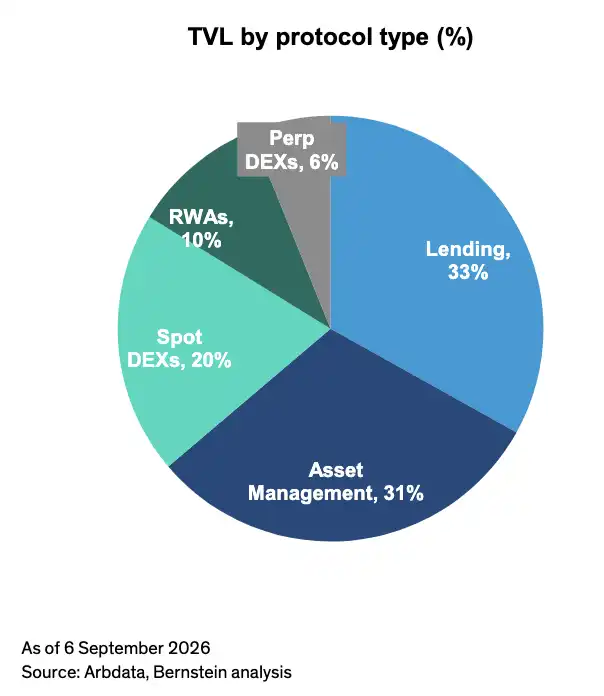
Morpho, Ethena, and Uniswap are currently the most prominent protocols. On-chain stablecoin supply has approached $1 billion, with USDG accounting for approximately 66% and USDe around 33%.
This suggests Robinhood is attempting to build a relatively complete on-chain capital loop: users move funds into stablecoins and yield products, obtain liquidity through lending, and then use tokenized equities and other assets for DEX trading or as collateral.
Compared to relying solely on trading fees, this model has a better chance of improving retention rates for users, assets, and liquidity. However, stablecoin supply is currently highly concentrated in two assets, and TVL is also primarily contributed by a handful of protocols. Capital concentration, incentive decay, and the inherent risks of stablecoins and lending protocols could all affect future growth.
The Valuation Logic Behind the $160 Price Target
Bernstein maintains an "Outperform" rating on Robinhood with a price target of $160. Against the report's closing price of $122.11, this implies approximately 31% upside potential.
The firm expects Robinhood's revenue, adjusted EBITDA, and earnings per share to grow at compound rates of approximately 32%, 47%, and 49% respectively between 2026 and 2028. Its price target is based on 2028 earnings per share of $4.56, applying a 35x one-year forward P/E multiple.
Bernstein projects Robinhood's revenue will grow from $4.473 billion in 2025 to $7.230 billion in 2027, adjusted EBITDA from $2.640 billion to $5.161 billion, and earnings per share from $2.12 to $3.35.
Currently, Robinhood Chain's projected $160 million in fee revenue for 2028 is still not decisive relative to the company's overall revenue. Its more important valuation significance lies in the fact that Robinhood is beginning to capture trading, asset issuance, settlement, and on-chain fee revenue, extending its business model from a retail trading gateway further toward financial infrastructure.
What needs to be observed next is how much of the current fee growth comes from sustainable demand for tokenized equities, lending, and stablecoins, versus how much comes from short-term meme coin speculation. Cross-border sales of tokenized equities, investor rights, and regulatory positioning may also become important variables in the business expansion process.
Additionally, some discrepancies exist between certain sections of the original report's text and charts regarding tokenized equity proportions, perpetual contract trading volumes, and individual statistical dates. Therefore, these data are better used to observe the growth direction of Robinhood Chain rather than to make overly precise inferences about individual figures.
Bernstein's core judgment is that the Robinhood chain has initially proven its ability to simultaneously attract assets, capital, and trading, and to convert on-chain activity into high-margin revenue. If stock tokens can ultimately form sustained trading and collateral demand beyond speculative fervor, Robinhood's role will no longer be limited to a retail brokerage, and may move closer to a globally operating 24/7 asset trading platform.
Welcome to join the official BlockBeats community:
Telegram Subscription Group: https://t.me/theblockbeats
Telegram Discussion Group: https://t.me/BlockBeats_App
Official Twitter Account: https://twitter.com/BlockBeatsAsia
