I first learned about Peter Thiel through "Zero to One." That book circulated widely in China's venture capital circles. After reading it, I didn't remember how to start a company—what I remembered was the person who wrote it. Wherever the crowd was loudest, he insisted on walking toward the shadows.
Later, when I did research, his name was always unavoidable. On digital payments, he was the godfather of the PayPal Mafia; on social media, he was the one who handed Zuckerberg his first bullet; on surveillance and state violence, you can't get around his Palantir; on the tearing apart of America's political landscape, behind both Trump and Vance stands his figure.
Capital, technology, political power, and theology. Four of the most dangerous things, and he holds them all in one palm, fingers clenched tight, refusing to let go of any one.
Does the end of technology necessarily lead to totalitarianism? Can the fear of God be accommodated within runaway efficiency? Can a person refuse to kneel before any camp? These abysses that ordinary people avoid at all costs are merely his daily routine.
This summer, the things he's been doing have grown more varied, and he's grown busier. When a person suddenly gets this busy, there are only two possibilities: either he's lost control, or he's panicking.
Peter Thiel has never been someone who loses control.
So I want to go through his past six months and see whether there's actually any connection between these things.
June 30, 2026, Aspen, Colorado. Peter Thiel stood on stage, and in front of a crowd of celebrities, he cursed the Pope.
Aspen is a summer retreat in the Rocky Mountains. Every summer, the world's richest and smartest people gather here like migratory birds, holding various closed-door forums, confirming to each other that they're still at the top of the food chain. In this arena, Peter Thiel's words carry no less weight than the Pope's in the Vatican.
That day, he spoke into the microphone and said that Pope Leo XIV was working for the Chinese government. This sounds like an outburst of anger, but Peter Thiel never wastes spit just to vent frustration.
Peter Thiel has spent his entire life finding a position for himself.
He was born in Frankfurt in 1967, and while still in swaddling clothes, moved to the United States with his parents. Later he founded PayPal, then made the earliest investment in Facebook before it had any real traction, and then built Palantir, a company that specializes in cleaning surveillance data for the U.S. Department of Defense, intelligence agencies, and police departments.
The word Palantir comes from The Lord of the Rings, Tolkien's "seeing stones." They were black crystals capable of perceiving all things across time and space, but the books also make it clear that whoever gazes into them will eventually be watched back by the eye behind the stone. Saruman, the wisest of the White Wizards in Middle-earth, fell exactly this way. He believed himself unmatched in cunning and sought to use the seeing stone to maneuver against Sauron, only to become a puppet on strings.
In that Aspen conversation, Peter Thiel brought up this name as an exception. He said Aragorn, the King of Men, also used a seeing stone. Aragorn was a good man, and after using it, he was unaffected. His logic was simple: the blade is not guilty; what matters is whose hand holds it.
That sounds reasonable. It is just that Saruman, who back then believed he could master the seeing stone, also thought at first that he was the clearest-headed person in the world.
On Washington's political ledger, his bets have always been ruthless and precise. In 2016, when Silicon Valley collectively stood on the sidelines, he was one of the very few to place a heavy bet on Trump; years later, he single-handedly funded Vance's rise from a rural bestselling author to the Senate.
He carries many labels: an immigrant from Germany, an oddity in Silicon Valley, a gay man in the Republican Party, a tech capitalist among believers, a believer among capitalists.
But the more labels he has, the bleaker the underlying color becomes. He has knocked on every door, and behind every door there is no chair for him. This has been his true situation for half a century: every identity is missing a corner.
He built his standing on "defying conventional wisdom." From Zero to One states at the outset: what important truth do very few people agree with you on? If a person takes "being at odds with everyone" as his guiding principle for survival, what awaits him is inevitably complete exile.
This outsider's fate ultimately became a geographical migration. From the West Germany by the Rhine, to the sunny plains of California, and now weighing anchor again, retreating all the way to the Southern Hemisphere. He has changed countries one after another, but in the world there has never been a door truly willing to take him in completely.
Disarmament
The Pope provoked him in mid-May.
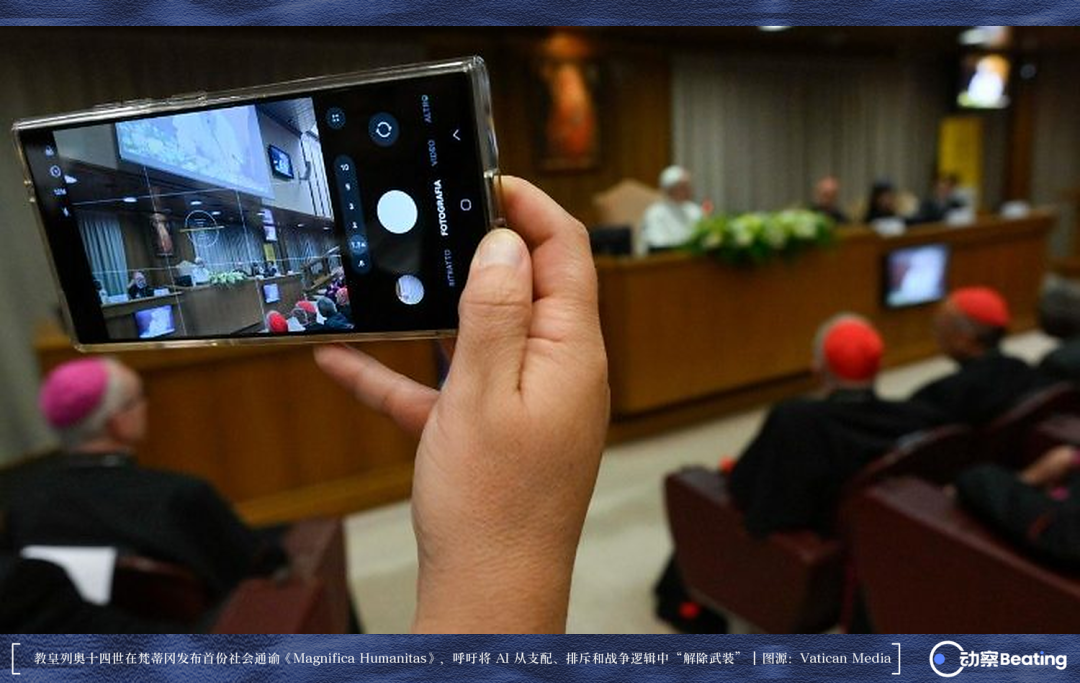
On May 15, Leo XIV issued his first encyclical since taking office. An encyclical is a teaching document issued by the Holy See in response to major crises, the highest-level decree in the Catholic world.
In this encyclical, the Pope said outright that AI has destructive power comparable to nuclear weapons and must immediately be "disarmed" and placed under the unified adjudication of global multilateral institutions; otherwise, it will not only intensify class divisions but also completely smash the饭碗 of the lower classes.
The encyclical also specifically mentions that in countries with intensive computing power but scarce employment, algorithms will force hundreds of millions of people into "enforced idleness."
In the Vatican, this is mercy and moral exhortation. But to Peter Thiel's ears, it is handing the devil a ladder.
What Peter Thiel hears is that the two-thousand-year-old Roman Curia is trying to form a multinational picket line, and the first weapon to be confiscated is the very code and chips spinning in his hands.
The papal name chosen was "Leo," carrying a heavy echo of the industrial age.
In 1891, Pope Leo XIII issued the encyclical Rerum Novarum, which shook Europe by confronting capital and labor beneath the roar of machines. Back then, the machine monsters were steam engines and power looms, and Manchester workers cared only about how many hours they had to endure in a day and at what age their children entered the factories.
One hundred and thirty-five years later, machines have moved from iron-cast factory halls into humming data centers. Workers are still asking what else they will lose, and the creator is still calculating what else machines can conquer. These two questions have spanned more than a century without a single word changing—only shifting from coal slag and rust to computing power and fiber optics.
What Peter Thiel uses to shut the Pope up is the geopolitical rivalry between China and the United States.
In his reasoning, if the United States follows the Vatican's exhortation and draws a line around itself, the other side of the ocean will never press pause, and the West becomes a unilateral victim. He directly swaps the concept of the Pope's ethical interrogation of "what makes a human being human," even slapping on the label of "shilling for the opponent." As for the technical feasibility of regulation, the boundaries of power, and the details of multilateral coordination—he kicks them all aside.
By casting the opponent as a tireless Leviathan, tech giants obtain exemption for unrestrained land-grabbing.
Data must be endlessly fed to models, so privacy becomes a stumbling block; computing power must be squeezed to the millisecond level, so labor rights become superfluous wear and tear; even the boundaries of war and violence can be easily crushed under the banner of "seizing the technological high ground." The ethical fences that modern civilization spent centuries building are all turned into waste paper obstructing efficiency the moment they are labeled "cannot lose."
Antichrist
Peter Thiel has been telling a story about the Antichrist.
He first held four closed-door lectures in San Francisco, with the theme being the Antichrist. In March of this year, the lectures were moved directly to Rome, the heart of Catholicism—four days, four sessions, entry by invitation only, with all media strictly sealed outside the iron gates.
Later, together with writer Sam Wolfe, he published two long articles in the Catholic intellectual journal First Things: "Sailing to the End of the World" and "The Pope and the Antichrist." Between the lines, there was a murderous intent.
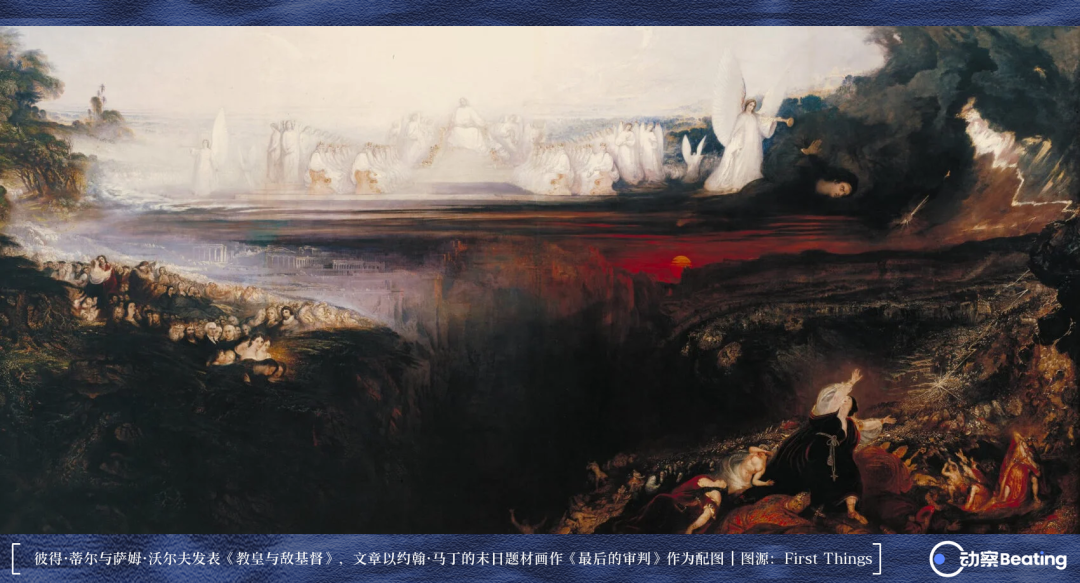
This Antichrist theory comes from two people: the nineteenth-century Russian philosopher Solovyov, and former Pope Benedict XVI.
In 1900, Solovyov wrote "The Tale of the Antichrist." The devil in his writing is not a ferocious beast with fangs, but a technocrat with a spring breeze on his face who knows everything. He speaks constantly of humanity, peace, and universal ethics, and under the cover of climate upheaval and endless wars, gently persuades all humanity to hand over sovereignty in exchange for order.
He has a mocking line about Christ: "You brought swords; I bring bread and peace." He does not intend to destroy the church; he only wants to co-opt it, to enshrine it in the display window of a vast technological order as a harmless ornament.
The Antichrist's monologue in the novel is extremely sinister. Christ came first, he came later, and precisely because he came later, it should be he who ties up the loose ends of history; Christ was merely paving the way for him.
By the late years of Benedict XVI, he repeatedly issued warnings against the "dictatorship of relativism." When a world can use technological consensus to smooth over all disputes over truth, what stands behind a seemingly stable system is precisely absolute tyranny.
Peter Thiel pieced these two men's ideas together. He said that the Antichrist of the twentieth century was a mad scientist recognizable at a glance; by the twenty-first century, the devil had put on a gentle face and become a kindly transnational regulator, speaking constantly of "security," "coordination," and "human welfare." The more frightened the world is, the more justification he has to intervene.
He explained this sense of crisis very thoroughly in a long conversation in 2025.
What he truly fears is that all humanity, in a mass panic over runaway algorithms, will personally assemble a globally linked regulatory Leviathan. Algorithmic models can run across borders, so regulatory agencies must coordinate across borders; coordination requires auditing code, and auditing code requires taking in the entire world's computing power and computational resources at a glance.
Carried to its extreme, every server on this planet and every keystroke would be exposed to the gaze of a single central authority.
In Peter Thiel's eyes, this is the arrival of the Antichrist.
Peter Thiel has never regarded AI itself as the Antichrist. What he truly fears are those god-makers who, under the banner of "protecting humanity," step by step reach for the highest global jurisdiction.
His entire life has been a struggle against "fear." The books he wrote argue against following the crowd out of fear, and the companies he invests in specifically bet on things others dare not touch because of fear. In his view, once humans are gripped by fear, their first instinct is to huddle together for warmth; and the price of huddling is quietly surrendering their weapons and freedom, enshrining above their heads an all-encompassing leviathan of power.
Fear, in his worldview, is the incubator of all totalitarianism.
To discuss this, one must bring up his intellectual mentor at Stanford, René Girard. The core of Girard's famous theory of "mimetic desire" comes down to one sentence: people do not truly know what they want; they only follow suit when they see others reaching out, their own eyes turning green with envy.
Peter Thiel's later writing that "competition is for losers" has its roots buried here. Today, this Antichrist framework shares the same underlying tone: a figure who seeks to be loved by all and to pacify and absorb all humanity through "you're fine, I'm fine," in his eyes, is far more dangerous than a villain armed with blades.
He even coined a name for those who, driven by fear, cry out and beg for regulatory intervention: "legionnaires."
Sweden's environmental activist Greta Thunberg, or AI safety researcher Yudkowsky who campaigns for a moratorium on compute, are, in his eyes, such figures. They are not villains, merely pawns blinded by fear. What they chant—"imminent" and "global coordination"—is just shovelful by shovelful, leveling the ground for a future supreme power.
Strip away all the theological paint, and the Antichrist Peter Thiel speaks of looks exactly like the crowd he has fought against for half his life.
From the EU's convoluted Artificial Intelligence Act to the Paris Climate Agreement, from forcing Palantir to open its algorithmic black box to requiring large models to hand over their weights for auditing—all are shackles he detests. Now he has draped this stance in a layer of theological packaging.
This packaging is not just talk. Over the years, Peter Thiel has been building bridges between Silicon Valley libertarianism and rock-solid conservative Christianity. The former worships "leave me alone," the latter believes firmly in "thou shalt not fall." The two camps originally had nothing to do with each other. Peter Thiel managed to reconcile a set of talking points both sides love to hear: individual freedom, deconstruction of order, the thorough decay of establishment elites.
The Antichrist framework is an extension of this bridge. He forcibly elevates a secular tug-of-war over industrial policy and geopolitics into a final showdown of good versus evil before the Last Judgment, conveniently stamping his own business empire with a commission from heaven.
Palantir's business depends on regulation not being too strict, the AI companies he invests in feast on the dividends of loose regulation, and his political projects aim to weaken multilateral institutions like the UN and EU. The brilliance of his apocalyptic theology lies in this: it conveniently transforms all institutions blocking his path to wealth and power into minions of the devil.
This layer of packaging also happens to include the Pope. The Pope wants global regulation of AI, but in Peter Thiel's scale, he is nothing more than a high-ranking legionnaire in a white robe with a prestigious title.
At the end of September, Peter Thiel will again give four consecutive lectures on the Antichrist in Nashville, Tennessee, still behind closed doors, with no recording allowed, and the specific address announced only at the last minute.
From the San Francisco Bay Area to the banks of the Tiber, and then back to the heartland of the American South, he is repeatedly refining how to translate his distaste for AI regulation, global governance, and technological stagnation into a set of religious language.
Frontier Models and Chips
He also publicly named Anthropic.
He said that this company, which bills itself as "responsible," is a bunch of woke liberals who are winning the AI race.
Anthropic did not respond directly, only bringing up an election protection blog post it published in April. But interestingly, Peter Thiel's remark amounts to an admission that Anthropic is winning. A person afraid of concentrated power first admitted that what the other side holds is exactly that kind of power.
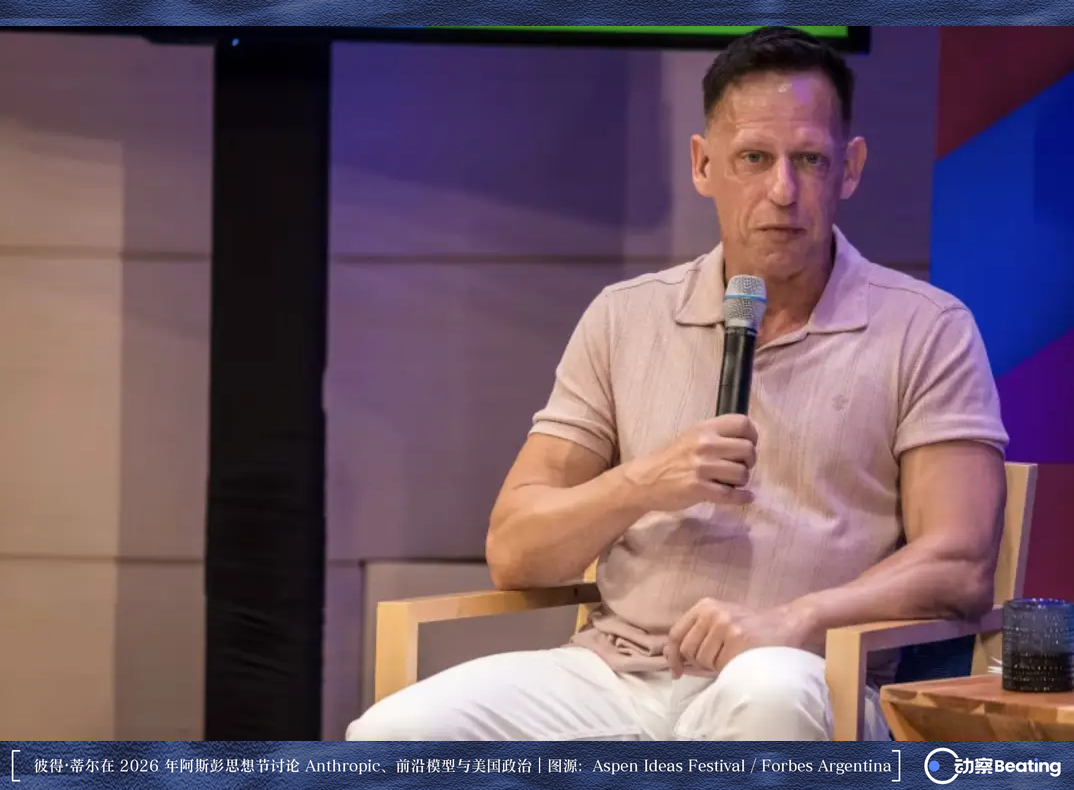
Peter Thiel's decision to go after Anthropic was not aimless.
Founder Dario Amodei left OpenAI in anger back then, dissatisfied that his former employer did not show enough reverence for safety, and struck out on his own to found Anthropic, engraving "alignment" and "safety" into the company's charter. In recent years, it has been the most eager player in the frontier tier to lobby for regulation, advocating licenses for advanced models, external red lines, and even pushing for multinational treaties.
Frontier models are the most expensive, most powerful tier that others cannot catch up with for the time being. Whoever has them has a say and can, in the name of safety, demand that the whole world follow its coordination.
What Peter Thiel smelled was exactly this scent, and Anthropic's every move happened to step precisely on his deepest vigilance.
A frontier model company simultaneously plays three roles. A wildly profitable commercial entity, a national strategic asset strapped to the war machine, and a guest of honor drafting global conventions. Together, these three faces, on Peter Thiel's radar, form an absolute power center in the making.
On June 30, the same day he cursed the Pope at Aspen, the chip company Etched, in which he had invested, made a series of announcements in San Jose. This company specializes in inference chips.
Chips come in two types: training chips are responsible for teaching models, feeding in massive amounts of data to train a model; inference chips are responsible for letting models answer user questions, relying on them for every Q&A. Training is heavy work, inference is daily application. Nvidia has already monopolized the training market, but there are still opportunities in the inference market.
The more widespread AI applications become, the sooner inference power consumption will surpass training. Peter Thiel is betting on this inflection point.
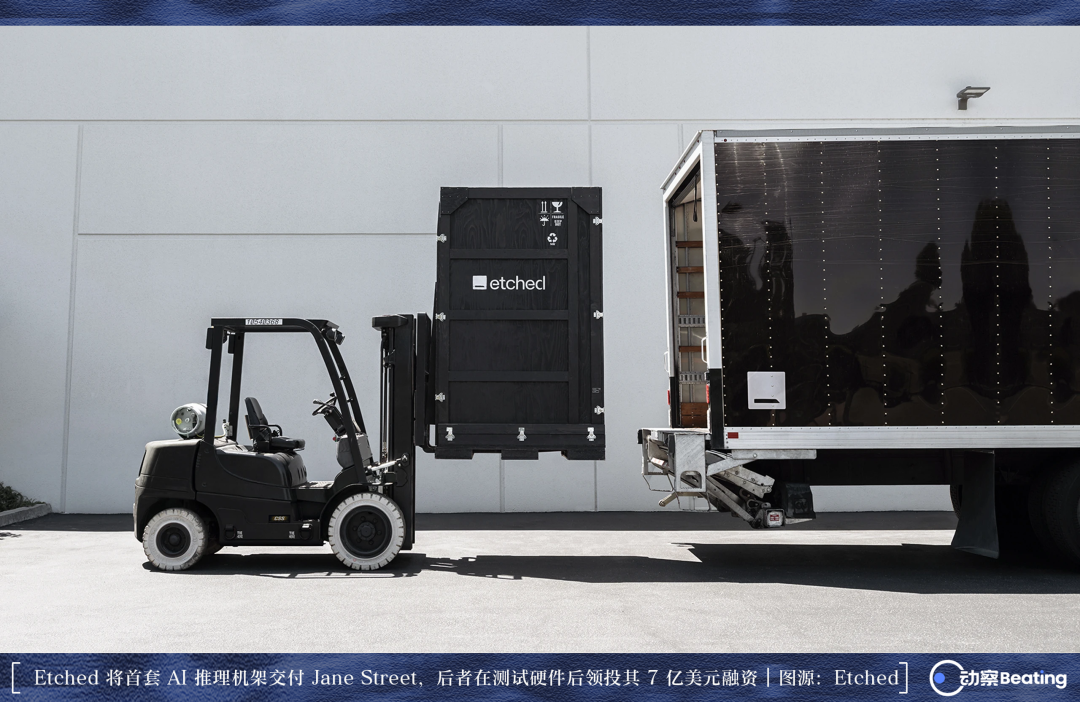
In the funding round Peter Thiel participated in in January, Etched was valued at $5 billion. By August 18, the company announced the delivery of its first inference rack to Wall Street market-making giant Jane Street, while completing a $700 million funding round, pushing its valuation directly to $21 billion. In seven months, it quadrupled. Moreover, Jane Street led the investment only after testing the hardware first.
The chip industry regards "first-pass silicon success" as a myth. Etched's first chip, A0, achieved first-pass success on TSMC's N4P process.
Etched makes Transformer-specific chips, which are more efficient than general-purpose chips. In June, it released the A0 chip and the software and cooling solutions for the entire rack, with long context, mixture-of-experts models, and agent tasks all included in the product goals.
Investors include high-frequency trading firms such as Jane Street, Hudson River Trading, Jump, and Two Sigma, as well as a fund affiliated with TSMC. The lineup of individual investors is even stronger, including former Tesla AI director Andrej Karpathy, "godfather of deep learning" Geoffrey Hinton, Stanford professor Fei-Fei Li, and hedge fund manager Stanley Druckenmiller.
Peter Thiel's bet on inference chips and his criticism of Anthropic follow the same logic: he detests the monopoly of old power. He avoids Nvidia, he points at Anthropic and curses it, yet every new chess piece he personally nurtures is expanding at the same terrifying speed into the next unquestionable center of new power.
Argentina
Before investing in chips, he had already moved his home to the other side of the world.
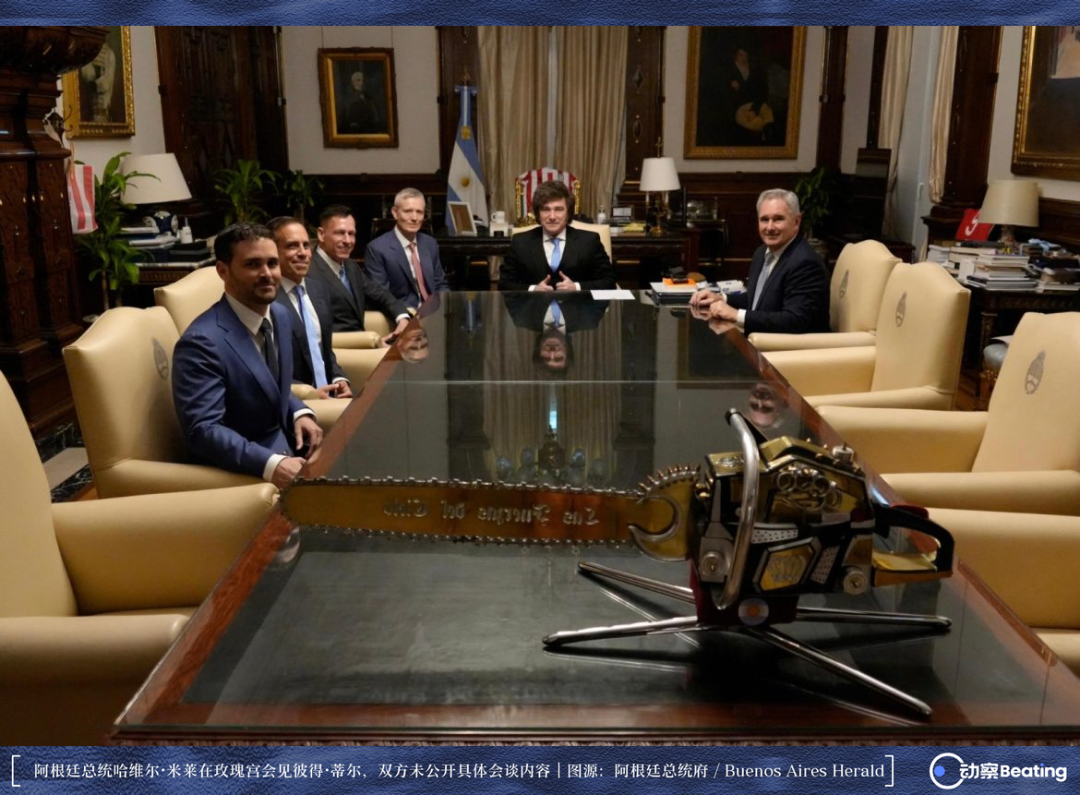
Peter Thiel moved his entire family to Buenos Aires, the capital of Argentina. On April 23, President Milei met with him at the Casa Rosada. The Argentine presidential office later issued an official notice confirming the meeting, but remained tight-lipped about the contents of the long closed-door talk.
On August 14, his macro fund Thiel Macro submitted its second-quarter holdings report to the U.S. Securities and Exchange Commission.
Eight stocks, with a total market value of $419 million, of which seven are entirely energy.
Four established American power companies each account for about $40 million, independent power producer Vistra takes $59.13 million, and he even tucked in X-energy, a company building small nuclear reactors. Add these together, plus the Argentine domestic shale oil company Vista, and energy stocks make up 71.8% of his entire holdings.
The most eye-catching is the $75.91 million stake in Vista, accounting for about 1% of the Argentine company's equity. Vista is a major exporter from Argentina's Vaca Muerta shale oil and gas region, an oil and gas field hidden beneath the Patagonian wasteland that has made Argentina an oil-exporting country again.
Buying this 1% is Peter Thiel's first oil well drilled in the South American continent.
Peter Thiel and Milei are a pair that see eye to eye in this wave of global right-wing politics.
The two fundamentally believe in the same thing: big government is a parasite, and the rule of law is the mortal enemy of freedom. Milei came to power wielding a chainsaw, cutting departments and dismantling welfare, even setting up a dedicated "Ministry of Deregulation," turning the whole of Argentina into a petri dish for far-right shock therapy. Peter Thiel put in real money to invest in Vista; on the surface, he bought shale oil, but in reality, he spent over $70 million to buy a ticket to observe or even manipulate this political high-stakes gamble.
Peter Thiel talks about the Antichrist, algorithms, and metaphysics, but what falls into his palm is all heavy crude oil. Large models need computing power, computing power devours electricity, and the source of electricity ultimately cannot escape the dirtiest, most viscous fossil fuels deep in the earth's crust. He rails against illusory global jurisdiction in Aspen, and buys up solid underground fire and tar in Patagonia. One virtual, one real, seamless.
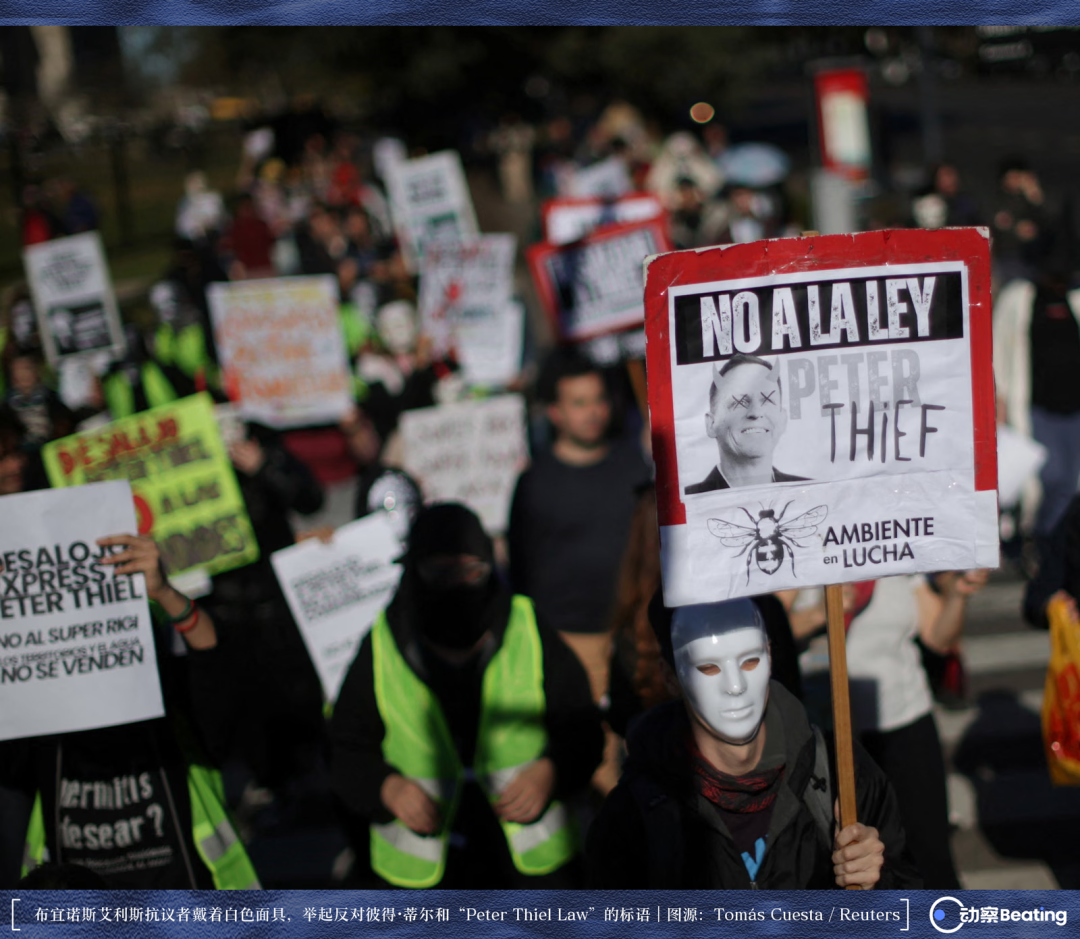
Street gossip is starting to spiral out of control. Some say he is digging a nuclear-proof bunker in the Andes, some accuse him of acting as Milei's overseas overlord, and on the streets of Buenos Aires, white banners have even been raised to drive him out.
Peter Thiel has long given up on the old continent. In his early years, he invested in the Seasteading Institute, hoping to build floating autonomous cities in the ocean.
But seasteading remains on blueprints to this day, the virtual network cannot accommodate a physical body, and space is not reachable anytime soon. On the surface of Earth ruled by gravity, he has nowhere to retreat, and only Argentina fits his needs. The heretical fantasies he spent his life writing on paper have finally found, in this near-bankrupt South American country, the first landing pad willing to accept them.
Peter the Thief
On June 4, Milei and his deregulation minister Sturzenegger co-authored an article in the Financial Times titled "Argentina Invites AI to Liberate Itself."
The two began by referencing the Dutch East India Company of 1602, stating that limited liability gave rise to modern capitalism, and now AI also needs a brand-new legal shell. The article wrote that the Industrial Revolution freed humanity from the shackles of muscle, and AI will redeem humanity from the limitations of the brain. At the conclusion, the ambition was laid bare, saying Buenos Aires is to become the Amsterdam of the AI era.
After the sermon in black and white came a series of legislative hammer blows delivered to Congress.
The Milei government introduced the Large Investment Incentive Regime RIGI, then doubled down on that foundation, tailoring a "Super RIGI" specifically for hyperscale data centers and large computing clusters. For qualifying enterprises, corporate income tax was slashed by half to 15%, with 60% of investment depreciation allowed to be deducted in the first year, and 20% each in the second and third years; more critically, the government made a written commitment to a thirty-year vacuum period on taxes, customs, and foreign exchange controls.
The $1 billion entry threshold precisely shut out all Argentine small and medium-sized enterprises and the common class; and the thirty-year unchanged privilege promise was tantamount to locking the hands and feet of several future elected governments in advance onto the account books of foreign capital.
Immediately afterward, Sturzenegger threw before Congress the most radical corporate law amendment in half a century.
The core of this bill is somewhat absurd, hoping to allow the existence of "non-human companies," which the bill calls "automated companies," meaning companies operated entirely by autonomous algorithms, requiring no employees or human managers, and possibly even no shareholders. The entire operation, buying and selling, and expansion of the legal entity would be fully handed over to lines of autonomously running algorithmic black boxes.
The draft AI law published at the same time has three major pillars. First, completely exempting algorithms from regulation, with the draft explicitly stating "free from the obstruction of the premature and misunderstanding-filled dead hand of regulation"; second, granting civil rights to algorithmic companies; third, extremely low tax rates, with enterprises even able to override Argentine law and arbitrarily select international legal provisions favorable to themselves.
The assembly hall erupted in chaos, yet the focus of the lawmakers' disputes shrank to daily necessities. How much of the servers and cooling equipment should be procured locally, whether the power-devouring beasts would crush Buenos Aires's residential power grid after moving in, someone urgently proposed a patch requiring tech giants to pay out of their own pockets to build substations, and debating whether to cut off the data center or the residential areas once the power grid was in emergency.
The bill makes no mention of labor rights, nor does it say who is responsible when things go wrong. Companies can operate without employees, workers' rights have no protection, and no one is held accountable when machines cause harm. Milei traded sovereignty and labor rights in exchange for nothing more than a promise that big tech might come and invest.
Protesters in Buenos Aires call this package the "Peter Thiel Law," and on their signs they've changed the name to "Peter Thief," denouncing him as a crook.
The government responded by saying it doesn't matter whether it's Peter Thiel doing this — anyone is welcome to come.
Across the ocean in Aspen, Peter Thiel decries global regulation as a devil's gateway to totalitarianism; in the Rose Palace of the Southern Hemisphere, Milei raises the banner of freedom and declares he will sacrifice an entire nation to unbridled algorithms. One in the North, one in the South, separated by the entire equator, two far-right fanatics each with their own hidden agenda have locked into gear on the same historical frequency.
Silence
What Peter Thiel is really after, perhaps only he himself knows.
The long trail of actions described above may seem like a scattered patchwork, but behind it all lies the same logic.
Writing this, I find it increasingly hard to tell whether he is fleeing or chasing. He never tires of warning against all "centers of power," yet every step he takes drives him deeper into the heart of power.
You say he abhors totalitarianism, yet the Palantir and chip networks he personally built come closer to a panopticon than anyone else's; you say he reveres God, yet what he believes in is a secular theology stitched together to suit his own interests.
Solovyov's "The Story of the Antichrist" ends by asking precisely this question. The Antichrist convenes a grand ecumenical council in Jerusalem, offering each denomination a price it cannot refuse — the Catholics get back papal authority, the Orthodox get a theological center, the Protestants get a Bible research institute.
Almost everyone kneels in gratitude. Only the Orthodox elder John rises in silence, stares straight at the false god on the stage, and asks just one question: "Do you yourself actually believe in Christ?"
The technocrat with the beaming face cannot answer a single word. That dead silence becomes his only flaw.
The novel does not head toward tragedy. Three denominational leaders who had quarreled for over a thousand years finally stand shoulder to shoulder after this one piercing question. They are exiled, slaughtered, and then resurrected from the ruins. The counterfeit empire collapses with a thunderous crash, and true salvation can finally descend. Tear open the illusory world, and what remains in the end are always the few who refuse to bow to power — not the deal-making masters who thrive in the system, smooth and well-connected.
This ending is more like Peter Thiel himself than the theology he preaches. He hops back and forth between Silicon Valley, the Republican Party, Catholicism, and the South American continent, always wanting to be a guest of honor everywhere; but if someone asked him to his face, "What do you actually believe in?" he would probably, like the Antichrist in the story, fall into a dead silence.
I sometimes think that Peter Thiel's migrations along the way have left him increasingly without a place to land. The banks of the Rhine cannot give him a place to belong, the California Bay Area cannot accommodate his heretical ideas, and the deep politicians in Washington will not treat him as one of their own. Now, whether this land in the Southern Hemisphere, gasping for breath after being ravaged by shock therapy, can actually take him in, no one can say for sure.
Argentina hangs at the southern tip of the Southern Hemisphere. It is separated from Frankfurt, where he was born, and San Francisco, where he started out and made his fortune, by more than half the globe's oceans. A man nearing sixty, with tens of billions of dollars, uprooting himself and throwing himself onto such a distant wild land, must be after something.
The black oil beneath Patagonia, a bill free of restraints, a place that has not yet been brought under control.
Perhaps what he is after is exactly the phrase "not yet brought under control." Those words mean the same thing as the "exit" he laid out in that manifesto in 2009.
His whole life, he has been looking for a place for himself. When he finds one, none of them count.
Buenos Aires is merely another temporary stop on his hurried flight.
On the morning of August 17, in the Palermo Chico district of Buenos Aires.
More than a dozen figures draped in gray robes and wearing pointed tall hats quietly gathered in front of Peter Thiel's mansion. They had rough fake white beards stuck to their chins and sunglasses on their faces to block the algorithmic facial recognition that is everywhere on the streets.
They unfurled a glaring banner, on which black paint read Gandalf's roar to the Balrog from Tolkien: "You shall not pass."
This group of young people called themselves the "Southern Gandalfs." In the cold, quiet morning neighborhood, some stepped to the beat of the old disco song "YMCA" and loudly sang in chorus: "You are Palantir's running dog, you can't survive in Argentina!"
Some slogans struck right at his sore spot, mocking the arrogant defense he once made:
"You think you hold the palantír in your hand? Go look in the mirror. Inside is nothing but a smart aleck fool."
The reason for the protest is that Peter Thiel is preparing to bring Palantir to Argentina.
Welcome to join the official BlockBeats community:
Telegram Subscription Group: https://t.me/theblockbeats
Telegram Discussion Group: https://t.me/BlockBeats_App
Official Twitter Account: https://twitter.com/BlockBeatsAsia
