Why hike now: short-term inflation and energy prices raise policy pressure
Citi expects the Federal Reserve to raise rates by 25 basis points at this week's meeting, lifting the federal funds rate target range from 3.50%-3.75% to 3.75%-4.00%.
Several short-term factors are driving this hike.
First, core PCE has remained elevated on a month-over-month basis over the past two months. Core PCE rose 0.25% MoM in July and 0.29% in August. Second, energy prices have rebounded, and global markets are repricing a more hawkish central bank policy stance, both of which increase the difficulty for the Fed to "do nothing" this week.
But Citi emphasizes that these data points are not sufficient to prove that underlying U.S. inflation is reaccelerating.
For example, of the 0.25% MoM increase in July core PCE, about 11bp came from portfolio management fees—an imputed price that will soon be revised down due to a methodology adjustment; of the roughly 0.29% increase in August, about 10bp came from a record increase in mobile phone plan prices.
Meanwhile, core CPI year-over-year, which better captures broad price trends, has fallen to 2.4%, the lowest in five years. Although energy prices have risen again, there is currently no clear evidence that this shock has passed through to broader consumer prices.
In other words, Citi's logic is not: "Inflation is out of control again → the Fed must restart hiking." It is closer to: "Some short-term inflation data remains hot + energy risks are rising → with the labor market still stable, the Fed can afford to buy one round of insurance."
The key is not the hike, but that this is not a new rate-hiking cycle
This is also the most noteworthy part of the entire report.
Citi believes that the Fed Chair will most likely describe this action as a "calibration" rather than the starting point of a series of hawkish policy moves.
The reason is that the U.S. labor market remains stable at present. Under such circumstances, even if some committee members are hesitant about whether to hike, they may accept a 25bp "risk-management hike": the marginal impact on the economy is limited, and if inflation continues to decline or the unemployment rate rises in the future, this hike can be withdrawn at any time.
This means the market needs to distinguish between two completely different concepts: "Fed hikes" does not equal "hiking cycle is back."
If the Fed emphasizes at the press conference that decisions are made meeting by meeting, provides limited forward guidance, and deliberately avoids hinting at subsequent consecutive hikes, then even if it really hikes 25bp this week, the policy signal may not be as hawkish as it appears on the surface.
Citi even believes that "a hike + dovish-leaning communication" could instead help the committee secure a unanimous vote. In the end, it could be a unanimous vote in favor, or there could be at most two votes in favor of keeping rates unchanged.
The dot plot remains hawkish: possibly leaving room for one more hike this year
This is the point in the report most worth highlighting separately.
Citi expects that, since there are only two FOMC meetings left this year, most members' dot plots may cluster around two options: either no further action for the rest of the year, or one more 25bp hike.
Only a minority of members may support consecutive hikes in October and December. Therefore, the final median dot plot for the end of 2026 may show: after this week, there is still one more 25bp hike within the year.
But this is not Citi's own baseline view.
Citi expects upcoming inflation data to be relatively moderate, so it will not continue hiking in either October or December; after entering 2027, because seasonally elevated core inflation data may appear again early in the year, the Fed will not cut rates immediately either, but will wait until June 2027 to restart rate cuts.
So there are actually two paths here:
·Fed dot plot: +25bp this week → possibly another +25bp within the year
·Citi forecast: +25bp this week → pause → rate cut in June 2027
If the meeting outcome really turns out this way, what the market truly needs to judge is not "whether there will be a rate hike this week," but whether to believe the dot plot's signal of further rate hikes, or to believe that continued disinflation will ultimately cause the second hike to fall through.
SEP Actually Turns Dovish: Rates Raised, Inflation Expectations Revised Down
Citi expects the macroeconomic portion of this Summary of Economic Projections (SEP) to be dovish on the whole.
The 2026 GDP growth forecast is expected to remain unchanged at 2.2%; the unemployment rate forecast may be revised down from 4.3% in June to 4.2%.
More noteworthy is inflation.
Citi expects the 2026 PCE inflation forecast may be revised down from 3.6% to 3.4%, while core PCE is revised down from 3.3% to 3.1%. In other words, even if the Fed chooses to hike, its own assessment of the inflation outlook may be more optimistic than it was three months ago.
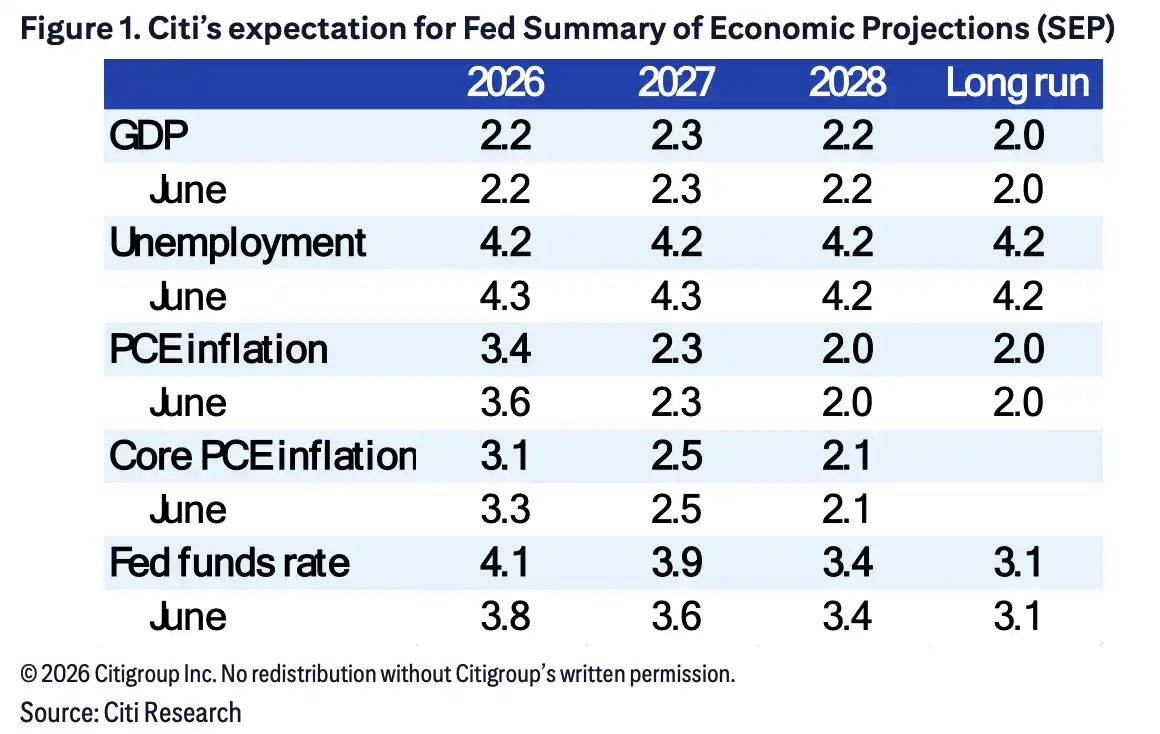
The chart most intuitively illustrates this contradictory combination: Citi expects the federal funds rate forecast for end-2026 to rise from 3.8% in June to 4.1%, and for 2027 from 3.6% to 3.9%; but at the same time, the 2026 core PCE forecast is lowered from 3.3% to 3.1%.
This can actually be understood as: the Fed is adopting higher rates in the short term to manage inflation risks, but has not raised its medium- to long-term inflation assessment as a result.
Citi's Baseline Path: One Hike, Long Pause, Another Cut in June 2027
Therefore, this report cannot simply be summarized as "Citi is bullish on rate hikes."
A more accurate statement is: Citi believes this week's hike has become a reasonable risk-management move, but does not believe the U.S. economy is re-entering a phase that requires sustained monetary tightening.
What truly determines the policy path going forward still comes down to three things: whether underlying inflation continues to decline, whether energy price increases truly pass through to services and core goods, and whether the labor market can remain stable.
If core inflation continues to cool, then this week's hike may ultimately prove to be an isolated policy adjustment; if employment deteriorates and inflation falls faster, Citi believes rate cuts could even come earlier than June 2027. Conversely, if seasonal inflation turns stronger again early in the year, it could keep rates elevated for longer.
So for this FOMC, the 25bp itself may not be the biggest variable. What's truly worth trading for the market is how Powell/the Chair defines this rate hike, and whether the "next rate hike" in the dot plot is actual policy guidance or merely keeping policy options open.
Welcome to join the official BlockBeats community:
Telegram Subscription Group: https://t.me/theblockbeats
Telegram Discussion Group: https://t.me/BlockBeats_App
Official Twitter Account: https://twitter.com/BlockBeatsAsia
