On October 8, 2025, Polymarket founder Shayne Coplan casually posted a tweet on X: "$BTC $ETH $BNB $SOL $POLY." Five tickers side by side — the first four were top market-cap mainstream coins, and the fifth was Polymarket's official token that did not even exist yet; at the time, everyone thought $POLY was coming.
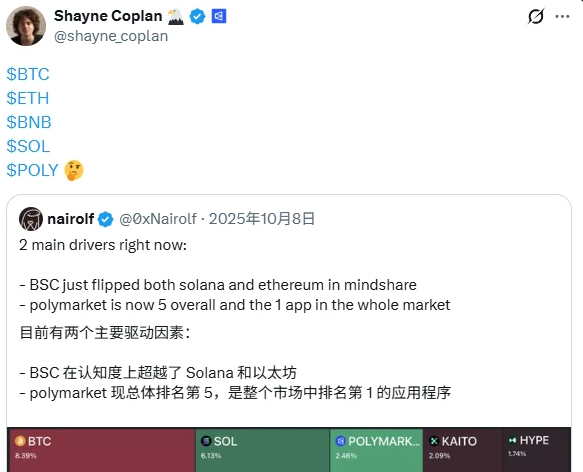
Fifteen days later, on October 23, growth lead William LeGate mentioned the term "expected airdrop users" in a podcast or related discussion. Then, on October 24, 2025, chief marketing officer Matthew Modabber said on the podcast Degenz Live the closest thing to an official announcement so far: "There will be a token, um, there will be an airdrop. We can launch it anytime, but we want it to have real utility and vitality, to be able to exist for the long term."
That was the real starting point of this story. It has been almost a year since then. But is Polymarket still going to issue a token?
A promise never withdrawn, and never fulfilled
If you open Polymarket's help center now, you will see this standardized anti-scam statement: "Polymarket has not announced any plans for an airdrop or token generation event." It has coexisted with Modabber's official confirmation that "there will be a token" for nearly a year, and no one has come forward to correct the other.
In September 2024, The Information reported that Polymarket planned to issue token warrants to investors in a funding round of about $50 million, meaning that before a token had even been issued, what investors received in the financing was not the token itself (because the token did not yet exist), but a warrant. This warrant stipulated that if the company did eventually issue a token in the future, investors holding the warrant would have the right to subscribe to a certain number of tokens under pre-agreed terms (such as a certain price or a certain ratio).
After entering November 2025, the focus of official discussions began shifting from whether there would be an airdrop to what kind of behavior would disqualify users from receiving one. On November 11, when responding to questions about wash trading, William LeGate made it clear that, in essence, accounts farmed through Sybil attacks would not receive any airdrop allocation and were simply wasting their time.
On February 4, 2026, parent company Blockratize Inc. formally filed an intent-to-use trademark application with the United States Patent and Trademark Office (USPTO) for the name "POLY," covering digital currency and crypto platform services categories.
On May 13, product lead Dustin Karp posted a photo of a workstation, with a caption saying he had passed by Mustafa's desk. After the community zoomed in on the photo, someone pointed out that an internal page tab related to the airdrop appeared to be visible on the screen. During the same period, LeGate also answered community questions about identity badges: the blue badge represents Polymarket employees, the Traders badge is for users whose cumulative profits have reached $100,000 or whose trading volume is sufficiently large, and the Builders badge is for project teams building on the Polymarket ecosystem. When someone followed up asking whether posting content on X could also earn airdrop eligibility, LeGate's answer was that linking an X account to a Polymarket account was only one-third of the requirement; users also needed to put their profile link in their X bio and continuously share trading records and market views on X.
It was precisely because of this round of escalation that prediction markets at one point priced in fairly optimistic odds. As of mid-May 2026, on predict.fun, the probability of the event "Polymarket will launch an official token before the end of this year" was once quoted at 56%, and the probability of "first-day FDV exceeding $6 billion" was quoted at 51%.
Odaily Planet Daily had previously summarized all signs of Polymarket issuing a token, see the article "POLY Debut Hints Grow Denser, How Far Away Is the Polymarket Airdrop?"
But this round of hype was also almost the last time this entire story appeared with such intensity. By July 6, 2026, Mustafa was still publicly recruiting "the world's top tokenomics model builders." Yet by August 2026, it is understood that this engineer had already left Polymarket.
Crypto media outlet The Merkle offered a possible explanation in an August 26, 2026 analysis: A company that has already formally filed an intent-to-use trademark application with the federal government has clearly moved past the stage where executives can casually tweet token tickers without triggering securities law disclosure issues.
JPMorgan's Cutoff and the Shift in Compliance Direction
On August 14, 2026, the UK's Financial Times was first to break a story that had been buried for nearly a year: As early as October 2025, JPMorgan had notified Polymarket that it needed to find another bank, citing "regulatory concerns" — a so-called "cutoff." Reuters independently followed up that evening, and Bloomberg republished the story the same day. Coincidentally, that timing fell in the exact same month Coplan posted that token ticker tweet on X.
But at the same time, while JPMorgan did not want to bear the risk of a bank account, it was unusually eager about Polymarket's IPO. In February 2026, JPMorgan invited Coplan to speak at its private banking client conference in Miami. According to The Wall Street Journal, in April 2026, JPMorgan even invited clients from its wealth management division to participate in Polymarket's funding round at a $14.5 billion valuation.
In other words, JPMorgan was still vying to become one of the underwriters for a potential Polymarket IPO in the future.
But once there's an IPO, there's no token launch.
In response to the Financial Times report, Polymarket's response was notably forceful: "We maintain a close, active working relationship with JPMorgan across multiple entities, operational integrations, and client fund flow processing... Any statement to the contrary fundamentally misrepresents our relationship."
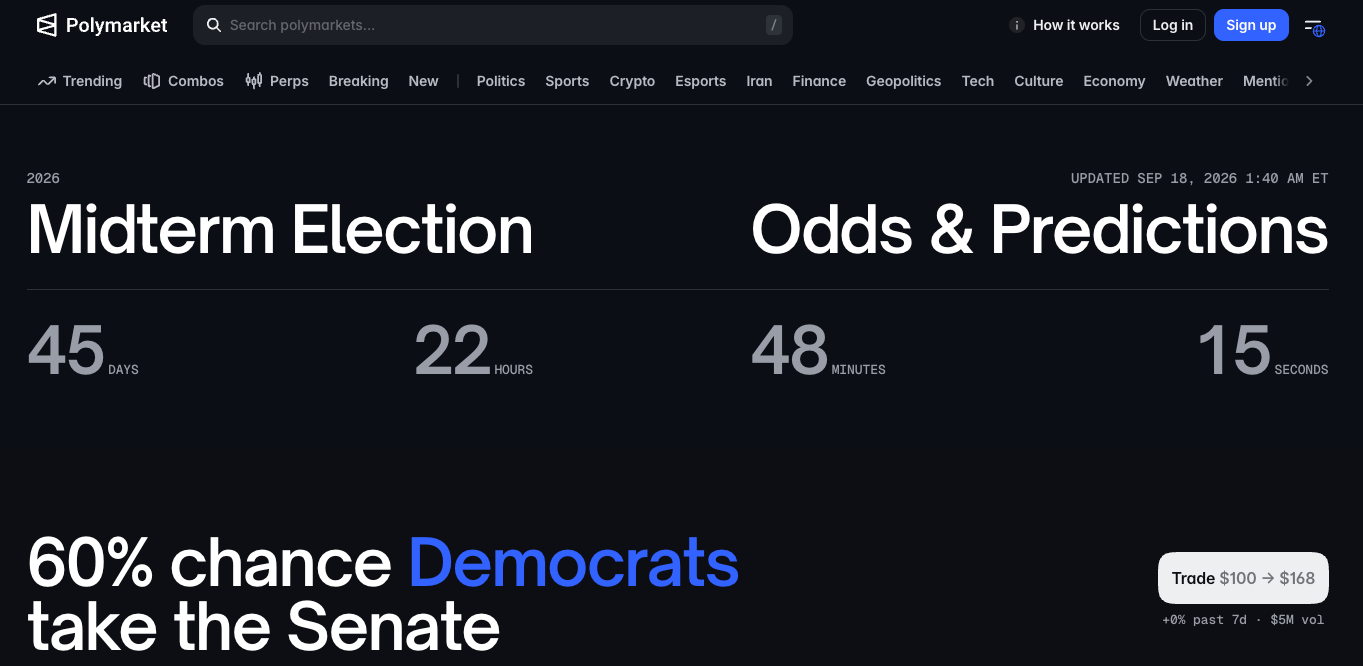
Meanwhile, CNBC reported on August 11 that Polymarket had been aggressively recruiting a batch of executives with traditional finance/regulatory backgrounds, including a chief compliance officer from Robinhood, a head of regulatory affairs from Coinbase, a former FBI official as global head of investigations and intelligence, and a chief risk officer from Nasdaq. This round of personnel appointments was clearly laying the groundwork for the trading volume surge expected from the NFL season and the November midterm elections. On September 16, Polymarket also launched a dedicated "2026 Midterm Elections Hub" page.
Why, from a legal standpoint, will Polymarket drift further away from a token?
The token's silence and JPMorgan's cutoff, on the surface, appear to be two unrelated matters. Currently, no authoritative media outlet has reported a causal chain of JPMorgan pressuring Polymarket to abandon its token. It must be honestly stated that existing evidence cannot prove a direct causal relationship between the two—only speculation from analysts.
But looking from a broader perspective, they actually share the same soil.
Polymarket is undergoing a thorough whitewashing: fined $1.4 million by the CFTC in 2022, the founder's residence raided by the FBI after the 2024 election, spending $112 million to acquire licensed contract market QCX in July 2025, securing a $2 billion strategic investment from Intercontinental Exchange (ICE, the parent company of the NYSE) in October 2025, returning to the U.S. market by year-end, and by August 2026, negotiating a new funding round that values it at over $20 billion. This is a clear path, from a gray-area gambling site to regulated financial infrastructure.
On this path, a governance token is a rather dangerous existence. It could trigger securities law disclosure obligations, could complicate the equity structure for a future IPO—whether value should belong to equity or the token—and could conflict with the compliance-friendly image the company deliberately cultivates.
So, are we really never going to get it?
Strictly speaking, existing evidence does not support the conclusion that "Polymarket has already abandoned its token." A more accurate statement is: this is not a cancellation, but an indefinite shelving.
And this is not the first time it has been delayed. As early as October 2025, the market had a round of expectations for a "token launch before year-end"; by May 2026, predict.fun's pricing had once pushed that probability to 56%. But the World Cup came and went, and the year-end is almost here, yet POLY still has not appeared.
If the SEC's new regulations come online and thoroughly clarify the obligations between token rights and equity rights, we might still see the emergence of $POLY. Until then, $POLY may not truly disappear. But at a company increasingly resembling a traditional financial institution, it will likely be shelved indefinitely.
Welcome to join the official BlockBeats community:
Telegram Subscription Group: https://t.me/theblockbeats
Telegram Discussion Group: https://t.me/BlockBeats_App
Official Twitter Account: https://twitter.com/BlockBeatsAsia
