A transaction fee generated from a token trade, when it reaches Orbio, could turn into credits consumed by AI for writing code and conducting research.
Under Orbio's design, half of the ORBIO transaction fees are used to support AI inference credits. After participants obtain credits, they can either use them themselves or sell them at a discount to developers who need to call models. Thus, traders contribute transaction fees, credit holders activate idle balances, and AI users have the opportunity to lower their calling costs.
This mechanism attempts to accomplish an uncommon conversion: turning the trading heat of the token market into AI resources that developers can actually use.
The market has already begun pricing in this idea. As of the time of writing on September 21, 2026, GMGN data shows that the ORBIO token's market cap is approximately $82 million, having risen to as high as $90 million today. For a project that has only been live for about 20 days, the market's expectations are already quite high.
An AI Credit Market Emerging from Pons
To understand Orbio, one can temporarily set the token aside.
From a product perspective, Orbio is an AI credit market. Developers can purchase discounted credits on the platform and then call different models through a unified interface. The official website at the time listed 446 available models, and after users purchase or obtain credits, they can use their own Orbio API Key to call services.
Its service chain is also clear: users submit requests to the Orbio gateway, and Orbio uses its managed OpenRouter account to call upstream models. Therefore, Orbio's current business focus is on credit allocation, trading, and usage entry points, while the underlying model services still rely on OpenRouter and the suppliers it connects to.
The crypto asset side comes from the Pons launch platform. The ORBIO token was issued on Robinhood Chain through Pons, with the issuance market paired against tokenized NVDA.
As of September 21, by market cap, among the graduated project rankings displayed by Pons that day, Orbio ranked second, after the platform token PONS.
The developer background of the project can also be traced. On the team side, Orbio's publicly participating builder is Yash (X account @0x_aster). His personal GitHub resume lists development experience with NFT perpetual contract DEX nftperp, and the nftperp official API documentation (updated 2 years ago) also directly shows this account's attribution, which can be matched to his previous development work.
On September 18, 2026, Jose (@The0xJose) announced that he would serve as an advisor to Orbio. His X personal bio lists the identities of former founder of nftperp and co-founder and head of product at Pacifica. In a follow-up post to the announcement, Jose also stated that he has known Yash since the nftperp period and worked with him, and that this time he will continue to support his building efforts.
Jose's judgment on Orbio mainly focuses on three directions: on-chain infrastructure that supports Agents in continuously executing tasks with less human intervention, inference credits that can be tokenized and traded, and market mechanisms that can simultaneously connect credit suppliers and users. These views represent Jose's judgment when he joined the project, and also explain the problem Orbio hopes to solve: how to enable AI credits to be programmatically acquired, circulated, and used.
According to TrustMRR's project profile, Orbio was founded in September 2026 and is listed as a one-person team, self-funded. At least based on existing public information, it is still an early-stage project with a very small organizational scale and rapid product iteration.
How does Orbio operate?
Orbio's mechanism has already undergone one important change. The early version mainly emphasized holding ORBIO to obtain credits. On September 16, the project officially launched CREDIT, further clarifying the path of "staking ORBIO, obtaining CREDIT," and airdropped users' previously accumulated available inference balances in the form of CREDIT to the corresponding wallets.
The two tokens assume different roles:
· ORBIO: Users can stake it to participate in obtaining CREDIT rewards.
· CREDIT: It is priced on the basis that each token corresponds to $1 of Orbio AI usage credits, and can be transferred, sold, or activated as an API balance. Activation will burn the corresponding tokens, and the actual amount received still needs to take applicable protocol fees into account.
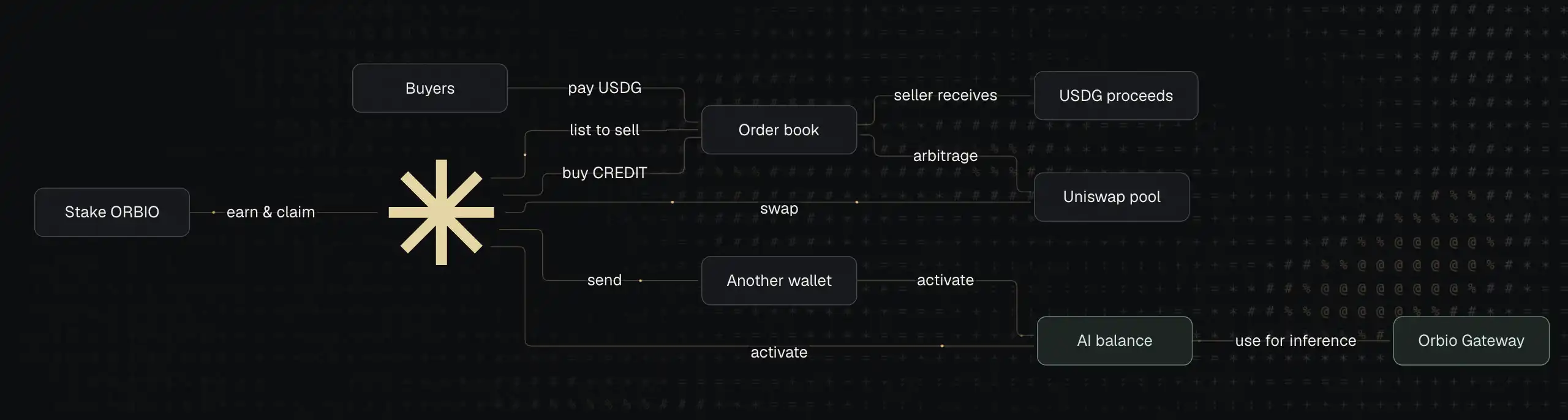
This means that people who want to use AI cheaply can directly purchase CREDIT without first buying and staking ORBIO. Token participants and AI users are connected through the credit market.
The source of funding for the discounts is key to this design. According to official documentation, half of the ORBIO transaction fees collected are used to support AI usage credits, with stakers receiving corresponding CREDIT and then selling off the portion they cannot use.
CREDIT can be understood as an AI usage voucher for which someone has already borne part of the cost. Sellers are willing to cash out at a discount, buyers want to reduce model invocation expenses, and the two sides are matched through the market.
However, a listed discount does not equal the buyer's final savings rate. The official website shows that when purchasing credits through web retail, the platform charges a 5% service fee on the discounted price. Assuming $100 in face-value credits are sold for $90, plus a $4.5 platform fee, the buyer pays a total of $94.5, ultimately saving 5.5% relative to face value.
On September 19, Orbio announced another platform revenue recycling arrangement: half of platform revenue is used to buy back and stake ORBIO, while the other half is used to purchase inference credits and mint CREDIT accordingly; the credits obtained by the protocol will also be supplied to the order book at a 20% discount.
This means that the Orbio platform itself will also become a supplier of credits. At the same time, an additional connection path has been added between product revenue and ORBIO: after the platform earns revenue, it buys ORBIO, but the tokens purchased will be staked rather than burned.
Another feature of CREDIT is that it facilitates automatic use by software and Agents. Agents can purchase, receive, and activate CREDIT through smart contracts to top up their budget for the next task without waiting for manual checkout. However, what goes on-chain is the holding, trading, and activation of credits, while actual model inference and balance accounting still depend on the Orbio gateway and its model providers.
How is Orbio performing?
Orbio has already disclosed a set of data that allows observation of how the product is operating. As of 15:48 on September 21, 2026, the official analytics page shows that the platform has generated a cumulative inference credit value of approximately $159,500, served approximately 249,500 requests cumulatively, and processed approximately 20.5 billion model tokens, the latter including model input and output. Among these, the generated inference credits reflect credit value and cannot be regarded as platform revenue.
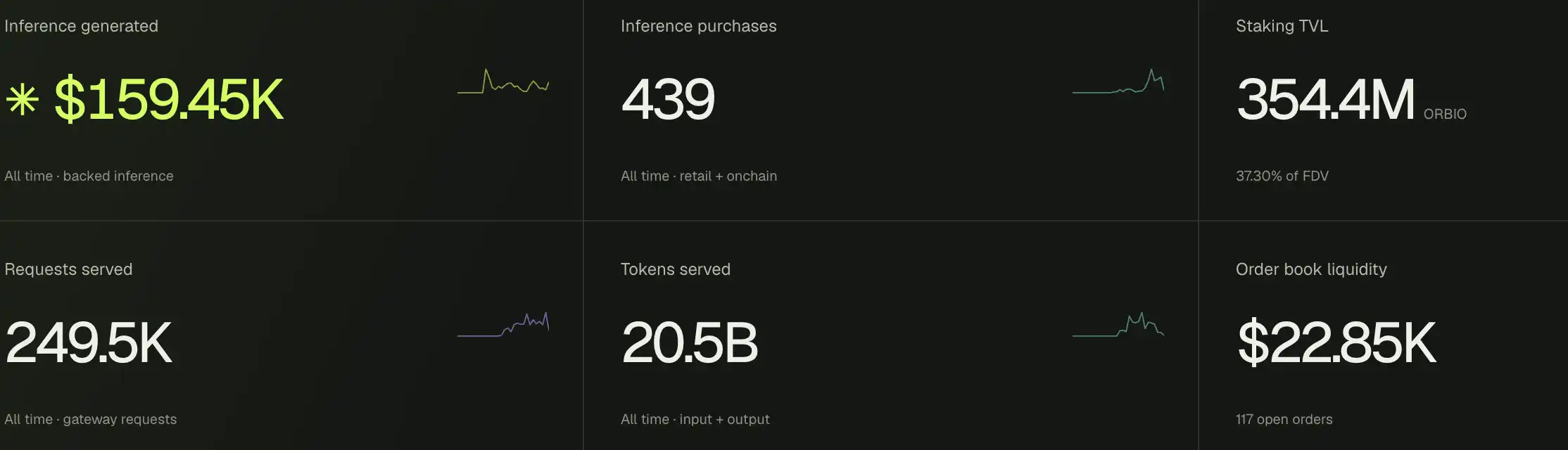
In terms of token participation and credit supply, approximately 354 million ORBIO is currently staked, representing 37.26% of the current total token supply. This relatively high staking ratio indicates that many token holders are participating in CREDIT distribution; however, it does not by itself prove that credits have been purchased or consumed by end users.
Demand-side data requires further differentiation by methodology. The platform has recorded a cumulative 435 purchases and activations, which include both retail purchases and on-chain credit activations.
The page displays a recorded combined sales volume of approximately $13,150, but this figure merges cash payments with on-chain activations calculated at face value. The official data notes explicitly state that this metric does not represent cash revenue.
Another window for observation is TrustMRR. Its page shows Orbio's cumulative revenue at $9,687, and notes that it is verified through the Whop API.
These data points at least indicate that Orbio has seen genuine model invocation and credit circulation activity, and that the product is not solely about token trading. However, the project remains at a very early validation stage. To determine whether demand is solid, it is still necessary to observe the number of independent paying buyers, repurchase rates, actual credit consumption amounts, and net platform revenue after deducting relevant costs.
How does it differ from Venice?
Venice is currently one of the more suitable projects for comparison with Orbio, as both are attempting to connect AI usage rights with on-chain tokens, but their specific mechanisms differ.
According to Venice's current documentation, users can stake VVV to obtain sVVV, then lock sVVV to mint DIEM; staking 1 DIEM provides $1 per day in Venice usage credits. Unused credits within an epoch do not carry over.
The difference between the two designs is straightforward: Orbio's CREDIT is more like a transferable, sellable prepaid credit that is consumed upon use; Venice's DIEM is more like an on-chain asset that continuously generates daily usage allowances. Therefore, while both are attempting to tokenize AI credits, one CREDIT cannot be simply equated with one DIEM.
Venice also has a longer business track record. Its July 1, 2026 announcement disclosed 3.5 million registered users, approximately 1.3 trillion model tokens processed per month, and approximately 2 million developer API calls per day. These are official disclosed figures at that time, not real-time data as of September 21.
On the token side, VVV currently has a market cap of $1.635 billion and an FDV of $2.77 billion. The market cap gap between it and ORBIO cannot be directly translated into upside for the latter: the two differ in business scale, quota rights, supply structure, and value recirculation methods.
For example, Venice previously announced in April a mechanism whereby eligible new subscriptions trigger VVV buyback and burn; Orbio's September 19 announcement described buyback and staking. Burning permanently reduces supply, while staked tokens still exist, and the impact of the two on the token cannot be conflated.
Summary
Orbio's attempt is to convert part of the fees generated by token trading into AI credits that can be used and sold. Those who obtain credits can use them themselves or sell them to developers who need to call models.
Compared with simply attaching an AI concept that has not yet been implemented to a token, this mechanism is easier to verify: whether anyone in the market is willing to buy credits, whether the discount can be sustained over the long term, and whether the credits purchased are actually consumed will all directly reflect whether the product has demand.
However, ORBIO's current market pricing has clearly run ahead of its business data. What Orbio needs to prove next is whether users can continuously obtain a stable price advantage, sufficient purchasable credits, and a reliable calling experience.
Welcome to join the official BlockBeats community:
Telegram Subscription Group: https://t.me/theblockbeats
Telegram Discussion Group: https://t.me/BlockBeats_App
Official Twitter Account: https://twitter.com/BlockBeatsAsia
