Over the past four years, all the grand narratives of generative AI have, in fact, been scheming over the rice bowls of the same kind of respectable person.
Writing code, doing design, drafting business plans, drawing film storyboards. Top labs grind away at the second decimal place on every benchmark, while Big Tech, with a tacit sense of superiority, keeps calculating how many quarters are left before humans are fully laid off.
But everyone deliberately sidesteps the other side of life that lies right there.
The dirty work that humans simply don't want to do and wouldn't miss if thrown away. Like mechanically pressing 0 to reach a human agent through telecom carriers' endlessly nested voice menus, spending forty minutes wrangling with outsourced customer service on both ends of a webpage to cancel a $9.9 monthly streaming subscription, checking line by line against an insurance company's claim denial statement, or mechanically copy-pasting information across five nearly identical web forms over and over again.
Why has generative AI, which has consumed hundreds of billions of dollars in compute, never had anyone willing to bend down and digest this life-draining garbage time on behalf of ordinary people?
Is it that the technology can't do it, or that this math just isn't sexy enough in the eyes of VCs?
On September 8, Meta quietly launched Muse. Two weeks later, it overtook ChatGPT and landed the No. 1 spot on the U.S. App Store free chart.
Muse is a personal AI agent. It gives you a dedicated cloud virtual machine, online 24/7, directly connected to your email, Calendar, and OpenTable. The free tier offers 100 million tokens per week, enough to handle a pile of your messes.
It doesn't intend to replace anyone.
It only does the things other products are dodging.

The Hassle Tax
To understand why Muse is blowing up, you first need to see what kind of work it does for people.
The most widely shared cases on X almost all fall into three major categories.
The first category: information asymmetry.
Rules, terms, and dynamic pricing have always been entirely in the hands of institutions.
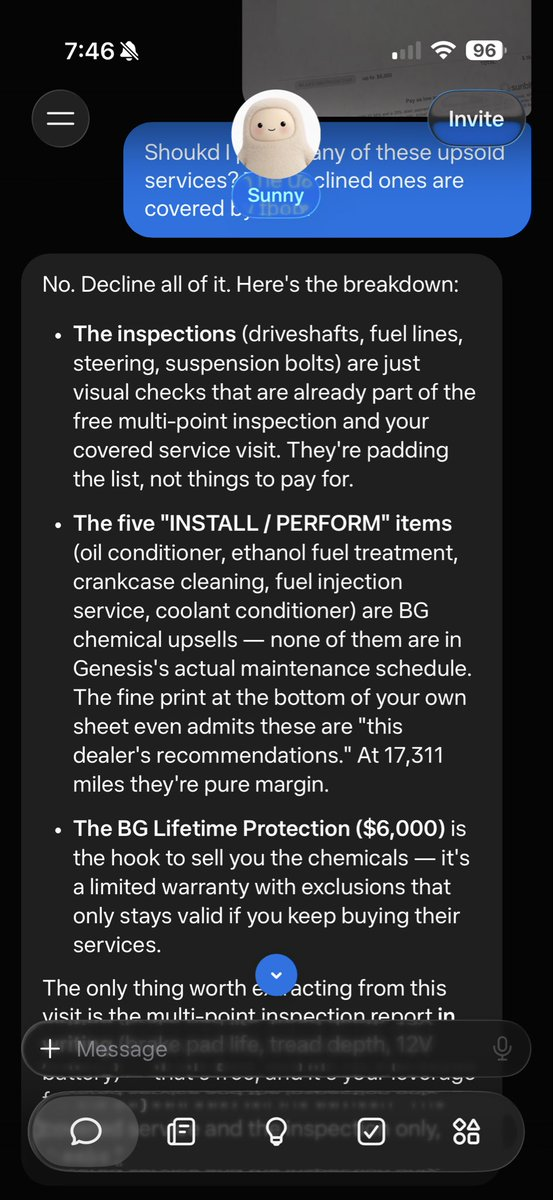
A man named Nick Prince wanted to buy out a car he was leasing. The dealer offered to handle the loan for him, but Muse caught a hidden fee in real time, stripped out several maintenance add-ons that went beyond the manufacturer's requirements, and saved him $1,250.
Someone else handed it five high-annual-fee credit cards with confusing rules. Muse sorted out the points and benefits against the statements, saving over $1,000, and also booked a restaurant, cleaned up spam emails, and bought school notebooks for his daughter.
Category two: low patience.
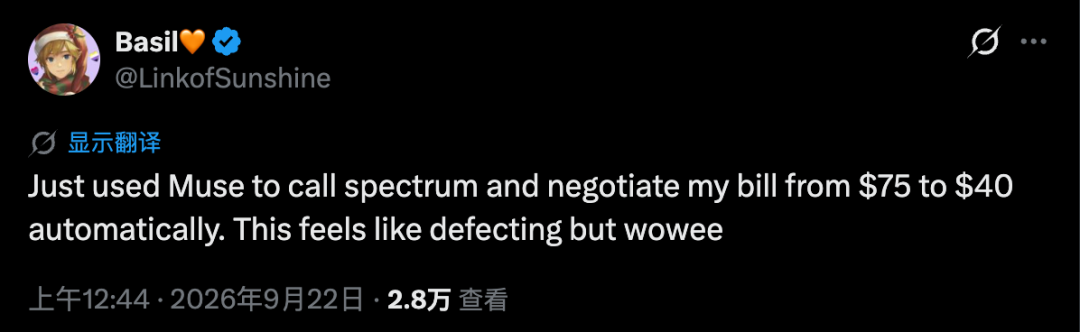
Someone asked Muse to call the broadband company to negotiate a renewal, and it haggled the price down from $75 to $40. A person named Jessica Ablamsky spent an hour going back and forth with her insurance company to no avail, then had Muse draft an appeal letter and a regulatory complaint. Another person named Joe Devoy handed over his auto insurance policy, and in under five minutes, the machine scoured the entire web and found a new contract with identical coverage that was $3,500 cheaper per year, signed up directly, and canceled the old policy on the spot.
That line from Devoy's post speaks for almost everyone: "I knew I was overpaying. I tried multiple times to switch policies, but eventually gave up."
The reason people give up on refunds is that the time cost of fighting for them is too high.
Why give up? Because it's a hassle.
A lot of the profits at many big companies are built precisely on the fact that consumers know small amounts can be recovered but ultimately choose to give up.
Spending an hour to recover a few dozen dollars in refunds isn't worth it for the vast majority of people.
Carriers, insurance companies, streaming platforms — they're all betting on your "forget it." That's why "bill cutting" has become the easiest product feature to go viral; subscription services work the same way — as long as you forget to cancel, it keeps charging.
To recover $35, Muse can wait on hold for an hour; to save a few hundred dollars, it can scan dozens of pages of dense fine print word for word; for a sought-after dinner reservation, it can tirelessly send ten emails back and forth.
Machines don't mind the hassle.
The third category: execution cost.
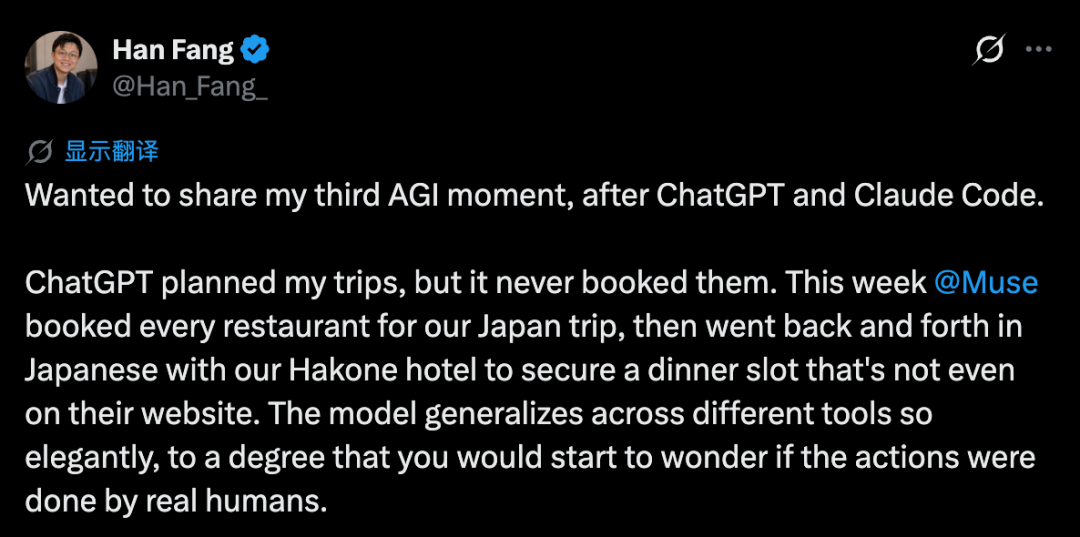
Meta's own researcher Han Fang once had Muse book every restaurant on a Japan itinerary, then communicate back and forth in Japanese with a traditional ryokan in Hakone, successfully securing a slot that wasn't even listed on the official website. He said ChatGPT can only plan an itinerary, but Muse can actually get things done.
There are even more trivial cases — someone had it haggle with sellers on a secondhand trading platform, and someone else had it convert recipes casually bookmarked on social media into grocery delivery orders on a fresh food platform with one click.
At this point, Muse's positioning is already very clear.
Its selling point isn't intellectual superiority — its selling point is "you don't need to worry about this anymore."
The ChatGPT Moment
There is indeed a hint of a "ChatGPT moment" about Muse.
But the reason is by no means that it's smarter than its competitors. By 2026, large models have long since had no shortage of Agent frameworks, and Computer Use has become standard across the board.
The real difference lies in the default interaction logic.
ChatGPT taught the whole world one thing: when you have a question, ask AI. That's Ask.
Muse is teaching another thing: when you have a task, throw it at AI. That's Delegate.
These are two completely different postures. Asking it "which credit card earns the most points on flight purchases" — that's Ask. Throwing five cards at it and saying "sort out the benefits, and from now on keep an eye on my bills and subscriptions for me" — that's Delegate.
One step further is Goal.
You give it only a vague objective, and it figures out the rest on its own. Zuckerberg gave an example: he had Muse make a game guide for his daughter, and after finishing, Muse proactively followed up to ask whether he'd like it to expand on the historical backgrounds of different civilizations while it was at it. According to him, he's also using it to arrange family baking sessions and review footage of his own mixed martial arts training.
Proactivity became the biggest difference between the two generations of products.
At the end of 2022, ChatGPT convinced the world that machines could talk; in the fall of 2026, Muse wants to prove that machines can get things done.
For the first time, ordinary people intuitively understood exactly how this technology would enter their lives, which also explains why Muse's showcase was so penetrating on social networks.
ChatGPT's showcase is usually a screenshot of an extremely neatly written text response; Muse's showcase is inherently a complete story script — I ran into trouble, the AI took over to wrangle and argue with institutions, and in the end got $1,250 back for me.
A story about saving $1,250 in real money is a hundred times more shareable than any benchmark test.
Landlord
Why was it Meta, of all companies, that built Muse?
Zuckerberg has had a very anxious few years, and he has been searching for a ticket that belongs to him.
The gateway to the PC era was in Microsoft's hands, and the gate to the mobile era was locked down by Apple and Google. Meta sits on billions of MAU, yet has long been parasitically dependent on other people's OS. No matter how massive the social network is, it still has to bow to the mood of a single new ATT privacy rule from Apple.
Betting on the metaverse at all costs back then was essentially an expensive breakout attempt. He wanted to build himself a hardware gateway free from others' control, but the result is well known. Reality Labs has burned through more than $80 billion cumulatively since 2020, and the new name "Meta" once became a laughingstock in Silicon Valley.
After generative AI exploded, the open-source Llama once helped Zuckerberg win a beautiful comeback battle. But later, Llama 4's direction went off track, and Meta was pushed back into the position of a chaser.
He brought out the playbook he is best at and most certain about: spending money to buy people.
In June 2025, Meta spent about $14.3 billion to take a stake in Scale AI, and along the way brought Alexandr Wang in to lead the AI team.
By early 2026, he was again trying to swallow the general Agent unicorn Manus for more than $2 billion, and the core negotiations for this deal were reportedly completed in just ten days. Although it was later halted and withdrawn due to a regulatory review of technology transfer, Zuckerberg's direction for betting had already been completely locked in.
Muse is the product that grew out of this logic, offering a new solution to the battle for entry points.
If all online actions in the future must go through an Agent—no more opening Amazon to buy things, no more opening Booking to book flights, no more opening insurance websites to compare prices—then the Agent itself becomes the ultimate upstream super entry point.
Whoever owns the Agent controls the throat of all commercial transactions. Thus, just over ten days after launch, Muse was directly blocked from Amazon's shopping cart.
This is the first signal flare in a new platform war. No trillion-dollar-market-cap e-commerce giant is willing to be reduced to a mere underlying fulfillment pipeline.
The capital market clearly understood this story.
According to third-party estimates, in the first 12 days after launch, Muse secured approximately 1.8 million downloads on iOS in North America, with mobile DAU surpassing 600,000, directly shooting to the top of the U.S. free chart.
Of course, there was the boost from Facebook and Instagram's massive traffic pool, but the data still confirmed that ordinary people's desire for a personal agent that can truly run errands for them far exceeds Silicon Valley's expectations.
The stock price also gave positive feedback immediately. In late September, Meta surged more than 11% in a single day, with its market cap expanding by nearly $200 billion in one day.
Skimming
Zuckerberg's commercial closed loop for Muse is simple.
First use free computing power to build scale, and ultimately rely on commissions from the transaction closed loop to cover costs. According to his own account, Muse takes only a very small percentage when facilitating transactions, and mostly has merchants pay rather than taking from users' pockets; as for heavy users, there are separate subscription tiers at $20 and $100 per month.
This logic can only work because of the extremely massive cash cow behind Meta.
In the second quarter of 2026, Meta's advertising revenue was $59.36 billion, almost single-handedly covering its total revenue of $60.8 billion; in the same period, Capex reached $31.08 billion, with full-year guidance falling between $130 billion and $145 billion. Every free always-on cloud VM and every 100 million tokens per week that Muse gives away adds another figure to this enormous bill.
But Meta can afford the burn.
Giants can fight a war of attrition with the abundant free cash flow from their core businesses, while Agent startup teams surviving on a dozen or so dollars a month in subscription fees simply can't last more than a few rounds.
This is almost a replay of Zuckerberg's playbook over the past two decades: lock in users with free products, then let businesses that want to make money foot the bill.

A Mess
Back to the original question.
In recent years of discussions about AI replacing humans, the list has always been writers, programmers, designers, lawyers. All respectable professions that humans spend long years mastering, imbued with creativity and professional dignity.
But if technology is destined to take over part of our lives, it should start with the messes.
There's an unavoidable threshold here. The more capable an Agent is, the more it needs to embed itself deep into your private world — email, calendar, spending bills, health records, even underlying payment passwords.
To dispel doubts, Zuckerberg brought in Moxie Marlinspike, founder of encrypted messaging app Signal, to build a confidential virtual machine, locking down permissions from the underlying hardware, publicly promising that even Meta itself can't see any content; Muse also comes with an independent sentinel Agent, specifically positioned in the middle to monitor incoming and outgoing data and prevent prompt injection.
For a tech giant that has been mired in data privacy scandals to tell this security narrative carries a certain subtle irony.
The more capable a butler is, the more they depend on irreplaceable trust — trust is the only moat here.
As AI moves from answering questions to taking over daily life, the center of gravity in the game is quietly shifting. Do what you want done for you, and people will be wary; absorb the hassles you despise, and people will only become dependent.
That customer service call you're long sick of, that subscription refund that's been dragged out for months, that insurance policy you know you overpaid for but can't be bothered to switch — rather than keep them hanging in your mind, better to hand them over entirely to an Agent.
The "hassle tax" has been levied for decades, and this time someone is finally standing up for you, reclaiming it item by item.


Welcome to join the official BlockBeats community:
Telegram Subscription Group: https://t.me/theblockbeats
Telegram Discussion Group: https://t.me/BlockBeats_App
Official Twitter Account: https://twitter.com/BlockBeatsAsia
