Over the past two years, the clearest main thread of AI Trade has been capital expenditure.
Tech giants such as Amazon, Google, Meta, Microsoft, and Oracle have continuously increased investment in data centers and compute infrastructure, with capital flowing along the industry chain to GPUs, storage, optical communications, power, and liquid cooling. As a result, AI Infrastructure has become one of the most important trading directions in US equities.
But as this construction cycle moves toward the trillion-dollar level, the questions the market needs to answer are changing.
In its latest US Equity Views, Goldman Sachs raised three core questions: How much longer can AI Capex grow? How much revenue must this investment generate to earn reasonable returns? And how much future growth is already priced into current AI stocks?
Goldman Sachs does not believe the AI investment cycle is about to end. On the contrary, capital expenditure will continue to grow. The real change is that the phase of fastest Capex growth and continuously upgraded market expectations may be passing, and the key in the next stage will be whether this investment can be converted into sufficient revenue and cash flow.
Trillion-dollar Capex is still expanding, but the fastest phase is passing
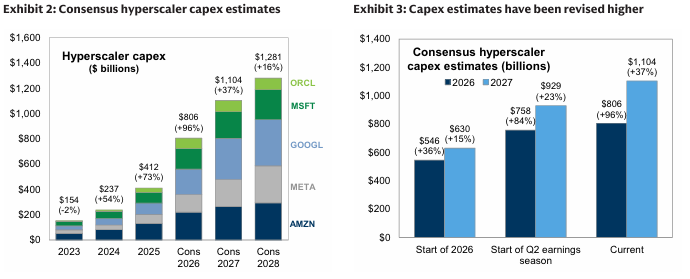
According to current market consensus, capital expenditure by large U.S. tech giants is expected to reach approximately $806 billion in 2026, up nearly 96% year-over-year; in 2027, it will further rise to about $1.1 trillion.
Since the start of this year's Q2 earnings season alone, consensus expectations for 2027 Capex have already been revised upward by approximately $175 billion. Compute supply remains tight, and cloud providers still hold massive order backlogs, factors that continue to support tech giants in expanding their investments.
Goldman Sachs' forecast is even higher than market consensus: Hyperscaler Capex will reach approximately $1.2 trillion in 2027 and $1.4 trillion in 2028, about $130 billion and $100 billion above current market consensus, respectively.
But more important than the absolute scale is the growth rate.
Goldman Sachs expects Hyperscaler Capex growth to slow from nearly 100% in 2026 to 54% in 2027, and further to 12% in 2028. In other words, AI Capex has not yet peaked, but is gradually transitioning from explosive expansion into a phase of growth rate normalization.
At the same time, factors constraining Capex from continuing to grow at high speed are also beginning to increase.
Tech giants' capital expenditure has now exceeded operating cash flow, meaning further expansion will increasingly rely on debt and equity financing. Goldman Sachs believes that large tech companies' balance sheets remain healthy for now, and what could truly limit the pace of investment is the capacity of financing markets, as well as real-world bottlenecks in power, memory, labor, and data center construction.
The implication for AI infrastructure companies is: Capex can still support earnings, but as investment growth slows, the room for continued significant upward revisions to EPS may begin to narrow.
What AI Infrastructure needs to answer next is no longer just "will there be more investment," but whether current earnings can be sustained after investment growth slows.
$300 billion is merely the "break-even line," and the application layer still needs to cross $1 trillion
When capital expenditure enters the trillion-dollar era, a more direct question emerges: how much money do tech giants actually need to earn to cover this investment?
Based on average annual AI Capex for 2026–2027, Goldman Sachs estimates that tech giants, including companies such as Amazon, Google, Meta, Microsoft, and Oracle, will need to generate approximately $300 billion in AI revenue each year over the next few years to cover depreciation and related operating expenses and achieve basic break-even.
If the requirement is not just to recoup costs but to earn a normal return on capital, the revenue threshold will continue to rise.
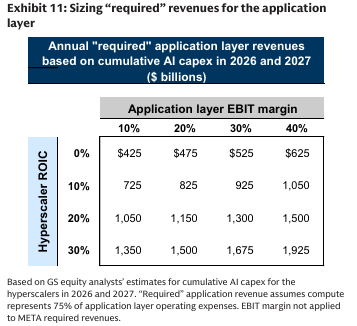
Goldman Sachs' sensitivity analysis shows that at 0% ROIC, meaning break-even only, the required annual AI revenue is approximately $308 billion; if a 10% ROIC (Return on Invested Capital) is required, this figure rises to $417 billion; 20% corresponds to approximately $526 billion; and 30% reaches approximately $636 billion.
In other words, $300 billion is not an optimistic scenario, but rather closer to the minimum economic threshold for this round of AI investment.
Currently, tech giants' AI revenue remains below this level, but the revenue side has already begun to catch up.
The year-over-year growth rate of cloud businesses at Amazon, Google, Microsoft, and Oracle has accelerated from approximately 25% in 2024 to 48% in the second quarter of 2026. Using the 2024 growth trend as a baseline, Goldman Sachs estimates that annualized cloud revenue in this year's second quarter is already approximately $67 billion above the original trend.
At the same time, the combined cloud Revenue Backlog (contracted but not yet recognized future revenue) reported by Amazon, Google, and Microsoft has already reached approximately $1.7 trillion.
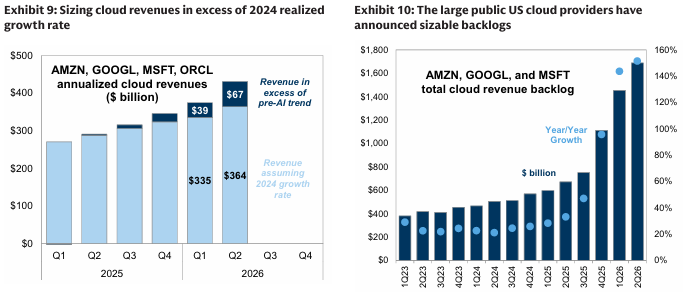
These data indicate that AI demand is still growing rapidly, but there is still some distance to go before proving that current Capex can generate sufficient returns. What truly needs to be verified is whether revenue can continue to catch up with the cost base formed by capital expenditure.
Moreover, $300 billion is only the tech giants' own bill.
Cloud providers ultimately need to sell compute to model companies and AI applications, and these enterprises, in addition to paying Compute costs, also have to bear R&D, personnel, sales and other expenses, while retaining sufficient profit. This means the end revenue that the Application Layer needs to generate must be far higher than the cloud providers' own break-even line.
Goldman Sachs further estimates that if application-layer companies maintain an EBIT Margin of about 30%, while tech giants achieve a 10%–20% ROIC, the annual revenue required by the application layer would be roughly between $925 billion and $1.3 trillion.
Therefore, the so-called "$1 trillion" is not Goldman Sachs' forecast of future AI application revenue, but rather the revenue magnitude corresponding to providing economic rationality for the current scale of AI investment under specific profit margin and return on capital assumptions.
For reference, global advertising and software spending in 2026 is approximately $1.5 trillion each. Goldman Sachs economists also estimate that AI could ultimately bring the United States about $1.8 trillion per year in capital-attributable labor productivity gains.
From the perspective of total economic output, trillion-dollar AI revenue is not entirely unimaginable. The real question is: the economic value created by AI does not equal the revenue that AI companies can capture.
Productivity gains may flow to consumers, traditional enterprises and other industry chain participants, and will not all convert into revenue for cloud providers, model companies and application companies. Therefore, "AI can create enormous economic value" and "current Capex can obtain sufficient investment returns" are actually two different questions.
After Capex slows down, the AI Trade begins to reprice
If trillion-dollar Capex ultimately requires such massive revenue support, the next question is: how much growth has the current AI stock actually priced in?
Goldman Sachs found that AI Infrastructure valuations have in fact clearly contracted. The sector's median forward P/E has fallen from about 32x in April 2026 to about 22x currently.
More importantly, pricing within infrastructure is no longer uniform.
Sectors such as optical communications, power grids, and liquid cooling still carry relatively high expectations for earnings sustainability, while market pricing for semiconductors, utilities, and Memory is relatively conservative. What the market is beginning to differentiate is which companies' earnings can withstand a slowdown in Capex growth, and which companies' high profits come more from the strongest phase of the investment cycle.
Memory is a typical example. Memory stocks currently trade at about 4x two-year Forward P/E, only half of the average level over the past 15 years; but at the same time, Memory companies' current gross margins of about 80% are also more than double the historical average. Goldman Sachs estimates that for the current P/E to return to the long-term average, Memory companies' earnings would need to decline by about 50% in the coming years.
By contrast, Goldman Sachs believes Fabless chip stocks are more attractive. Although their margins are also above historical levels, the degree of deviation is lower; Goldman Sachs estimates that Fabless companies' future earnings would only need to decline by about 10% for valuations to return to the historical average.
This means the trading logic of AI Infrastructure is changing: in the past, the question was who benefits most from rising Capex; next, the question will be whose earnings are most sustainable.
This shift also opens up another possibility for tech giants previously weighed down by Capex.
In the past, the market worried that companies such as Microsoft, Amazon, Google, and Meta were continuously increasing AI investment, eroding free cash flow, while returns on investment remained uncertain. But as AI revenue grows and Capex growth gradually slows, this logic may begin to reverse.
Currently, tech giants' Forward P/E has fallen to the lowest level in the past 10 years, with their valuation premium relative to the S&P 500 median down to only about 4 P/E multiples. If revenue continues to accelerate while Capex growth declines, free cash flow could gradually improve.
Over the past two years, the market has mainly traded: Capex ↑ → AI Infrastructure Earnings ↑
The next phase that needs to be verified is: AI Revenue ↑ + Capex Growth ↓ → Hyperscaler FCF ↑
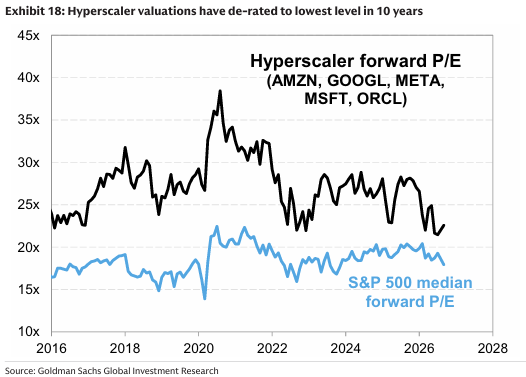
This is not an outcome that has already materialized, but rather a new logic the market may begin to trade as the capex cycle enters its next phase.
The Next Phase of AI: Who Can Actually Turn Compute Into Revenue?
Looking further ahead, Goldman Sachs believes the AI Trade will gradually shift from **Infrastructure Build-out** to Application Roll-out.
But the application layer will not be as straightforward as the infrastructure rally of the past two years.
When tech giants raise Capex, GPUs, networking, power, and data centers can capture relatively clear incremental demand; at the application layer, whether companies benefit depends on product adoption, pricing power, cost structure, and whether AI changes the original business model, so single-stock divergence may become more pronounced.
Currently, the software industry has not seen the broad AI disruption the market previously feared. Among software companies covered by Goldman Sachs, annual recurring revenue (ARR) growth has actually accelerated slightly recently, with IT Infrastructure and Cybersecurity performing strongest, while Enterprise Management Software lags relatively.
AI Agents may bring another kind of impact. Goldman Sachs constructed a Consumer Inertia stock basket, including industries such as insurance, telecom, travel, subscriptions, Marketplaces, and Fintech. Part of these companies' user stickiness comes from the time and operational cost consumers need to switch services. If Agents can automatically search, compare prices, and even execute transactions, this friction could theoretically decline.
Since mid-September, this basket has underperformed a sector-neutral hedge portfolio by about 5 percentage points. However, this only shows that the market has begun to trade this potential risk, and does not prove that the relevant business models have already been materially disrupted.
Ultimately, the key to validating this AI investment cycle still comes back to corporate revenue.
U.S. Census Bureau surveys show that about 40% of large U.S. companies have already used AI in the production of goods and services; Goldman Sachs' analysis of second-quarter earnings calls shows that about half of S&P 500 companies have already discussed AI applications in productivity, but very few companies can truly quantify productivity gains.
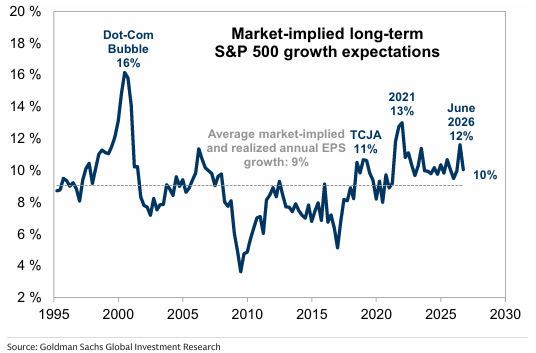
Meanwhile, Goldman Sachs believes that current US equities have not priced in extreme long-term productivity growth expectations. Its calculations show that the market-implied long-term EPS growth expectation for the S&P 500 is only slightly above the historical average, still showing a clear gap from the dot-com bubble era.
Therefore, what truly needs to be observed in the next phase is no longer just how much more Capex tech giants added in a given quarter, but three more direct indicators: whether AI revenue can continue to catch up with capital expenditure, whether tech giants' free cash flow can improve after Capex growth slows, and whether the application layer can generate sufficiently large real revenue to convert AI's productivity value into corporate profits.
Over the past two years, the AI Trade answered the question of who could secure more capital expenditure. After trillions of dollars in investment, the question is beginning to become: who can truly turn computing power into cash flow.
Welcome to join the official BlockBeats community:
Telegram Subscription Group: https://t.me/theblockbeats
Telegram Discussion Group: https://t.me/BlockBeats_App
Official Twitter Account: https://twitter.com/BlockBeatsAsia
